Tag: claires court

  • Principal for the Day – my work through the eyes of a boy aged 13 and three-quarters…

    It is a well know fact that the Headteachers within Claires Court have on occasion had their ‘lives’ auctioned to the highest bidder at the PTA Summer Ball; and my esteemed colleagues have then returned to the ranks whilst their ‘Headteacher for the Day’ has ruled the roost. To be frank, nothing as yet has gone wrong; the displaced headteacher has stayed close to the new incumbent, and made sure that only good things have happened as outcomes from their tenure.

    For the first time in June 2015, the role of Academic Principal was also in the Auction room, and pleasingly (for my ego at least) it sold really well. The winning bid was for Nathan, aged 13 and three-quarters, and on Tuesday 29 September, Nathan was able to take up his role for the day. Nathan visited all three of our sites and all divisions; it was most noticeable that he felt most at home with the Year 9 girls, who captured him at lunchtime and squirrelled him into a Biology lesson for the afternoon. I must confirm that at no stage during my career have Year 9 girls, or indeed any other group of children captured me for an afternoon, so more power to them for their powers of persuasion.

    The day commenced at Senior Boys, with Nathan (AP4D) acquiring a suitable ‘Voldemort’ style Gown to give him a sense of my normal ‘noble and dignified air’ (ahem), prior to travelling across Maidenhead to present to Mr Rowan at CCJB a case of Samsung tablets for his work with computing and digital literacy. AP4D then worked with Year 6 as they practiced their manoeuvres prior to acting as Open Day guides, before returning to SB to take part in a video morning with the team from Discovery Education. Pleasingly Discovery Education were content to video me asking of the AP4D his views on the role, as well as his use of digital technologies. I hope to post a clip of the interview once it has been processed by their crew.

    We then ‘teleported’ via my iQ to College, where Year 5 girls awaited to share with the AP4D their practice for Harvest Festival for Thursday and of course Lunch. Meanwhile, I was sent back to SB with some female Discovery ambassadors so they could be interviewed, so I am less aware perhaps of the antics  of my ‘doppelganger’.  In my absence it appears AP4T was persuaded to award the Head of Sixth Form and his team substantial pay rises, and to command that a regular commemorative day off named in Nathan’s honour was to be founded.

    The AP4D then encountered my brother Hugh, Administrative Principal at Claires Court, and both enjoyed a photocall.  At the end of the day, I ‘chauffeured’ Nathan home to meet with his proud parents, who had not in their wildest hopes for Nathan seen him appointed as a headteacher at such a tender age.  Actually, that’s why they bid for the ‘placement’ at the Summer Ball in the first place.

    A short film of Nathan’s day can be found here – a mash-up from the real APs camera!

    P.S. Sadly for the Head of Sixth Form, those salary changes were reversed the next morning, and AP4D’s annual holiday has been permanently rained off.

    Short video of Nathan, Academic Principal for the Day

  • Whatever you can do, or dream you can, begin it.

    Whatever you can do, or dream you can, begin it. Boldness has genius, power & magic in it. Begin it now. – Johann Wolfgang von Goethe

    Claires Court is about to return to work. Since the publication of A level and GCSE results, the fingers of many have been itching to get back to business. There is a serious rule, for both children and adults that enforced rest is important. It’s not that I  imply  by that statement that school is a bad thing, but that independence from focussed demand for a sufficient space of time is. I am not the only adult, parent or teacher, who was able to look into the eyes of the young and realise that come mid-July, we are all done in. Ready for a break. Kaput.

    For the last 2 weeks though, the staff have begun to stoke the boilers, review the pipework, read the manuals and check their directions. After all, come week beginning 1 September, we’ll be ready to take off – gently, steadily, watching for wheel spin and friction burns of course – and bit by bit, as we load the crew, first Sixth Form, then Year 7, then the sportsmen and women, then everybody else, we will gather speed for the run up to the Autumn then winter of this, the first term of 2014-15.

    As results from the Summer show, teachers and pupils know how to make the good, and more often excellent, happen. It is bitter sweet of course because the best and oldest of Claires Court are on the  move  to pastures new, to University and a chosen path for higher education for most, for some the path to work. I am delighted that they have their chosen ways open to them, yet of course always mindful of the selfish gene within, that would have wished for one more term, one more spin of the wheel, one more dash for glory.

    And yet, as research evidence continues to show, for the best schools the best is yet to come. We have learned so much in the last 10 years on on what works best with those that can be enabled by their school. The realisation is that for the  most  the best is always yet to come is a mantra we must adhere to.  There have been golden years in the past, largely because they are done and dusted and the pain of their creation largely forgotten. Like all harvests, the joy is in reaching their fruition, and recognising that this is now the time to rejoice and reflect. But progress was never made by standing in the shadow of the past.

    So let’s be brave and look forward to a future steeped in what we believe; that all may achieve by their lights, of whatever cadence and hue. And it is by the mixing of our lights, by the sharing of both their heat and other energies, that all are able to reach to those possibilities beyond reason.  Trying our best is never good enough; it is through the inspiration of our peers and our forebears that we recognise that there is a quality in all for which we aspire, and beyond that, a pursuit of excellence that once gained to be shared unselfishly for all to enjoy.


  • “It is in the shelter of each other that the people live” An Irish proverb

    cropped-p1020294.jpgDuring our working lives at Claires Court, we plan a very good deal, check across the piece that the opportunities arising are fairly shared, and reflect yet further after the event to ‘mop up’ where needs be. Serendipity however has its part to play, and last week included more than one such luck break.
    It started when the arrangements for us to welcome 3 parties of 50 headteachers and school leaders from Sweden visited Claires Court for half-a day. This time of year, London is awash with Technology tourists, coming to visit the BETT show at Excel, the largest exhibition of its kind in the world. All the major corps are there, Microsoft, Intel, Lenovo, Google and Samsung etc.  The organiser from Samsung Sweden was Joakim Abrahamsson, and post the event, he had this to say:
    Dear James,
    I would like to thank you once again for a fantastic reception and visit at your school.
    Everyone who participated was really stunned by the hospitality and kindness from staff and students.

    It has been very inspiring for the Swedish delegation to visit your school and understand how you work with Google apps, Samsung Chromebooks and ICT overall at your school.

    The school environment and surrounding’s was something that really impressed the delegation, alongside with the very polite and engaged students. The feeling of being in someone’s home instead of in a traditional school environment was a comment that came out several times.
    Being toured around by the students, having the chance to talk to both them and other teachers was something that was highly appreciated.
    We hope we get a chance to visit you again in the future. 

    Thank you again!

    Kind regards
    Joakim Abrahamsson
    Product Manager IM B2B
    Samsung Electronics Nordic AB

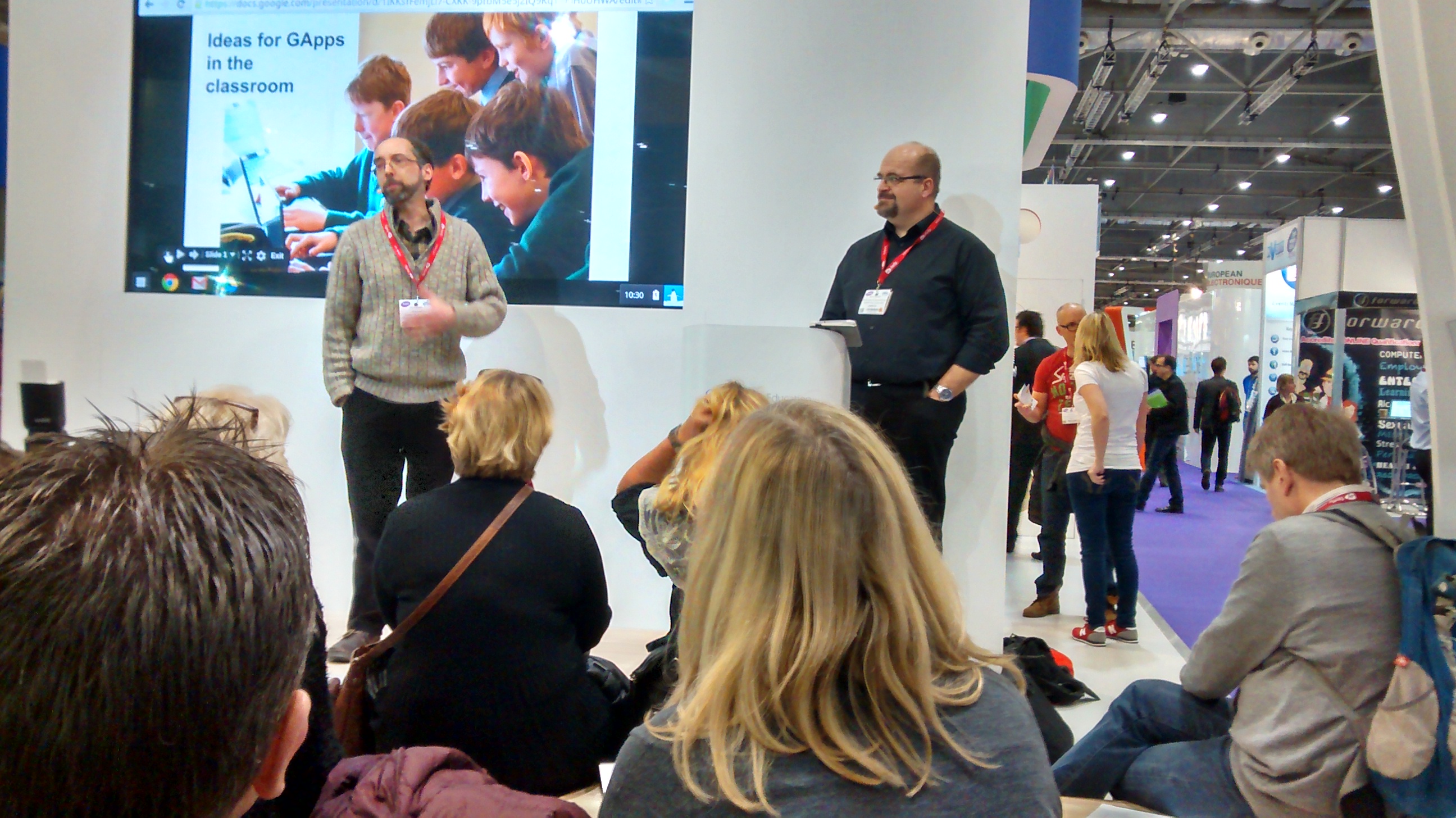
    cnr eclRegular readers of this Blog know we are working closely with Google and Samsung, and so it was perhaps no surprise that both corporations were keen to invite us to speak from their stands at BETT, to share our experiences and expertise with others planning a similar educational journey.  Chris Rowan and Eric Leuzinger spoke on Friday morning, 10.30 am, on the best of Junior boys practice, spotlighting the Weblog and wowing the large audience quite considerably.

    Paul Robson spoke from the stand at 1pm, sharing some of his huge expertise on managing such an amazing roll out as ours, explaining what’s hot and what’s not and in every other way highlighting the very best of what can be done.  I spoke with 2 younger students, Joe and Barnaby, from the Samsung stand on Friday noon, and at Google on Saturday noon – here is our presentation.  These various talks seemed to do 3 things: build further on our reputation for caring and sharing, building a body of professional knowledge and experiences for others to work with and connect; link us with new friends and acquaintances with their own talents and interests, keen to sweep us up into a bigger mainstream of ‘flow’; excite us as practitioners, renewing our interests and passions for our own colleagues back home.

    It was most notable that the main entrance to BETT 2014 was dominated by the Samsung stand. They had areas for lectures, for using their Chromebooks and tablets, to study their services and to test out other initiatives and technologies that are coming in to the Classroom. Their front door was formed by a mammoth video wall, and guess what – pictures of Claires Court pupils and staff featured all over the display. Respect, Samsung and thank you for the recognition. The pictures came from the video they made here last summer, and included stills from the other 2 institutions they included in that work last year.

    I found the whole week quite moving. For such serious players from Sweden, for example the team leading digital learning in Sweden’s 3rd City, Malmo, to be so very impressed by what we are doing was indeed gratifying. But more than that, they were blown away by the hospitality our children offered, by both their friendship and quality as communicators. They admired our teachers ability to make demands of our children in just the right way; tough enough to get output, wise enough to ensure choice and diversity was possible.  And we have been offered many opportunities to engage further, which is nice, and we’ll be thinking that through over the next few days and weeks. You can read our news thread here.

    I guess that the Irish saying covers our work last week quite well. Nothing really happened, we didn’t invent anything new, and this week we are back at the ranch, cutting and mowing as normal. But we did really live our values last week, we stood up and were counted when our friends asked. We know this week that we have rather more friends in the world community, ones who recognise that we are worth the journey for refreshment and conversation. Oh, and for some very serious learning opportunities too.

  • Blogging the Leap Year!

    What to do with a Leap Year?

    Of course, that’s a silly title; for 365 days, this year’s like any other, the days may differ but the total is the same. What makes this year special is today, Wednesday 29th February, so let’s make it matter.

    15 Chromebooks arrived late yesterday afternoon from the ISAG4L project I am running (here’s a sliderocket of my presentation to BETT 2012 about that, with many thanks to Dave Orchard of Canbury School for the work!) with Google support to bolster the Claires Court junior pupils efforts to grow the Weblogs and take our reputation for hands-on-learning that next step. That means we have across the organisation up to 250 machines available to go to the ‘Hub’ at any one time, some using Windows, others using Ubuntu, still more using Chromebooks, most using Chrome browser and all going to the Cloud through the Hub.

    So here’s the challenge for One and All; make this day really different and Blog Feb 29th. It’s important, and for some of our pupils, the first time they will have a world audience!

    What is Feb29.net?  The aim of the project is simple – Stripped down blogging to its simplest form to record one special day in time across the globe. As soon as the first country’s time zone enters Feb29th.net the blog will be open to posts. It’s simple, by filling out the form here – http://http://feb29th.net/, you will be creating a blog post on the Feb29th blog.

    So go Blog the Leap Year! If you need some help, here’s some tips from the site – http://goo.gl/uEMws.  On the site, you may see I have already posted, but hopefully you won’t, because of the sheer volume of engagement across the Globe, from Tonga in the East to Alaska in the West.

    ‘So what’s the benefit of Blogging’ I hear you ask? For most, writing for public readership (authoring, journalism or blogging) is all about the audience, attracting their attention, engaging them to their story, even encouraging them to write back! As David Mitchell, Deputy headteacher at Heathfield Primary School in Bolton, founder of this amazing Feb29th project, writes “Blogging is all about the audience. Having a real global audience makes a huge difference to learners of any age. How many times must teachers say “Consider your audience!” expecting their pupils to do something extra special for them? Give a child access to a blog and their audience becomes real”.

    Here’s what the Independent Newspaper has to say about @DeputyMitchell and his work – http://goo.gl/B3BVa

    Now witnesses to the Claires Court Schools website will have noticed for years our Boys have been blogging, and we’d agree with Mr Mitchell; show boys or girls an audience and they’ll step up to the mark and take to the stage, be that metaphorically as writers or as performers ‘strutting their stuff’. Claires Court’s got talent – but that’s another story -read it here – http://goo.gl/jJtyB!

  • Normalising the Extraordinary…

    So this is my end of first Half of Lent Term presentation to the Senior Boys School.
    Robert, Ben, Michael, Ben are all former students of the school, and proud to be part of our heritage.
    Stuff happens in our place, we normalize the extraordinary, we build on our best selves, we fight so strongly to support those of all abilities and with a need for a big friend like us.

    The Kids in Sport Video was made by past pupil, Toby Hefferman, assistant director on Clash of the Titans, Pirates, stuff…
    … in memory of another old boy of ours Julian Budd, who died tragically of a rare throat infection aged 33.

    Anyway here’s the link…http://goo.gl/lVuyf

  • It’s all about reading…

    Following my first blog about the Learning Frontiers event I attended in Shoreditch, in which I was able to make a contribution (http://bit.ly/i6bk2U -69min28secs onwards), I have a little more to add. When I thrust forward into headship, I had the courage of a lion and the pride to go with that. 30 years on, I have learned that school leadership is a humbling profession, and above all to be successful you need to have the blinkers off, and gather every idea possible to ensure your school remains on top of its game.
    The best schools (or should I say the best school leaders) don’t waste a moment disparaging their peers, locally or nationally, and it has been the most remarkable feature of organised Independent education in England that we have pleaded with government for ever (particularly since the introduction of league tables) to consign school comparisons to the bin. Internationally though, our country’s performance is compared against the rest, through the OECD PISA survey, which by the way rates the UK Independent schools grouping as the best providers in the world. Talking about success in Nations, OECD report that “the share of top performers – those students who attain reading proficiency level 5 or 6 in reading – increased in Japan, Korea and the partner economy Hong Kong-china such that these countries now have the largest proportions of high-achieving students among the countries participating in the 2009 assessment”. Rather than complain about that independent judgement (be that on best schools or best countries), allow for a moment that OECD’s reasoning might be true. Is there a comparative model of like provision against which we could test that judgement?
    We are in the season of University rankings, and the latest to appear is the THES list of the best Universities in the World by reputation. Only academics who had published more than 50 research papers and had worked in universities for more than 16 years were asked to take part in the survey, so we are looking at a pretty privileged electorate. The answers reveal that the UK as a nation sits second only to the States in terms of numbers in the top 100 (45 plays 12), with Japan a distant third (5). The point about such tables is that the criteria often change, but the overall outcomes don’t., so well done Cambridge, Oxford, Imperial, University College, LSE and Edinburgh for making the top 50 as well.
    The absence of great Universities such as Durham, Brimingham, York is perhaps as inexplicable as the presence of Sheffield in the reputation list, but here’s the broader picture. It’s not just having great Universities in the top 10, top 50, top 200 that’s the point, it is that we have all of our Universities striving to be the best, and in what ever myriad of ways they can find, encouraged of course and stimulated by the outstanding examples of those Universities leading the way. The best University for Engineering, for Town Planning, for Hospitality management or for great arts is going to be a different name, and the very independence of our Universities means that we have built excellence through diversity, and as a nation we should be deeply proud of just how egalitarian (in comparison with the States, Japan or France for example) entry into our higher education system is.
    The UK Independent Schools Council group is not made up of schools that select their intake from the privileged elite. I can say this with certainty because the greater volume by school numbers of our sector accommodates those in the age range 5 to 14, engaged in working with children of all abilities, with their results unannounced to any authority or any table anywhere, encompassing over twelve hundred schools. Less than half that number even get close to educating 16 year olds, let alone an A level cohort. Of course all of our leading Independent schools by academic reputation do select for their A level cohort, and as a body of school educating at this level, we represent 7% of the country educating 25% of the nation at A level getting 50+% of the top grades. But that’s not to say that all of our Sixth forms are selective, and some like mine actually have a balanced mission, educating for excellence sure, but also offering pupils the chance to pursue A levels where other centres (state and independent) won’t permit.
    I don’t think any of us would wish to argue that in order to achieve great things, you have to have centres of excellence. We know that the outstanding outcomes from the Royal Ballet School, Chetham’s School of Music or the Manchester United Football academy are without parallel. The various Cathedral choir schools are equally phenomenal, as are the schools for full-time education in the performing Arts. Almost all in these categories I could mention are truly independent schools, but whether they receive state funding or not depends entirely upon the legacy by which they were created. In the last decade, again irrespective of state or independent funding, we have seen a growth in understanding on how to achieve excellence, and I don’t doubt that we’ll see Oscars and International awards & caps going to alumni from all school backgrounds.
    But none of the above is about the engagement of all of the pupils, or at least most of them anyway. I run a school of 1000 pupils in which every one must be treated as special because that’s my brief, funded as I am by their parents. Our nursery is as free the nursery funding allows, with up to 100 children making their first educational steps in life, and no-one rails at us at this stage about operating a system to nurture the privileged elite. Nevertheless, the outcomes for those that stay all the way through Claires Court are extraordinarily good, both in terms of academy, in specialism, in roundedness and in common sense. I don’t think for a moment that other centres are not capable of excellence, but I do have a phenomenal confidence from the data we generate that the longer pupils are in our school, the better the outcomes for them. As one recent ex-pat correspondent writes about her son’s current Sixth Form education in a centre of excellence abroad “The personal touches are what makes (CCS) so special, the Headmaster here would never know each child’s name, the extra opportunities you offer, like the public speaking etc. are invaluable to everyone whatever their abilities. Your school seeks to bring out the best in everyone and that can only be a good thing.”
    I understand that school visionaries such as Toby Young are capable of selling their vision on a one horse pony trick such as Latin. In making clear why Acton and Hammersmith needs a new free school, and one that includes an ancient language he said “to deny children an education in the classics means they are never on the same footing as their independent school peers” or some such comment, and at his new free school, all will study Latin to age 14. Sure my school offers Latin, teaching it from Year 5, but from Year 7 it’s an option and by Year 9 a minority interest group, and I certainly understand why our own pupils move out into more vocational subjects such as Business Studies, Drama and Technology (be that Design, Food or Music).
    What all centres of excellence must do is try harder to engage all learners, or at least most of them most of the time, and I think many in the Shoreditch audience feared that Mr Young’s new school will find life a bit bouncy in Year 9 if all (irrespective of academic ability or persuasion) are required to study Latin still as a compulsory part of the curriculum. What Katherine Birbalsingh saw from her prism of deputy headship (in a school that sacked her and which now has been sacked itself, closing at the end of the summer term), is similar to that we dear viewers can see watching Jamie Oliver’s dream school on Channel 4, namely this; engaging many young people today is not done by being brilliant as a writer, actor, publicist or musician. Great teaching is an extraordinary talent, developed over a number of years and given to people who have worked at it, not born with it. For far too long, we have concentrated on things we can measure in education, the examination results for pupils, and not sufficiently on the qualities that make for great learning environments. Jamie’s dream pupils are a school’s worst nightmares, boys and girls who simply won’t shut up, who feel they have a divine right to chat, disrupt, ignore and cavort, irrespective of time and place. This last Wednesday’s episode in a London theatre, where they were to watch their teacher, Simon Callow perform, they managed to upset the rest of the audience with their lack of respect or even empathy with the production itsefl!.  This is sadly all too familiar a sight for those of us who go to ‘school’ performances, where whole year groups from different centres seem to vie with each other to outrage and disrupt.
    During my opportunity to speak at the Learningwithoutfrontiers conference, I made a bold statement that the Education profession does actually know what works to raise achievement, and for a summary of some readable recent research on this, do read the OECD digest from the 2009 survey (http://bit.ly/haZzCn). There are some pretty clear words in its final conclusion, which are “enjoyment of reading tends to have deteriorated, especially among boys, signalling the challenge for schools to engage students in reading activities that 15-year-olds find relevant and interesting”. Academic achievement in schools rises when children engage in reading activities, period. So whatever interested parties in education might wish (students, parents or teachers), there is no substitute for reading, though there might be for the medium of transmission, it’s ok to repalce the book with a screen. The PISA report ends “Overall, aspects of classroom discipline have also improved. thus there is no evidence to justify the notion that students are becoming progressively more disengaged from school”. So it won’t surprise you that I really do believe that reading is of paramount importance, whatever the ability of the learner, and that we’ll continue to invest in Libraries and events such as World Book day to celebrate reading. And it won’t surprise you to know that the most successful Universities in the World, be they Harvard, MIT, Cambridge, Tokyo, Oxford et al, also still ask their students to ‘read’ for a degree.