Reflecting on the milestone year to date of 2026, I find myself looking at the long arc of my journey alongside Claires Court. Earlier this year, I shared thoughts on “Making the Magic Happen”—observing those quiet, vital moments in our classrooms. More recently, in “Fifty Years and Counting,” I looked back at the evolution of leadership and pedagogy, mindful of the foundations laid by those who came before me. My brother and I know that we have found perhaps the most significant partner in England to secure the future of Claires Court in the Licensed Trade Charity (LTC)’ a charity of great longevity and significant service to its own community and more broadly to Education, both in school and in adult life beyond.
Maidenhead: A Shared Campus: My own growth is inseparable from the ecosystem of the Eastern Thames Valley. For 66 years, Claires Court has been part of the fabric of Maidenhead, and I have always viewed the town not merely as my home or a location but as a living campus. The relationships built here are a willingness of RBWM to host the paddling centre on Boulter’s Island, to the rowing and sailing clubs whose facilities I am grateful to share and the sporting clubs we helped found, with the Phoenix and Claires Court Sports Club in Taplow 43 years ago to Maidenhead Royals Cricket club, based on our lovely playing fields at Claires Court Juniors, at Ridgeway Maidenhead Thicket.
I have been a quiet supporter of ‘The Friends of Maidenhead Waterways Trust,’ and after the previous three years of helping clear Strande Water, it is a joy to see the “flow” return. The school always looks forward to our active participation in the Waterways Fun Day in September at the Chapel Arches centre—a testament to what happens when a town thrives. I am clear that while the school is a destination for many, it is our presence as a neighbour and a partner in the town’s sporting and community life that defines our true value.
Lessons from a “Silent Spring”: As someone deeply invested in Ecology, Psychology, and Digital Technology, I often return to the warning in Rachel Carson’s 1962 book, Silent Spring. Her work exposed the “bioaccumulation” of toxins that threatened our world, sparking a movement of awareness. Today, I feel a similar responsibility to ensure our children understand that “Their place is here.” To protect their future, I believe Education in schools must:
Prioritise ‘Forest School’: Not as an extra-curricular, but as a fundamental way to ground children in the natural world.
Cultivate Cognitive Capacity: To help students become critical analysts who judge by actions, not just words.
Spark Internal Momentum: So that they may eventually find their own path to becoming changemakers.
Turning Toward the Light: There is a simple truth in physics: when you turn toward the light, the shadows fall behind you. My intention as I move forward is to keep my focus aligned with that brightness. If I can maintain a steady, hopeful path, perhaps it helps clear the way for others to do the same, which in practice means keeping hold of the many hands that exist within our links to the town and our community partners, as well as reach out to grasp new opportunities where they exist to support the life and vitality of the area. Which is of course a great starting point, because as the Top-Ranked Vitality Index (2026 by Lambert Smith Hampton (LSH), Windsor & Maidenhead was named the top-ranked location, retaining its status from 2025 and 2022.
I am not celebrating my own tenure; I am celebrating the opportunity to be a small part of a much larger story—one of lighting the way for the generations to come.
For fifty years, I have witnessed the evolution of education from the classroom frontlines. As a headteacher, I introduced the National Curriculum with optimism, only to see later reforms push high-stakes testing and diminish children’s creative writing. In response, my school designed a question-based curriculum, prioritising curiosity and creativity alongside knowledge and analysis. Today, only GCSEs remain as high-stakes tests at my school, but my concerns go deeper.
To add weight to this blog, here’s news of a national petition to highlight why play is so important
What worries me most is the gradual erasure of unsupervised play from children’s lives. The relentless focus on attainment and ‘outcomes’ has crowded out the spontaneous world where children explore, fail, and grow resilient. Children now face schedules packed with adult-led activities, which deprive them of opportunities for self-discovery and independence. This is not just a loss of leisure—it’s a loss of the safe space to fail and learn, a vital part of developing an internal sense of control and adaptability.
I see this even more clearly as a grandparent. My grandchildren, in private nurseries and independent schools, benefit from open-ended play and choice. Here, oracy and decision-making are valued as much as traditional skills. Heuristic play, rooted in the Greek concept of “discovering for oneself,” is central. Research and biology agree: play isn’t a break from learning—it is its most sophisticated form, nurturing innovation and critical thinking.
Through play, children gain firsthand experience of space, measurement, and quantity. Everyday materials spark curiosity and deep concentration, helping children learn to entertain themselves without electronics. Structured games like chess teach choice and consequence, though I must admit, I still haven’t let my grandchildren win!
Recent studies, such as those on parkland fallow deer*, offer a warning: play occurs only in stress-free environments. Human interference—or, in schools, rigid curricula—disrupts this, leading to poorer emotional resilience and developmental outcomes. Policies prioritising test scores at the expense of play risk creating high-stress atmospheres that stifle the very growth they intend to promote.
The rise in childhood anxiety parallels these educational shifts. By removing the “relaxed field” necessary for play, we’re denying children the foundation for innovation and wellbeing. Schools must reclaim protected, stress-free play zones—much like deer need undisturbed woodland. These spaces should be rich in natural materials, free from constant adult oversight, and scheduled when children are alert, not tired or hungry. At my school, for example, one morning a week is devoted to outdoor exploration, fueling conversation, writing, and learning.
If we are to foster healthy, resilient children, we must rebalance our priorities. Play is not a luxury; it is essential to growth. In short, it’s the highest form of learning. Let’s ensure our schools reflect this truth.
The European fallow deer, scientifically known as Dama dama, is a widely distributed Eurasian ungulate whose survival and historical range have been deeply influenced by human translocation and habitat changes. While populations in its native Turkey face extinction risks due to urbanisation, the species thrives in numerous introduced regions, including Ireland’s Phoenix Park, where it has been studied extensively. Research shows that these deer exhibit distinct personalities, ranging from “beggars” who actively solicit food from tourists to “avoiders” who maintain distance from humans. Contrary to expectations, bolder mothers in peri-urban environments actually select more concealed bedsites far from human activity to protect their offspring from threats like unleashed dogs. As fawns mature, they undergo a behavioural transition, shifting from hidden, milk-dependent lives to active herd members that balance foraging needs with constant vigilance against predators. Finally, observing play behaviour in such livestock and wildlife is increasingly recognised as a vital indicator of positive animal welfare and emotional health.
In my fifty years in education, I have watched the pendulum of school reform swing back and forth with dizzying speed. We have seen the rise of the “knowledge-rich” curriculum and a laser-like focus on the “core” subjects of English, Maths, and Science. On paper, the UK is a success story; our performance in international league tables has markedly improved. But as I look out across the landscape of 2025, I am deeply troubled. We have traded the soul of our schools for a set of metrics. While we have been busy passing tests, we have left a vacuum in the lives of our young people—and that vacuum is being filled by something far more sinister than a poor grade.
The Missing “Outlets” The rise in youth misogyny and the “Manosphere” is not in doubt. But its causes are far more widespread than a failure of schools to “instruct” boys on how to behave. Education is about building pride—the kind of pride that comes from knowing you can lead a choir, command a stage in a drama production, hold your own on a muddy rugby pitch or stay at the helm when the wind blows so strongly. When we narrow the curriculum to meet testing targets, we strip away these “outlets.” For boys, this creates an identity vacuum. If a young man doesn’t find status and belonging within the school gates—through the arts, public speaking, or sport—he will look for it elsewhere. He finds it in the aggressive, individualistic “alpha” rhetoric of the online world. He isn’t looking for hate; he’s looking for a way to feel significant.
The Internalized Crisis for Girls The damage to our girls is equally profound, though it often wears a different mask. In our “attainment-focused” culture, girls are increasingly internalizing the pressure to be perfect. Without the “safe failure” provided by a creative performance or the communal resilience built in team sports, we are seeing a crisis of confidence. National data shows that girls’ enjoyment of physical activity drops by a staggering 30% as they transition to secondary school. Why? Because the school has become an “attainment factory” where there is no space for the messy, joyful growth that happens in a choir or on a sports field.
Understand there is Crossover
However, we must be careful not to paint with too broad a brush. In the Venn diagram of character building, the needs of our students often overlap in vital ways. Just as we see boys who internalize their anxieties and retreat into isolation, we see many girls who desperately need the overt, public validation of success that only the arts or sports can provide. For these girls, a “gold star” on a maths paper isn’t enough to build an identity; they need the tangible thrill of a standing ovation the visceral pride of a last-minute goal or stroking the quad to victory to feel truly seen. When we cut these programs, we don’t just lose “extracurriculars”—we lose the primary mirrors in which these young women see their own strength and capability reflected. As the header to this post highlights, the ‘high’ that can be achieved when 33 rowers, boys and girls, row in unison to a collective override to ‘exhaustion’ really is worth the effort!
A Different Path: The Claires Court Model
People often ask why schools like Claires Court maintain such a formidable reputation, not just for academic success, but for the character of their alumni. The answer isn’t a secret formula; it’s a commitment to the whole child.
We have always believed that a “broad and balanced” education isn’t a luxury—it is a necessity.
We protect the Arts because they build empathy and emotional literacy.
We champion Sport because it teaches the “social contract” of loyalty and respect.
We prioritize Oracy because a child who can speak with confidence is a child who can navigate a complex world without falling prey to extremist ideologies.
Above all, we stand by the strongest set of values, that include and set a bar strong enough to hold when times get rough: Responsibility for ourselves, Respect for others, Loyalty to our school (and family) and Integrity above all.
The Role of the Alumni
When I look at our alumni, I don’t just see people with good A-Levels or vocational BTecs. I see individuals who make a meaningful contribution to wider society. They do this because their education was a rehearsal for life, not just an exercise in memorization. They learned to build pride in what they can do, not just what they can test for.After five decades in this profession, my conviction has only grown stronger: It won’t come from just the academic.
We must restore the “holistic heart” of our schools. We need to give our children back their voices, their creative outlets, and their communal spaces. If we don’t, we shouldn’t be surprised when they find their sense of purpose in the darker corners of the internet.
For enthusiasts of Trivia and Pub Quizzes, please check the last section of this Blog on the song.
We’ve just a couple of weeks left to the end of term, and all 3 schools are all set for the season, with trees, ivy, lights and decorations everywhere, and probably ‘Songbird Supreme’, Mariah Carey’s dulcet tones reminding us that Christmas is much more about people rather than presents. What’s worth our children knowing is that Maria Carey writes almost all of her songs herself, starting during junior school, and that writing has captured her a handsome net worth of $225 million. I guess that might make her children, twin girls, Moroccan and Monroe, a bit more ambitious for their gifts than the rest of us.
Clearly, our young family members won’t have those kinds of expectations, nor perhaps have ‘Oompah and Granny’ top buyers on their list of prezzies wanted. What’s more important, as the lyrics go, is wanting the humans there in the mix. Coming together across the ‘break’ certainly works for Family Wilding, though perhaps by the close of ‘Twelfth Night’, it’s time to move on for us all.
ClairesCourtTV features this week the topic “Surviving Christmas. As families around the world prepare to celebrate Christmas by decorating their homes, singing carols, buying gifts and planning feasts, often the true meaning of Christmas can be lost due to the commercial exploitation of this time of year. Many people see it as a joyous occasion to spend with family and friends, but for others, it is viewed as a stressful and challenging time attributed to a combination of factors such as financial pressures, relationship issues, and, quite often, loneliness.
Perhaps more importantly for parents is to set sufficient boundaries around their children’s access to social media, and best of all, keep them in the real world rather than alone in the digital space, where virtual friends are certainly not always the best influence, or even actually known! Mariah’s early life was spent largely with her mother. Although Carey looked forward to Christmas every year, she said in 2019 that her “dysfunctional family” and financial struggles in childhood often overshadowed her excitement. “I always wanted to have a really good time at Christmas, and they would ruin it, so I vowed in my own life I would make sure every Christmas was great.” She says it’s these struggles that gave her the encouragement to write, to express herself and find her true voice.
There are so many traditions at this time that are really worth observing across the family. I feel very sorry for the population of Denmark that at the end of this year, it is closing down its Postal Service at the end of December, so presumably the few left who choose to send Christmas cards have this as their last opportunity. Here in the UK, it seems we share 1 billion each year, with 150 million posted through the Royal Mail. How on earth do Danish children send their ‘thank you’ letters?
The physical act of writing on paper is now understood to be one of the key features of successful learning, with the latest research highlighting that screen-based memory decays so quickly that the average writer can’t remember what they typed 10 lines previously. However painful it is, helping children write their own lists, cards and letters, as well as to develop their personal signature, does every youngster the greatest service.
Staying smartphone-free is a great ambition for our youngest, and readers may have already heard of the move in Australia from next week (10 December) to ban anyone under 16 from keeping or making accounts on social media apps like TikTok, Instagram, YouTube, Snapchat, X, Facebook and more. Prohibition in isolation of course, never works, so nations that go down this route need to provide suitable alternatives. Just as England has been moving up in terms of its literacy and numeracy skills, Sweden’s overfocus on e-learning has seen parents and teachers really worry about their children’s inability to focus and work in school successfully.
As a consequence, Sweden is reintroducing printed textbooks and handwriting in schools to address this declining student literacy and concentration, reversing a previous trend of relying heavily on screens & devices. The government has invested millions of euros to buy new textbooks and is encouraging less screen time, particularly for young children, citing concerns that digital tools have led to reduced focus, comprehension issues, and a decline in basic skills.
Here in the UK, as well as in the USA, austerity in state school budgets is giving rise to similar concerns, with the literacy divide becoming more acute between the various socioeconomic layers, where access to physical books differs significantly. Ultimately, the signs are really clear; as adults, we must model, as best we can, reading and writing, thinking and expressing our views to each other, because that, it turns out, is how children acquire the skills they need best of all.
Back in 1967 or thereabouts, when brother Hugh and I were writing our lists for Father Christmas, or Dad kept us guessing about the ‘8 legs he had bought for the family present. He had taught my brother and me how to play snooker at the various hotels we stayed in over the summers. When he asked us to hop in the Commer Van we used for transporting us boarders between Ridgeway to collect said gift, we were certain that we were to collect our hearts’ desire. Instead of a showroom, we turned up at a kennels, and picked up 2 black poodles, Claude and Eustace, the first school dogs to join our community.
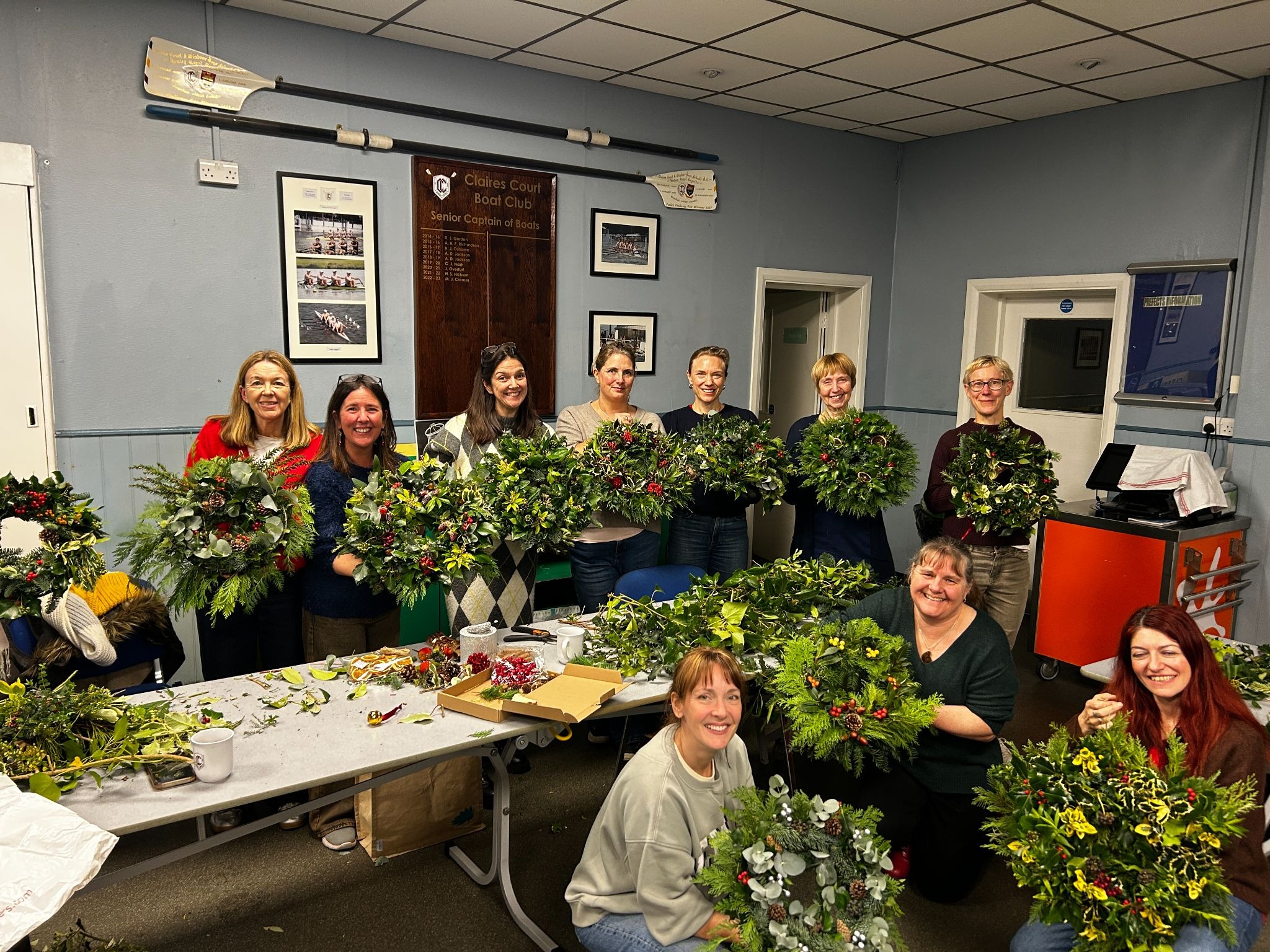
And finally, this Wednesday evening the sailing squad ran their annual fund-raising winter-warmer and wreath-making at the Senior Boys’ school. Over 2 hours, the parents transformed from willing amateurs to gifted professionals, as the closing snapshot below of their work reveals.
P.S. If anyone wants to buy said Sailng Squad one extra of the additional fireflies they need for national team racing, they can check that out in Santa’s basket here – https://ovingtonboats.com/firefly
Trivia
Written in 1994 with Walter Afanasieff, her record producer, and released on her album, “Merry Christmas”, these days Mariah’s dulcet tunes are to be found universally around the shopping centres and favourite seasonal downloads. For those shortly to take part in Pub Quizzes, the other key bits of information are:
The song was released in 1994 but didn’t reach the top spot in the UK until 2020 and in the US in 2019, after 25 and 26 years respectively, 70 weeks in the UK Top 100 and 16 weeks at number one on the Billboard Hot 100.
Billboard No. 1 of the Greatest of All Time Holiday 100 Songs—ahead of legendary vocalists like Bing Crosby, Brenda Lee, and Nat King Cole.
Mariah Carey wrote 18 of the 19 songs listed by Billboard, and she holds the record for the most cumulative weeks spent at number one as a songwriter.
It’s the song that just keeps giving, annual royalties an estimated $2.5-$3 million.
YouTube downloads to date (Noon, Thursday 4/12/2025) are 805,582,218.
This half-term, we publish the Court Report, our annual statement, which covers the various successes of last year, and includes my commentary on the times ahead. You can see the website copy here, a really colourful celebration of Claires Court in action. As I make clear, we remain acutely aware of the financial challenges placed on families due to the addition of 20% VAT, and are doing our level best to keep core charges down. However, our catering prices are set to rise, so we can continue to provide high-quality offerings, and a separate communication outlining the changes will come out over the holiday half-term.
Schools win permission to appeal government’s VAT policy
The High Court previously acknowledged that the policy would disproportionately affect families in the bottom half of the income distribution, with 3,000 pupils expected to be displaced immediately. Despite this, the Court declined to intervene, citing Parliament’s broad discretion in matters of taxation. However, the Court of Appeal’s decision recognises the serious human rights implications of the policy, including potential violations of Article 14 (prohibition of discrimination) and Protocol 1, Article 2 (right to education) under the European Convention on Human Rights.
Our recent visit by the Independent Schools Inspectorate was most encouraging too; and we look forward to receiving the report and sharing its contents, expected in the 2nd week after half-term. Good news is always nice to receive, of course; we are very aware, though, that it is in the future that we plan our daily work, to give all of our children, whatever their strengths and differences, the skills and opportunities that will nurture the very best longer-term outcomes for their successful development. Nurture is one of the key values within education, is always spoken of within the Early Years Framework for nurseries and Reception, but seems to be quickly forgotten by so many, including Secretaries of State for Education. Nurture is a core principle in education, parenting, and personal development to emphasise the importance of caring, emotional support, commitment and providing a safe environment for growth.
To that end, and reflecting on the PTA Fireworks event on Saturday night (and the risk assessment we make every year to cover exploding mortar bombs in the air!), it provided a great opportunity for our school community to meet and enjoy a convivial evening of activity and conversation. With over 1000 present, what with ticket sales and footfall to the bar, ice cream van, pizza trailer and stalls, it provided both wonderful entertainment and a useful surplus to the PTA Foundation funds. Those in turn provide many valuable extras for the children and the school’s activities, for example, for the Flexitent providing cover for our stall as well as for other PTA events, and the next one arrives to benefit Forest school after half-term.
I appreciate that the most important recognition of the school’s suitability for our future pupils is the word-of-mouth recommendation of our current and previous families. It seems that the 2 major talks run this term, online with Marilyn Adams (video here, well worth watching) on the active parenting needed to safeguard children from the online harms of the internet and in person by Olympian 400m runner, Mark Richardson, to a good audience of parents and sports students. Mark spoke compellingly on his clear ambition to become the best in the world, and belatedly this Summer, he and Iwan Thomas, Roger Black & Jamie Baulch received their Gold medals for their victory in the World Championships in 1997, the original winners (USA) being subsequently disqualified because of the use of performance-enhancing drugs. You can see the final here, with Mark Richardson running the anchor leg and posting the fastest time he has ever run, 43.5 seconds.
During his talk, Mark was asked whether he was disappointed to receive his Gold medal 28 years late. His answer was a huge surprise: “Certainly not, as my daughters had only ever known their dad as once being an athlete a long time ago. For them to be present whilst we took the podium was an enormous satisfaction, bringing my past life into the present. And anyway, I got to keep the Silver medal too!”
Mark is one of those many ‘Diamonds’ who have enjoyed their education here at Claires Court. Whilst he did well at school and then Loughborough University, he recognises now he has ADHD (Attention Deficit Hyperactivity Disorder), a neurodevelopmental condition characterised by persistent patterns of inattention, hyperactivity, and impulsivity that interfere with daily functioning. Sport, in general, and Athletics, in particular, provided Mark with the discipline and excitement to help him focus. We now know that arises from the dopamine release, providing the reward for focusing so well, and it’s why we continue to include so much sport in our curriculum.
Dopamine is not the only hormone valued by education (and amongst adolescents, that’s just as well). The ISI inspectors noted just how calm the school is during the working day. We know that is due to class size, teaching quality, the children’s willingness to learn, a really well-balanced curriculum and the great relationships that are engendered. If we get that right, then those companion hormones come out to play as well, endorphins (which reduce pain and stress), serotonin (which stabilises mood), and oxytocin (associated with social bonding), which contribute to feelings of excitement and happiness. When schools get this right, then we lay down the conditions to find Diamonds, as most parents know, their children are really precious to them, not far away in the sky, but gems in their own homes, whose talents and facets of personality just need bringing out.
So, let’s all look forward to ‘Sparkling’ – it’s half-term ahead. Enjoy!
Thursday 18 September saw the 2025 scholars and their families presented with their awards, for academic excellence, for the Arts and Sports and for those who are excellent in the round. Those present included new entry and long-serving families to the schools, covering in the main Years 7 to 9. In the address I gave to the 48 scholars and accompanying adults, I highlighted of course the success the young people had achieved in winning the scholarship, yet that it meant something more to them and the school. I quote verbatim below:
”Now to business – Scholarship is a word that is rarely used, and perhaps often misunderstood.
What this means at Claires Court is this:
Scholarships are awarded based on merit, such as academic achievement, artistic or sporting talent, or specific subject potential. Please note that for you young people, it’s not a REWARD – in a sense, you haven’t done anything yet! We have every expectation that, whatever your award, you recognise that you have entered a performance pathway that will, no doubt accelerate your knowledge and skill acquisition. As we celebrate with Holly Hatch and Gareth Wellen at the close of today’s celebration, our leading GCSE students now moving on from Year 11 into A level studies, they have been a major influence on the other students in their Year and the school more generally, and we hope you will have the same extraordinary effect on the school as you move through as Claires Court Scholars.”
This week, for both Senior School open days, Steve Richards presented to over 100 families in attendance that Claires Court was founded by my parents, that my brother Hugh and I are still fully involved in the school, but that in addition, our prospective parents would see on their tour around the school, young people who really were proud of their school, aware of the myriad of opportunities available to them every day, and clearly perhaps very conscious that they were already achieving so much more than they could ever have imagined prior to entry.
Of course at some point in the future, the 2 founding pupils (Hugh and I) will no longer be around, yet the school will be, with its ongoing aims and values being retained because of their fundamental value in what makes Claires Court the school it is. Yet the school has to be pioneering in its approach for education all the time, as what works now will certainly hit ‘cracks and potholes’ in the way ahead, a route for the ‘futures’ as yet unknown to us all.
The headteachers and I are really proud of the close relationships we build both with the children and young people in our care, but also with the parents & guardians that support their sons and daughters and our wider school community so strongly. One great recent example has been the enthusiasm and determination of our younger families to ensure their primary age children enjoy a SMARTphone-free childhood. Hosting the inaugural group of 60+ heads from RBWM at our Junior school highlighted that ‘Now was the time to act’, and it’s so good to see that message proliferate not just in our local authority but across the country as a major groundswell of parental opinion covering the next few years of their families lives so well.
For older students and us adults, the world of the SMART phone cannot be ignored, providing as it does a route to so many services required in life, and not just because we are now a cash-free society. Prime Minister Starmer announced today the need to have a digital identity card for citizens permitted to work in this country, and frankly since I no longer have a bank locally and need to access NHS services via an App, the reality of their universal use is evident to us all.
I’ve received the video released this week by the SMARTphone free pressure group in the USA. It’s a powerful message to us all; whatever the benefits of our digital economy, our children need the best protection they can get from the families they live amongst. Here’s an example of just how dynamic famly attention needs to be to the dangers let loose when young children are presented with such a device.
And finally, very many thanks to Marliyn Hawes, Freedom from Abuse for her powerful and hard-hitting presentation on the wider challenges that now exist in navigating young people through the turbulent waters of adolescence. What makes the difference between the childhoods of parents and those older generations beyond and the young of 2025 is the the sheer mobility of society and immediacy of access to knowledge and experiences that were usually ring fenced by geography and community.
In my family history there are ancestors from Essex/East End who were transported to Australia for criminal activity, but kept local and out of sight from the rest of the country. As a boy, I remember seeing the appalling photos of children in flames during the Vietnam war, and of the civil war of the ‘Troubles’ in Northern Ireland. Yet they weren’t sent to the screen in my hands, but arrived perhaps in a colour supplement delivered first to my parents who with some care might have talked me through the stories. That’s the major difference now, and why managing the access to the world of troubles so sharply expressed in the video above is an essential part of the dynamism that schools and families need to embrace.
Ending on a high note about our pupils at Claires Court, whether they be the scholars winning awards last week or the wider school on show yesterday and today, they clearly just love that the continuity between schools is welcomed, and gives them the skills to express their voice, support their school and enjoy so many of the opportunities around them, very much beyond my wildest dreams from 1960, when I first started at Claires Court!
Most of the readers of my blog will be very well aware that things get better step by step. My first car bought whilst I was at Leicester University, in the summer of 1972 was a Ford Popular 100E (1960 model as in photo below), replacing my Honda 75 motor scooter. Travelling the 100 miles each way to Uni to get home on the Honda, open to the elements in a dreadful winter was no fun at all, so replacing that with a car, with some heating and room for 3 friends was life changing. The ‘Pop’ was by all measures a dreadful car, not capable of going faster than the scooter, and when travelling up hill, the windscreen wipers would crawl to a halt, running as they did on the air intake manifold. As for acceleration, 0-60 mph was only possible downhill, and over 30 seconds. Where GB car ownership now is beyond any recognition of those times, who knows what we will be in 50 years from now, yet it’s likely to be approximately the same space and size for 4 or 5 humans to use.
The same can be said of so many sports; in my times, GB sports have moved from participation to world leading, and these improvements have not occurred by luck, but through the careful and systematic research, starting with the question ‘Why?’ David Brailsford ‘reinventing the wheel’ is nicely described in this Harvard Business Review , in which he explains how the ‘podium principles’ for success were broken down into strategy, human performance and continuous improvement. In Bounce (2010), Matthew Syed gives so many examples on why practice makes perfect, not least by repeating the mantra practice makes perfect! Because GB sport has learned these lessons, in almost all areas of sporting endeavour we are right up there, hence our place as number 2 in the Olympics.
You won’t be surprised to hear that critics of the classroom suggest that it has not changed over the past 200 years’ designed as it was for the industrial age to create automatons for the factory floor. Images of the Victorian classroom are placed alongside those of the 21st-century classroom, where now in the AI age it is suggested that little is to be learned by gathering knowledge; what we need are the many and various transferable skills to meet the multiple challenges of the post-industrial world, where machines will replace all of our working careers. Such ideas are worth exploring, testing and indeed seem enticing. At the time of my graduating, us new young things were enticed by the idea that our improving wealth would give us more leisure time, happy families and a world of ‘perfect’. So we know how that’s worked out – not!
Certainly, at my school, we’ve adopted all the podium principles suggested by Brailsford, embraced most of Syed’s psychological and philosophical standpoints, and in every area of our school lives, we’ve seen the marginal gains arise for the children. We’ve learned the lessons of too much screen time; we know that children must learn how to be bored, how to build resilience by failing and enjoyed/admire hugely seeing the extraordinary successes of 18 Ukrainian refugees over 3 years, with little knowledge of the Roman alphabet and spoken English on arrival to the UK, be able to graduate to secondary school, sixth forms and Universities with academic results that most families would say ‘I’d take that!’
I was intrigued this week when watching a short BBC news clip on Otters, once considered vermin and almost exterminated by vicars and game keepers up to the time I was at Uni. Now they are welcomed back into rivers across the countryside, with some care of course, because they’ll eat you out of fish House and Home in a trice. As with humans, otter pups are intensely curious, and they need be stimulated and enabled to roam, through which they learn all the necessary skills for successful adulthood. It’s just the same for children. Before the age of 5 or 6, learning happens most successfully by play, in a cohort, working together and learning how to socialise. You check out Maslow’s hierarchy of needs to see how success starts, understand the steps taken here, each won through marginal gains. From then onwards, the way we organise our higher thinking skills requires some formalised teaching, not least to keep the child’s emotional development in harness with their intellect – see Bloom’s taxonomy for more on this. Originally shown as a pyramid, I prefer Bloom’s intellectual development in the shape of a 20th-century light bulb because when working with others, we know when our own or their light bulb moment happens – a marginal gain switching on the ‘wow’ and ‘wonder’ and ‘I get it’ moments!
Whether Bloom, Brailsford, Maslow or Otters, it’s clear the adult coach has their place to steer improvement to happen Yet necessary to that struggle is peer group socialisation, intervention when that’s not going right, teaching to lift the child over the knowledge and skills barriers that are counter-intuitive, ‘parenting not friending’ when managing the household and above all, not putting one’s brain on the shelf and letting others, including AI, carry the load and not bother learning the skills ourselves. I’m intrigued by the latest research that highlights that children need to learn to write physically before using a modern keyboard and computer. Back in the day, whether using paper & pen or typewriter, you had to think about your writing before hardcopy simply because, whether be ink from the pen or the ribbon, once on the paper the mark was permanent. Now, you don’t need to trouble yourself because the screen is a friend to correction. Using such a modern screen, it seems the child can’t remember what they wrote 2 or 3 sentences before, and within about 10 minutes after the work is complete, the work done has been completely forgotten.
Taking the time to do things well encourages the world of marginal gains, and such practice makes perfect, and after much repetition, practice makes permanent. From brain surgery, through cycling to table tennis, it turns out it’s never about talent (5%), it’s perspiration (95%) – fired of course by curiosity and the desire to improve one’s own performances and seeking, if not a podium finish, at least the self-actualisation of a job done well. And most of the time, that needs a peer group of about 20, of people of about the same age and interests. As indeed the ancient Syrians knew 9 centuries ago, as we’ve discovered from the archaeologists uncovering the ruins of their towns, they found classrooms. And that clearing of the dirt to reveal the evidence beneath can only be done, brush stroke by brush stroke, with common purpose and understanding, that classrooms were just big enough to house a teacher and 20 learners. Well, who knew that?
At the close of this Academic Year 2024-25, I’ve sought to summarise the lessons I’ve learned over the last 12 months, In Blog 1 advised “Speak truth, build and give trust”, Blog 2 “Show up on time, know the text and have an idea” and to close “Be Curious, Not Judgemental”. The quote is attributable to the American poet, Walt Whitman, yet I gathered it from a wonderful scene from Ted Lasso, in which the American football coach surprises a pub audience that he can play darts really well. The endearing point of the scene is that, as so often in life, those who think they know often underestimate the skills and talents of those around them, or in his case, of a foreigner from the US knowing anything about the pub game of darts, let alone being able to throw triple 20, triple 20 and bull in a set of 3. Fortunately, you don’t need to subscribe to Apple TV, the scene in question is here.
As I have written to parents in my end of term letter, here, my brother and I could not be more proud of Claires Court’s achievements, where the support of our parents and guardians lies at the heart of every occasion. Outside of the limited catchment area of our day school in the Eastern Thames Valley, few know of the school, unless they move in one of our common circles of influence. Therein lies the rub, because it is expected that such schools have only one or 2 areas in which they shine, their chosen specialities. Claires Court covers the age range 2-18, so it might be thought that we don’t work to scale, yet with 981 on school roll as school closed yesterday, taught by 173 teachers, with additional learning support, nurses, school administrators and all, that’s a powerful faculty that do understand teaching, learning and welfare very strongly indeed.
Newspapers like judging schools, providing league tables and the like, yet have no mechanism at all how to judge schools that choose not to select their entry on ability. I feel a little uneasy to highlight that the Telegraph rates Claires Court as ‘poor value’, suggesting that’s because we don’t have a squash court, golf course, stable or theatre, and apparently, to cap it all, we don’t row. Of course, I have written to ben.butcher@telegraph.co.uk, the journalist concerned, but as with Labour MPs, I’ve had no reply and expect to get none. This is no lonely lament; it’s true for all the inclusive independent schools in the country, including Millfield and Royal Hospital School, which I mention because we’ve been in competition with them recently in national finals for tennis and sailing, respectively. Of course, I’d love to find us named in the ‘Tatler’ or ‘Muddy Stilettos’ awards of the year, but that requires us to pay a very large sum of money, and that get’s ‘trumped by the school’s leading key value of Integrity. We continue to promise our parents to keep our costs down, and to spend all we can to maintain the quality of provision, teaching, learning and access to both opportunities and support as necessary. Many years ago, Australia produced a value-added measure for its schools, which showed how successful a school’s students were 4 years on. Did the progress the young people made during their education get maintained as they left university? For us, that’s an indicator we follow really carefully, and from September 2025 plan to add post-Uni support for our alumni, because even if the majority graduate with 1sts or 2/1s, there is no guarantee of a job afterwards.
The EdTech community are curious, and follows what we do at Claires Court with considerable interest. First school in the UK to the cloud with what is now known as Google Workspace (2012), then first in the World outside the US with Merlyn AI in the Junior Classroom (2021), it’s going to be a real challenge for the school to move forwards with promoting a SMARTphonefree childhood whilst embracing all the lessons that need to be gathered around Agentive AI and how to use those tools intelligently. These seem very similar to me to the challenges provided by the arrival of the motor car over 160 years ago, when in 1865, the Liberal government of Lord Palmerston passed the Locomotive Act, soon to become known as the Red Flag Act, with the extraordinary stipulation that any self-propelled road vehicle had to be preceded by a person walking at least 60 yards ahead, carrying a red flag. With all the benefits of hindsight, the Red Flag Act, according to one writer, “effectively stopped innovation in powered road transport in Britain for over a quarter of a century”.
In common with other thinkers in this area, I’ve been very aware of the dangers of TV, video games, phones & tablets upstairs in children’s bedrooms for decades. Circa 2000, I suggested to parents that they leave a basket at the bottom of the staircase in which the family phones were deposited rather than follow everyone upstairs. It prove to be particularly helpful, because the text messaging that preceded WhatsApp, Snapchat and Messenger were already proving to be toxic, and the kids needed to escape even then! As a school we’ve chosen to leave X as a vehicle, and we know that some 50% of our parents already shun social media, other than the local social groups on WhatsApp or Signal. It’s fair to say that no-one trusts Elon Musk, owner of X, but I do have a high regard for Meredith Whittaker, President of the Signal Foundation, which owns the Signal App. In March this year, she spoke about the real danger of adults just giving permission to AI to unite all their applications using their AI assistant, describing the user as being willing to put ‘their brain in a jar on the shelf’. To reduce the need for parents to use interactive Social Media, we post Flickr albums too on the school website, because everyone does like a good photoshoot!
So, inline with staying curious, I’ve kept a close eye all year on Bridget Phillipson, Secretary of State for Education, who continues to ignore my calls for engagement and collaboration. Her latest pronouncement on getting children ready for school, which requires “4-year-olds to sit still so they can learn”, shows a breathtaking ignorance of the Early Years Foundation stage, and has once again opened up howls of disbelief from experts in the field. I quote parenting specialist Kirsty Ketley, who makes this crystal clear: ‘The issue isn’t that these kids aren’t ready for school, it’s that schools often aren’t ready for them. It’s not just that they can’t sit still. It’s that so many of them don’t know how to play. They can scroll an iPad and smartphone independently, but when it comes to real, independent, curious, creative play… no idea. We’ve taken away the space for it. We’ve filled every moment with screens, schedules, and adult direction and then wonder why kids can’t settle in Reception. And for neurodivergent children? It’s even tougher. If we’re serious about school readiness, we need to bring back unstructured, imaginative play, build classrooms that work for all children, not just the neurotypical ones, and above all support parents instead of judging them.
We have whole books written in recent years to assist us in the field of education, perhaps the best one in the field (if a little dated) is Daniel Willingham’s “When can you trust the experts? How to tell Good Science from Bad in Education”. Where all the advice books fail is to assist parents in getting out of the swamp once they are stuck in the middle, without a boat or paddle. That’s been particularly difficult as the emergence of really anxious children is now at such volumes that children and adolescent mental health services (CAMHS) are overwhelmed. The key is always to work together, to find common ground, build future enthusiasms and not be dictated to be the ‘it’s not fair’ initial reaction of the child. Life truly is not fair, and we have to be realistic. In England, we always have an opportunity to reset the child-school relationship at the juncture of primary and secondary, and it’s in this area that senior schools can be particularly insensitive, loading children with 3 hours of homework a night and expecting parents to carry the burden. Where parents can be particularly helpful is in the encouragement of reading, and if not of text only, with picture books too, and to supplement those by listening to tapes, made just as easy now as in the last century using Yoto players for example. Whether reading or listening, there is a benchmark time of 20 minutes that allows for vocabulary to pass from short-term memory into the long-term, and that builds attention spans and concentration. Likewise, where schools have given up teaching handwriting, suggesting that the keyboard makes handwriting irrelevant, they are having to put into place handwriting recovery plans because the very act of fine motor control helps build neural networks across the brain that increase the child’s agility to recall information and manipulate objects in 3 dimensions. It’s no accident that my school has stayed closely involved with managing dyslexia in the classroom. It’s not an SEN but a different way of thinking, and many dyslexics, as they move into adult life, find their creative ways of thinking are highly valued.
And finally, of course, I am proud that our Year 9 boys made national news last week through the saving of a man’s life on the River Thames, an unexpected addition to their successful DofE Bronze Expedition award. Critics of our sector blame us because many state school children don’t have the same opportunity to learn these practical skills, and attach yet another ‘privilege’ label to us as a consequence. As the headlines in the Yachts and Yachting magazine made clear this month, this is where Claires Court truly understands why being a really active partner in the local community, investing in and sharing facilities and opportunities, puts that criticism in the bin, by running a regatta for all comers over the weekend.
Secretary of State Bridget Phillipson and her Labour constituency MPs refuse to visit schools like ours, stating that they are there to provide support for the state sector only. So they will stay ‘Judgemental’, of schools like ours, of families like ours, of communities like ours, and ignore the many and varied opportunities that a collaborative partnership could bring to benefit all. As with the Red Flag decision 160 years ago, whilst this government remains in power, they will effectively stop innovation in children’s education, health and welfare for the foreseeable future and damage the young people they purport to represent for their lifetime.
In this second of my 3 blogs written to summarise my world of work over the last year, I am building on the core words of advice I set out last week for politicians to consider: “Speak truth, build and give trust”. It’s quite clear that there is conflict around the globe, and the tensions within our own country and society are very evident too. When the Chancellor of the Exchequer is sat in the House, tears streaming down her face, she became easy prey for the pundits, and that’s not fair. We have no idea what is going on in people’s private lives, and I admire her for sticking to her promise to support the Prime Minister at Question Time. Being absent would have been even more damaging to her professionally.
Tom Hanks has expressed on a number of occasions the reasons for his success, being a simple philosophy of life given to him (at age 20) by the director Dan Sullivan – you can see that here. My audience of parents, educators and fellow professionals will have seen the Hanks’ advice for life expanded by so many and in every walk of life, I won’t expand it further. But what’s important is to understand that it’s not just a ‘turn up’ motto – much more ‘know what you’re about and add value’ instruction.
The full professional information on schools can be found on the Get Information About Schools government website, GIAS, and the info on Claires Court Schools Ltd. can be found here. As the listed Headteacher/Principal is James Wilding, there is no escaping my responsibilities, and you’ll know I take them very seriously. Over the past 10 days of arts, athletics, cricket, drama, music, social events and sport, it might be easy to suggest I haven’t been worrying about the academics, but the truth is of course I do. Whatever else, parents will choose our school because we have a clear curriculum designed to educate, inspire and bring out the best for each child as well as for the cohort as a whole. We cannot escape our responsibilities to generate the ambition to collaborate, to highlight that there is a greater good to be achieved and that in reaching for the stars, we’ll generate future leaders willing to play their full part in times to come.
School ‘climate’ is everything, and I am deeply proud of both the way our values underpin everything we do and yet in terms of forward thinking, both in our approach to learning and the use of new digital tools, we’ve always been on the pioneering edge of what do next whilst retaining the best. The letter we have sent to all Claires Court families about supporting the Smartphone-Free-School approach across the Royal Borough will come as no surprise to our own parents, as we’ve been navigating that approach for many years now, and without asking parent to embrace the cost of a pouch as well. All Tolkien fans will know that Gollum’s fascination for his ring is likely to become just the same when students use ‘pouches’ yet keep their mobile near them; it’s far better that they see such devices either left at home or put in a common class bin, because separation is very much part of the therapy needed. It’s far too easy to ‘doom scroll’, and that’s not an addiction young developing minds ever need to acquire.
Of course, we’ve got to be realistic, and for purposes of medical health and tracking, mobiles will continue to have their uses, and for the time being, the adult world can no longer work without one. Yet once boys and girls enter our school and feel the energy of their fellow pupils and staff, they do quickly understand the imperatives we place on doing the right thing right, and rules are followed well. Above all, they appreciate that almost anything is possible given the opportunities available to talk, chat and build human relationships. Take the Year 7 & 8 drama festivals this week, for example. Parents who’ve never seen ‘Trestle Masks’ in use could not have imagined their girls performing Macbeth, Hamlet, The Tempest or Romeo & Juliet with such control on stage, or their sons being able to perform Commedia dell’Arte or slapstick comedy as an ensemble.
As the headline photo shows from the Girls’ sports day, that’s not just one athlete showing she can hurdle, but a race-full. The boys’ tennis team claimed 3rd place in the National Schools Tennis finals this last weekend, beating Millfield. We’ve had 3 crews at Henley Royal Regatta this week, the boys’ eight and 2 quads, and they fully look the part – and we have the Brit champs to come!
It’s simply not just about competition, and being the best. There are times when I am genuinely blown away by the spontaneous acts of our students, when throw into emergency situations and they react so amazingly well. Take the example of the Year 9 boys who encountered a drowning man in the river 2 weekends ago, whilst on their Bronze Award paddling expedition. Whilst paddling south of Wallingford, midway through their expedition, they heard a call for help from a capsized canoeist. The struggling man had flipped his canoe between two moored river boats and had drifted between a raised jetty. The boys immediately rushed to his aid and radioed Mr Wragg and Mr Campbell-Starkey to let them know.
First on the scene were two students, Harrison McNamee and Felix Gregan.In the time it took for Peter Campbell-Starkey to paddle over to the exhausted man, Harrison had already exited his boat and helped the man cling to the jetty. The boys also fashioned a makeshift stirrup using a rope, allowing the man to keep his head above the water. You can read the whole news article here.
All students involved successfully completed their Bronze DofE expedition, a testament to their resilience and values instilled by the programme. The boys’ bravery was also recognised by Head of Seniors, Steve Richards, who awarded them all the ‘Claires Court Compass Award for outstanding achievement’ at assembly.
The various graduation assemblies are still to come of course, though our eyes are still on the prize. 81 Year 12s Future Focus week from Monday has them pursuing those possible Tom Hanks’ triggers: “What possible career ahead might work best for me!” CEO of Transform Society, James Darley is leading the thinking across the following ideas:
AI in selection – included in the session the context of gamification;
Career Resilience – a key skill that ALL students need – explains what it is and gives some coping strategies for when you get knocked back;
Future of Work – a fascinating session where they are shown what is being predicted as the future of work and get students to give feedback via Mentimeter
Graduate Market – the reality of the graduate market – where the jobs are and what you need to do to get employed in the future!
Year 13 life at Claires Court comes to a close with 86 students pretty much aligned for where they might be showing up in the Autumn. In addition to winning undergraduate apprenticeships at the Bank of England and L’Oreal, I can highlight 40 different University destinations, including the great cities of Bath, Birmingham, Durham, Edinburgh, Exeter, Manchester, Nottingham, Oxford, Leeds, Liverpool, Sheffield, Southampton and… San Diego! Their highlights reel from school will carry all the other stripes that come from taking the opportunities here, whether that be DofE awards, LAMDA and Music grade exams or of course the natural kindness that sits as the central marker of a young adult that can truly make a difference!
National Thank a Teacher Day is an annual celebration of teachers and support staff across early years settings, schools and colleges. This year it will take place on Wednesday 18th June 2025. Last year over 82,000 Thank a Teacher Day personalised e-cards were sent and we had a media reach of 60,000,000 including national coverage on BBC, ITV, The Sunday Times, The Daily Express and The Sun https://thankateacher.co.uk/nationalthankateacherday/
After our prep school years which lasted until the end of Year 8, my brother Hugh and I pursued our Senior School Education to University entrance at Douai School, Woolhampton, one of the great Benedictine monastic schools in existence in the 1960s-1990s. The plan had been for us to study much more locally at Beaumont College in Old Windsor, owned and run by the Society of Jesus, another monastic order known as the Jesuits. The school announced its closure in 1965, deciding to focus the community’s efforts on their other school in England, Stonyhurst in Lancashire. Given that Douai was in easy reach of Maidenhead Thicket via the 1/1A bus service to Woolhampton, and a 15 minute walk up the hill to Douai Abbey and its school, as well as, of course, by car, the decision to board locally was one our parents found easy to make.
I left Douai in December 1971, having stayed back a term after A levels to take Oxford Entrance exams to Pembroke College and to play Rugby for the 1st XV. As anyone of our age will relate, a boarding education anywhere in the country was both spartan and at times, notoriously physical by way of punishment to manage behaviour. My first year at the school included ‘fagging duties’ which meant attending to the Sixth Form at meal times to serve them food, as well as cleaning the prefects’ shoes and meeting their idle needs as they felt fit. What made this apparent reincarnation of Tom Brown’s violent school days acceptable was the incredibly strong pastoral care given by my housemaster, Father Bernard Swinhoe, of Walmsley House. Throughout my time at Douai, he kept his eye on me as he did on the other 80 boys in the House, and communicated particularly well to my parents on my conduct (good or bad) in school. For example, he wrote to my parents during my O-level Christmas term that ‘Jimmy has joined a smoking gang’; this did not actually come as a surprise to my parents, both at the time habitual smokers, but it did cause me to take stock and be reminded that I was not after all quite so invisible at school as perhaps I thought. And that warning certainly caused me to avoid further physical punishment at school.
My final 4 terms at Douai were spent even closer to Father Bernard; his seemingly massive interest in, and knowledge of, everything made him an ideal mentor for A-level General Studies; together with the Head of English, William Bell, I was scrubbed up well for the exams I needed to take for A-level and Oxford, as well as taught niceties of working in seminars via an evening dining club known as ‘Parnassus’. He took an enormous interest in my exploits on the Rugby field as open side for the 1st XV, and kept in touch with me during the 3 years at university beyond. Father Bernard’s perceptible joy at being asked to assist at my wedding during the hot summer of 1975 was perhaps his recognition of the strength of admiration I held him in. As his obituary written by a fellow monk from Douai makes clear, the way he lived his life and the way he formed relationships were indeed remarkable, and I am one of his many charges who will never forget how he made us feel, welcome and wanted.
The abridged version of his obituary is below, the fuller version can be found here on pages 127-129 of the Douai Magazine.
If I were writing to Fr Bernard now, I’d add the following:
“Dear Bernie, above all of the many happy memories you helped create for me, it was your ability to keep the tuck shop fully stocked before film night, that you ran the best ‘smokes’ during the weekday evenings when we could come together and listen to the latest LPs that we had managed to buy from the Reading record shops, and above all, not to mock me too much when I forgot where I was and called you ‘Dad’. You saw my disappointment when I received the rejection letter from Pembroke, and made it quite clear that ‘Oxford’s loss was to be Leicester’s gain’. You never met the 2 sons that Jenny and I have brought up and now grandparent for, but they would hear your stories and completely agree that ‘Jimmy’ hasn’t changed much since, interested in everything and everyone, a chip of the same block from which you seemed to have been carved!”
We never had ‘Thank a Teacher Day’ during my childhood, and it’s a very good idea now that’s been around for 27 years. You can read more from their official website and as Michael Morpurgo makes clear, ““For so many of us, it was someone at school who changed our lives, was at our side through hard and difficult times, lifted us up when we were down, helped us find our voice, gave us confidence when we needed it most, set us on a path that we have followed ever since.”
Father Bernard at the Tuck shop
Fr Bernard Swinhoe OSB, 1931-2020 Our much-loved Father Bernard slipped away into the hands of the Lord on Maundy Thursday night. It was no surprise; he had long been failing with gentle dementia, then a two-week stay in hospital over Christmas was followed by some weeks in a care home. What a fitting, peaceful end for a gentle, kind and sensitive monk. Charles Swinhoe was born in Rochester on 20 June 1931. His father was an army colonel in India, so he spent time there as a child. He was then some years at St. Richard’s Prep School at Little Malvern. He and his sisters and younger brother lived with their mother in a number of rented houses during the war years. Family was always important to him; mother, sisters and brother mattered a lot. In 1944, he came to Douai School, where he distinguished himself in many sports, captaining the rugby and cricket teams.
After National Service as a commissioned officer with the King’s African Rifles in Kenya, he joined the monastic community in 1952, taking the name Bernard. He was professed in 1953, obtained an English degree at Oxford and was ordained priest in 1961. He was, however, always somewhat less comfortable as a priest than as a simple monk. His mastery of English stayed with him all his life, and he loved to painstakingly hone his writing. His sermons were always beautifully crafted and elegantly delivered. One of his brethren once cheekily quipped that his university degree was in punctuation. Quintessentially a monk and full of life, Bernard was quietly self-effacing. Deeply rooted in the Douai soil, where he belonged for 67 years (or 72, including school days) he is now buried in that earth. Stabilitas loci! He was faithful to the end to the community and to the round of Divine Office, the praise of God. In his last fading months at Douai, he especially loved sharing the night prayer of Compline. He naturally accepted his final lot in hospitals and care homes, remaining ever appreciative of the nurses’ attentions.
Bernard’s genuine self-deprecation was not false humility; rather, reticence, scrupulosity, and dissatisfaction with himself. Mindful of the dangers of self-satisfaction, to which most of us are prone, St Benedict in chapter seven of his Rule strongly insists on turning from this undermining vice. It has been said that “the secret of one person’s success is another person’s success remaining a secret; some people would not provide to be so pivotal in your life had they been more concerned with their own”. And this was Bernard’s humility, mixed as has been observed, with a measure of quiet roguishness. One remembers his merriment recounting somewhat scurrilous anecdotes heard in an august commission on which he sat. For one former pupil, Bernard “did not suggest or rely on a hierarchical relationship with us as boys, he displayed an openness both to his own uncertainties and to your possibilities”.
Bernard had the inestimable gift of being ever available and accessible to all, boy or fellow monk. He would repair your rugby boots, fix your watch, mend your lock and make you a key, fill a gap to play double bass in the school orchestra, bind the monastery books or paint the missing oil portrait of a long-deceased abbot he had never met. His natural curiosity about everything, how many interests, his enthusiasms and skills, his practical knack and unremitting generosity remained with him until the end. He has left a mark on us all.
Fr Bernard died quietly on 9 April, during the COVID-19 lockdown, and was buried simply in the monks’ graveyard, after a private Requiem celebrated by the community on 17 April 2020. May he rest in peace. Peter Bowe OSB
To repeat, Michael Morpurgo makes clear, ““For so many of us, it was someone at school who changed our lives, was at our side through hard and difficult times, lifted us up when we were down, helped us find our voice, gave us confidence when we needed it most, set us on a path that we have followed ever since.” I see this happening every day here at school, brilliant leading & learning relationships being forged between adults and children, and I do thank them (and my lucky stars) that I have so many teachers and support staff who have this vocation to make a difference to the lives of the children and young people they teach. If as a consequence of reading this blog, you feel moved to thank a teacher, please do so – it will really make their day!