
During this term, and not for the first time as part of the Year 3 curriculum, they have been studying the history of Claires Court School, and as a consequence of their searches of old magazines etc. the year group asked to have their photo taken with the Principals, Hugh and James Wilding. It’s been a real pleasure to deepen the research resources for this topic, and clearly the project has gone really well. It’s interesting to appreciate why such collaborative work led by children of the ‘Big Question’ variety works so well. The children have choice on the research materials, retain almost total control on the ‘how’ they carry out their project, and yet there are very clear objectives on what a successful outcome might include – it was they that demanded the photocall!
I chose the title for this blog because we are approaching the feast of Ascension Day, that day as written by 2 of the gospel writers, Mark and Luke, in which they record the event after Christ’s crucifixion and resurrection “So then, after the Lord had spoken to them, He was received up into heaven, and sat down at the right hand of God.”
Of the many things we know about for education to be successful, children need to discover ‘stuff’ beyond their ken and use that curiosity to search, unpick, learn, forget and return to discover more and bit by bit ‘mastery of the topic’ will be built. It’s why teaching can be the most exciting of professions, which has nothing about easy wins, but about the potential epic fails that take the learner to the brink and then back again, keen and eager to study more. This is as true of 7 year olds as 70 year olds!
I have in my possession a family heirloom, a Gold medallion presented to my ancestor and namesake, James Wilding (below right). Dated with his birthday, 1781, James received this as a prize for his studies whilst at Magdalen College Cambridge. The coin carries the quotation that heads my blog, very much a Christian idea based on Christ’s resurrection from the dead, and quoted in the New Testament by another of the gospel writers, that being that ‘Death is swallowed up in Victory’(Matthew 28: 1–10).
Given that most faiths and religions believe in an afterlife (only agnostics and atheists yet to be persuaded), it’s a simple idea really to understand that there will come a judgement day when a personal life well led, perhaps a personal sacrifice for the betterment of others will be rewarded, that Victory will come to all, even after death. In Christian theology, this is made very clear: “Death is swallowed up in victory” signifies the ultimate triumph over death. It refers to the final, complete defeat of death, not just as an end to earthly life, but as a victory that grants eternal life and immortality for believers. This victory is achieved through the resurrection of Jesus Christ, who conquered death and sin, paving the way for humanity to share in his victory.
Coming to terms with any theology always takes the student to that ‘cliff edge of failure’, and of course, often causes clashes with the conscious knowledge of the practicalities of daily life.Yet, leaving those aside, areas of school activity would simply disappear if learning to fail did not exist. My grandson has yet to beat me at chess; aged 6, he’ll keep cracking on at after-school club and return every week or so to have another crack at his Oompah! We see this curiosity turn up time and again in school, most so in the Sixth Form where depth studies often mean just that. Subjects such as Sociology and Philosophy & Ethics (Religious Studies) permit students to challenge received wisdoms to a high degree, and that’s definitely to be encouraged!
I’ll close with a bit more on that other James WIlding, who was a teacher too, and from a family of teachers then as my brother Hugh and I are now. Below is a lithograph of that venerable Ancestor, the Reverend James Wilding MA, whose lifespan covered the late end of the 18th century, the Napoleonic wars, and well into the Victorian era, the development of railways and the wider industrial revolution, the abolition of salvery and expansion of the British Empire. The drawing appears to date from the mid 1820s.

James clearly was a remarkable man, as the following record suggests:
He was the son of James Wilding, who was a master at Shrewsbury School, and his son James went to that school for his education. He went on to Magdalene College, Cambridge, where he was 15th Wrangler (a first in Maths!). Subsequently, he entered the teaching profession, in those days very much a respected role; as preceptor, he was an experienced practitioner who guided, supported, and mentored newly qualified professionals during their training. He was master of Cheam School, Surrey until 1840, when he became Vicar of Chirbury. The 1841 census records him as living in Chirbury Vicarage. He died in 1863, at a very good age for the Victorian era of 82.
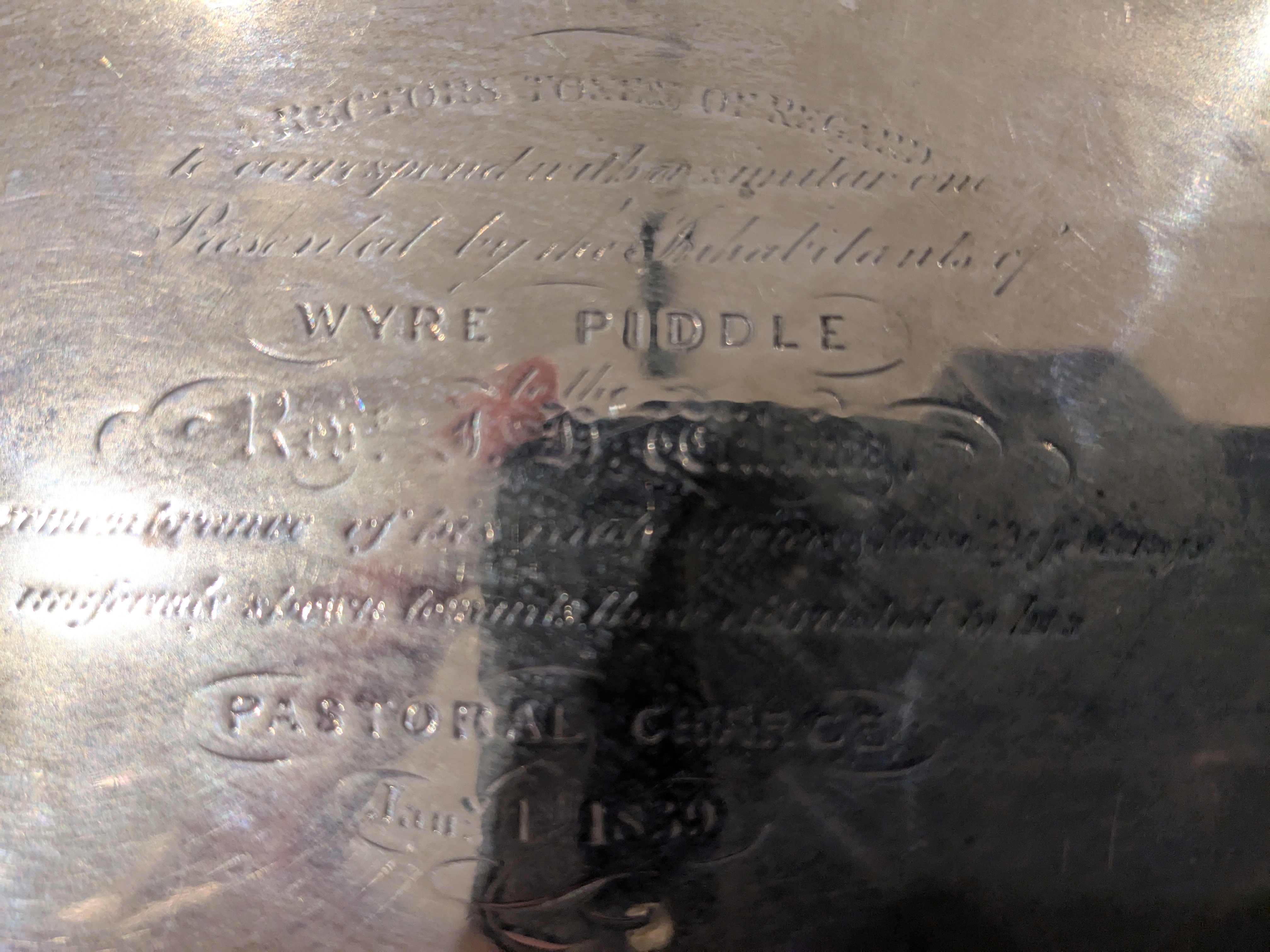
I have 2 other artifacts presented to James, one being a scroll (plus a mention of a Silver plate) presented to him by 86 students at Cheam School to thank him for his stewardship of their studies in 1828 (sadly the piece of silver plate was stolen during my lifetime from the family home) and another silver plate presented to him by his congregation during his time as vicar in Wyre Piddle in Worcestershire in 1830.
As and when I have the time, I am really curious to find out the identities of the 86 scholars in the list below. They were the sons of important people at the time, well enough off to fund such a generous gift. I’m guessing there might be one or two seriously distinguished adults in the making then in his care, as of course there are now in 2025 in my care. Everyone has a chance for victory!


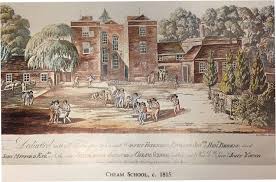
Cheam School in 1821 looks a grand place!

 A Principled view