“Learn from yesterday, live for today, hope for tomorrow. The important thing is to not stop questioning” – Albert Einstein.


The Tower of London Remembers logoOver half-term, I visited the Tower of London to see the Tower of London Remembers evolving installation ‘Blood Swept Lands and Seas of Red’.  Created by ceramic artist Paul Cummins, with setting by stage designer Tom Piper, 888,246 ceramic poppies have been progressively filling the Tower’s famous moat.  You’ll see more at: http://www.hrp.org.uk/TowerOfLondon/VisitUs/Topthingstoseeanddo/Poppies/TowerPoppies#sthash.UvduS5nZ.dpuf

My favourite picture taken on the day is that of the Poppy wave, flowing up and over the moat entrance to the Tower, on its own a spectacular show of the Ceramicist’s Art.  The moat is now so poppy showerfull of poppies, it seems an impossible task to find even more room for them.  I wonder whether there will be more waves created? As school prepares for its own commemorative events this week and next, the artist has found a breathtaking and novel ways of commemorating the sacrifice of our forebears, one that will assist in awakening in our students, young and old, an appreciation of the past, its connection to the present, and perhaps a sign too of hope for the future.
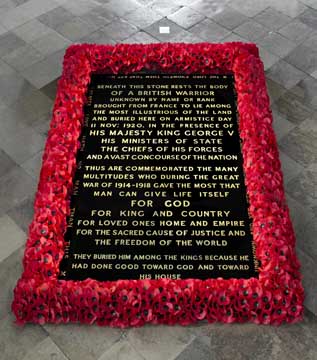
As the author of the title of this piece, Albert Einstein makes clear, it is by questioning that we find out more about ourselves and the philosophies around which we build our society. And in our efforts to reason around Remembrance,  after our visit to the Moat installation, my wife and I travelled the short distance to Westminster Abbey, to see the Tomb of the Unknown Warrior.  Our forebears were as remarkably original about the creation of this initial epitaph to the fallen, as we are a century later.

Unknown Warrior's graveThe inscription reads:

BENEATH THIS STONE RESTS THE BODY OF A BRITISH WARRIOR UNKNOWN BY NAME OR RANK BROUGHT FROM FRANCE TO LIE AMONG THE MOST ILLUSTRIOUS OF THE LAND AND BURIED HERE ON ARMISTICE DAY 11 NOV: 1920, IN THE PRESENCE OF HIS MAJESTY KING GEORGE V, HIS MINISTERS OF STATE, THE CHIEFS OF HIS FORCES, AND A VAST CONCOURSE OF THE NATION.

THUS ARE COMMEMORATED THE MANY MULTITUDES WHO DURING THE GREAT WAR OF 1914-1918 GAVE THE MOST THAT MAN CAN GIVE, LIFE ITSELF. FOR GOD, FOR KING AND COUNTRY, FOR LOVED ONES, HOME AND EMPIRE. FOR THE SACRED CAUSE OF JUSTICE AND THE FREEDOM OF THE WORLD, THEY BURIED HIM AMONG THE KINGS BECAUSE HE HAD DONE GOOD TOWARD GOD AND TOWARD HIS HOUSE.

I quote from the Westminster Abbey site verbatim:

Selecting the Unknown Warrior.

The idea of such a burial seems first to have come to a chaplain at the Front, the Reverend David Railton (1884-1955), when he noticed in 1916 in a back garden at Armentières, a grave with a rough cross on which were pencilled the words “An Unknown British Soldier”. In August 1920 he wrote to the Dean of Westminster, Herbert Ryle, through whose energies this memorial was carried into effect. The body was chosen from unknown British servicemen exhumed from four battle areas, the Aisne, the Somme, Arras and Ypres. (some sources say six bodies but confirmed accounts say four). The remains were brought to the chapel at St. Pol on the night of 7 November 1920. The General Officer in charge of troops in France and Flanders, Brigadier General L.J.Wyatt, with Colonel Gell, went into the chapel alone, where the bodies on stretchers were covered by Union Flags. They had no idea from which area the bodies had come. General Wyatt selected one and the two officers placed it in a plain coffin and sealed it. The other three bodies were reburied. General Wyatt said they were re-buried at the St Pol cemetery but Lt.(later Major General Sir) Cecil Smith says they were buried beside the Albert-Bapaume Road to be be discovered there by parties searching for bodies in the area.

In the morning Chaplains of the Church of England, the Roman Catholic Church and Non-Conformist churches held a service in the chapel before the body was escorted to Boulogne to rest overnight. The next day the coffin was placed inside another which had been sent over specially from England made of two-inch thick oak from a tree which had grown in Hampton Court Palace garden, lined with zinc. It was covered with the flag that David Railton had used as an altar cloth during the War (known as the Ypres or Padre’s Flag, which now hangs in St George’s Chapel). Within the wrought iron bands of this coffin had been placed a 16th century crusader’s sword from the Tower of London collection. The inner coffin shell was made by Walter Jackson of the firm of Ingall, Parsons & Clive Forward at Harrow, north London and the larger coffin was supplied by the undertakers in charge of the arrangements, Nodes & Son. The coffin plate bore the inscription:

“A British Warrior who fell in the Great War 1914-1918 for King and Country”. More to read here.

In the chaos that is life in the present, be that 1914, 2014 or indeed any era, it is through the creation and maintenance of an ordered society that provides the stability we desire for our own personal ends. Stability is perhaps the wrong word, because that certainly would not sit well with Einstein’s requirement for ceaseless questioning. Perhaps Equilibrium is a better term, focussing as it does on the dynamic balance between what works and what could be even more effective.  The world is not a pretty spectacle at present, and with so much conflict evident, it might seem somewhat trite to highlight the poppy at this time. Yet as I will remind students and staff at Assembly next Monday, it is in conflict resolution that the peace for the future is won. Working hard for peace means not just fighting just wars against nations, but supporting the defeat of Ebola Virus or ISIS philosophy or Climate change.  And tackling our own enemies within is also a reason for hard-line questioning, be that of communities that tolerated the grooming of children or those in power who turned a blind eye to the paedophilic tendencies of celebrity friends.

EinsteinThere is much to be said for being sceptical, or  as the Royal Institution would say it “nullius in verba” which means “take nobody’s word for it”. The RI elected Albert Einstein to its membership in 1921, and they did so because they wished to record his Relativity Theory and award of Nobel prize.  For 354 years the Royal Institution has celebrated scepticism; for over 1000 years the Tower of London and Westminster Abbey have birthed, married, buried and commemorated conflict. The fact all three of these institutions have enjoyed such longevity pays huge tribute to our own nation’s ability to ‘Learn from yesterday, live for today, hope for tomorrow’.


Posted in Uncategorized | Tagged , , , , | Leave a comment

Why is Curiosity central to better learning?

The wide-ranging debate on identifying effective teaching is inspiring. What concerns me is the disconnect between each year. Children can have 5 years of primary education with admired teachers in each year, yet seem to join secondary school having lost that spark for learning. Parents worry about this loss of interest hugely, because they know that until their son or daughter’s interest is re-ignited, they are likely to ‘fail’. As we welcome children from a variety of primary settings, including our own, it is very obvious that some schools seem to keep this enthusiasm for learning alive, whilst others clearly cannot.

At any given time in the school year, we have about 100 children in our Early Years settings, and with seven different ‘classes’ it really does provide fantastic evidence that at this stage, children are very curious about life as a whole, and deeply interested in many, diverse activities. Harnessing that in-built spirit of inquiry through our own junior years continues to keep children in the learning loop, and wonderful progress continues to be made. It is interesting that when learning by rote is needed, for example lines in a script, children are not bothered by that ‘need’, and interestingly some of the worst actors are those for whom learning comes easily,  but so too does their stage-fright! In short, we are what we repeatedly do, and those whose personalities are of the ‘show and tell’ kind make the most convincing stars in the limelight.

We have  just  been entertained (once again it must be said) by the Year 6 Boys and GirlsOB2014display feedback displays from their week away on the  Jurassic coast at Osmington Bay. The 4 day residential has many purposes, not least re-introducing our ‘gendered’ school to ‘coeducational’ working, but mainly to a whole host of physical and investigative activities on the foreshore. Hearing 11 year olds speak with considerable knowledge about the change in ecology as the depths in the inter-tidal region changes really does remind me that if ‘a child is good enough, a child is old enough’. It strokes our vanity to hear that these  ‘Sixers’ are every bit as successful in their learning as the GCSE students were the previous week, and we need to be careful about that. I remember studying foreshore activity as an Ecology student at University, and it is actually very difficult to be even more enthusiastic or successful when another 10 years older!

Over the past 6 years, since dropping the National Curriculum, our teachers have continued to work on creating a curriculum with curiosity as a driving requirement at its heart. How have we done that? By realigning the curriculum as a series of questions right the way up to age 14 for all subjects and then into the GCSE years as appropriate. That work has not been easy, and indeed some very hard yards needing to be made in the teeth of the welter of curriculum change forced upon us by Exam boards and Government dictat, because schemes of work content published by the Boards don’t make for thrilling reading it must be said. It most cases they effectively describe what needs to be learned in terms of  knowledge and what skills are to be assessed in terms of applying the knowledge.

By all means go hunt amongst our secondary schemes of work and see what I mean about our ‘Question-based’ curriculum, http://www.clairescourt.com/academic/curriculum-statements, and you’ll see what I mean. The evidence that such an approach to learning is the most effective in the long-term is widely spread and recognised in the profession across the world, and in some senses it is why the current coalition government have sacked their own previously tightly prescribed curriculum and asked schools to make up their own against a much thinner set of outlines. The trouble is of course that politicians are not educators, and they find it very easy to mislay their script, or actually not even learn it in the first place. Lord Nash, the Academies’ minister and chair of the Future Academies Chain of schools showed his complete ignorance about lesson planning earlier this month when suggesting that schools could save themselves money and teachers’ time by using a bank of pre-prepared lesson plans. What price  curiosity if it doesn’t fit the text-book?

box of chocolatesIn this excellent article entitled ‘Curiosity improves memory by tapping into the brain’s reward system’ published in today’s Guardian, “Researchers in the US found evidence that curiosity ramped up the activity of a brain chemical called dopamine, which in turn seemed to strengthen people’s memories. Students who took part in the study were better at remembering answers to trivia questions when they were curious, but their memories also improved for unrelated information they were shown at the same time. The findings suggest that while grades may have their place in motivating students, stimulating their natural curiosity could help them even more.” 

The report carries a conclusion from Professor Guillén Fernández at the Donders Centre for Cognitive Neuroimaging in the Netherlands: “Understanding the mechanistic underpinning of how we learn is of utmost importance if we want to optimise knowledge acquisition in education. The brain is the most individual organ we have. The authors of this report show nicely that individual differences in curiosity are associated with differential abilities to learn new information.”

And finally, this does not mean that learning work already covered needs to still have a Problem-based approach. Actually, motivation to learn does not just come from a sense of open curiosity, but a closed-circuit of needing to know ‘relevant stuff’ to achieve a short-term goal. The more we learn about the learning process, the more we understand that we need to have covered the ‘stuff’ in a number of ways, and perhaps even have forgotten it once at least before it becomes properly embedded in long-term memory. By adopting the Curiosity approach, we have maximised the routes available to promote learning using the brain’s own chemical reward, dopamine. As the lead researcher from University of California, Davis,  Professor Charan Ranganath puts it: “This work suggests that once you light that fire of curiosity, you put the brain in a state that’s more conducive to learning. Once you get this ramp-up of dopamine, the brain becomes more like a sponge that’s ready to soak up whatever is happening.”

In adult life of course, being curious may not be enough. As this article from the BBC archives highlights, actually there might be some thing better than dopamine helping our Nobel Prize winners –  http://www.bbc.co.uk/news/magazine-20356613 –  Chocolate! But that’s a blog for another time.

Posted in Uncategorized | Tagged , , , | Leave a comment

The future is coming faster than you think?

Welcome, dear Reader to my ‘Start of Half-Term’ blog. Since last I wrote, some 1500 adults and children have attended our annual fireworks event, held at CCJB up at Maidenhead Thicket, managed to spend over £11,000 thus assisting our PTA raise funds for their many and various causes. It seems this event races around each year, and I can’t actually believe we have already booked Messrs Firework, Electrician and the food already for next year!  Time fairly races by.

When I was young, and when I recollect about my youth, the days were indeed long and I know I had to learn much about boredom. My parents spoke about such things as well; ‘Children are seen and not heard’ my mother would say, sending us scurrying for cover because, of course, we had long since learned that if we pressed our parents patience, to bed we would go, even if it was still daylight and not (in our view) bedtime. And not just that ‘don’t go interrupting parents’  regime was instilled in us. Education and Family life seemed 2 sides of the same coin, with a very good deal of overlap. The parish priest was in my primary school often enough to know that we knew him. Absence one Sunday was followed by a chivvy up  of  “where were you?” the next. Learning to serve as an altar boy developed manners to the n’th degree; after the host had been consecrated, how could I, he i/c wine and water cruets, subtly hold up the tray of condiments without being either too early or too late.

And oddly, I don’t remember any of our generation not knowing how to mind our ‘P’s and ‘Q’s, one of those quaint phrases lost in the midst of time. Whilst it might be attributable to the barman watching their customers navigate through pints and quarts, I prefer the literary suggestion that in the early days of printing, and given their mirror  image status, I prefer the concept that the printer’s apprentice would be asked to mind these in the lower case setting, because they look so similar.  In short, we were wary of parents and other adults in charge, and they seemed to know that we were likely to be up to mischief.

So, late October 2014, and what do I make of our next generation cohort, as they (some 1,005 in number) break for a well deserved few days of Rest and Recuperation, though lots has run to plan. From top to bottom, when and where we have won is because our children and their teachers have played the comedy of manners to perfection. Ablaze with current pedagogy, good technology, staffing in depth and obvious parental support, I’d have to confirm the first 6 weeks have gone really well, and the signs are good for the 2015 cohort, whatever their age. Yes there are some issues that have emerged that we are having to ‘scrub up’, and given our pathological hatred of the concept of ‘complacency’, there is an advantage to the customer/consumer that we grow more self-critical each year.

I am a great fan of Alfie Kohn, parent, author and educationalist. The graphic at the side highlights one of his key beliefs, which rather fits into my story starter for 10. More generally I do fear for the nation, because their advisors seem to have lost all contact with the continuum that brings cohorts in school through to a sensible conclusion. With every aspect of the state’s provision now up for review, from A-level down through GCSE and the Key stages, the only thing that’s certain is uncertainty. And in that uncertainty, those that direct our thinking, such as DfE and Ofsted, continue to set out their stall.

Now, if you have time, have a watch of this video that suggest the best of what can be achieved at Nursery level, released by Ofsted last year. It makes most experienced educationalist blood run cold, because throughout the film the teacher is in charge of the narrative. Not only do the children all get to wear the policeman’s hat, but the teacher appears to insist on putting the hat on! What is chilling about the debriefing at the end is the sage affirming that the teacher did really well to ensure that each child picked the animal the teacher wanted them to.

So in this liberal, informed, exciting educational environment, we set out our stall at every level to show children that they have choices and challenges to face, and the best learning happens when they rise to all that they face. In the alternative world of ‘teacher knows best’, a frightening future in which children’s interested are ‘sidelined’ by the teacher’s strident certainty that ‘objectives need to be met.  As a fellow blogger, author and highly respected commentator, Sue Cowley writes “I’m sorry, Ofsted, but you cannot just stick a police hat on a child, set all the rules of the game, tell the children exactly what to do, and then call it ‘play’. Play is messy, joyful, creative, child led, imaginative, risky. It is about defining yourself, your relationship to your peers, and to the world in which you live. It is a fundamental part of the way in which young children develop. And children tend to laugh a lot when they are doing it. Therefore, I conclude that these videos are not an example of ‘learning through play’. They are a demonstration of ‘direct instruction for tiny children”.

At any level in school, learning is messy, and the higher the level of learning, the messier it gets. Well that’s our view, those that feel as teachers and school leaders, we know our pedagogy. And the joy of such learning is that it is much more fulfilling, because above all it does not demand pace above substance. All the best learning is characterised by the paradox of pace, sometimes quick, and sometimes slow and often uneven. We have our duty to ensure the children get through all they need in an academic year, and we exercise that duty best if the opportunity to explore is made available as each and every child sets out on their next educational stage with their new teachers at the start of the new term. As those in our new Year 12s have made clear, it is a huge step up after GCSE, sentiments shared by those commencing their GCSE and their new Year 7.

The epithet of the moment might indeed be ‘The future is coming faster than you think’ and it is so obviously our duty not to get caught up in the rhetoric but to keep our eyes on the main prize, because ‘steady as she goes’ does make for the best learning in the long term.

Posted in Uncategorized | Tagged , , | Leave a comment

“Most people don’t read the writing on the wall until their backs are up against it.”

quote-man-is-a-strange-animal-he-generally-cannot-read-the-handwriting-on-the-wall-until-his-back-is-up-adlai-stevenson-178108My colleague John Carr introduced me to this lovely epigram, attributed to the American vice- president, Adlai Stevenson. If you consider the various headlines published this last month, most of the situations highlighted seem to remind us of Stevenson’s caution.

For example: In some senses it  would have been easier for the Westminster parties to have lost the Scottish referendum vote. Instead, they now have to solve how they give greater devolved powers and authority to Scotland, whilst removing from Scottish MPs the rights to vote over English, Northern Irish and Welsh dominion. What is known as the West Lothian question is insoluble as our current arrangements stand – you simply cannot have a totally devolved Scottish Assembly on the one hand and have Scottish MPs voting on English business on the other.

Well you could, actually and therein lies the rub. Because the whole business about being a United Kingdom is that we can all sign up for a national strategy for the UK, whilst leaving the tactics devolved to the regions (wherever they are found) for delivering local solutions that meet local needs.

In the education space, the state sector finds itself divided into millions of pieces, each fighting for its bit of space amidst  local authorities which are no longer funded to be concerned about that provision.  I have written before how odd it is that the Independent Sector, atomised as it is of course, have invented their heads’ associations, overarching councils and professional inspectorate to ensure that its schools are held to account for issues and problems as and when they arise. My own Association, ISA is the second largest of the Heads’ Associations with over 340 members, and we have a vast raft of activity going on each year that ensures pupils and teachers have access to regional and national opportunities for competition, collaboration and professional development.

So what are we to make of the Chief Inspector’s comment that Mediocre schools need maverick heads, says Ofsted chief: Sir Michael Wilshaw wants teachers ‘who aren’t afraid to ruffle feathers’ to take charge:
Read more: http://www.dailymail.co.uk/news/article-2785813/Mediocre-schools-need-maverick-heads-says-Ofsted-chief-Sir-Michael-Wilshaw-wants-teachers-aren-t-afraid-ruffle-feathers-charge.html#ixzz3Ff1pFhSJ
He might be right, but he could be colossally wrong. What does he mean by “Mediocre schools need maverick heads” actually. What makes successful schools is the deeply embedded professional supportive culture that supports all kinds of learning for all kinds of children. “Culture eats strategy for breakfast” and it particularly does so in schools. Willshaw and others within the DfE seem to imagine that the coasting/failing schools are full of complacent teachers too afraid to challenge the status quo.  The reality is that in the vast majority of those schools, those that lead them are not provided with either the resources or the know-how to make that leap forward into a better, more successful place. The dismantling of the local authorities has taken away the obvious way of providing knowledgeable local support, and their replacement by chains of academies mean that the support by its very nature will be less focused and distributed more widely across the country.

Establishing and maintaining a highly successful culture is not something just for schools either. The international PISA tables highlight just how strongly the South East Asian countries do in attainment, and Wilshaw and DfE suggest we could learn lots from those schools, even though for some, their schools ppermit caning. Again I have written about this previously, because I certainly would oppose any introduction of corporal punishment into my school! The latest detailed research into this area has been conducted by Institute of Education, London looking at the performance of Asian Children in Australian schools.  And guess what – these children do as well in Australian schools as they would have done in Singapore, South Korea, Hong Kong or Japan. Here’s the news story around that research – http://goo.gl/le8WCv and it really does underpin the Claires Court approach – it’s about a school’s culture silly, not endless and repetitious drill and kill to achieve passes in national tests every year or so.

I am not alone in speaking out about this;, the retiring HM of Eton College, Tony Little has made this clear time again this last year.  Testing children ’til they drop’ is not what Singapore does; supportive culture to ensure the child never falls behind or is made to feel worthless by being offered feeble tasks different to their peers.  The curriculum is not overburdened, yet is made sufficiently challenging not because there is too much knowledge to learn, but because knowledge and skills are juxtaposed to solve questions and explore new areas of research.

Nor it is a good idea to find all the gifted and talented children and put them in one place to ‘hot house’ them to a brighter future. As Malcolm Gladwell explained in his seminal work on achievement ‘Outliers’, it was not the early gifted and talented violinists in Germany that made the grade as adult violin students. None of the naturally gifted had risen to the top. The psychologists found a direct statistical relationship between hours of practice and achievement. No shortcuts. No naturals. Read more here: http://www.wisdomgroup.com/blog/10000-hours-of-practice/

So when Wilshaw and others thrash around looking for answers on how to improve individual students, groups, teams and whole schools, they really need to do a lot better than suggest mavericks and/or lots of tests/inspections. I guess when your back is against the wall, your freedom of manoeuvre is very limited so soundbytes are perhaps the only way forward.  The success of the Asian communities is to instill family values of hard work in their children, and not give in to the mantra that ‘only bright children can achieve’. Success at school is about learning to learn, which takes hours and hours, and school and home need to provide such opportunities with relentless regularity. You don’t luck into learning the scales on the piano or being able to hit a golf ball to 5 foot to win the Ryder Cup, as Jamie Donaldson did at Gleneagles last week. When your back is against the wall, it’s that relentless practice you have had hitherto that makes the difference, come rain or high water. You certainly don’t have time to turn and read the writing!

Posted in Uncategorized | Tagged , , , , | 3 Comments

To couple or decouple, that’s the political question we teachers face for the General Election

Michael Gove announced in March 2013 that the current system, by which Sixth Form students take AS levels at the end of Year 12 and then complete them at the higher A2 level in Year 13 would cease at the end of this year.  For most subjects (but not Maths and Geography), all change is currently underway, as the Examination boards scrabble to put in place 2 Year A level programmes with no half-way house available.   This is called decoupling, and although students may be able to take an AS, it is not half-the subject nor are the skills examined to be the same either. For subjects such as English, the Sciences, History,and MFL (the Russell Group Facilitating subjects) the changes are quite profound, and will in some ways lead to  a better Year 12 Educational experience, with time given over to developing the highest level skills required for leading University success, and skills perhaps not so fully tested under the current modular regime.

Losing AS levels as a half-way house to A level success is not something either the majority of schools or indeed the majority of Universities wish, and it is quite bizarre that the then Secretary of State chose to go against their recommendations.  University courses are all now modular in nature, with students being able to weave their way through areas of interest and expertise. University admission tutors like being able to review AS performance prior to making an offer, as AS performance is much more likely to indicate probable success at Degree level than broader range GCSE outcomes. Indeed the DfE’s decision to decouple AS was based on research that has now been shown to be very flawed indeed.

On 15 July 2014, Nicky Morgan was appointed Secretary of State for Education in Prime Minister David Cameron’s reshuffle, replacing Michael Gove. On her promotion, she retained her post as Minister for Women and also added the equalities brief to it, thus also becoming Minister for Women and Equalities.  She has quickly become a busy lady (no surprise there) and is doing her best to smooth the stormy waters within Education. Morgan has to work hand in glove with another impressive female leader, Glenys Stacey, who is CEO of Ofqual, an NGO that reports directly to Parliament in Westminster and the Northern Ireland Assembly. While they are independent, they give advice to Government on qualifications and assessment based on their research into these areas.  Trouble is, that research means nothing when politicians decide!

Glenys Stacey is now in the unenviable position of supervising the migration of our national qualifications through a General Election.  Unless Nicky Morgan causes a stay of execution, decoupling takes place and AS as a route to A level dies, if the Conservatives are elected to power in May next year. If Labour are elected, then AS will be recoupled to A2, the Universities will breathe a sigh of relief.  Stacey is having to openly remind schools of this fact. And therein lies the rub for teachers – whether Coalition or Conservative, our vote there goes for another 2 years of turmoil, rewriting of schemes of  work and catering for a mixed diet of coupled Maths and Geog with decoupled everything else in Year 12.  A whole raft of new resources will need to be bought or otherwise developed and that takes time.  Please don’t think this is all that secondary schools have to worry about, as Gove also blessed us with the complete reform of GCSEs at the same time.

Secondary schools with ample specialist staff such as ours can cope with the work load, though it is a sincere waste of time that could be put into the classroom and supporting individual children.  Many secondary schools don’t carry the breadth of specialism we do, so will really find this extra demand hard. Further down the line, as we look back, the ‘Haves’ will be seen to be doing so much better than the ‘Have Nots’, and there is no easy way to assist in bridging that gap.   it’s not the facts that are the problem, but the intellectual, specialist knowledge that is needed to shape academic courses to fit the criteria once revealed.  This coalition government are committed to ensuring greater equity for all, whatever their circumstances, as indeed are all the other main parties. The extraordinary turmoil this and previous governments have caused through their constant meddling with public assessment methods is not something the Teaching profession find easy to manage, so it particularly gets ‘all of our goat’ when we are told we are not doing anything to assist in improving access for the less well off.  To mix the animal metaphor…It’s difficult enough to pin the tail on the Donkey anyway, but blindfolded and with one arm, and with the said beast of burden itself hugely agitated by circumstance, the job’s well nigh impossible!

Posted in Uncategorized | Leave a comment

“You have only failed if you have given up. Until then, it is called Learning”

One of the notable assets of successful learners is their tenacity. So in creating a curriculum that promotes enquiry and interest, as an academic faculty we have got half way through the conundrum that faces teachers every day they go to work.  That is, to ensure their charges are engaged in their learning. Now the next bit that follows is to ensure some ‘Trying’ happens. As Anne Atkins reminded us last week at Speech Day, it was Winston Churchill’s maxim to “Never, never, never, never give up”.

But what happens if you are told that you are never going to be clever enough? That in the ‘Smartness’ stakes, you have a way to go?  All too often, in Education at least, the rule is ‘To the Victor the spoils’.  Well that is all very well, but in adult life, Gifts and Talents are not measured by test and exam, but by track record and witness. When I write references on employees or students moving on to pastures new, I refer to the achievements they have gained and the contribution they have made.  Earlier this year, in recognition of Maya Angelou’s contribution to humanity, I quoted perhaps her most remembered thoughts: “I’ve learned that people will forget what you said, people will forget what you did, but people will never forget how you made them feel.”

Before Dear Reader you feel I am going soft on school achievement, I am happy to confirm I am not. But what is so obviously the case in a school that chooses not to select by ability is that we attract a substantial number of children who will be known as ‘Divergent Thinkers’, but who in their school years are rather more obviously labelled as Dyslexic and/or Dyspraxic, to name but 2 ways of thinking that are not of the convergent, linear kind. Of course we have a clear duty to ensure such learners gather the strategies that assist them in coping with their inabilities to spell or lack of fine motor control, and in the main that happens by some discrete withdrawal from class.

But what such children do obviously have in abundance is other talent.  Much of the time, these different ways of thinking highlight our better actors, artists, creatives, music technologists, sportsmen and computer ‘geeks’. It may be true that perhaps it seems they could do with learning to spell better, but actually spending more time on that won’t improve their accuracy. What you do notice is that they can spend inordinate amounts of time engaged with some very difficult problems that need solving, or practicing relentlessly to ensure that a dance movement or rugby conversion is reliably accurate.

And it is not just that they show tenacity, but they also come at problems from new and different angles. Now that might frustrate their teacher who was rather expecting a logical answer to the 2+3= question, but in the bigger picture that’s not the case.  And it is their obvious other strengths that so enrich the friendships and achievements within their peer group, and as we encourage a very good deal of collaboration in what we do, it is no surprise that their relative strengths and weaknesses help our balance more generally.

GCHQ_2684658bAnd it is not just me that thinks this, by the way.  GCHQ need to employ over 100 ‘spooks’ who have this  have just opened up some serious recruitment opportunities for Divergent thinkers, in their ‘Thirties it seems, to assist in their higher level problem solving and code breaking. read more about that here in this week’s Daily Telegraph.

However much we would like to think that it is all about traditional routes to success, actually it is far from that for so many now and in the past.   As Richard Branson’s nomination as the UK’s most admired businessman of the last 50 years indicates, dyslexics not only can get to the very pinnacle of achievement, but also carry with them a feel-good factor too. Because he struggled every day at school, he knows and appreciates that for many, life does not come easy. Here’s a nice article that wraps up Branson’s learning and life in one easy read, and as we know, he’s certainly an example of someone who never gives up!

Posted in Uncategorized | Tagged , , | 3 Comments

“The greater prizes are to come…” Anne Atkins at Claires Court Senior Speech Day

On Thursday 18 September 2014, Claires Court Senior School celebrated its prize giving, and what an endurance feat it was too. It is never my intention for events such as Speech Day to last more than 100 minutes, but whilst I am the architect of Speech Day, and may lay some of the foundations and even dictate some of the methods of construction used, actually Speech Day at Claires Court is a construct of some 100+ voices of teachers and students whose contributions are aggregated into our annual celebration. You can whip through the main scripts of the Sixth Form Heads of School here – http://goo.gl/WUAFRp – and the powerpoint that goes with their work will appear here shortly.  We did have to wait some time for our guest to speak…prizes to award, don’t you know.
image

Central to the celebration though was our principal guest, the broadcaster and journalist Anne Atkins, whose presence was both stimulating and warming. You can hear her whole 10 minute talk to the students and wider audience here – and core to her theme was the concept that prizes won at Speech Day are just tasters for the bigger prizes to come. It is a lovely notion this, and one I have not heard in recent times. She makes clear to us that the arrival of marriage, children, career and progression too are just tasters of what is to come. In short, we must live life to the full, enjoy the rewards when they arrive, but set not too much store by them, because they can be false gods, to which we can fall prey.

Prizes are there to inspire and encourage, within everyone’s reach so long as they know how to persist and persevere. Anne Atkins drew our attention to 2 awards her children have made her – large pictures to remind her of the challenges in life.

Here’s the first – “The courage to ignore the obvious wisdom of turning back!”

Courage to ignore the obvious wisdom

yourcourage

The second picture she has to energise her says “Your Courage, Your Cheerfulness, Your Resolution will bring us Victory!”

What endeared us all to Anne’s thinking is she made it quite clear she had never won prizes whilst at school, she had three great tops for the future adult in the hall.

1.  Dare to dream your dreams!

2. Let your dreams develop!

3. Never, never, never, never give  up!

(Courtesy of Winston Churchill talking at Harrow School, 29 October 1941)

“The prizes you will win in adulthood too won’t last, so they too are a foretaste of what is to come”. Anne reminded us of the words of the second most influential person the world has ever known (St Paul) “Many people strive for a crown that won’t last (ref Olympic games), but you can strive for a crown that will last forever.”

The reference is to the broader message from St Paul, asking us to strive not to be just great, but dedicate our lives to Jesus Christ and by doing so and really training hard, winning an everlasting crown into the next life.

Postscript

Anne arrived from Bedford to Maidenhead by train and folding bicycle, and she took the same route home, via an early evening meeting in Marylebone. Even on her return to Bedford, her precious floral tribute from us remained intact. On cycling then back home, she was mugged, knocked to the ground and the presentation flowers crushed to the floor.  “I held on to it, fought and kicked and screamed blue murder. Not what the police advise but in the heat of the moment… It did at least frighten off the assailant and bring someone to my aid”. The police of course were involved and were both considerate and supportive, but really not bothered about her flowers. Fortunately her lodger was, rescued the bouquet and reset them in a vase.  Anne woke the next morning with a lovely floral tribute of her work with us in all their glory. By any measure this short story is indeed an inspiration to us all – it being all about persistence and perseverance despite circumstances.

Hannah solo: http://youtu.be/xdS_CBOyjnM

Staff choir: http://youtu.be/OeSInleCc3A

Ensemble: http://youtu.be/mJo-8ocvWic 

Year 11 boys choir: http://youtu.be/D0YyPLHklAE

Year 8-10 girls choir: http://youtu.be/9HQAcox2ofI

Posted in Uncategorized | Leave a comment

@SirKenRobinson: “We don’t know who we can be until we know what we can do”

@jameswilding “Ask not How Good are We, but How are We Good?”

In the educational journey that we promote at Claires Court, we understand that the most important aspect of our provision must be to ensure that a positive and supporting culture exists, one that permits difference, failure and opportunity in equal measure.  Ken Robinson’s recent book, “Finding Your Element: How to Discover Your Talents and Passions and Transform Your Life”, is both an inspirational check for Educators who want to reach past a system driven by government- imposed metrics and a testament to the success of those ordinary people who chose to change their lives following Ken’s philosophy that there are no limits to what individual humans can achieve.

I am interested to read today that Wellington College, closeby here in Berkshire, has established a research unit in conjunction with the Institute of Education here in London and Harvard Graduate School of Education to support their further curriculum development, in  conjunction with three other schools in their sphere of influence. Their ‘Eight Aptitudes’ approach, follows Professor Howard Gardner’s ground breaking  work to demonstrate that Humans have multiple intelligences, not just the one needed to pass the 11+, Verbal reasoning.  We too are are a researching school, and whilst we don’t have the resources to have a research unit, we do have great links with education groups, from schools of all kinds, great Universities to world corporates. As it happens, our specific focus this year is to look at the learning of Languages, with a specific focus on the earlier years below secondary, and our partner in this work is the University of Reading.

I remember hearing Howard Gardner talk live 12 years ago at the HMC conference in Celtic Manor, and read his work subsequently too, and whilst he is clearly most scholarly and passionate about his lifetimes work, I did not get the feeling he really believed  that  humans have the capacity to reach past the limiting mind-set of fixed intelligences. In my view, we already have some really clear voices in terms of World research into education, from the UK based powerhouses of CEM centre at the University of Durham, NFER and the Sutton Trust/EEF to name but three, and the additional views from world research such as the OECD and Professor John Hattie in Queensland.  In short, teachers the world over can see quite clearly what modern research is surfacing. What schools need are educators within who have kept abreast of such thinking and continue to reflect how best to make use of the recommended processes for the children in their care.  For let us make one thing very clear – those working in education come to work to ensure their pupils get the very best opportunity to raise their skills and develop gifts and talents beyond measure.

Because of the evidence from this research, I diverge from Wellington’s thinking in a number of ways at secondary level. Whilst I appreciate the many benefits the Middle years curriculum for the International Baccalaureate, that programme was invented to bring coherence across multiple countries for an itinerant set of pupils. We are a  day school, serving a local area and families cannot be expected to afford all of what we do at the expense of portability between us and other local schools. More importantly, the best results are gained when children collaborate and teach each other, find resources and share experiences, and despite the bad press, the English curriculum is extraordinarily well supported by teachers, institutions and publishers, surfacing fantastic learning opportunities and new points of focus almost daily. Here’s the British Museum’s latest translation of its 100 Objects project for schools, one example of how an individual teacher can find age and stage appropriate stimuli for enhancing learning in class.  In short, I feel the school’s curriculum should be a strong reflection of the wider world in which the child is brought up, with much that is familiar and nearby at its heart.  Hands-on education is not that easy if visits and practical outdoor activities are not made possible.

At Sixth Form, I have seen the benefit of the IB programme for some students, but it does require a breadth of thinking and approach which holds back the specialist learner willing to dig somewhat deeper into subject-based study.  For Scientists and Medics, A level is a more certain and challenging (and shorter) route to qualification. I have also seen that within our creative subjects at Sixth Form, the very best students have a need to stretch their specialism at the expense of other subject-based literate and cognitive thinking skills. There comes a time when the actor, artist, dancer and sportsman needs to spend so much time on their ‘element’ that the other ‘elements’ don’t need to be assessed in a formal exam structure.

With Speech Day next week, I am working with the headboys and headgirls to speak about our work of the last 12 months. All 4 have extraordinary gifts, Academic, Music, Sport and the Arts, and during their Year 12, their focus in terms of what lies beyond has deepened and opened new possibilities. Perhaps the most surprising thing all speak of is their discovery of both the elasticity of ability and time.  They never have enough of the latter, but in such diverse ways, they never seem to miss a deadline or a quality benchmark!

All though continue to reappraise their next steps, because their ability to focus on their futures is sharpening their act. No longer would any be prepared to listen to a rhetoric that suggested they were not mature enough to know their own minds, yet all will continue to listen to their own and others’ thoughts about their current chosen pathways. In my view, all four are lucky because they can see/hear the sirens/voices attracting their peers onto their next step.
?Should he really switch from Actor to Lawyer? ?Should she sacrifice such incredibly academic talent for a Gap decade playing professional sport? How does a potential 1st in Natural Sciences deny the ‘riff playing skills he has on guitar? ?How does an as yet politically neutral young adult realise they could inspire a nation in politics?

And this is where @Jameswilding wins at his level – ‘Keep working at the skills so each know in what way they are good, nudge them if they need it when self-identification does not work, and highlight to them those multiple pathways that are open for individuals with a mix of skills at hand’. I really like Sir Ken’s notion of ‘Find your element’, but to be frank I thank most need a nudge, a hand, a mighty big shove or even more. Ken’s stories are about how he saw people miss those opportunities, or by exception make them happen, or permit the arrival of adulthood to permit the remaking of choices because ‘one can’. For most, it too late as adults to start with this notion of Learning liberation, and certainly most by adulthood have learned by bitter experience that multiple intelligences need a patient and inclusive culture yet to appear on their horizon that permits different paces/strokes for different faces/folks.

And therein lies the rub for those of us who work in this space of ‘growing up children’. How does 21st Century Billy Elliot happen outside of the state sector, when no school is monetised for this level of nurture outside English and Maths? The national Music and Ballet scheme can barely touch the demand that exists for a skewed education delivering amazing vocational skill development and yet securing the Academic results that provide a traditional safety net into higher education. Whilst I fear for those in public education, because of its growing asymmetry between great highly selective schools and the rest, I don’t fear for our own within Claires Court. We continue to develop a culture in which children of all kinds are able to find their element, because so much is possible.

I will, if I may, leave the last word to Sir Ken: ““Human resources are like natural resources; they’re often buried deep. You have to go looking for them, they’re not just lying around on the surface. You have to create the circumstances where they show themselves.”

Posted in Uncategorized | Leave a comment

ISANet Newsletter Monday 8 September 2014 – Beyond fulfilling your potential…

ISANet Newsletter Monday 8 September 2014

http://goo.gl/jWbZ6o for the full picture edition.

Beyond fulfilling your potential…

At the start of every new Academic Year, teachers and pupils have a chance to reset how other people perceive them. There has been a substantial break, a chance to refresh and renew, an opportunity perhaps even to reinvent their personae.

And many choose to make that step, and because of their change in attitude, change what others perceive they might achieve. We have been back at school for 2 days (3 days for Year 7) and whether we  are 6, 16 or 60, it seems those of us that believe we can change for better are giving it a go. The extensive evidence from science around how neural pathways are formed, how they can be further changed and developed with time has developed rapidly over the the last decade. And as the evidence grows exponentially to support the principles of ‘Growth Mindset’ theory, it’s notable that educators need to take these principles on board if they want to extend the achievements for their pupils, themselves and their school.

For those of you that need an easy-peasy guide to Growth Mind set theory, here’s Eduardo Briceno at a TEDx event in 2012 – http://goo.gl/OqggAZ.  Now don’t go shuffling about now thinking, do I really need to know this stuff, you do. It’s teachers using the wrong kind of language for praise that sets boundaries and limits for children.  “You’re really smart” rewards intelligence and encourages others not to try hard. “You must have tried really hard” rewards the learner and encourages the others to do the same.

Post-modern Western Parents tend to protect their children from making a greater effort by siding with their children when the going gets tough.  “I used to find Maths hard too” or “I gave up X as soon as I could, I just didn’t get it” are typical examples of Parent-speak. It’s very noticeable in Far Eastern cultures, such as Japan, that getting Maths is a requirement that requires effort not genius, and they’ll work at it much more obviously to achieve a good standard.

Here’s a new-ish National Numeracy for everyone, for life website that rather helpfully shows us how we can move Maths into a Growth mindset approach.  Judging by the enormous struggle we still have nationally to get our 16 year olds up to scratch, we could do with a bit more Challenge in this neck of the woods – why don’t you take the National Numeracy Challenge and restart your own willingness to improve your Maths!

Beyond Michael Gove…Morgan the Mighty

The sacking of Mr Gove is now yesterday’s news, and it is amazing just how suddenly the soundbites in education have dried up. The worry remains that those Ministers (Morgan – Surbiton, Laws – St Georges, Gibb – Bedford Modern, Nick Boles – Winchester, Timpson – Uppingham, Lord Nash – Milton Abbey)  that drive education policy were educated privately, so can’t represent the wider Education community that is still (93%ish) state educated. I am not so sure about that – after all, there is a signficant volume of senior markers and subject leaders in the Exam boards who work in our sector, as inded tehre are represented in many other facets of education, and the whole system would be lost without that contribution. There was a nasty scare last week that our new Secretary of State, Nicky Morgan, was about to direct Sir Michael Wilshaw that his inspectors were to find in favour of universal setting and streaming at secondary level.  Now that really would have been the worst kind of political interference in an independent inspectorate, and I honestly think Sir MIchael would have welcomed such a call. Fortunately, such was the outcry from those who are specialists in education, here as reported by the BBC for example, that NM backed tracked very smartly.

What else can we now look forward to?  The good news is that she’s has not put a foot wrong yet, and peace making seems more important than news.

Special Education Needs Reform

I quote from the Torygraph: In July, the House of Lords approved the long awaited final version of the 0-25 Special Educational Needs and Disability (SEND) Code of Practice for England.

The SEND reforms are the largest overhaul of services for children and young people with special educational needs in the last 30 years, and will see education, health and social care services joining up to provide a more holistic approach to service provision.

Currently the needs of children and young people in England are assessed and detailed using statements of Special Educational Need (SEN) and Learning Disability Assessments (LDAs).

From this September, these will be replaced with Education, Health and Care (EHC) Plans and will bring together all the education, health and care needs of the child in order to form a more cohesive support package, placing the needs and aspirations of the child at the centre of the process.”

The thing to watch here is that Needs that are underpinned by SEN statute are compulsory, and those by Health are advisory.  This ‘great revolution’ could be undermined by local authorities and central govt. slipping the ring fence from one to the other, for example with Speech Therapy services, and thus permit the ‘I know it is desirable, but we don’t have the cash’ excuse’.  Think ‘Nice’ for example. At the start of the year, RCSLT ensured that govt. kept these services within Education statementing, but there is bad news too.  The needs identification does not include joint commissioning; if the child’s GP felt that a Child’s needs required some extra support at school, they can’t just write a chit. And typically what will emerge is that some LAs are going to be more generous than others, so the arrival of a postcode lottery is feared – so what’s new? A good explanation of this here by Newcastle Uni blogger James Laws. Independent Schools need to join up to the EHC movement too –

Five things Schools need to know about the SEN Reforms.

Nice Guardian article here covers our responsibilities, but as Independent Schools don’t have to be involved, their children might miss out. I don’t see that it is schools interests not be part of the offer, but let me know if you think otherwise!

Looking after the Tiger… from my Twitter stream


What an extraordinary story – who’d have thought?  Here’s the ITN movie clip…

https://www.youtube.com/watch?v=xqkzJoRua5U


And finally…

The research bank at Wilding Towers has captured a vast number of interesting snippets over the last 8 weeks. I like…

Teaching History with 100 Objects by the British Museum

Design Thinking an Animated walk-through by Ana de Armas

Five Research-Driven Education Trends At Work in Classrooms by Katrina Schwartz

Top independent school puts lessons free on iTunes by the Stephen Perse Foundation

US pediatricians call for delay to morning school start for teens – everywhere


Future Dates

Saturday 18 October 2014 – Google’ Hub’ Event at Claires Court.

It’s 3 years since Claires Court went to the cloud, and our ‘Hub’ community numbers over 30 schools across the country.  This event, co-sponsored by Claires Court and C-Learning, seeks to bring those communities for a lively day of chit&chat – booking opens next week.

Objective of the day:

  1. a) to allow staff from the 30 – 35 schools who have gone done the “Hub” route to get together and share experiences of how they have evolved their use of Google Apps and other resources to create their Cloud based learning service
  2. b) to show these schools new products and services that they may wish to add to their own services including Chromebooks, Chromeboxes, Chromebases, Chromebox for Meetings, Google Play for Education, Tablets, Google Vault, Synergyse, Securly, etc

In terms of the schedule for the day

9.30am to 10am – Arrival & Tea/Coffee

10am to 11am  – Welcome to Claires Court & All Schools – Hub Show & Tell

11am to 12.15pm – Streamed sessions for Prep/Primary Schools and Secondary / Seniors schools for them to continue their Hub Show & Tell as there are uses which are age specific

12.15pm to 1.45pm – Lunch, Networking and hands on trials of Chrome devices, Tablets and Google Glass

1.45pm to 2.45pm – Software demonstrations (all) – 5 minutes plus discussion on Google Vault, Backupify, Synergyse, Classroom, Hapara, Securly, GoGuardian, Google Play for Education

2.45p to 3.15pm – Panel Q&A and Close

Posted in Uncategorized | Leave a comment

Extraordinary claims require extraordinary evidence.

Welcome back to Claires Court for another fully-committed and high-energy Academic Year.  Please do read my last post, Whatever you can do, or dream you can, begin it,  in which I highlight the sweet and the sour of the Summer, celebrating the best of our students’ results at A level and GCSE, opening up as they do other doors for their future, and somewhat selfishly reflecting that if only he had them for one more term…

We have received two major pieces of evidence this week, both of which highlight just how well our Sixth Form provision promotes excellence for all in our care.  Here is what the Edexcel Art Moderator wrote to our Head of Art, Jan Price.

” I would like to thank the centre for taking the time to talk me through the course structure, and congratulate them on the accuracy and rigor applied to its assessment. The centre should celebrate and feel confident in its richly mature and dynamic approach to Art practice; I would happily recommend the centre to Edexcel as a model for its exemplary standards. Thank you for all your hard work and hospitality in respect of this moderation. It was a pleasure visiting such an exciting and organised centre.”

Now lets face it, dear reader, it is difficult not to swell with pride reading that.  We have received general praise for other departments too, from History to PE, and I don’t think I have ever had a Faculty of Teachers quite so strong as just now.  And here’s an example of one of our colleagues, Huw Buckle, Head of Y11, teacher of Business Studies and Master in charge of Cricket, as reported in the Press:

Berkshire Cricket Coach of the Year 2014

Congratulations to Huw Buckle, teacher at Claires Court who has been awarded ‘Coach of the Year for Berkshire’ by the ECB (English and Wales Cricket Board) Coach Awards. The award is in recognition for his contribution to Girls’ cricket, having been instrumental in developing the Girls’ Section at Maidenhead & Bray, which is now in its third year.

Several of the Claires Court Girls play for the teams, who have had great success, winning the U12 County Championship in 2013, the U14 County Championship this year and later in September the U12 Girls are in the County Final again.

Mr Buckle received the award during the recent England v India Test match at the Oval, where he was presented with his certificate by former England batsman Mark Ramprakash, on the pitch during the lunch interval.

This broad ability school also received really strong A level and GCSE results in August for our students, and here’s a sample of our reporting of that on our website:

100% Pass Rate at Claires Court – Exceeding the National Average

For the third year in a row, Claires Court students are celebrating a 100% pass rate at A Level, with 19.6% of the grades at A* and A, up nearly 6% on last year. This marks a year of excellent academic and personal achievements for students at the school with over 93% getting their favoured University choices.

Across a wide range of subjects the grades reflected the hard work of students and staff, Andy Giles, Head of Sixth Form said: “This is a fantastic set of results, we encourage our students to aim high and they have been justly rewarded for their hard work. Our cohort has a diverse ability and it is pleasing to see across a breadth of subjects, from chemistry to economics, art and psychology, success and achievement of such a high quality. We wish them all the very best for the future.”

What our Academic Auditor, CEM Centre University of Durham feeds back to us is how our performance as an  institution  stacks up against all other schools in their project, which covers over 50% of all A levels sat. In 2013, our performance placed us in the top 20% of schools, and this year we have moved up a gear and now are  placed  in the top 15% of Sixth Forms. The most important message of all is that our best do as well as the best, whatever their core natural ability or intelligence.  Some entered the Sixth Form with 6A* or more, others with 2Bs and some Cs, yet by their own lights they have achieved so very much at the highest end of their capabilities.

We started school today, Thursday 4 September with some 994 pupils on roll, and we have 3 more students to join us who arrive next week.  We have a further 4 children in the pipeline for a new start this month, so I have my fingers crossed we’ll nudge past 1000 any time soon.  And that number is a great achievement in these times of austerity; in itself indicative of tremendous confidence our parents and wider community have in us to nurture, inspire, engage and  energize  the young boys and girls in our care.

Posted in Uncategorized | Leave a comment