
The summer break gives staff, families and our wider school community a break from the tyranny of school routines. We know for some though that breaks in routine are a curse, not a blessing, part of the widely accepted condition that as humans, we are actually very different! Neurodivergence as a concept emerged in the education sphere as recently as the 1990s, and in many ways those whose set-up is divergent from the norm (neurotypical) are still often treated using the ‘deficit’ model, i.e. there is something ‘missing, rather than just being different. Our special report this month is on Neurodiversity and published on the school’s TV service. The report can be found here on the school’s schools website – https://clairescourt.uk.schooltv.me/newsletter/neurodiversity
Neurodiversity emphasises the natural variation in how an individual’s brain functions and how they perceive and interact with the world, leading to diverse ways of learning and communicating. While most young people are neurotypical, some exhibit variations in brain development, such as ADHD, autism or dyslexia, making them neurodivergent.
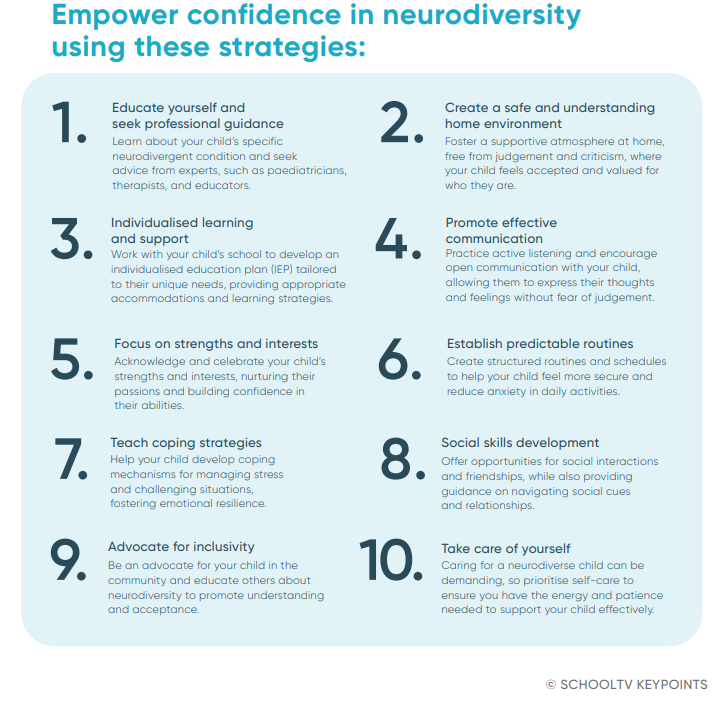
Embracing neurodiversity involves accepting, celebrating, and supporting neurodivergent children and adolescents without attempting to change or treat their differences. Using respectful language, challenging unhelpful attitudes, avoiding assumptions, and actively promoting inclusivity can help embrace neurodiversity effectively.
Acknowledging the unique ways neurodiverse young people do things and then adapting tasks and activities to ensure their full participation will encourage them to develop strategies that feel natural to them. It will help improve their mental health, wellbeing and sense of self. By recognising and nurturing their strengths, parents and caregivers can contribute to building an inclusive and compassionate society where all young people can thrive.
Learning more about neurodiversity, equips caregivers with insights into effective communication techniques, educational strategies, and parenting approaches tailored to the specific needs of their neurodivergent child. We hope you take time to reflect on the information offered in this month’s edition, and we always welcome your feedback.
If you do have any concerns about the wellbeing of your child, please contact the school when we are back in session for further information or if urgent, please do seek help from a medical professional.

 A Principled view
Excellent comments!
To add, I think we sometimes forget that autistic children become autistic adults. Often they no longer enjoy the understanding and support offered (perhaps!) in their younger years. You can find many of them teaching in schools, often demonstrating creative talent and excellent rapport with children.
Some do not need support. Others, flying under the radar as they ‘mask,’ would often welcome some ‘reasonable adjustments.’
I recently completed a survey from Bucks County Council who are presently promoting understanding and inclusion of autistic people. The one thing it appears they failed to recognize is that there should really be autistic people actually in leadership and decision making capacity if that understanding was to be adequate.
Thank you for highlighting this important issue.