
It’s 25 years since I knew I was to lead as Chairman the Independent Schools Association, and it made me concentrate on the ‘Power of words’ spoken as “Calls for Action!” At a time when politics in the UK had stabilised, our military had positively engaged in the Balkan crisis and a new century had been born, I wondered out loud, looking ahead, how things were set to be so fair for the future. In short I had adopted the new millennium positive mindset, carried through for the next 12 years to include Danny Boyle’s great opening ceremony for the 2012 London Olympic Games.
5 June 2024 saw Claires Court host for the 25th year in succession the ISA London West Athletics Championships at the then newly built Eton College Thames Valley Stadium, built for the use and development of public athletics development in the Thames Valley and beyond. The event has grown from 20+ schools to 32 present today, and from a few schools to many now able to provide teams that cover the entire age range from 8+ to 16+. Circa 1200 athletes participated today, and they demonstrated once again that the limits of human achievement have not yet been reached, establishing new athletic records at this regional level. Deputy Head Co-Curricular, Jo Cox started work on our preparations back in January, engaging 25 Claires Court staff and a considerable number of our own Sixth Form students plus over 100 volunteers from all the other schools so that we could both offer the opportunity to compete and to be selected for the ISA LW team for any of the 106 schools in our region.
So, just to be clear, a private day school in the Thames Valley has chosen to run on behalf of 106 other schools in the same geographical area a day-long track and field competition, both to give any children chosen the opportunity to run, jump or thrown, and, if they are the best, then swap team shirts and represent our area against the other 6 areas in the nation.
In 2000, under the then Labour Government, all private schools , either individually or collectively, were invited and included in local, regional and national conversations about how ‘Education, Education, Education’ could be delivered. As the incoming Chair of ISA, I then spent the next 10 years of the Labour Government as an invited and active participant member of ‘thought leadership for Education’ for the nation. ‘Bully for you’ I hear you say. I loved it, of course!
Over the past 25 years, I have always remained committed to engaging with local, regional and national conversations on Education. If you are a subscriber to my blog, you know that anyway. Below, I describe the rules of the game, the boundaries of our operation and the ‘Faustian pact’ struck by proprietors such as I and the education environment in which we operate, at least in the memory of this headteacher whose service as a school leader is now 41 years old and counting
Rules of Engagement for Education. Education is not a Business: here’s what Gemini has to say on the matter:
Profit vs. Public Good: Education is seen as a public good, necessary for a functioning society. Businesses prioritise profit, which can sometimes conflict with educational goals.
Standardization vs. Individual Needs: Businesses thrive on standardisation and efficiency. Education, however, needs to cater to individual student needs and learning styles.
Measuring Success: A business might measure success by profit margins. Education success is trickier to define; it could be test scores, graduation rates, or a student’s ability to thrive in the future.
While education isn’t a business, there is some overlap. For instance, some schools might use business practices for efficiency or fundraising.
Point 1 The key takeaway is that the core purpose of education differs fundamentally from a business.
The United Kingdom has been part of the EU from 1 January 1973 until 31 January 2020. Throughout that period, the ground rules for Education have been very clear on the matter of Value Added Tax: In 2020, certain businesses were exempt from Value Added Tax (VAT) in various countries. Here are some common examples of businesses that were VAT-exempt:
Healthcare services: Hospitals, clinics, and other healthcare providers offering medical services were typically VAT-exempt.
This includes services provided by doctors, nurses, midwives, physiotherapists, and other healthcare professionals.
Financial and insurance services: Banking, lending, and other financial services were often VAT-exempt. Insurance and reinsurance services were also generally VAT-exempt.
Education services: Schools, universities, and other educational institutions providing tuition and related services were usually VAT-exempt.
Certain cultural and social services: Activities related to culture, sports, and entertainment provided by non-profit organizations were sometimes VAT-exempt. This could include museums, libraries, and similar cultural institutions.
Supplies of land and buildings: The sale, rental, or leasing of residential or commercial real estate was often VAT-exempt.
Supplies of investment gold: The supply of investment-grade gold, such as gold bars and coins, was typically VAT-exempt.
The whole point for Services above as described is that whilst what you do as activities is regarded as non-VATable, you are not able to reclaim spent on goods and services provided for you. The landscape of EDUCATION is not BUSINESS is utterly engraved into that landscape, as is the VAT exempt rule. From 1973 to Summer 2020, that’s been the agreed framework. Honestly, there is so much more in addition embedded in the Public/Private sector shared engagement in Education over decades now, it’s difficult to list them all. Here are some examples from Education alone:
- SEN EHCP funding: Parents who choose with the LA and Private school that their child is best placed in the private school have to pay the Private school tuition fees, whatever they are (Element 1); the private school has to cover the first £6000 of additional EHC funding as declared in the plan (Element 2) with the LA ‘topping up’ the final Element 3, as required.
- Private schools winning planning permission for new buildings and facilities are required to limit their usage to a very narrow audience, usually just for the children based on the site concerned, so as to limit the use of the facilities and reduce or ameliorate their usage on surrounding neighbours and traffic infrastructure.
- As Private schools are not registered for VAT, then they need to ensure their business activities do not exceed £90,000 per annum.
- Despite the above, a whole host of activities and government initiatives invite all schools to participate, but private schools cannot benefit from the funds made available for their implementation and realisation.
- Whether a private school is a charity or business, it is expected and required to provide public benefit to wider society. So, please take time to properly take this in. My customers of my school, fee payers, have been expected and required to invest in the school already, despite having paid their taxes which cover the cost of a state school place for their children. AND in paying the tuition fees for their children in the school, the excess not used for covering their teaching and learning costs are also to be used for the benefit of future users, who have never invested a penny farthing in the school. Here’s an example from Sport England’s recommendation to our local authority on a small development to provide 3 tennis courts at our Junior school to be built this summer – please bear with me for labouring this point:
- For Clarity Sport England’s Position: Sport England raises no objection to the application because it is considered to accord with exception 5 of our Playing Fields Policy and paragraph 103 of the NPPF.
The absence of an objection is subject to the following condition being imposed the
local planning authority (LPA) resolve to approve the application:
Within 6 months of the work commencing on site, a Community Use Scheme
shall be submitted to and approved in writing by the Local Planning Authority.
The Scheme shall include details of pricing policy, hours of use, access by nonschool users management responsibilities and include a mechanism for review.
The approved Scheme shall be implemented upon commencement of use of the development.
Reason: To secure well managed safe community access to the sports facility,
to ensure sufficient benefit to the development of sport and to accord with
RSS/UDP/LP/LDF Policy **
If the LPA is minded to approve the application without imposing the above conditions
then Sport England objects to the application as it is not considered to accord with any
of the exceptions to our Playing Fields Policy or paragraph 103 of the NPPF.
June 2024 is election month in the UK (as it seems to be for 50% of the world). The Party most likely according to Pollsters to win the election is the Labour Party, whose manifesto makes it quite clear they wish to move the status of Tuition Fees from exempt to 20%. For everyone in our sector, whether placed by National, Regional or Local Authorities or indeed privately, their fees are to be taxed at 20%. The newspapers and gossip columns have filled their pages with huge volumes of writing, BBC Question time etc. filled the air waves and the latest podcast this last Tuesday afternoon from ‘When it hits the Fan’, led by David Yelland, former editor of the Sun and Simon Lewis, former trouble-shooter for the Queen and Gordon Brown,
Almost all that written, spoken or broadcast seems to carry copy of the laziest and incompetent kind, not least shaping the sector as being the sole preserve of the elite. There are 2,400 private schools in the UK, with many including membership of the 11,000 day nurseries that cover the Early years Foundation stage. Almost every parent makes use of day nurseries, their places funded by government for some of the hours those parents need. here’s what the DayNurseriesUk had to say in their state of the nation report this April.
“Nurseries across the UK have faced financial difficulties for some time. A lack of government funding and the Covid pandemic meant that many were forced to close their doors for good. For the nurseries continuing to operate, they continue to face multiple hardships. “the increase in interest rates and 9% inflation predicted for the coming months could spell disaster for many nurseries and childcare providers. Recently released government reports show that last year, half of providers were already only breaking even or making a loss while our research with providers suggests it could be much higher. They suggest that the only way for nurseries to withstand these times is to continue to increase their fees, otherwise they face permanent closure. As the government provides the majority of the funding for early years childcare through funded places for those eligible, nurseries are dependent on the government to increase this funding price to allow for rising costs.“
The situation for private nurseries is then dire, and whilst there is no chance that the VAT proposed for Private schools will affect the under 4 age range, as most private schools in the 4-11 age range have a nursery, it doesn’t take a genius to work out why Junior schools are unlikely to cope with the imposition of a 20% tax on their tuition fees. Rudi Lockhart, CEO of ISA schools (660 all private, 50% charity, 50% commercial) wrote the following letter to the Times yesterday:
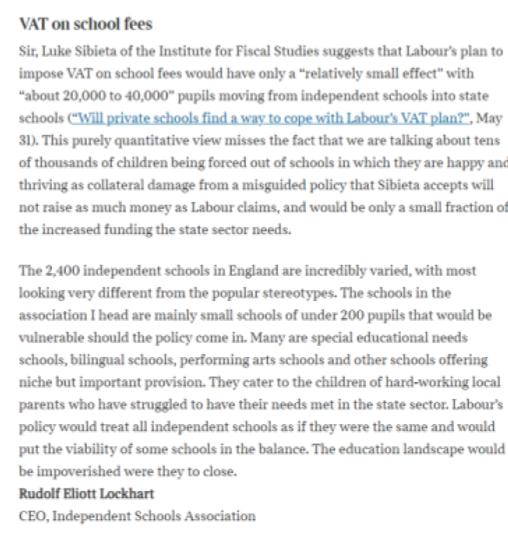
Point 2. The Labour party’s proposals to imposee VAT on Private education suggest there is the low hanging fruit of easy pickings available, from Wealthy Families who have enjoyed a tax break they don’t deserve and Elite Public Schools whose endowments will ‘mind the gap’ with ease. The reality is that the majority of independent schools number 200 pupils or less, with a nursery that is largely sustained by the ‘whole school’ wrapper that benefits the children across the younger age range. We don’t have anything like enough nursery provision already, nor do we have the spaces in the public sector to readily handle the transition of 50,000 children swapping sectors, and finally nor has the legal landscape been cleared to permit private schools to share their facilities and resources more actively with their communities to raise the missing funds, as planning permissions/development controls have always been allied to the school’s Education status, not that of commercial business.
The greater good all of us in our sector propose is to ensure the incoming government of whatever hue recommences dialogue with our sector. We have know-how, talent and expertise in abundance; choose to use it as the Blair Government did, and Education, Education, Education will thrive once more.

 A Principled view
Pingback: VAT and next steps: an update from ISC | A Principled view