From East to West Coast – a journey made at Claires Court celebrated by short story board.

Charlie Ingham Clark, formerly History lead and Rowing coach at Senior boys has taken time out of his career to cycle across the United States, fulfilling an ambition he has nurtured for many years. Whilst at CC. Charlie made many firm friends and inspired a generation of students to love both the academic and the physical.

Whilst with us, Charlie was clearly inspired by the work of our independent counselling service, Number 22, and by the contact he has had with our Ukrainian refugees to give a financial purpose to his cycling trek across the US.

As a consequence, he has been sending us a digital postcard to map his journey, and …

the best news of all is that he made it safely across the continent to arrive at the Pacific Ocean this Tuesday. At the bottom of this blog will appear a final ‘vlog’ I have asked him to provide to say ‘Hi and thanks for your support’!

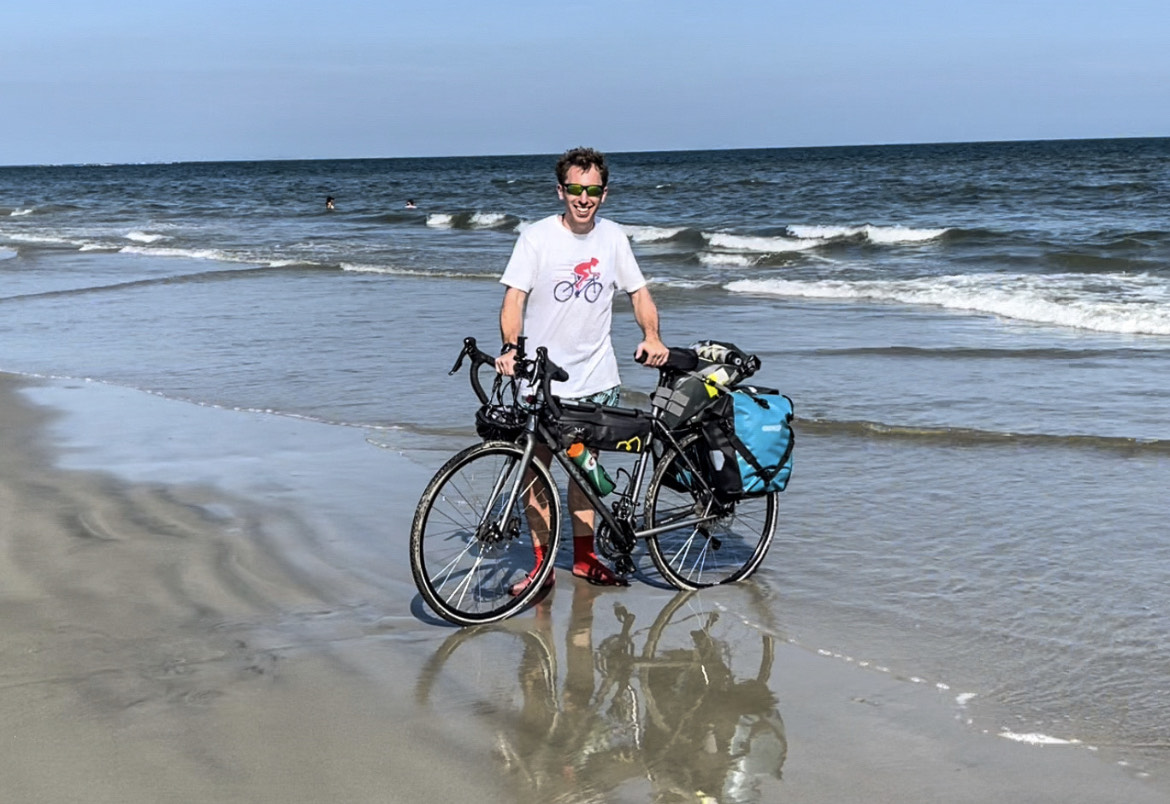
The photo below shows Man & Bike ready for the challenge, photo taken by his father who accompanied him for the first days of his marathon journey, starting on 20/08/2022.

Charlie’s postcard from Charleston had this to say:

“Hello All,

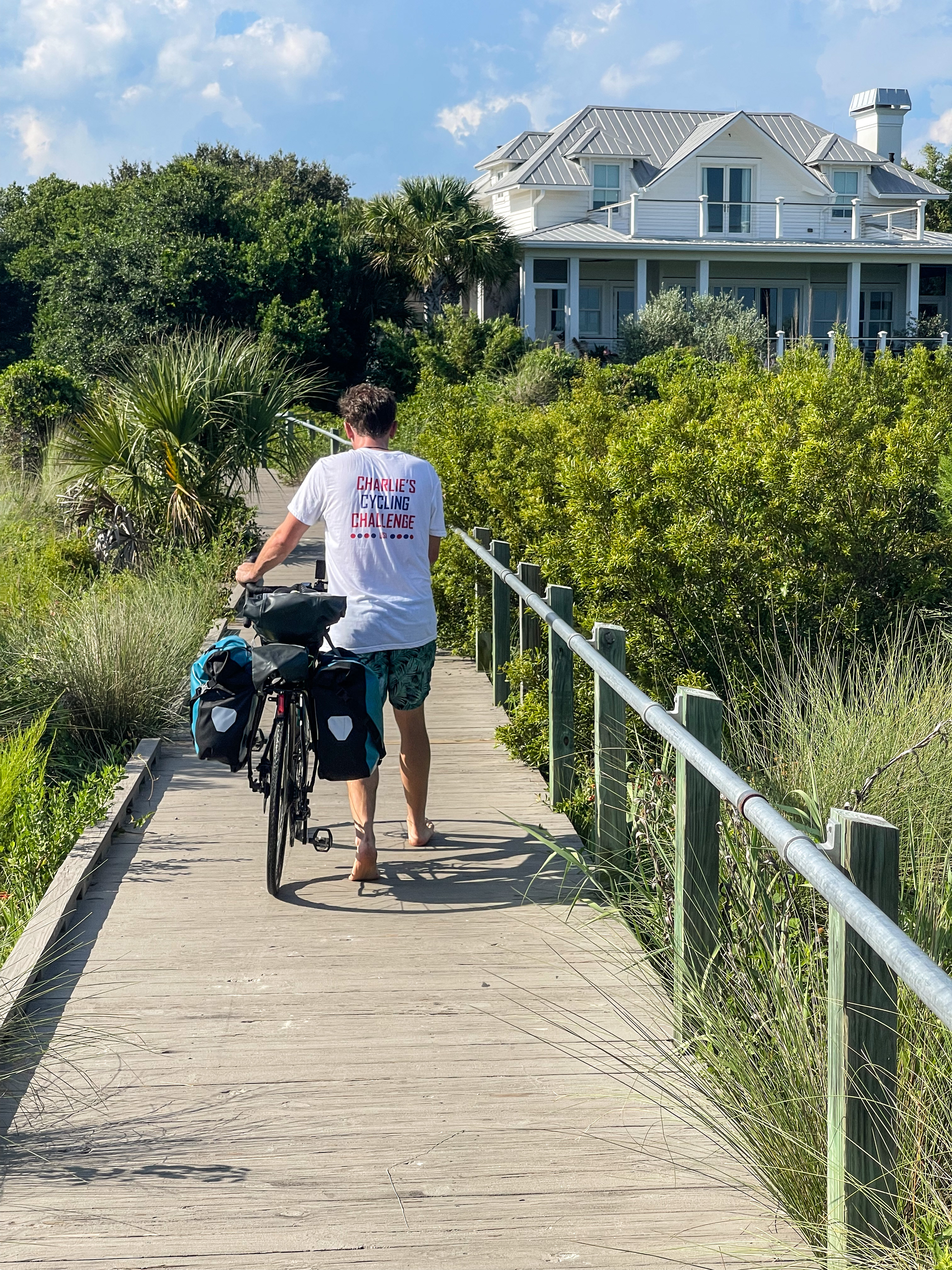
I hope you are all well. Thank you for all your support so far on this challenge. I set off looking over the Atlantic Ocean at Sullivan Island near Charleston, South Carolina on the 20th August after two days of preparation and admin. The first few days were beautifully flat with long straight roads. I also had my father for company who was driving and meeting me at various locations on route that was great fun. 

Since my fathers return to the UK, Georgia has been rolling hills for the last 150 miles and this is set to continue for at least the next few days while staying in some very quiet American towns.  

You can follow me along on this link to Polar steps:

https://www.polarsteps.com/CharlieInghamClark/5557510-charlies-cycling-challenge?s=8C491A31-9677-4489-8198-A3E6A465A6E8

I also have a just giving page: https://www.justgiving.com/team/charliescyclingchallenge/

I’m raising funds for two incredible charities. ‘Number 22’ and ‘Ukraine Charity.’ Please do check them out on the just giving link above. I have a target of £4000 (£1 for every kilometre cycled). You can also follow on Instagram @charlies_cycling_challenge. If you know anyone along in the south of the USA please do let me know. Company and support is always welcome. Please do forward this email on to anyone interested or send me their email  

Thank you again for all your support. 

Charlie Ingham Clark 

Hello All,


I hope you are all well. Thank you for all your support so far on this challenge. I set off looking over the Atlantic Ocean at Sullivan Island near Charleston, South Carolina on the 20th August after two days of preparation and admin.

I am currently in LaGrange, Georgia and have cycled 360miles (579km). 
The first few days were beautifully flat with long straight roads. I also had my father for company who was driving and meeting me at various locations on route that was great fun. 

Since my fathers return to the UK, Georgia has been rolling hills for the last 150miles and this is set to continue for at least the next few days while staying in some very quiet American towns. 
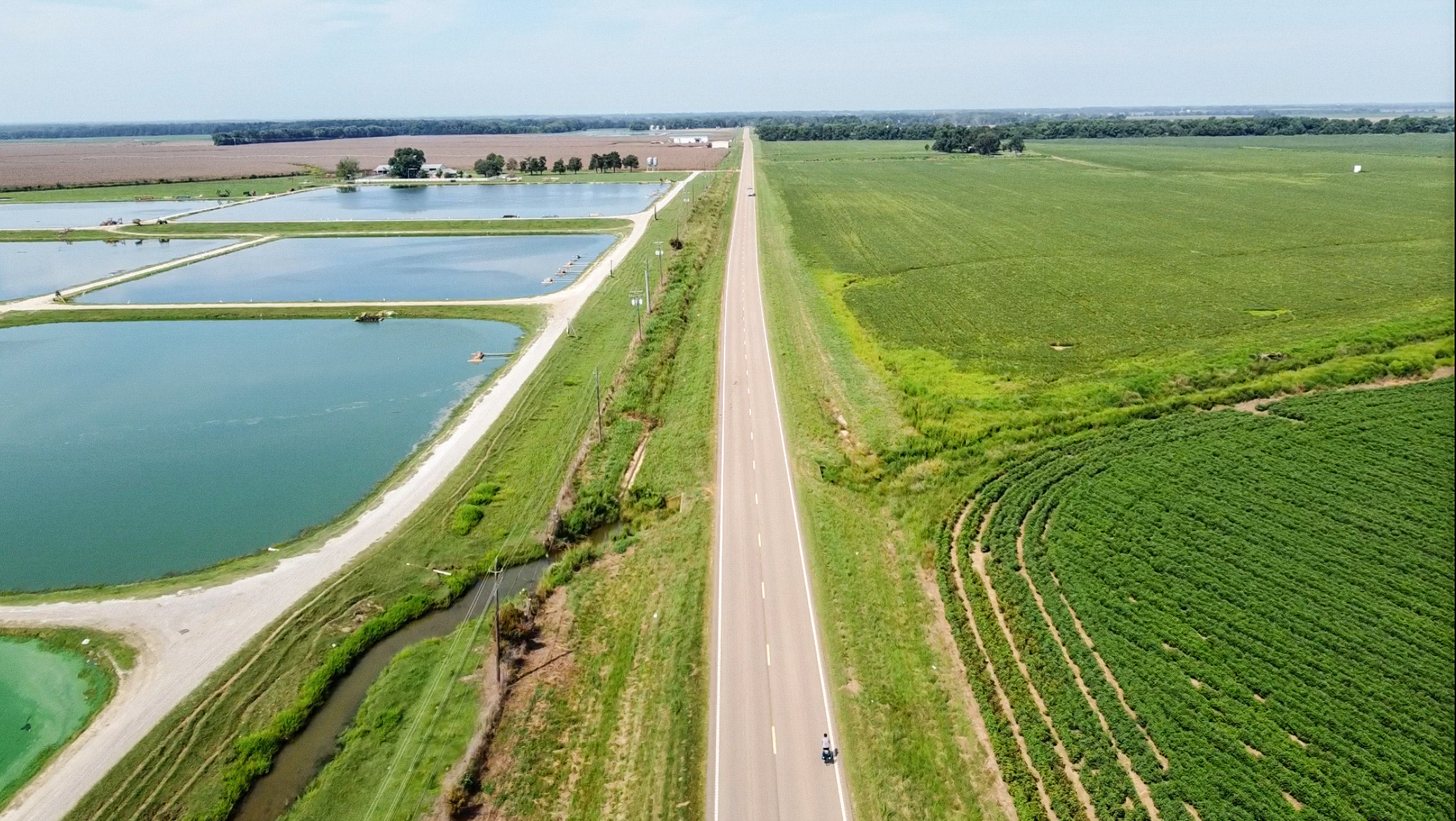
​The landscape has drastically changed as entered Mississippi with open farm land. 
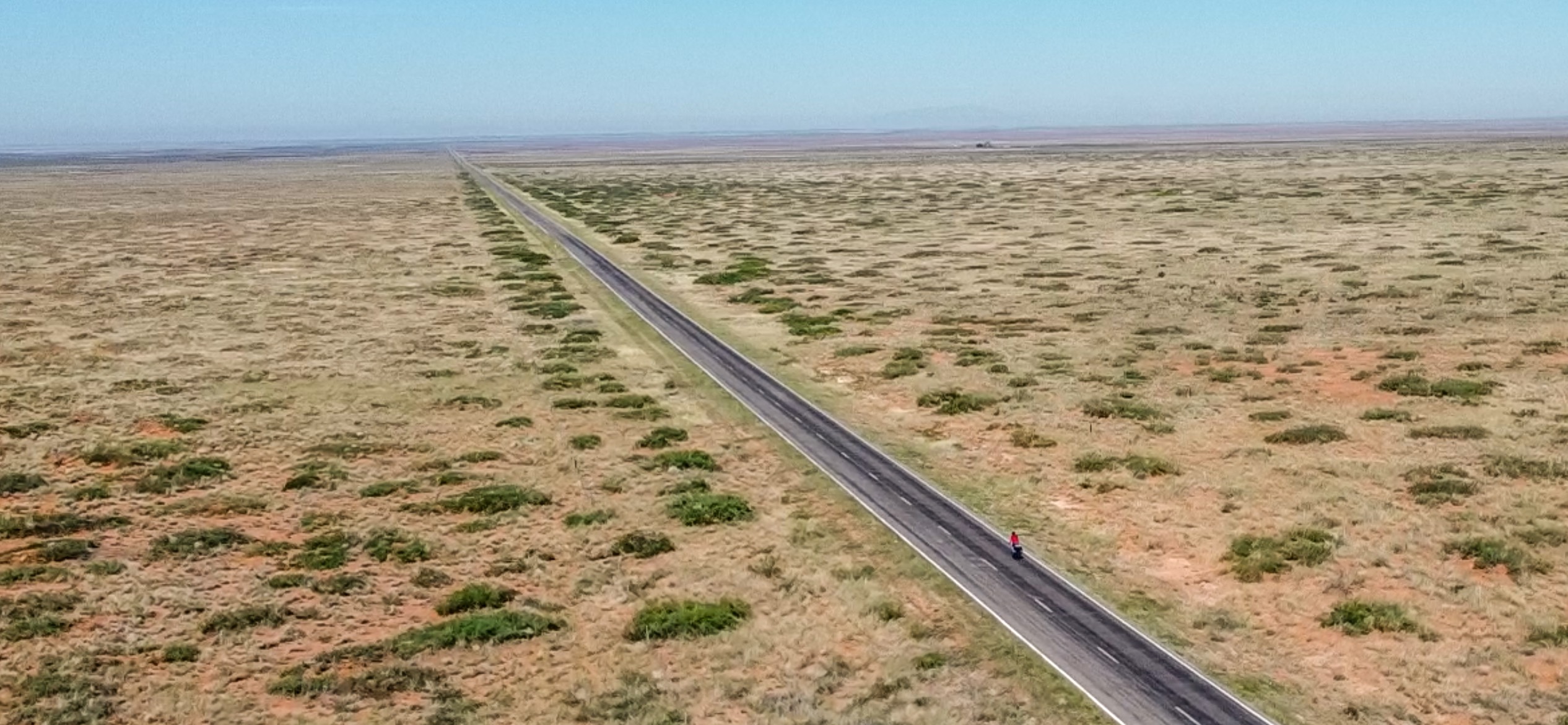
Made it Half Way(ish) across the USA. 🇺🇸Been cycling across Texas for just over a week now and the landscape has completely changed. Open empty land for as far as you can see. Currently in Abilene as had a few issues regarding the bike this week so had to take some time off to get it fixed. Fingers crossed it is all done and can now move a bit closer to New Mexico. Total Cycled: 2308km

His big postcard from New Mexico signalled progress was really good!

“Hi All,

Been on the road over 5 weeks now. Cycled across Texas and now in a town called Soccoro, New Mexico. Been getting up very early to start moving before the heat of the day. It can push up to 37c in the afternoons. New Mexico is proving to be incredible beautiful. With mountains, desserts and fields. The gaps between settlements is getting larger and larger too(Today it was 103km). 

Went close to were the Americans tested their first Atomic Bomb today. Spoke to a gentlemen who told me that they still test there for various weapons and the military drive them out of the area. 

Currently raised £1896 for charity and cycled over 3000km. Thank you to all of you who have donated so far. If you wish to donate please do so from the Just giving page:

https://www.justgiving.com/team/charliescyclingchallenge/

Thank you for all your support. Charlie 

Made it to Phoenix, Arizona. Been cycling almost 7 weeks and now deep in the desert. 
Had a few days in the Mountains that was pleasantly cool but had massive climbs stretching for miles. Arizona is just as beautiful as New Mexico and so stopping a lot to take photos. 
Into California and 150ish miles to the Pacific coast. Right in the desert now, with early morning cycling before the sun gets too high.

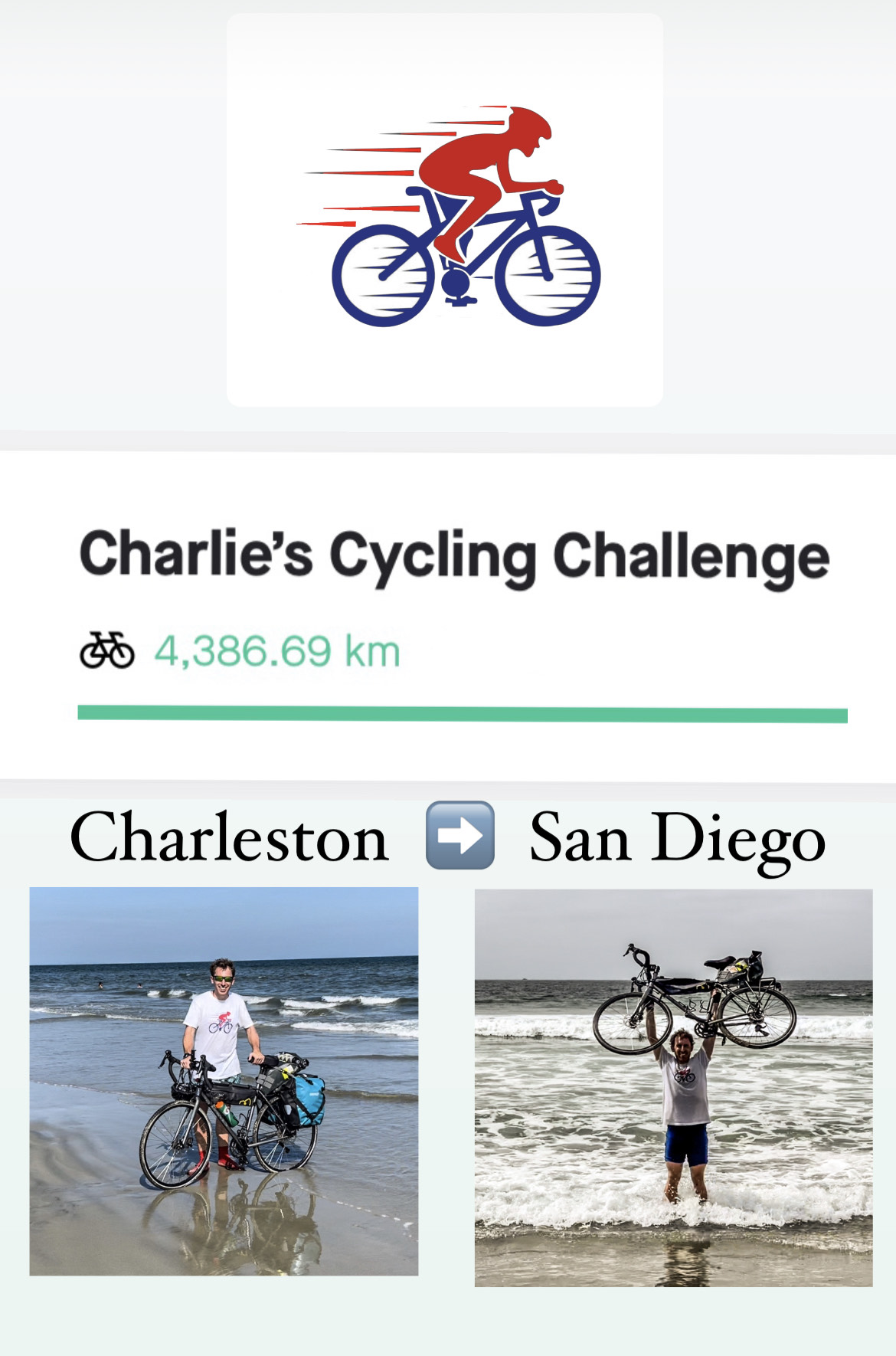
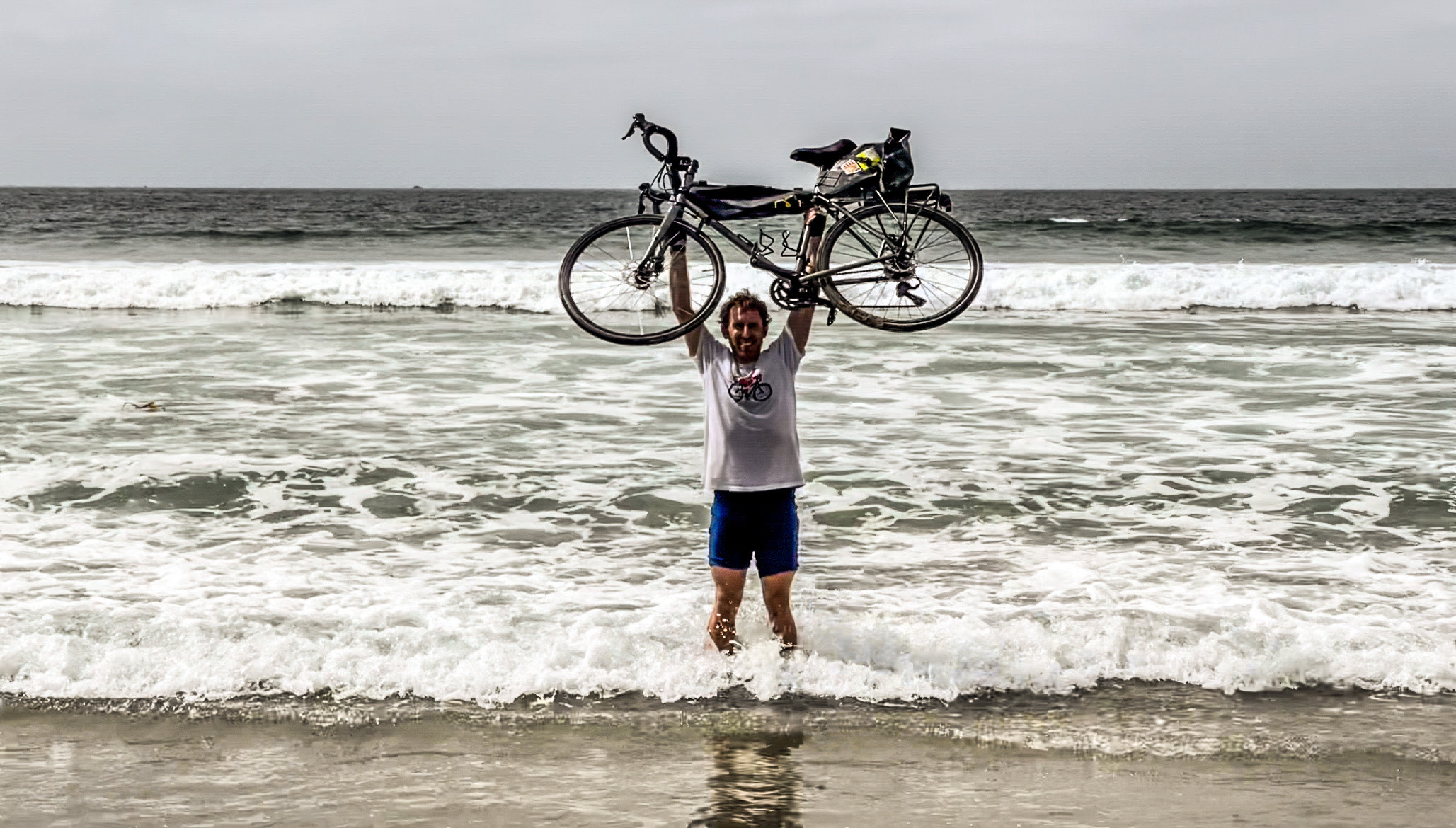
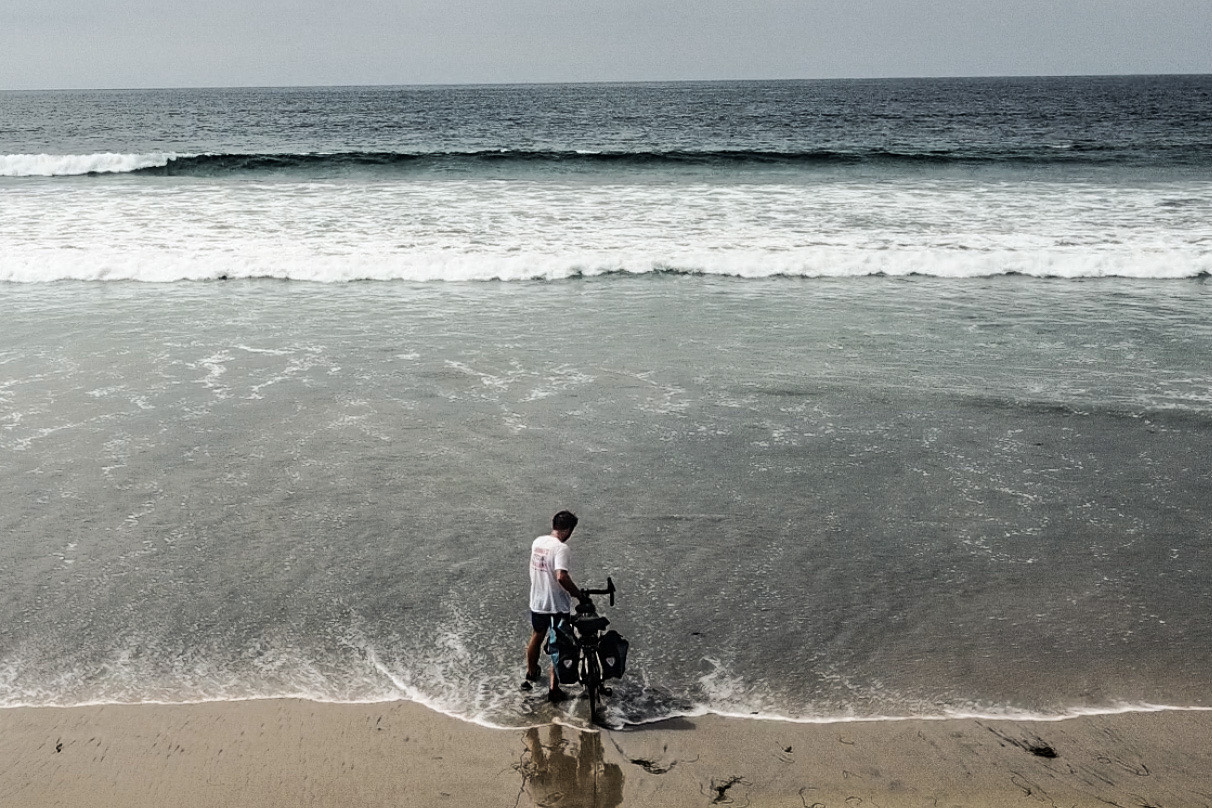
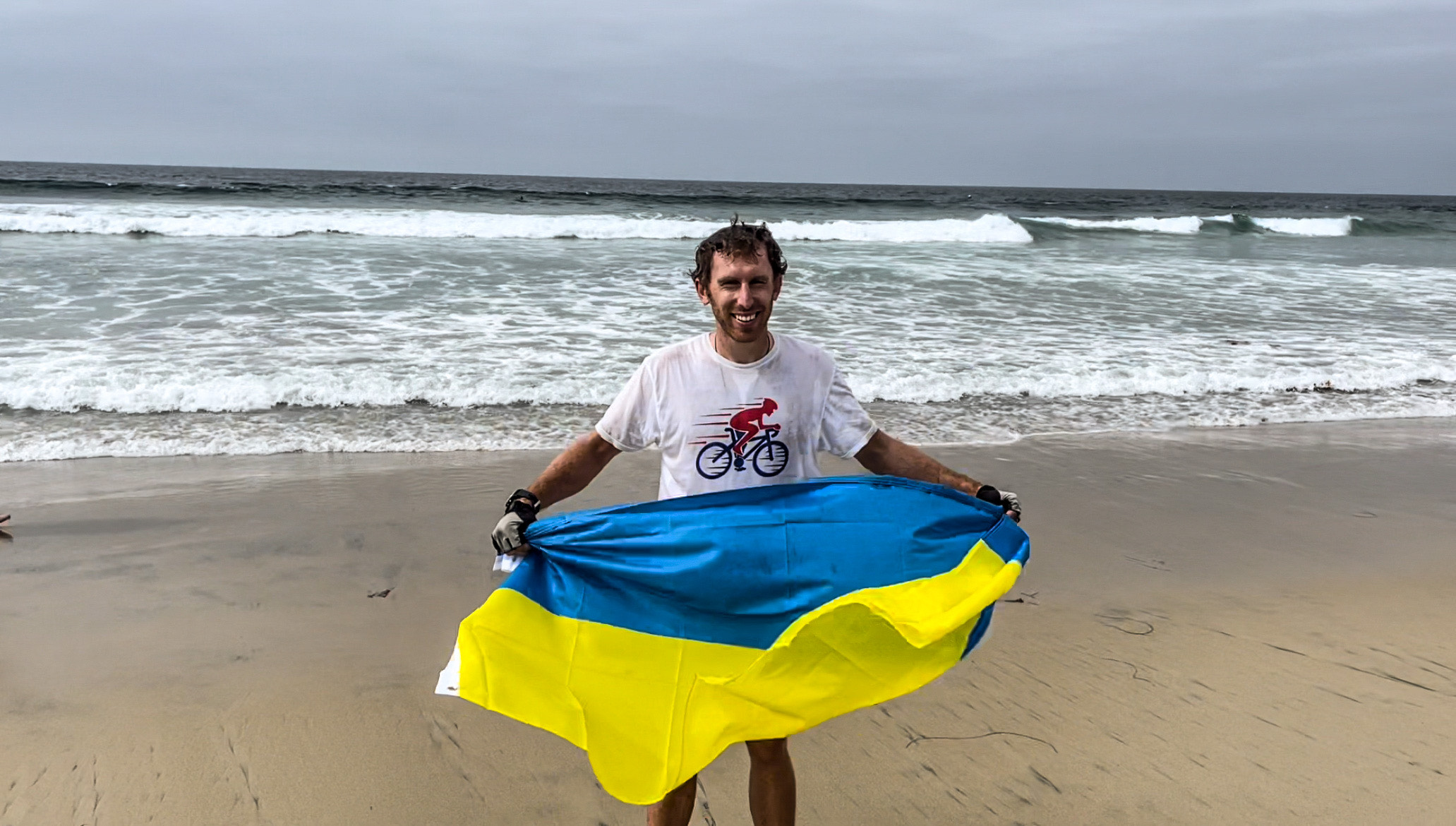
After 4386km I have cycled from Charleston South Carolina on the Atlantic coast to San Diego on the Pacific. Here the cycle element of the Challenge ends. 

Proof Charlie made the sea…
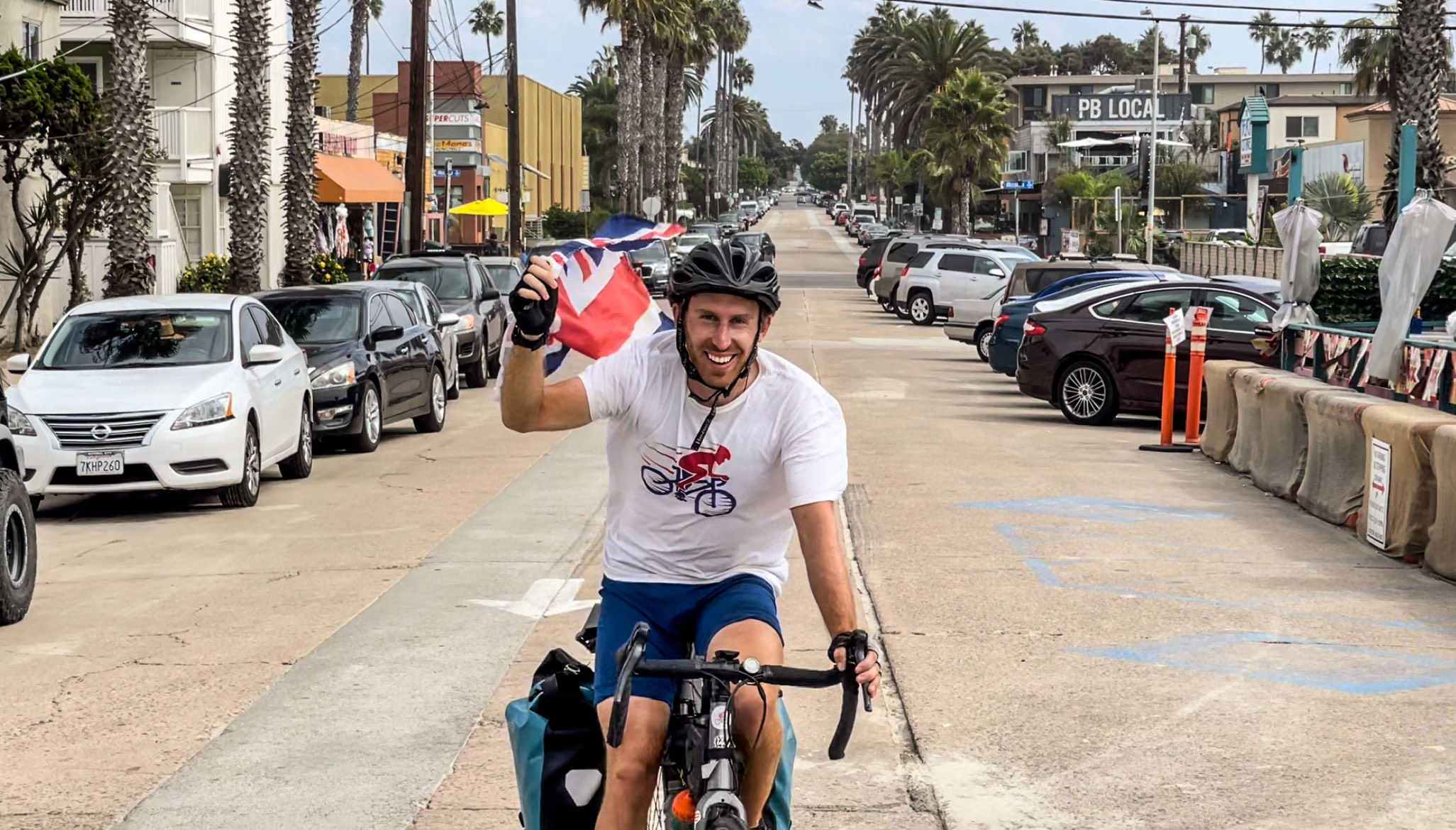
Downtown, it’s clear Charlie is proud to have completed the physical aspects of his challenge

To ensure Charlie meets his ambition to match every kilometre cycled by £1 raised, I copy below his links to the 2 major charities his fundraising seeks to support. Both are clearly close to the Claires Court Families’ heart, ‘Number 22′ and ‘Ukraine Charity‘.

In practice, Charlie has made it easy for us to donate to his chosen 2 charities via his Just giving page:

https://www.justgiving.com/team/charliescyclingchallenge/

“We are a registered charity providing free and confidential counselling to adults and young people in Windsor, Maidenhead and Slough, supporting those in distress where clients can feel valued and heard.

Number 22 provides counselling, advocacy and independent visiting services to the community, free at the point of use.”

“Ukraine Charity was established in 2007 in London in order to raise funds for various charitable causes in Ukraine. Our primary focus has been on helping orphans and underprivileged children and young adults in Ukraine. However, at the beginning of 2022 we have focused our efforts on providing much needed humanitarian relief.”

Proof of Charlie’s completion of his route can be found by clicking on the Polar Links link for his route, which also picks up some more photos along the way. https://www.polarsteps.com/CharlieInghamClark/5557510-charlies-cycling-challenge?s=8C491A31-9677-4489-8198-A3E6A465A6E8

This individual cause captures what the school would wish; if you feel moved to, please do give it up for Charlie’s Cycling Challenge.

Charlie’s Vlog to Claires Court can be found here:

Posted in Possibly related posts | Leave a comment

Local AND Global – navigating the dimensions of learning.

Now the new academic year is well under way, the termly/annual cycle of quality assurance activities is underway, from parent/teacher evenings and forward facing Open Day events to work scrutiny, lesson observations and work scrutiny. I chose Boys Year 10 Maths lessons to visit earlier this week, and found ‘SURDS’ being taught with top set. To save you quickly reaching for Google to find out what a surd is, the definition is “A surd is an expression that includes a square root, cube root or other root symbol.” There, that’s put you right hasn’t it!

Here’s Wilding’s brief explanation, involving a bit of history. Whatever you do as an engineer, you need to have accurate numbers, and if the number isn’t actually capable of resolving into a finite number, such as Pi (π) – back in Babylonian time, 1700 or so years before Archimedes (c. 287 – c. 212 BC) they made use of Pi and geometry to sort their land sales and estate boundaries. The Babylonian tablet below (ca. 1900–1680 BC) indicates a value of 3.125, good for even these days.

Trouble is of course that plenty of numbers like Pi actually don’t resolve as a decimal, going on for ever. You may remember Pi=22/7; please carry out the maths and you’ll see what I mean. Numbers that complete are called REAL numbers, and those that don’t are called IRRATIONAL numbers. π is an irrational number, which has no end however many decimal points you get to.

For a huge number of engineering operations, you don’t not just need π, but you also need to know what the Square Root of a number is, for calculations to find the radius of a circle when you know its area and circumference, r = √(A / π). Early in the days of learning about √, we find out that /4=2. √9 is 3, √16 is 4 and so forth. But for example, when you try to work out what is the /7 is, i.e. what number multiplied by itself = 7, then you fin that you get an answer that never comes to an end or to a predictable repeating pattern. For engineers then, rather then know that they are dealing with 2.64575131106…, it’s so much easier for them to know they have /7 as the value – then if they are taking about mm, the above accuracy to 2 decimal places would be enough, whereas if they were talking about 7km, they might need to use many more places to ensure the accuracy didn’t rob someone of land that was theirs, or dare a say leave some engineering miracle like the Forth Bridge a few metres adrift of the accuracy needed (and metal to span!). Numbers as √2, √3. √5. √7 and √11 all have irrational numbers as answers – this kind of √ answers is known as a SURD (remember by thinking that’s abSURD). There are six different types of surds, namely: Simple surds, Pure Surds, Similar Surds, Mixed Surds, Compound Surds, and Binomial Surd. To conclude, take something incredibly complex, irrational and never ending or deal with /number, and I know why engineers need surds – elegantly expressing what the answer is – under the square root sign √.

The SURDS above are just one example of many types of learning that have spanned the globe and the centuries, and we all know to the present day that there remains so much more about the world that we don’t know than we will ever begin to learn. It’s incredibly important then that learning in schools carries this GLOBAL dimension, and not just to span the tangible, such as Maths, but also the theoretical such as religious beliefs and customs and of course the evidence and experience that comes from Geography and History, such as the effects of Global Warming (definitely a thing, Mr Trump!) and ‘never appease a dictator’.

The trouble with Globalism, even dare I say Nationalism, is that is that it chooses by its very approach to ignore the local, with all the dangers that then ensue, that all that is local becomes devalued and ignored. We’ve seen it in the modern political failure of national governments not to ensure all parts of a country are invested in, and in the race for cost and convenience over the rights and wrongs of employment and environment. Schools such as mine that have taken the trouble to work locally on their engagement with the locality in which they are seated find incredible, unbelievable items on their doorstep. You only have to see the utter fascination of an A level group undertaking observation work around a pond (thanks Woolley Firs field centre) to see the miracle of real learning happening.

And therein has lain the problem of overweening, nanny statesmen, who might fear for example that specialist English teachers might be ignoring their favourite male victorian authors, but in reality as a consequence have forced an inappropriate and insufficiently diverse set of authors on children, in turn perhaps stunted truly their emotional development and a love of literature. Whilst our sector can choose to be different, it is perhaps no surprise now to note that for the country as a whole, English A level has dropped out of the top 10 subjects list. How could you reverse the trend? Why not start with a bit of John O’Farrell’s ‘Things can only get worse’ to cheer the mood!

What getting onto the localism agenda means of course is finding every possible reason to study what’s local, in part because perhaps it has not been sanitised. As a school, we’ve a fabulous relationship with the Stanley Spencer gallery in Cookham, and the opportunity to see his paintings as well as visit the ‘set’ where he painted so many of his works (and of course where he is buried) gives real presence to learning of his work. I’ve written plenty of times about the work we have created with the National Trust at Cliveden, and as we embrace more the language, literature, history and culture of immediate surrounds, the tangible growth in knowledge actually permits the learners (children and adults) to become even more creative about the comparisons they can then draw with the other evidence arising from across the globe.

And of course, for fear of being branded nany statesmen, Mrs Truss and her new government seems to be avoiding lecturing to us about the cost of energy and how to reduce it. The one thing politicians can be sure of is they could mobilise the eco-army they need to keep energy consumption down this winter. To every family home each day we send home a climate warrior wishing to make a difference. They absolutely get the need to change attitudes about global warming and climate change, and really they should be mobilised to turn the heating down a notch or 5. You’ve only got to look at the fun boys and girls are able to have at school each day, refusing to wear anything warmer than their minum school uniform to know they can ‘do’ colder climes. There might still be a bit of a way to go with getting 10 set 1 to navigate the heinz variety of surds they see in the classroom, but at a fell swoop they’d certainly help get UK’s gas bill down a couple of notches – and that requires local action in every home!

Posted in Possibly related posts | Leave a comment

Rt Hon Theresa May and her visit to Claires Court

We were delighted to welcome Maidenhead MP, and former Prime Minister, Theresa May on Friday 23 September where she met some of the 15 Ukrainian students currently enrolled at the school.  

Claires Court was approached at the start of the Ukrainian crisis by former staff and current parents, each with a personal connection with Ukraine.  They were collectively concerned that a school locally needed to be willing and able to take a large cohort of children all fleeing Ukraine, and from their connections with the school, felt that Claires Court would be well positioned to do so.  

Community is the absolute heart of who we are at Claires Court and we were determined to do our level best to help those students who had experienced such awful circumstances at home. Providing their education is only a small step in this process, welcoming their mothers so they feel included and welcomed has been important too. We seem to have provided them, and for many of their fathers back in Ukraine, with the comfort of normality and importantly, the stability of routine and friendship in school.

James Wilding Academic Principal

Mrs May was invited as MP for Maidenhead to speak to the students and understand first-hand the challenges that had faced them and their individual circumstances.  Mrs May started her visit in the newly furbished nursery school where the youngest child started age 2 and continued to meet Milana (Year 2) alongside her teacher and dedicated teaching assistant.  

The visit was very special for the children and Mrs May was presented with heartfelt gifts.  Three A-level students, Marina, Vavara and Daniela presented Mrs May with a Cyanotype print, framed and signed by the girls who are now learning subject based English to assist with their studies.  Daniela, who is studying Photography at A-level, also presented Mrs May with a print of a photograph she took of iconic Big Ben, now showing a Prussian blue clock face.  

The students within the school are supported by Ms Balynets, a qualified teacher & Ukrainian translator employed by Claires Court who also fled Ukraine as a refugee.  Introduced by a former pupil, Ms Balynets is concentrating on teaching English to the youngest students and offering classroom subject help throughout, specifically with assistance at GCSE & A-level.  

Mrs Rogers, Head of Sixth Form said, “In addition to the class work, Ms Balynets has been of great help acting as an interpreter between students, their mothers and the school to ease the transition between home and school.  She’s really helped to explain how the school works for them, so very different from their experiences in their home country.”

Four of the senior students each took time to write a personalised letter to Mrs May outlining their experiences of the war and how this has affected them.  Mrs May read the letters from the girls when presented with them and asked them questions about their time at school.

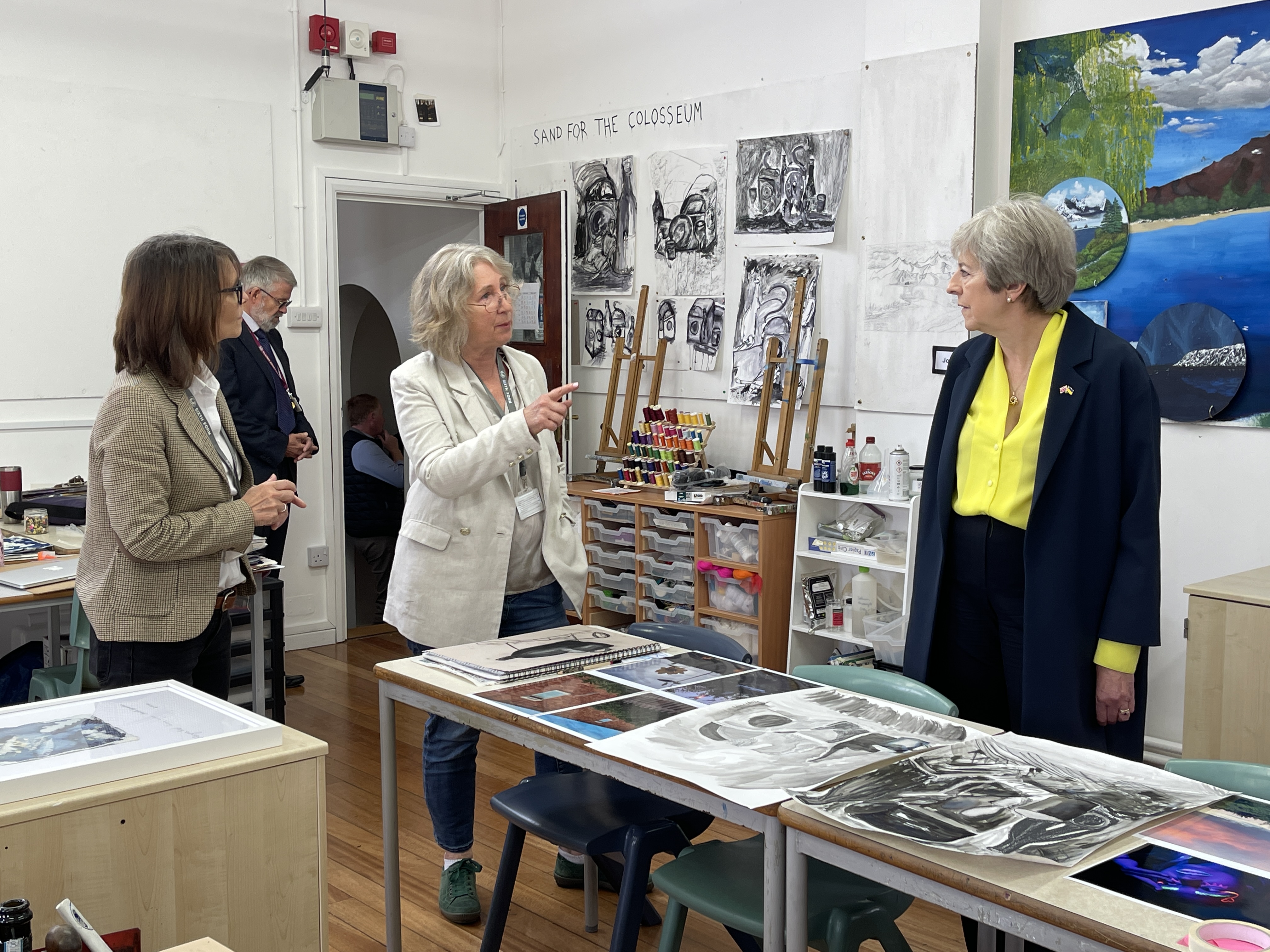
As the photos show, Mrs May dressed to impress for her visit, wearing Ukrainian colours and sporting the UK/Ukrainian crossed flags. The photo below shows our Head of Photography, Jane Wimshurst engaging Mrs May in an A level teaching point, supported by Stephanie Rogers, our Head of Sixth Form. One of the key points of Mrs May’s visit to our central College site was to show just how the breadth of our provision has been enhanced and developed over the past 3 years, clearly providing some remarkable, ground breaking provision from Nursery to Sixth form, both for teaching, accessibility and well-being support. One of the most important reasons we were able to support the Sixth Form arrivals from Ukraine is that they have keen interest in creative, artistic and technology based subjects. Our offer in this regards of high quality digital art, photography, media and music technology kit and teaching programmes fitted their needs as well as lowering the bar in terms of language accessibility.

And finally, we must never forget the value of supportive adults, be they fellow travellers from Ukrainine or generous Host families providing a secure home locally. Mrs May was very much a celebrity in the eyes of Mrs Balnyets and children, almost as much so as Dr Sheru George, who is hosting 3 families alone, mums and their 7 children! Dr George has been extraordinarily generous in his support of our work, assisting in the funding of adult language learning support as well. Mrs Balynets is getting used to her multi-layered role here, accompanying Year 7 boys and girls to Cliveden on Tuesday this week, in which we have 3 boys and 2 girls hosted learning our ways and enjoying their first taste of secondary school.

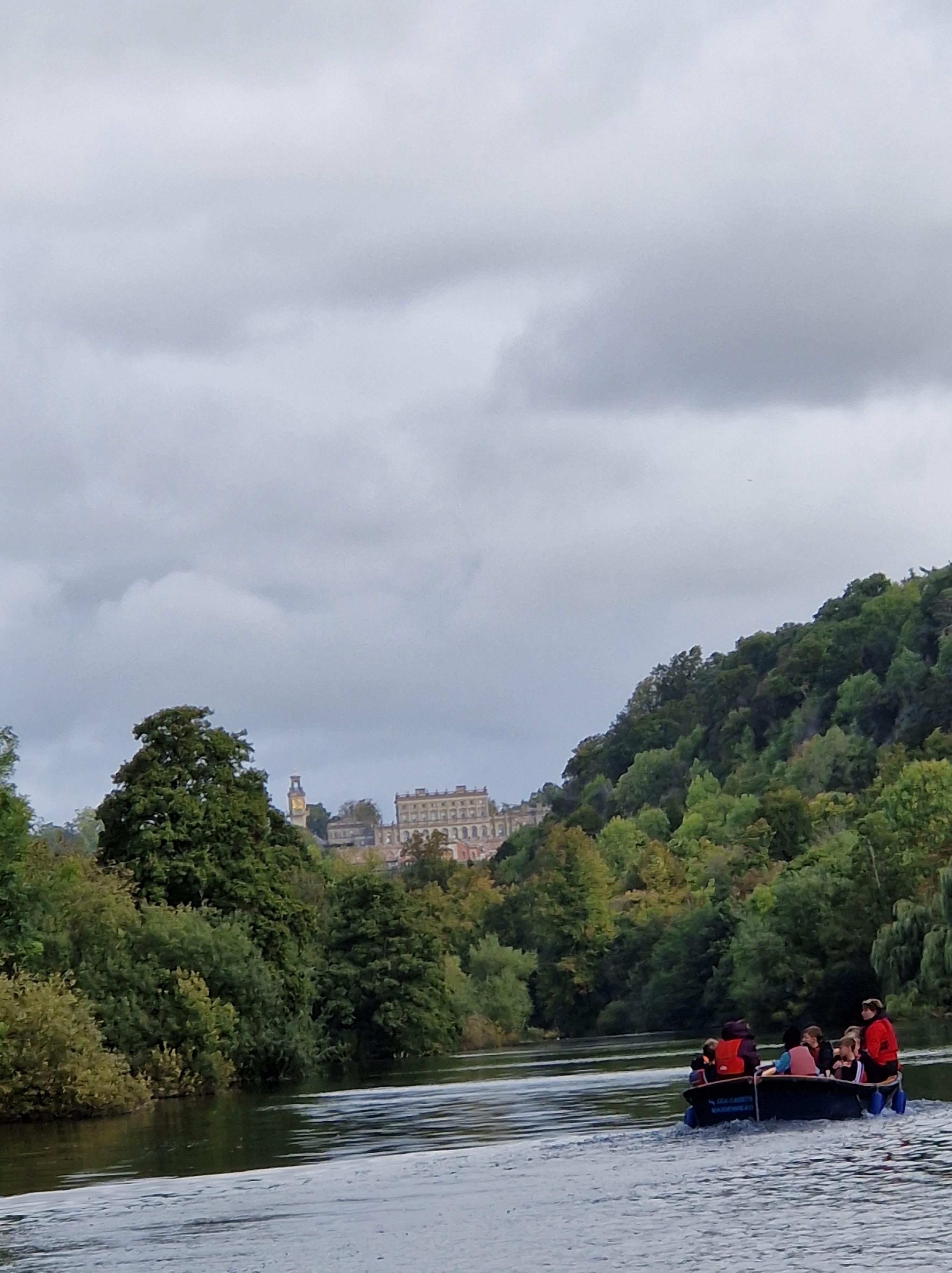
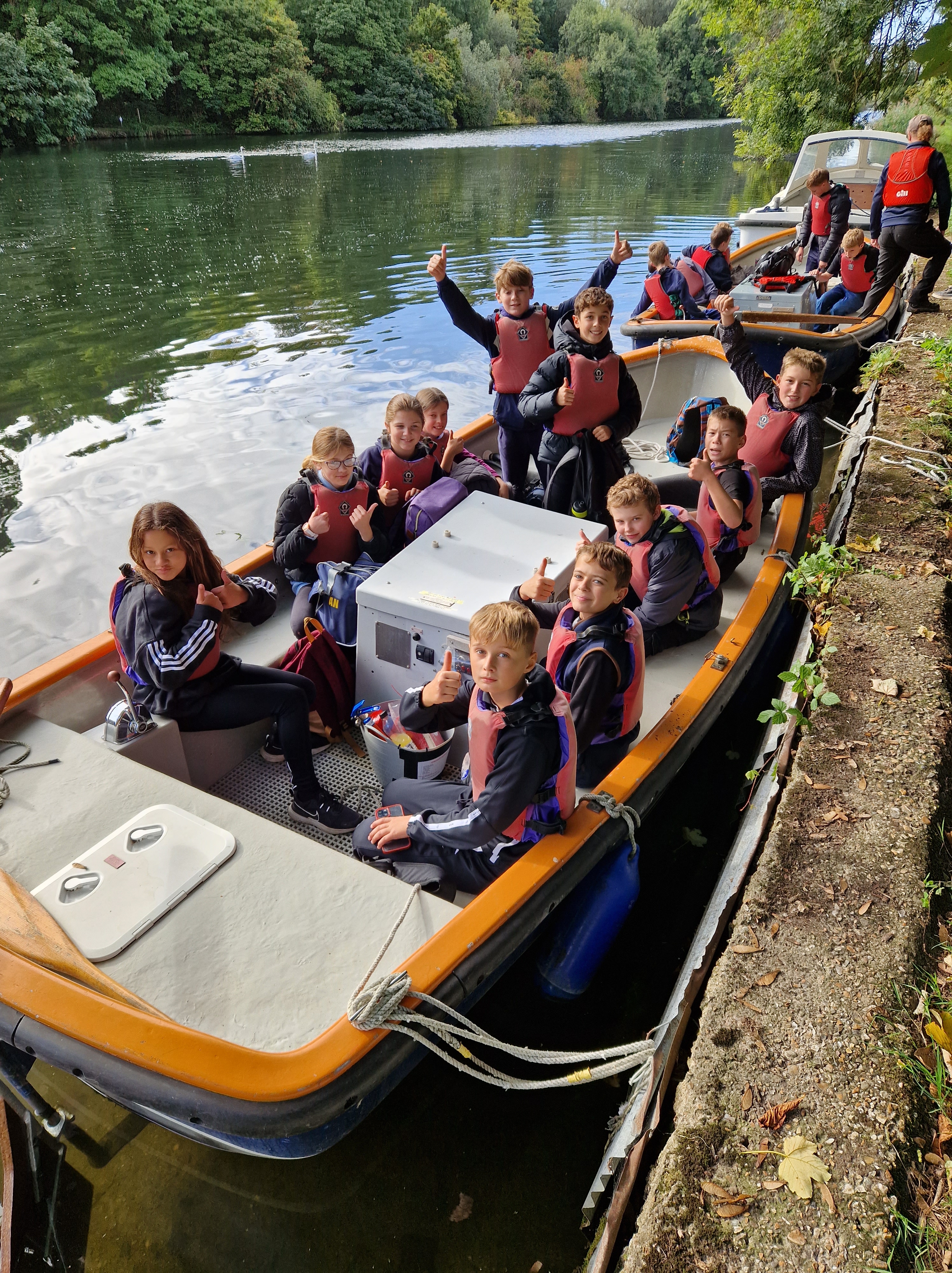
2022 version of ‘My Lady Ferry’ carrying some of our 100 visitors for the day from Claires Court to Cliveden – we had 9 boats full in total!
Arrivals from school to the Cliveden bank courtesy of the Claires Court Outdoor Education team
Tree identification in the Cliveden woods
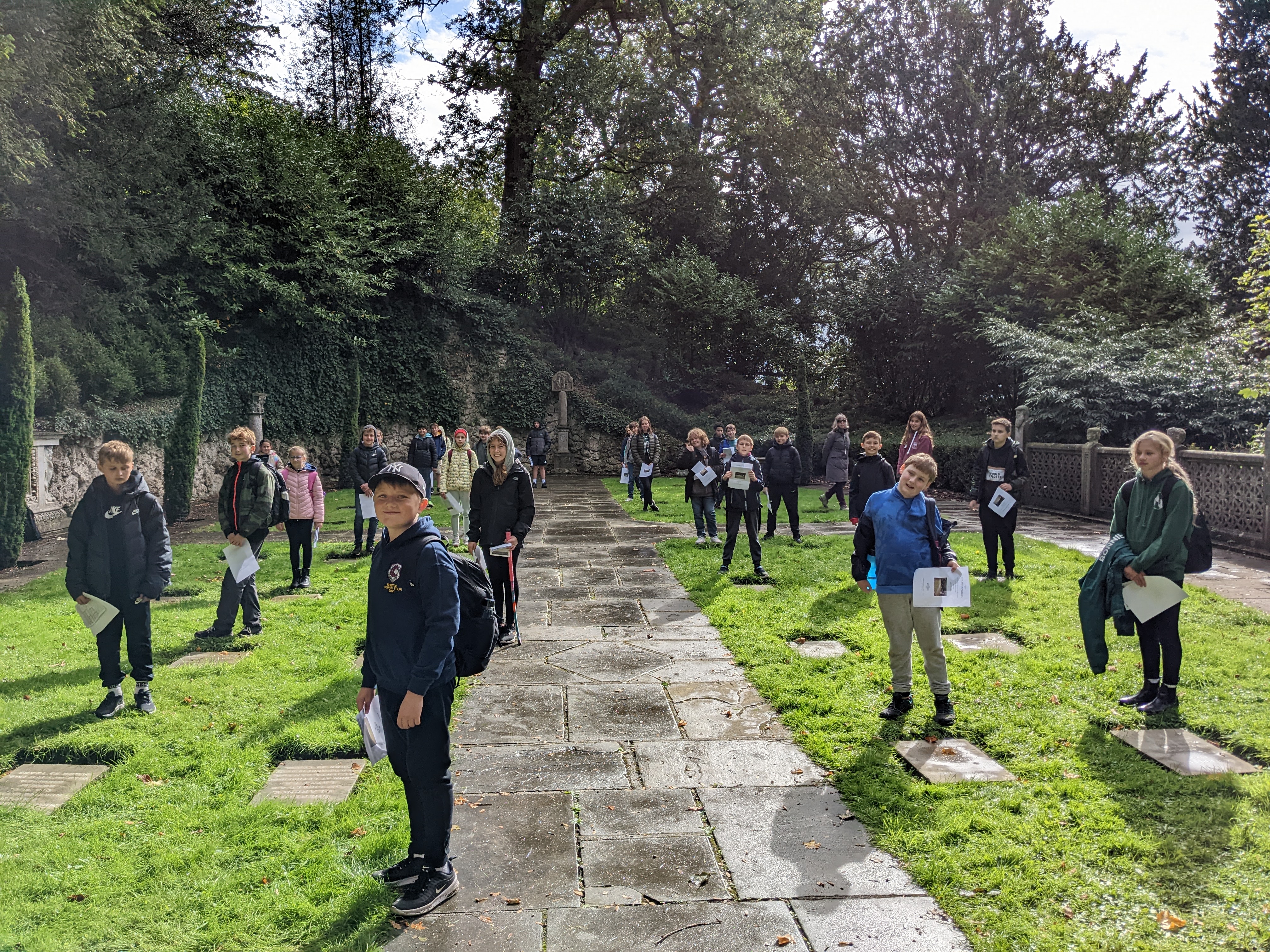
History discovery work in the Cliveden Memorial War cemetery
Posted in Possibly related posts | Leave a comment

Education enters the Carolean Era…

Highlights of the post that follows:

  • The last Carolean era saw the Restoration of the Monarchy in 1660;
  • The Restoration saw a flourishing of the Arts, Theatre, Sciences and a return to personal freedoms;
  • It was also characterized by some Greats, the 1665 Plague, the 1666 Fire of London and the reintegration of Great Britain and Ireland;
  • Claires Court enters the new Carolean era, renewed with the best examination results at both GCSE and A Level achieved through public examinations this century (and ever);
  • with the largest leading cohorts of children in Years 6, 11 and 13 as well;
  • and with some pretty impressive investments visible throughout the estate, including the complete refurbishment of our Elizabethan silver jubilee teaching wing (1978) at Senior Boys, at the close of the school’s own Diamond Jubilee celebrations.

Claires Court’s history has to date been entirely encapsulated within the modern Elizabethan era; established in 1960 by my parents David and Josephine Wilding as a consequence of the post world war II economic boom enfranchising baby boomer parents to seek the educational opportunities for their male children unavailable otherwise. 

Such ambitions of course included those of the young parents, Queen Elizabeth and Philip, whose separate experiences of education either revolved around home education, or spanned continents, languages and cultures. They chose for their children’s secondary British mainstream boarding education (Charles, Andrew & Edward to Gordonstoun and Anne to Beneden), Charles’ sons going to St. George’s Windsor and Eton (William in 1995), by which time our own school had acquired Maidenhead College and opened its own Sixth Form. 

Queen Elizabeth devoted her life in this 21st century to restore  the country’s trust in her monarchy, to stabilize and reinforce the value of Commonwealth to other countries and above all (my wisdom of hindsight here) to keep a sense of ‘Greatness’ about our country in the eyes of the rest of the World to the extent that President Macron of France was able to say in his eulogy on her death “To you, she was your Queen, to us she was The Queen’. Whilst the 2012 Olympics may come to symbolize the zenith of our country’s recent influence worldwide, I have no doubt that the 2022 celebrations of her own Platinum jubilee were a fitting culmination to her reign and tribute to her benign influence over our remarkable and unique democracy.

So it seems Claires Court has left the Second Elizabethan era on a high, and faces its future (with the rest of the UK) under the incoming Charles III and Queen Consort Camilla with both trepidation and expectation. None of us know how we are going to pay our way in the wake of the energy crisis, nor escape the most serious of threats arising from the war in Ukraine. A new Prime Minister, Liz Truss and government are exercising their first days of government having laid the Queen to rest, and it seems pretty evident that she is using a similar approach to that of the post war prime ministers to cause growth and expansion. Fortunately, Ukraine has the support of a host of nations and not just ours, so the threat to Russia may just cause its own population to make a change at the top to avert world war and worse.

During his lifetime, Charles has developed a host of themes that schools have adopted and embraced; his father’s Duke of Edinburgh award has never been more important for our young people – I quote from the DofE website “In 2020, young people stepped up and played an integral role in supporting communities across the UK to respond to the coronavirus pandemic. A remarkable 330,000 young people continued with their DofE activities – a huge force for good, dedicating 1.8 million hours of volunteering, equating to an investment of almost £8.5 million, to local communities at a time when they needed it most. DofE participants sewed PPE at their kitchen tables, delivered food parcels to those who needed them and put on virtual concerts for care homes. As the UK recovers, the benefits that the DofE offers are more important than ever. Our new strategy puts the DofE at the heart of the national effort to back young people through the challenging years ahead.

Last weekend, 42 of our current Year 9 completed their Bronze expedition, with a further 78 in Year 10/11 are now completing their other sections, which given all the other calls upon the time of our teenage boys and girls shows a really significant commitment to service above self. King Charles’ interest in ecology and sustainability is also to the front of both academic teaching lessons and a major priority if we are to ‘save the planet’. And of course, the generations are clicking over, and his grandchildren and mine both starting school this month locally in RBWM, as day children with parents joining their school community and planning to be active participants in their children’s lived educational experience.

As my key headlines for this post make clear, over the past 10 weeks, our maintenance staff and builders could not have been busier. The official reopening of our ‘Jubilee wing’ at Senior boys is to be scheduled for a formal reopening event week beginning Monday 17 October, and of course wherever within has been full and bursting with life since we returned from our summer holidays on 7/8 September. Perhaps even more importantly, we have invited The Rt Hon Theresa May MP to visit us on Friday 23 September to meet with our invited Ukrainian children here at school, to bear witness to the sustained investment into both nursery and school facilities and to follow up her interest from 12 months ago in our ongoing diverse and innovative activities for our children.

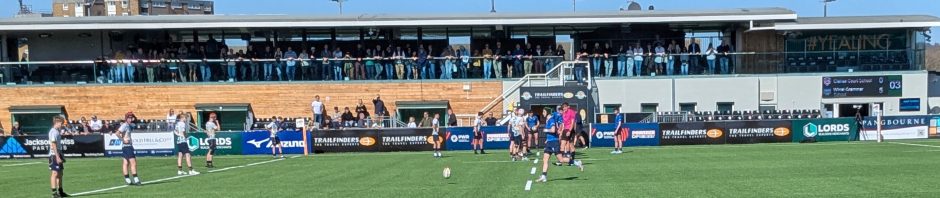
Dear Reader, do please continue to be our unseen ambassadors for the work we do and for the growth we promote in all of our community, whether they be children, parents & guardians or our partners here in RBWM. If ever there is a downside to reporting the best, it is the inevitable fall (if only in volume numbers) that will follow further down the road. Covid-19 was an extraordinary catalyst for change in our society, with working and shopping from home becoming a norm. Here at school, we have lengthened our breaks to ensure that childhood is protected, yet embraced technology to conjoin home and school learning environments and this month to live stream our 1st XV Rugby matches on Wednesday afternoon using AI cameras to enable our supporters to spectate.

Over the coming weeks, we have open days and opportunities for visitors to learn more about Claires Court and what we do – please spread the word, because we do want to see real people to show them what we are about. 

Posted in Possibly related posts | Leave a comment

A Brave New World, Mrs Truss & Mr Malthouse?

Great Britain has a new Prime Minister at the same time as schools, colleges and Universities come back into session. Liz Truss has a monumental in-tray, not least the energy market crisis, conflict in Ukraine, tensions with the EU, dis-union within and the complexity of migrant need to meet our employment needs and illegal migration overwhelming our services. I don’t envy her, or indeed any world leader currently, beset by the clear set of problems with no obvious financial solution either except to kick the can down the road once more to future generations. Whilst writing this piece, I see that Kit Malthouse, MP for North West Hampshire has been appointed our new Secretary of State for Education, so I include them both for consideration of the points I make below.

I am only going to write about Education in this blog, but UK PLC should be very clear that it has a really effective early years and compulsory education provision which is frankly the envy of the world. It’s clear from the ‘levelling up’ narrative that we still have more to do in ‘opening up’ of opportunities for those areas of the country where deprivation and poverty continues to stifle ambition and as a consequence academic progress in school. Recognising that we have more to do needs to be tailored with the generosity to meet that need where it is most acute; in schools we are acutely aware that the funding of special education needs requires exactly this, coupled with a reassessment of actually how best should such needs be met. The advocacy of Individual budgets for Education, Health and Care plans has badly atomised the funding available, as a consequence local authorities being ‘spent out’ even before the start of a financial year. So first steps for Mr Malthouse is to accelerate the review of SEN to ensure we have the budget short term and the approach long term to bring inclusion in mainstream a reality for those for whom that solution is appropriate, and the support of alternative providers to meet the needs of those unable to be in school.

We have had 2 reports published this summer looking at the state of playnin our schools, one by the Times Newspaper’s Education Commision, the other by the Tony Blair Institute for Global change both of which summarise the key developments needed and come to broadly the same conclusions: the reversal in recent years at Sixth Form level to a narrow, knowledge led curriculum is not providing us with the broader set of skills and enthusiasms we need for the future, whether that be for higher education or employment. The Labour government took us closer to such proposals with their development of Curriculum 2000, though that only focussed on Sixth Form studies and kept the huge apparatus of GCSE and examinations in place at 16+. Both reports summarise the need to reduce substantially the ‘testing’ nature of 16+ exams, in part because they cause such a huge additional cost to the country in terms of lost teaching time, resources and facilities and because they are so divisive in terms of individual and school community well-being. What Mr Malthouse can plan with DfE is how to take these education metrics out of the political maelstrom, forging a 10 year or longer plan unting schools, colleges, employers and universities with a common purpose to meet the country’s widest employment needs for skills and qualifications.

It remains a national outrage that we refuse to provision sufficient training places for medics; choosing to rob third world countries of well qualified doctors and nurses they can ill afford to lose whilst refusing to provide sufficient places for home qualified students is the greatest hypocrisy. Of course it is not just about providing training places for students but retaining those really experienced doctors and surgeons to teach in hospitals with more than just A&E and Covid underway. Here curiously education has something to teach medicine, as we manage to keep many staff employed well into their 7th and 8th decade, partly because of course our pension pots don’t grow large enough to fall foul on the lifetime allowance (for most people £1,073,100). Every year, Claires Court graduates circa 50% of its GCSE scientists good enough in ‘old money’ to move to Maths and Science A levels and potentially into Medicine beyond – and we like most other schools would love to see Medicine degrees return to where they used to be last century, relatively available for most good candidates.

What we must do is plan to evolve over time. The efficiency of the UK system of University degrees is celebrated around the world, recognisably providing great content over a 3/4 year period coupled with time to develop the other skills and opportunities that permit young graduates to accelerate away when employment aged 21/22 beckons. I have appreciated Martin Lewis (Moneysupermarket guru) straight talking to government on energy costs this summer; previously he has spoken wisely about University Finance and we do have a best of all worlds scenario for students here in England, given the relative poverty of the national piggy bank – see here. Evolving over time must also include bringing more undergraduate courses into the undergraduate employment apprenticeship field. Again my school has really good experience of training teachers ‘on the job’, circ a 6 a year. With residential costs for Universities competing with the wider housing shortage, many students can enjoy a full Uni experience by staying local to home, and we are certainly very fortunate to have many leading universities within easy reach on our public transport network.

And finally, my own cautionary tale… last week in the early hours of Wednesday morning, I suffered a fit and needed to be hospitalised to find out why. Despite the ambulance, I was a walk in, walk out casualty, and between 05:30 and 17:30 I could not have been looked after better. Every test under the sun, scanners, cardiac and bloods later, and I am, it appears, as right as rain. The quality of care was extraordinary, for me and all, and so whilst I can read the headlines about ‘broken NHS’, my reality is very different in experience. Of course we can continue to point, finger, blame, but in my view, we won’t make progress as a country if we keep up as our main strategy the ‘blame game’ rather than use a ‘solutions based’ approach instead. I am having to make some running repairs to my working life straight away; I can’t drive for a while for example, and I am certainly keeping a very lively watching brief on diet and lifestyle. Very boringly, there’s not much to report (that’s a good thing), and actually the road to my full recovery is as it is for anyone else, one step at a time.

So all hail our new PM and EdSec, and good luck to you both. Thank you for returning Mr Gove to the back benches, his claim to fame being his famous distrust of experts. You have already highlighted that your approach is solve the problems in front of you as you see them, so do please have a good read of the 2 reports I have highlighted above. The many contributions made to both reports have been by experts in the field of education, and their preferred solution for skills development maps onto the work Claires Court has developed over the past 15 years very nicely indeed, with values even more clearly aligned, placing Integrity and Character above all. I see that your cabinet is as diverse as it could be, pulling talent from across all – perhaps you could look to adopting our school’s motto, “Ut Omnes Unum Sint”, ‘That all may be one’; at this time of national crisis, a sense of bringing the nation together is much needed indeed.

Posted in Possibly related posts | 1 Comment

Going to University – the No-Win, No-Fee system

Over the past few months, what with the tightening of belts because of inflation, and the growing skills gap that cannot be filled from the labour market, there has been a growing call for our 18 year olds leaving school to consider going to work as opposed to going on to study. Indeed the student loans landscape is to change – spoiler alert, but that doesn’t change the core essence of what follows… read on.

For mature adults considering career changes, it’s clearly better to look for salaried conversion courses than it is unpaid university, because the maintenance loans available are not that generous – you can read off the details here – https://www.gov.uk/student-finance/new-fulltime-students/

But for every young person (and parent) considering post 18+ study at University, this Martin Lewis talk on Student Loans Decoded is a ‘much watch video’. In it, he explains completely that student loans are not loans for students, that University fees per se for UK students are paid by the government loans company so invisible to the student, and that the monies to be paid in due course come from a graduate tax of 9% when earning more than £25,750 per annum a year past graduation (currently (£27,295).

Martin makes it quite clear why even if the post graduation adult gains a windfall, they should not pay off the student loan company, until they have considered the 30 year life span of the account, and the possibilities the luck adult might wish to consider for their windfall. In short, the graduate debt is not a millstone, but a convenient way our society has made the extraordinary benefits of higher education available to its citizens.

Some will argue that the European system works better (though none the US system), and I would certainly agree the Scottish system is best value as tuition fees are covered by the Student Awards Agency for Scotland (SAAS), though their maintenance loans are less generous and Scots usually have to spend 4 years to graduate rather than 3. Martin does not cover this element, though Which? journalist Gareth Shaw covers it well in an article published earlier this year.

So… click on the Youtube link, crank the playback speed on the cog up to 1.5 and be thoroughly entertained – it’s a really worthwhile watch, than you

Alternatively, you can read Martin’s updated article of June 2022 here – https://www.moneysavingexpert.com/students/student-loans-tuition-fees-changes/, though it does rather send you back to the video above, which includes that essential learning scenario of Martin teaching and making sense of the mire!

Spoiler alert postscript. As the Higher Education Community post here makes clear, the changes afoot see starter payback drop to £25k from , period for payback to extend to 40 years (from 30), but rate of interest to be pegged back to RPI, not RPI plus 3%.

Posted in Possibly related posts | Leave a comment

“The Road to Hell is paved with Good Intentions”

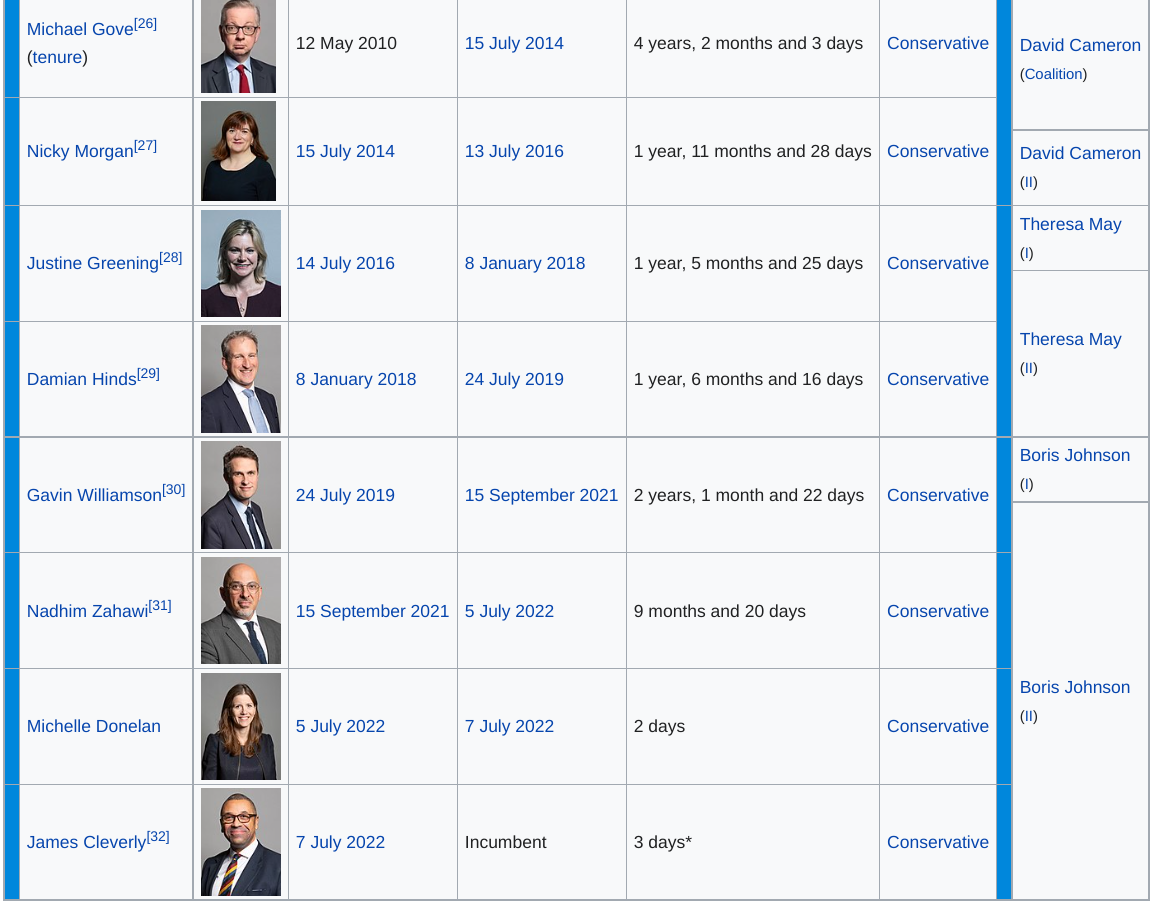
This old English proverb seems to have evolved over the centuries, and remains as fresh today as a millennia or more ago. English Education is looked after by its own ministry, the Department for Education, since it was recreated as such by David Cameron’s government in 2010 – the conservative appointments since are shown below.

UK Parliament sources, courtesy of Wikipedia

Regular readers of my column will not imagine I am a fan of the DfE nor of its many Secretaries of State over the years. The headline quote on ‘Good Intentions’ is directly pointed at SoS, promising so much and delivering so little and often moving education in the wrong direction. As the timeline above indicates, the main issue with Education’s SoS is that their period of tenure is pretty short, ambitious younger members of parliament seeking to make their name quickly by delivering some easy to achieve outcomes before moving on. Famously, only one SoS has declared they were not good enough for the job, that being Estelle Morris back in 2002. Ms Morris had planned to raise standards of both numeracy and literacy when she moved up into the hot seat in 2001, from her role as school’s minister, and when there had been no progress in raising standards in the meantime, she resigned; In an interview with BBC News Ms Morris said she had “been honest with herself” and thought she had not been as good at the cabinet post as in her old job as schools standards minister.

This image has an empty alt attribute; its file name is the-blob-010-1.webp

Since Michael Gove to Nadhim Zahawi, they have done their best to alienate those they profess they wish to lead, namely schools & universities, by setting out their stall at complete odds to those professionals with whom they are seeking to build relationships. Gove put our hackles up right at the outset by referring to the establishment in education as ‘The Blob’, seeking to stand in the way of his incisive introductions, including performance related pay and free schools, re-formalising examinations (reducing/removing controlled assessments/coursework) and above all, objecting to child-centred learning. Not 9 months ago, Zahawi was warned of the urgent need to provide more money to assist with the recovery of children who had been lost to education in the pandemic; whilst he found £6 million for that job, what on earth made him seek to deflect a further £5 million away to assist with the re-establishment of Latin, for goodness sake? Those within education have always sought to evolve practice steadily over time, and certainly over the past 12 years I have seen huge progress in terms of raising awareness within the profession on matters as diverse as safeguarding, children’s well-being and pupil voice. What I have not seen is a willingness of the Secretaries of State is actually understand our ‘landscape’. Back in March 2021, Gavin Williamson called for children to be ‘silent on their return to schools’ so that their learning could be more successful. The most important of all the skills children need to learn in school is ‘oracy’, so keeping them silent simply is not an option. Obviously, when GW was knighted this March by the Prime Minister for his services to education, despite being sacked from the cabinet for failing in that brief. I am with the Labour’s shadow education secretary Bridget Phillipson when she said: “Gavin Williamson let children to go hungry, created two years of complete chaos over exams and failed to get laptops out to kids struggling to learn during #lockdowns. His record is astonishing and disgraceful.”

It’s difficult to report on the conduct of Zahawi over the past 9 months, but I reckon Dame Rachel de Souza, Children’s Commissioner for England. will have a few things to say about his legacy, now we have almost 2 million children missing education and a growing scandal around the DfE’s imposition of Relatinship and Sex Education and the lack of scrutiny over the actual resources being deployed in school. My school is very unusual in that we have employed school nurses who are particularly well placed to work with our teachers to provide RSE that actually meet regulatory requirements yet delivered by well qualified adults who know the children they are teaching and any issues of background and identity that might need to be handled sympathetically. Speaking to the Parliamentary Education committee last week, de Souza was clear that outsourcing the solution to independent providers was exacerbating the problem in state schools, who do not in the main have access to the resources yet are inspected against this standard.

So as our country has to sit and wait to learn who is to be our next prime minister, so we will have to sit and wait to see if James Cleverly remains in post longer than the 3 days currently served, before we know the direction of DfE travel for the next year or so. Here is the brief he has currently has as SoS, responsible for the work of the Department for Education, including:

  • early years
  • children’s social care
  • teacher recruitment and retention
  • the school curriculum
  • school improvement
  • academies and free schools
  • further education
  • apprenticeships and skills, l
  • higher education
  • oversight of the departmental coronavirus (COVID-19) response

By any measure, the Education brief is a big one, and the department’s performance in all 10 areas has been pretty patchy at best. Education sits in a partnership with Health & Care, subject to the whims of another Department (Health) and to an utter ‘horlicks’ of provision, state, private and voluntary whose services cannot be guaranteed even under the flashing ‘blue light’. So here’s the rub, what on earth can we ask of a Secretary of State and how can we measure their performance in role.

  1. Adopt the demeanour of an Estelle Morris, recognising that the profession has great expertise, listen to the sector and make decisions that keep power distributed across the educational estate. Do not seek to establish a series of commandments that work across the sector, because each slice operates very differently (nursery, primary, secondary, tertiary) and above all don’t let DfE employ any more – its headcount has ballooned since 2010 (+2500), but that is now largely because it is actively managing so many more schools and areas within, and that’s a growing recipe for disaster (+10,000) .
  2. With care evolve the public examination system so that it brings in to play once more locally assessed coursework as part of the level 2 (GCSE) or level 3 (A level), and value that local dimension too, permitting schools to be proud of those elements it develops that enable citizenship, employment skills and public service.
  3. Adjust the balance of University Education v Apprenticeship so that the overall population of the country required to go to University for 3/4 years before being qualified is reduced downwards from 50 to 40%, i.e. reduce the Uni population by 100,000 per year group and offer those alternative pathways that permit them to go to work directly, gain skills, add to the workforce and reduce waiting lists across so many areas of public activity. This means moving student debt from Uni to Further Education, not increasing public expenditure per se.
  4. Reinforce above all the early years – the best way of levelling up is to to ensure the under 5 age range are well looked after, fed, washed, loved and learning by play.
  5. And finally, please stop blaming the Private sector for what we do well and when we do it. The latest blame we have received is for managing so well on-line learning during the pandemic and maintaining academic standards when the state sector could not. These effects did not happen because we cheated, but because we tackled the challenge and rowed through it, despite #covid-19 and #quarantines. Maintaining the ‘rowing metaphor’, we still had all the hours of practice needed to be put in, the failures and breakdowns to manage and the darkness to face before the dawn. Of course, great victories can follow, as witnessed at Henley Royal Regatta by our Girls Quad winning the Diamond Jubilee cup, but we also witness near misses to, with the boys losing to Windsor Boys in the Fawley semi-final. And Windsor Boys is of course a state school, with a great rowing tradition as we have, and yet one of so many state schools that can also show how ‘good intentions’ can be realised.

My personal good intentions for the Summer include having a break from work and from the pressure of school. The one lovely thing though about education is that its life cycle always includes these ‘breaks’, public exam results are not out for a month so ‘rest’ is assured. And then… well, that’s another story!!!

Posted in Possibly related posts | Leave a comment

When Silence sometimes is not Golden…

Regular readers of my blog will have noticed that I have become less prolific over the past year or so, as a consequence by implication that I have had less on my mind and less to say. Whilst my work on internal communications within school has remained pretty vibrant, I have had to be much more focused on a range of targeted audiences, and so I am taking this half-term post to draw some threads together and give some publicity to that range of work.

Ticking to the same Tock – Awakening school life after Covid – Entrainment

I am deeply indebted to the range of psychologists and researchers who have made it abundantly clear that organisations simply can’t just emerge from catastrophe and carry on as if nothing had happened. Operational fatigue, relationship stress and conflicting pressures have meant that as schools have come back to life and recovered that wide range of learning activities in addition to classroom work, we’ve had to check those operations that used to run like clockwork, and make sure that that the various working parts are still aligned and engaged. Both at the end of last term and the start of this, our professional work as colleagues has involved coming together, many meeting colleagues for the very first time after 2 years of forced separation because of requirements for isolation and disease control. The term “entrainment” was coined by noted physicist, Christian Huygens, in 1666 when he noticed that a pair of pendulum clocks, left to their own devices, would eventually synchronize to each other. I have an image conjured up from my university days of entering a Swizz cuckoo clock shop, and noticing that all the time machines would be ticking to the same tock, in synchonous harmony with each other. The clocks as a consequence would be accurate tellers of time, yet once removed from the same building, each clock would steadily drift out of synchrony, and need correction in ways they never would have done if they had not been sold to a customer!

Most living things are entrained, to the earth turning on its axis, to the rise and fall of the sun & moon, and to each other living organism around. The schooling of fish, swarming of bees and murmuration of starlings are all examples ‘flocking’ caused by their biology being in very close concert with each other. Breaking the symphony so to speak, as #lockdown has done, has affected us all, and certainly disrupted many of the feedback loops that kept us unconsciously sane and connected to the wider societal activities giving purpose to our employment and lives. For communities, be they families or workplaces, we have all noticed the drop in some individuals’ well-being and mental health, made much more obvious as we have come back to life and noticed that some are off the pace or disengaged. In so many ways, as a school leader, I’ve had to spend so much more time with my colleagues, consciously ‘clicking’ so the tick of the tock could be heard and entrained. Meetings have had to be more frequent, checking the pulse and giving the praise, both ways of ‘oiling & spinning the wheels’ so to speak. It’s only now, having seen the exam hall with A level and GCSE candidates in full flow, watching the boys in years 5 and 6 perform together on the stage, seeing the CCF in the fields training Year 7 and of course seeing our many and diverse sports activities participating in national competition that I begin to see we are operationally back in full flow. It’s taken its time, and we’ve reflected on keeping those #covidbenfits of ‘slowing down the rat race’, using technology ‘to save time and effort’ and ‘being kind to others’ and making them even more overt.

Equality, Diversity, Gender and Challenge

I remember one of the greatest lessons from my own childhood was that ‘Life is not fair, get used to it’. I won’t be the only child that resented being sent to bed at a time I considered too early, or unable to play with the bow and arrow recently acquired, or even more obviously when a coveted toy would not be bought from the shop. When the boot moved to the other foot, when I became a father, I found myself mouthing the same words of my own parents on the lack of equity between adults and children. Fundamentally though, as I have worked as both a professional and private person, I have always aimed to my best for others, to ensure fairness was visible and people were treated well and fairly.

In 2022, it is so very clear we don’t have the equitable society we need, that in some way, we’ve managed to stretch the links between supply and demand so greatly that event the calls to our emergency services no longer summon the immediate response of those front line workers we’d expect. When a call for an ambulance can’t be met at all, when most crimes are not brought to justice and when social care can’t actually help, we know immediately those services simply don’t have the staffing and experience they need to carry out their front line duties. For education providers this massively increases our work load, and for my school that means we are now indeed doing much more, providing not just education, but health & social care advice and support in full measure. That in turn impacts upon training, upskilling, time for professional development and quality assurance measures we’ve needed to grow at pace. Currently we have 6 Early Career Teachers in post, completing their first year post qualification induction as part of the new national framework to provide for their support and development. We attract new talent from all walks of life to train to be teachers, because if we don’t we be part of the cause of the shortage problem of suitable professionals by stripping workers from other schools that can scarcely afford to lose them.

We’ve just received the quality assurance report from ISTIP following their visit to meet with our 6 new colleagues, and the report concludes with this peaen of praise:“The professional, patient, unstinting support of the SM/ITs is a great strength of induction at Claires Court and their confidence in their role, despite the fact that most of them are inexperienced, is a great tribute to the proactivity and efficiency of the Induction Lead. The quality of the relationships within the induction team and the genuine commitment to ensuring a positive experience for the ECTs are of inestimable value in fostering professional progress. The Headmaster’s personal knowledge of the ECTs and awareness of the process was demonstrable and again reflects the seriousness with which the school takes ECT induction.” (The Induction Lead mentioned is Caroline Butterfield, and I the Headmaster, not a title I often use.)

Matters of diversity, gender and challenge are with us every day, facing the multiple parodoxes our society throws at us. I wait with some trepidation the guidance DfE are working on for schools on the management of gender fluidity in schools; for those under the age of 18 their rights to express their gender are not supported in our legal framework, though it is quite clear that we have to give very good sight of such developments. DfE are also conducting a full review of the Special Education Needs framework, so clearly utterly broken in terms of funding needs for the state sector. The trouble is, DfE is so wedded to the public examination framework that it will always ignore those in schools or wider parties in receipt of our ‘products’ that know the assessment framework is utterly out of date and irrelevant to our modern needs. Let’s face it, after 2 years without exams, schools are very aware we can both assess accurately and develop learners for their next stage of learning, and the last thing Universities and Employers want us to do is to turnout young adult who know stuff but can’t join it up to be competent human beings.

This is not a call to scrap A levels or other assessments at 18+, as across the globe including all the most successful education pathway providers, University course providers claim they need to be able to select the best from the rest, and clearly, those seeking to embark upon a Named subject degree need to have the effective baseline of skills and knowledge to pursue that channel of study. It turns out you only need 2 years for such refining activities (the Sixth Form years in England), so it’s the GCSE examination requirements that attract all the opprobrium, and not just from me. Every GCSE subject has its own exam requirements, lengths, assessment objectives etc. and that’s before as an Exams Centre lead, I have to provide for those who need additional time, keyboard, scribe, speaking out loud, rest breaks and such like. The sheer cost of enterprise to provide an independent assessment process for 16 year old is astonishing in terms of employment and resources (a total of 10 weeks in a 35 week academic year), locking up sports halls and building from their many other purposes. You can read here the summary in this from the Times Education Summit earlier this month – link – but even Sir Michael Wilshaw, once Head of Ofsted and scourge of failings schools has this to say “Children should be assessed at 14 or 15 not only on core subjects but also on their ability to be courteous, punctual, work in a team and show leadership qualities. This would focus attention on the first few years of secondary school and address the slide in standards after primary that is seen in many areas, he said.“.

How Integrity above all was forged

When I chose to move the school from a faith-based values system to one that those of all faiths and none could adhere to, it struck me then as it does now that of all the values we should hold dear, Integrity was the most important of all. Without doubt my own value system was developed under the careful stewardship of my teachers whilst at school, and I consider myself fortunate that amongst the best I count my father and mother. Dad taught me History and Latin, in those days the former covered a romp through the entire history of the British peoples, from Ethelred to George VI, the latter not just Wilding’s books 1, 2 and 3 (no relation) but also the ancient history of the Greeks and the Romans. Mum taught me English, largely creative writing it must be said, and we covered a range of great books, from Shakespeare’s comedies & tragedies, Dickens (all the biggies) through to the then modern classics, including Animal Farm and 1984, both dystopian novels by George Orwell.

Through my history and Latin studies, I formed some pretty strong impressions, of the civilising power of the ancient civilisations, the power of their controlling philosophies and the quality of their leaderships. I revelled as much in Emperor Nero’s fiddling whilst Rome burned as much as any of the successes of the Caesars. I was as intrigued that we only knew what Socrates said because Plato wrote it down (Socrates despised writing, blaming it for the failure of memory) as I was by the many evidently wise sayings of theirs we had to commit to memory. From Socrates “We are what we repeatedly do. Excellence then is a habit”. From Plato “If you do not take an interest in the affairs of your government, then you are doomed to live under the rule of fools.”

History managed to cover it all. From William the Conqueror through almost all reigns through to Edward VIII’s abdication, the struggle between monarch and the people was always to the fore, with a clear understanding that the king or queen could and would be held to account eventually. Doomsday book, Simon de Montfort, the scheming Wolsey and Cecil behind Henry and Elizabeth Tudor’s power, Oliver Cromwell’s dour legacy of Protectorate & Commonwealth, the heroics of Marlborough and Wellington in conquering the French across the ages, Victoria’s star rise with Disraeli and Gladstone as her prime ministers through to the decline of the British Empire and the optimistic emergence of the new Commonwealth after 2 catastrophic World Wars.

Whilst Shakespeare and Dickens romped through every emotion, frankly it was the bleakness of both Orwell’s novels that struck home to the emerging adolescent shortly to leave prep school for boarding public school at Douai, and prepare me pretty well for an educational experience that was both exciting in the freedoms offered and emotionally draining because of the callous stewardship of the times of the boarding provision. As with Winston Smith, star of 1984, I saw myself slowly slip into the thought control of my peer group, and having to confront my greatest fears (not being eaten alive by rats it must be said) of personal failure. However, it was in Animal Farm I found the greatest parallels to the real world I occupied, always imagining there was a Snowball or Boxer somewhere nearby to trust and rely on, to be deeply suspicious of self-appointed Napoleons, associated Squealers and of course their nearby attack dogs. I hadn’t really understood propaganda until I learned of its power in controlling the animals under the pigs’ leadership, and to this day I check headlines on chalkboards with great care, remembering how “4 Legs Good, 2 Legs Bad” morphed to “4 Legs Good, 2 Legs Better”, and the stark realisation of the animals outside when they saw the pigs inside the farmhouse cavorting on hind legs, drinking with the very humans whom they had deposed.

The Present DayAnimal Farm once more

I won’t be the only commentator that finds the conduct of our current Prime Minister ‘beyond the pale’. Andrew Marr is one of many journalists that have felt they have had to leave the BBC in order to surface their own opinions rather than remain neutral: “For politics is also an animal business and Johnson is a big and bloody-minded beast, a kind of hairy, obstinate, and endlessly energetic mastodon. It seems there is simply nobody else in the party big enough to push him over – no prowling Michael Heseltine figure, as he was the last days of Margaret Thatcher. Yet it is also true that much of the party has fallen out of love with the mastodon. And so, on the great tussle goes, day after day, week after week.” When the Sue Gray report was published last week, Marr blew his top “There has never been anything remotely like this.” Marr attacked what he saw as “egregious, stinking behaviour at the heart of government”, which leaves the Prime Minister with serious questions to answer. He went on to say that the most damning conclusion from the report is the line that these events, in the view of Sue Gray “were not in line with covid guidance at the time. We have it in black and white from Sue Gray herself. Rules were broken again, again and again.”

So Boris is currently under investigation by the privileges committee over whether he knowingly misled parliament when he repeatedly told MPs there were no parties in Downing Street during lockdown – which the police and the Sue Gray inquiry have proved otherwise.How on earth is he going to wriggle out of this, I hear you ask? None of us could have possible guessed that he would authorise the rewriting the said Minesterial code, now making it clear that “Ministers who are found to have breached the ministerial code will no longer have to resign or face the sack.” Revisions to the ministerial code, which sets out standards of conduct for government ministers, were published last Friday, changes arising from a review arising from the loss of previous ministers for mistakes they have made whilst serving in his administration, and look set to permit ministers merely to apologise for their conduct and ‘not do it again’.

When Johnston first stepped into the murky depths of rewriting the Ministerial code rules, he wrote this in the foreward: “We must uphold the very highest standards of propriety — and this code sets out how we must do so. There must be no bullying and no harassment; no leaking; no breach of collective responsibility. No misuse of taxpayer money and no actual or perceived conflicts of interest,” it said, and a breach of the code was meant to be followed by resignation or dismissal from post.

But in his most recent foreword, Johnson merely notes that “thirty years after it was first published, the Ministerial Code continues to fulfil its purpose, guiding my Ministers on how they should act and arrange their affairs” and removes any reference to propriety at all. And what punishment may now take the place of resignation? Options such as public apologies and loss of ministerial salary are now stated in addition in the code. Could it get worse? of course.

Johnson’s reference to “my Ministers” is placing himself in place of the person previously reserved to use the phrase, ‘My Ministers’ notably the Queen. Whilst the minor changes to the Code relate to new terms of reference for Johnson’s independent advisor on ministers’ standards, Lord Geidt, it turns out Johnston is not to give Geidt the power to carry out such investigations. No, difficult to believe but it’s true, Johnson has given himself the power to mandate investigations or not as he thinks fit – in short, a request by others for an investigation can be denied if the prime minister sees fit.

As I write, Conservative Members of Parliament are having to consider their positions very carefully. In the light of the never ending set of scandals that emerge from Johnston’s coterie, I do hope they do the right thing and ‘bring him down’. Headteachers are always expected to be loyal servants of the Crown, leading their pupils down a pathway to honest and diligent citizenship, and at the time of the Queen’s Platinum Jubilee, I can say I’ve done my best, what with a ‘Green Canopy’ and Tiny Forest to boot to commemorate her service. But in all honesty, I cannot serve this Prime Minister or the country by remaining silent on the matter “Egregious stinking behaviour at the heart of government’ sums it up!

close

Posted in Possibly related posts | 2 Comments

Ukrainian Refugees – a position statement ♦ April 2022

Background

The Principals and staff have been approached by friends, relatives and interested parties, requesting that we make available school places for refugees soon-to-arrive from Ukraine.

Position

For the Summer term 2022, the Principals are willing to offer places freely for such applicants; we wish to make clear that any longer term engagement is subject to review (with an explicit expectation that full fees will be paid in most cases). We will seek via the good offices of our staff, parents, friends, PTA volunteers, school outfitters and/or other sources to find uniform in the PTA vaults but other incidental costs should be met directly e.g. food, trips*.

*Funding

Incidental costs are substantial; from school transport to lunches, trips & activities, we know these will mount up. Claires Court makes no profit on its incidentals even in the best of years. We will look to raise support in these areas from a range of providers, from our own fundraising efforts this term, through our PTA should they wish, and wider charitable and/or commercial/private donations including from the host families to cover incidental costs.

Future placements

Claires Court’s experience with our various local authorities & public service providers is that children placed at Claires Court become invisible to such services. For September 2022, it is expected that any review would first check to see where best the local state sector can place such children, bearing in mind the issues of visibility, service provision, health visitors, welfare and social care. Claires Court has an excellent reputation for its provision, but every specialist service required to be bought in currently costs circa £100 per hour.

Application

The Principals will be open to applications via the Registrar, with fee waiver for this purpose, to join the school from supporting families in the knowledge we will do our best in the short term, and that we are willing to place circa 20 children in total, with the proviso also that we have the available physical capacity to manage such numbers in classrooms (1/2 per year group).

Scrutiny panel
Using independent adults, who have the time to bring, and interest & skills to bear, admissions will be managed by the Scrutiny panel to ensure placements are made in a careful and managed way, to ensure that the refugees’ interests and care are always kept to the fore. 

James Wilding

Academic Principal

Posted in Possibly related posts | 1 Comment

Non-Uniform day at Claires Court Friday 2022

Rarely have I seen a school react quite so immediately than with the onset of the Russian Military invasion of Ukraine, causing so much personal, physical and economic damage to a country and resulting in the largest migration of refugees in Europe since the 1940s.

As an immediate response to the staff, pupils and families’ concerns, we have agreed to hold a Non-Uniform day this Friday to recognise the plight of the Ukraine refugees; whatever the rights and wrongs of the situation, these are adults, children and families sundered from their normal lives for reasons beyond their control. Many of our pupils & staff will wish to wear Yellow and Blue, others their own choice of clothes.

The usual tariff of £2 is expected on the day, and we have put a slot on the parent payment portal to help those families who don’t have a piggy bank of coins to draw upon.

All monies raised will be passed to the Disasters Emergency Committee specific Ukraine Humanitarian Appeal.  DEC represents 15 well known charities working in this area, and you can find out more info on those charities  here – https://www.dec.org.uk/member-charities.

I do hope this immediate response has our parents and guardians’ support and longer term suggestions will emerge during the class/year group/section discussions on their forthcoming charity week work later this month. 

I do know that ignorance is no defence, but throughout our local schools, such days have been known by the colloquial word MUFTI, used in music hall and concert parties meaning non-uniform. However I see some concerns arising in New Zealand and Australia, with its use; I quote a spokesperson for the Human Rights Commission “The word ‘mufti’ was an Arabic word used to describe a Muslim scholar of high standing but in the course of colonisation, the term was appropriated. That appropriation has a history of degradation and racism.”2 Jun 2021. I do apologise for any inadvertent offence I and my school have caused in the past and we’ll cease its use straight away.

Posted in Possibly related posts | Leave a comment