Claires Court, the Equality act and our new campus…

Since the passing by parliament of the Equality Act in 2010, society in general, and education in particular has had to adjust its steering more than somewhat. Here’s the starter for 10 from the Government’s own website:

The Equality Act 2010 legally protects people from discrimination in the workplace and in wider society. It replaced previous anti-discrimination laws with a single Act, making the law easier to understand and strengthening protection in some situations. It sets out the different ways in which it’s unlawful to treat someone. Find out more about who is protected from discrimination, the types of discrimination under the law and what action you can take if you feel you’ve been unfairly discriminated against.

The act came into service in 2011, and had an immediate impact within education: It has three main elements; in carrying out their functions, public bodies are required to have due regard to the need to:

  • eliminate discrimination and other conduct that is prohibited by the Act,
  • advance equality of opportunity between people who share a protected characteristic and people who do not share it,
  • foster good relations across all characteristics – between people who share a protected characteristic and people who do not share it.

There is so much more that I could write here, but in reality, when the the Court of Appeal in October 2017 held that complete segregation of girls and boys in a mixed-sex school is discriminatory on grounds of sex, per se the separation by gender caused detriment. Most of the diamond* schools in the country (circa 20) share the same campus and during breaktimes etc. the girls and boys can socially interact. In lessons and during other times of segregation, whilst the genders may be separated, at least the facilities are identical, so no discrimination through provision arises.

Claires Court was a boys’ school when in 1993 it acquired the Girls’ school, and saved the latter from closure. 26 years later, both boys and girls’sections are thriving, but the demand for girls places is circa 50% of boys because there are simply so many other independent girls schools around sharing the same catchment area. The school has carefully planned over the years how to ‘balance’ the differences in provision, and as the latest GCSE results indicate, there is little to separate the boys from the girls – both circa 90% 5 or more 4-9 Gcses a head. In their most recent inspection in January 2017, the Independent Schools Inspectorate gave us an excellent rating, and I hope they would today. Except of course the landscape has changed. Here is the Deputy Director of the Department for Education, Peter Swift, writing last month to us:

“However it is critically important that there is no discrimination in the way this provision is organised and delivered. As well as boys and girls having to have an equally wide range of subject choices, it is important too that the teaching is of the same quality and also that the facilities they have access to are equally good. Where a diamond school operates on a single site, this last point is not likely to be a problem because boys and girls will be using the same facilities — the gym, the IT suite, the chemistry labs, etc. But for a school that operates on separate sites this can present a prodigious problem. To comply with the law it would be necessary to ensure that neither site had facilities that were superior — or inferior — to the other. This is likely to be very difficult, if not impossible, to achieve. There is a theoretical alternative of moving the children from site to site so that they only ever use the same facilities, at either site (eg a gym at one site and an IT suite at the other, etc). But, depending on the distance between sites, this may present insuperable operational problems as well as being wasteful in terms of time, money and transport costs, as well as all the additional transport being deleterious to the environment.
Consequently it is likely that a diamond school that has traditionally operated from separate boys and girls sites may conclude that the only way that it will be possible to comply with the law will be to re-engineer their buildings so that provision for boys and girls is co-located in the same premises. “ You can read the whole letter here – http://schl.cc/5P

Right from the start of planning our new campus back in 2013, we were crucially aware of the existential threat arising from this legislation; whilst the AL Hijrah judgement forced everyone’s hands 2 years ago, reinforced of course by the DfE’s clear guidance from June 2018 that segregation per se caused detriment in schools, the writing has long been on the walls. The Independent Schools Standards Regulations demand that schools meet a whole raft of curricular, pastoral care, welfare, accommodation and leadership standards, and we’ve got to provide equality of opportunity and provision for our children at comparable ages. Wiser counsel than me have studied the form; here’s Kevin McDaniel, Director of Children’s Services on the matter in July:

“While the local authority does not have a duty to ensure that independent schools
comply with this guidance, in this context, I appreciate your point of view, that the
proposed consolidation of the Claires Courts School sites onto a single location is a
sensible way to comply with the guidance whilst still maintaining the chosen diamond model of education. I should however note that it is not the only way to achieve compliance with the guidance.”

Kevin McDaniel is right in suggesting other routes are open to us; for example we could apply to upgrade our sites to meet the mutual requirements of all, or we could move away from our single sex model from age 5 to 16 and go fully co-ed. Trouble is, since 1990, RBWM planning advice has directed against any further major development on the Senior Boys site, so there exists no option here to add Art textiles, food, or additional music facilities for senior boys, nor swimming pool, playing fields and the like. There are lots more examples, and not just for seniors but juniors too. All our arguments are fully rehearsed in our submission to the planning authority, and their judgement just published agrees with ours:

With regard to the above, evidence has been provided on the shortcomings of the existing school buildings and the challenges this puts in place for sustaining and improving educational standards in addition to complying with the Equality Act 2010. There is also evidence to demonstrate that alternatives in relation to addressing the shortcomings of the school buildings on the existing sites would present difficult challenges in terms of the practicalities and financially,
and there are no suitable or reasonably available sites that are sequentially preferable than the proposed site. Therefore, it is considered that the proposal would maintain choice in school places that may otherwise be lost. In accordance with paragraph 94 of the NPPF this should be given great weight to support the proposal and as part of the case for VSC which is assessed below.
” see here page 96, para 9.149

With only days to go until the planning meeting, it seems we are still having to explain and justify our reasons for bringing the school together onto one site; primary legislation has changed the educational landscape as it does from time to time. Over a SIX year period, we’ve consulted and cooperated through the planning process, and next Wednesday sees us able to have our application heard.
Go to clairescourt-newcampus.com to get involved.

Posted in Possibly related posts | Leave a comment

Patricia Fowles – 10 December 1931- 28 July 2019 R.I.P.

Pat Fowles – October 2015

The following is the text of my appreciation of Pat Fowles work within our school over a 50 year period, given at her funeral service held at Slough Crematorium on Thursday 15 August 2019.

“It is with great sadness that we learned of Pat’s death recently, and for me a great privilege to have been asked to say a few words about Pat today. 

I met Pat first in the early summer of 1993, when as the new proprietors of Maidenhead College we took over her employ. She was of course but a young 61 year old then, teaching sciences and thoroughly involved in the care of those who needed additional learning support. Those of you that know our school will recognise that age has no barrier to employment with us, and so it prove with Pat, whose on-going career here lasted until she was taken by her serious illness in April 2016, working in her latter years within learning support and examination services. 

I say I met Pat – it’s fairer to say she met with me, and made her mark straight away. Firstly, Pat was a  redoubtable lady, who could fix child or adult with a steely gaze. It may not be that she had always been quite so formidable, but her experiences in mid-life, divorce followed by having to build a career from scratch certainly made her a force to be reckoned with. Pat’s maiden name was Tozer, commonly believed to have originated in Devon, South West England. It is a reference to the occupation of carding of wool which was originally performed by the use of teasels (Latin carduus), via the Middle English word tōsen, to tease [out]. And my goodness me, Pat could ‘Toze’ like an expert. Once she had me ‘straightened out’, and had worked out that I could be trusted, she then became one of the most delightful of convivial colleagues, always seeking me out as and when to check out that all was well and fill me in on the latest goings on in College Avenue & Road and environs, and the wider St Marks area, where she lived in Fielding Road. 

I am not remotely suggesting that Pat was indiscreet, rather more well-informed and protecting her own interests as best she could, and because she took such a great interest in everyone and everything. For younger vulnerable learners, she opened routes to acquiring skills  they never believed they could master, and to this day former pupils return to the school and ask after Mrs Fowles, who made such a difference to their lives. Taking an interest meant that Pat was a great listener, and for those who wanted or needed an audience, Pat was there for them, as their teacher, as a colleague or indeed simply as a wise friend. 

P. W. Fowles (Mrs) first wrote to the then Maidenhead College on 21 October 1979, to ‘apply for the post of Laboratory Technician , as advertised in this week’s Maidenhead Advertiser. I am forty eight years of age and have had 5 years laboratory experience  at a research station near Bristol and have also taught science at a school in the Midlands, two schools in Gloucestershire & at Furze Platt, Maidenhead. My son has just started at University, & I would like a little job as an added interest.  My phone number should it be required, is Maidenhead 34084. Yours faithfully

P.M Fowles (Mrs) commenced work on or about the 29th November 1979.  Pat’s career with us spanned 5 decades and enriched all of our lives. In the various letters I have been fortunate to find in her personnel file, our school and teachers prove to be a lifeline for her, for shortly after starting with us, she and her husband divorced, heralding a very unhappy period for Pat. She writes a year later in November 1980 to the then headmistress Violet Long  ‘By joining you at the school, I have found  happiness, gratitude and contentment and I pray I can continue to stay with you and perhaps in some small way repay your kindness.’

Some 18 months later, Pat wrote further “My thanks as always go to you and Ann (Doherty) for giving me the opportunity and confidence to pick up the threads of my very shattered life. Without your kindness, I hate to think where I would be today’ 3 April 1982.

It’s clear that in the personal adversity Pat faced almost 40 years ago, she found in our school a place of safety and security. This explains perhaps why she stayed so fiercely loyal over the years, through thick and thin, and why she stayed such a strong advocate for the most vulnerable of children in the school. On her retirement from teaching (April 1996), Pat had pitched to me an idea for providing specialist support for less able pupils – I suggested the idea had ‘legs’, and so it prove, with Pat supporting such children for a further 20 years – she not only repaid those earlier kindnesses but did so magnificently.

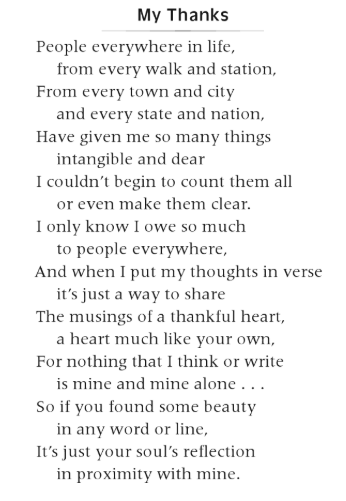
Pat drew great comfort from the American poet, Helen Steiner Rice, and she wrote on the back of one such poem notelet which I found yesterday at school. I’ll close with her poem ‘My Thanks’, which so fits how Pat made her life entwine with all of us who worked with her, and who came to value her so highly as a colleague, supported and friend:


Helen Steiner Rice

Pat is survived by her son Mark, who lives in Manchester, and who cared for her so magnificently during her illness over the past 3 years of her life.


Posted in Possibly related posts | Leave a comment

Correlation and Causation – why Independent schools are not to blame for the success of their pupils!

Over recent months, there has been a growing stridency in the voice of the Labour party and its fellow travellers about the role of Independent schools in England’s Education system. Using the #AbolishEton, the group, Labour Against Private Schools, hopes to persuade the party’s conference in September to commit a Labour government to their integration into the state system, whilst at the same time stripping fee-paying schools of their ‘privileges’. You can read more of that in this Guardian article of 9 July. The Guardian has been carrying quite a lot of anti-independent school copy on its pages for many years, but when independent think tank studies such as this one by the Sutton Trust continue to report that Britain’s top jobs are still in the hands of a private school elite, it does cause us all to take a deeper look into quite what is going on in this ‘education space’ of ours. And of course, last week in comes Boris Johnson, the 20th Old Etonian to serve as our new Prime Minister, and ‘Quod Erat Demonstrandum’ Q.E.D. it must be true.

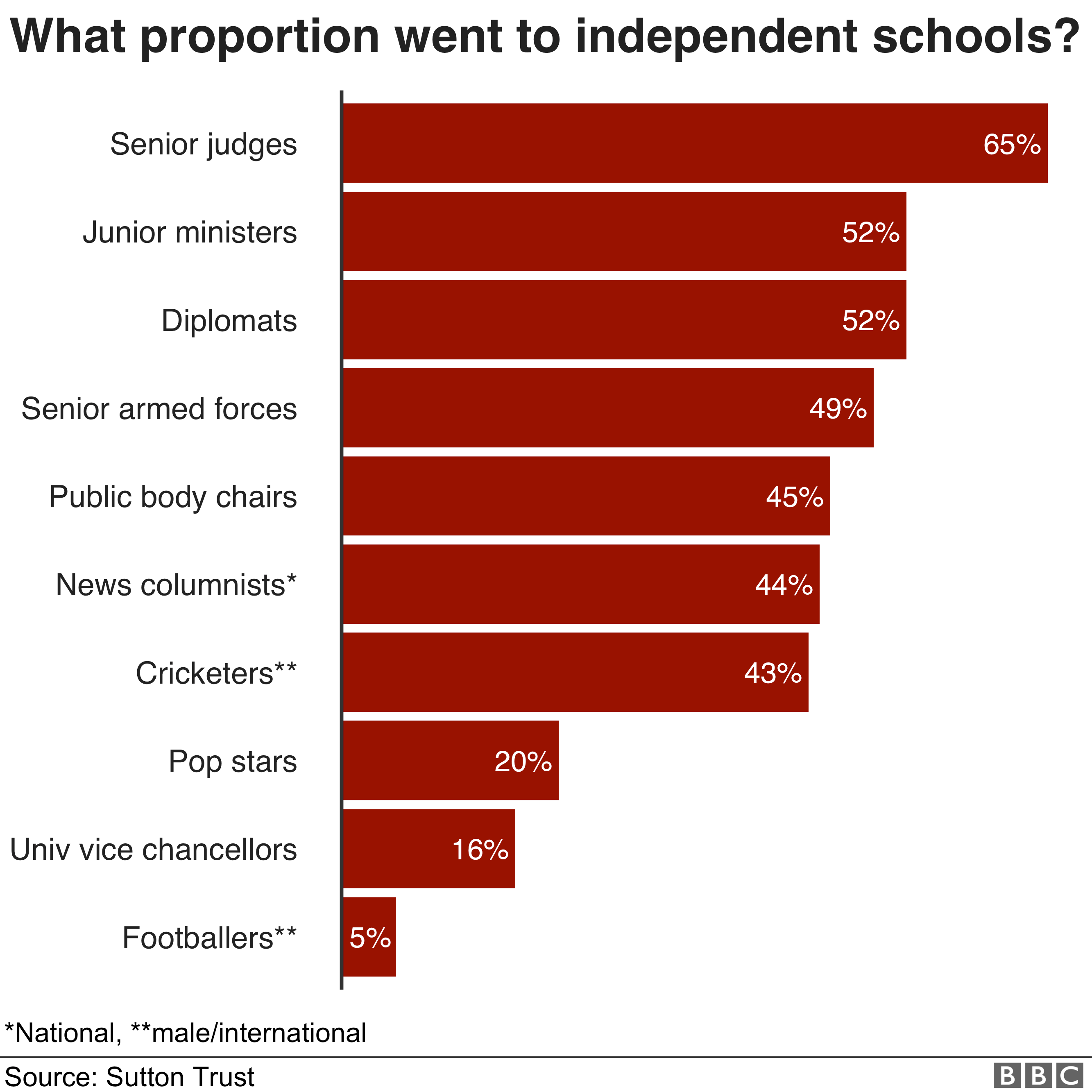
It’s certainly true that Eton has been an utterly extraordinary institution for centuries, endowed as a King’s College by Henry VII, attracting the sons of the mighty alongside poor scholars, and yet, within its walls, ensuring that all were treated with great equality, so that its alumni could then ensure that Eton would ‘Esto perpetua’, translating as ‘May it last forever’. With 300 students a year graduating to the very best universities in the world, it should come as no surprise to anyone that its alumni are to be found in positions of influence. Johnson’s cabinet does have 2 other Etonians (his brother Jo and Rees-Mogg Esq.) plus a total 64% of other ministers independently educated. Take a closer look at the England Cricket or Rugby sides, and it is apparent that independent schools more broadly have been developing talent disproportionately more successfully than one might expect of their apparent 7% hold on the country’s population. The BBC summarised the Sutton report in this area well, the graphic below from their report:

My school at 59 years of age, with now circa 100 boys and girls graduating a year from GCSEs/A levels, tracks the success of its former pupils with interest but not forensically, though anecdotally we can certainly see they represent well on departure the qualities of ambition, collegiality and stickability that’s needed later on in life, and their track records subsequently look very encouraging and magnificently diverse. It’s interesting to note that the few of our best footballers that appeared good enough to make it in that sport have had more options than just football, with other sports and higher education seeming more alluring and open as routes. Swap sport for music, drama, the arts, and it’s clear our best have gone on to thrive, build commercial careers, win glittering prizes and awards. Or indeed, stay resolutely academic and reach for University, Doctorates and beyond – CC alumni are there too. In short, the block chain works well – enter Independent Education, gather the academic, social and collaborative skills needed to get on in life, and guess what, you will.

Behind every child to be found in an independent school, and you find a family deeply interested in the school being the right place for their child and getting the best out of them. Throughout my professional career, I have seen successive governments (Labour and Conservative) shift the focus of the state sector from providing a full, broadly facilitated education to one that is only required (and therefore funded) to cover academic subjects in the classroom. As I look at our plans for a new campus to be considered by the RBWM planners at the end of this month, we are clearly not just seeking to cover a narrow academic core. Apart from a rather obvious centre of excellence for regional hockey, the buildings cover all the arts, mathematics, sciences, languages, business, computing and enterprise education we could hope for. Who wouldn’t want their child to have such a set of opportunities? The master blueprint though that’s been allowed has not provided any silver spoons or gold taps – but what it does do is declare unequivocally that ‘all of the various skills and talents that a child might have’ will be nourished here.

And therein lies the heart of the reason why ambitious parents might choose independent education for their children; namely to ensure they have the opportunity to test out their mettle and find their spark. And having chosen to make such an ‘investment’, continuing to hold their attention on the child so that the ‘sparks’ are captured and nourished into the flames of a future ambition. If this is the root of why children succeed, that is, the energy and commitment of their parents and wider family to that success, why don’t the Sutton Trust and others just come out and say that? I’m not blaming the Sutton Trust or others for that matter for being ‘lay journalists’, indeed the founder of the Trust, Sir Peter Lampl actively espouses that the state should fund thousands of place in independent schools in order to “improve educational opportunities for young people from non-privileged backgrounds and increase social mobility.” The truth is that it is government’s place to make the core decisions on funding, and it hasn’t joined up enough over the past 10 years to make this happen. And here perhaps is why…

Last month, Professor Christopher Ferguson* wrote an excellent article on Bad Data Analysis and Psychologies Replication crisis in Quillette, an aggregating website on ideas help human societies flourish and progress. This triggered a commentary on the same site by Professor April Bleske-Rechek, headlining this Crisis in Psychology, namely the willingness of this new science to sensentationalise weak effects and to bias publications in favour of sales of the ideas in question. She writes “That illness is the conflation of correlation with causation, and the latest research suggests that scientists, and not lay people and the media, are the underlying culprits.Last month, Professor Christopher Ferguson* wrote an excellent article on Bad Data Analysis and Psychologies Replication crisis in Quillette, an aggregating website on ideas help human societies flourish and progress. This triggered a commentary on the same site by Professor April Bleske-Rechek, headlining this Crisis in Psychology, She writes “I believe a related, but perhaps less-recognized, illness plagues psychology and related disciplines (including the health sciences, family studies, sociology, and education). That illness is the conflation of correlation with causation, and the latest research suggests that scientists, and not lay people and the media, are the underlying culprits.

This morning I was listening to Alan Johnson, former Home Secretary and minister in the Blair/Brown Labour government of the noughties. Johnson expressed so clearly that the difference in life expectancy of a boy born in 1950 between North Kensington (where he grew up) and South Kensington is 16 years today. That’s got nothing to do with state or private education, and everything to do with the failure of national government to invest in a joined up way in health, education, welfare and social care. You may recall he was the Minister of State for Universities, and introduced the loans-for-degrees we now have. This has been an amazingly important way of increasing the number of disadvantaged students (on free school meals) from 10% (when student grants existed) to 27% today in 2019 (from 31:00 mins). Any English qualified national can apply to University and receive the funding to attend, with the ‘tax’ on their funding being the requirement to pay back in adult life from the additional earnings as they receive them. Alan Johnson was absolutely clear about what needs to happen if we are to see growing social equality in our country, which is for the Prime Minister to take this requirement for society to provide greater social mobility as the core mission of their premiership and cause the great offices of state to bend to the task. Theresa May expressed this so clearly in her opening speech on entering 10 Downing Street, and was thwarted by the confusion of Brexit.

There is a clear correlation that exists between opportunity and success that follows, and a clear model already in the UK that shows how opportunity can be extended, through the generous funding for all that is needed for education to work. Of course, you could just nationalise our independent schools, cut the funding to the bone and watch our excellence whither. Alternatively, wise government would introduce vouchers that entitle any to spend to acquire the education of their choice, a situation that works for higher education, and now needs to enter lower down too. Those vouchers would inevitably not cover the full cost of the education received, but would provide to the child concerned a funded place. As universities have had to seek additional revenue streams, so have our independent schools too, and this requirement would continue into the future. Where state schools are already good enough, and there are so many that are just that, parents would not need such a voucher. But since such schools cause house prices to be so much higher, entry into an alternative independent school would provide other opportunities for parents to consider.

I’ll close with a ‘nod’ to the chairman of the Independent Schools Association, Matthew Adshead, HM of the Old Vicarage school, Derby, who appeared on the Radio 4 Today programme a couple of weeks ago alongside the founder of the @AbolishEton campaign, Holly Rigby, a state school teacher and coordinator of the campaign. Her stance was “There is no justification for the fact that young people’s opportunity to flourish and fulfil their potential is still determined by the size of their parents’ bank balance.” Matthew’s riposte was perfect, asking her to visit his school, and meet with the parents, the postman, the shopkeeper, the hardworking artisans choosing to spend their earnings on their children as they thought best. And therein lies the rub, our parents are everything in our schools, causing the success of their children’s school lives and beyond; we may be architects, designers and such like of course of the opportunities needed, but we but bask in that reflected glory which is of amazing children doing really well. Holly, Jeremy and all, please don’t blame us for the success of our schools, celebrate with us. Don’t let your fury at a Johnson entering Downing Street blind you to the wisdom of another Johnson, one of your own party, who even today clearly is worth celebrating for the actions he caused when in government to improve social mobility.

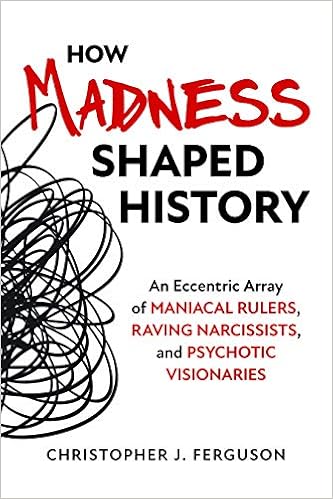
* Professor Christopher Ferguson has a book coming out in January 2020, entitled How Madness shaped History. His tag line suggests an interesting read – “This lively investigation demonstrates that, when conditions are ripe, one unstable individual can create the best or worst moments of a generation or even a century.

With Trump in the White House and Johnson in 10 Downing Street, who possibly has he in mind?

Posted in Possibly related posts | Leave a comment

On Theresa May’s departure as Prime Minister, 24 July 2019

As all will know, Theresa May met with the Queen yesterday to resign as Prime Minister. Mrs May has spent 3 years at the helm of her government, during which time her plan was to ‘Build a better Britain’. On her accession back in July 2016, I wrote an open letter to her, which I commenced with the following words:

Firstly, on behalf of the Claires Court community, may I congratulate you on becoming the Prime Minister of the United Kingdom.  You have been Maidenhead’s only MP ever, since 1997; before then, the constituency used to be shared with Windsor, whose castle of Royal residence for reasons of history and heritage somewhat overshadows our larger suburban town to its north. I watched you speak on the TV on Wednesday night.  You called our country to attention, you asked us to believe that your government will show it has listened to the outcomes of the recent referendum.  Central to your message, you had this to say:

“We will do everything we can to help anybody, whatever your background, to go as far as your talents will take you.”

You can read the whole letter here on a previous blog https://jameswilding.blog/2016/07/14/building-a-better-britain. On reflection, I am quite proud of my writing this time, in so far as I highlighted what I felt could be the key issues for us in our sector over the forthcoming years.

I concluded the letter with these thoughts;

In conclusion, as with so many things, it’s an ill will that blows no good, and the circumstances leading to the self-destruction of both the Cameron administration and the Corbyn opposition have opened the door for your ‘kind’ of administration.  The news tells us you are building a very new government, and we have every faith that you will take this opportunity.  We wish you good luck and God’s speed. You’ll need both of course, and some extra friends in addition from time to time. You know where to find us if you need our help.

3 years on, and it’s difficult not to conclude that whilst there has been much huffing and puffing, actually little has moved on. It may be that Brexit and its works have just consumed so much time to nil effect, hence Boris Johnson and his new team coming in to deliver same in 100 days. Firstly, as is conspicuously noticeable, our own plans to relocate onto one site have still to be heard by the local Maidenhead Planning Committee.

Secondly, education was impressed to have gained Justine Greening as Secretary of State for Education in your first cabinet. To lose her after just 18 months, and shortly after her launch of a plan to enhance social mobility through education ‘Unlocking Talent, Fulfilling Potential’ was as sad a sign of the ‘wrong people being listened to’ as any. None of us could find fault with Ms Greening’s core plan to boost social mobility, indeed her covering statement back in November 2017 says it all still:

“Talent is spread evenly across this country; the problem is that opportunity isn’t. We need systemic change and we need everyone – government, employers, education professionals and civil society – to work together so that social mobility runs through everything we all do.”

Because the evidence still shows that opportunity is not there for all, it’s led a growing number of Labour councillors to call for the nationalisation of our sector into the government’s own schools. Under the #AbolishEton banner, Labour continues to highlight just how over-represented our sector is in the higher walks of life. I’m not going to comment on the suitability of Boris to be our new prime minister, but with 70% of his cabinet independently educated, clearly politics in parliament needs to look for itself anew at the issue of #opportunitiesforall.

It’s fair to say that over the past 3 years, the Labour party itself has not got a grip on itself to good purpose, most notably on its take on Europe and antisemitism. And as it too has chosen to take a tighter grip on its members, spreading further divisions at shadow cabinet level, Shadow justice minister Gloria De Piero resigning last week from Corbyn’s frontbench team over party’s ‘lack of tolerance’. Ms De Piero is like Greening a shining example of social mobility in action, and one whose career is worth watching for the future.

3 years in politics is of course a long, long time. Sadly, in the history of Crossrail, it’s not long enough. We had been promised that our speedy links to the city would open last year in December 2018, and we now await its opening by 2021. We were also promised its budget would also stick to initial announcements (£15.4billion), though sadly, at least a further £2.2 billion pounds needs to be found to ensure the project is completed. What might £2.2 billion pounds buy if only the contractors had kept on budget? I’ve become a fan of the National Numeracy website, and via one of their articles understand perhaps we could have 4 more frigates to enhance our Navy. It’s certainly the case that over the past 3 years, the national estate has sadly deteriorated further, with the military, judiciary, education, health and social care all crying out for additional spending on this scale now.

I welcome Theresa May’s attention back on our constituency solely once more. To her enormous credit, she has not ignored Maidenhead at all during her premiership, but it sadly has ignored her ambition of 3 years ago, to build a better Britain here in SL6. We still don’t have a borough plan (due 2013), and whilst the town centre is now being rebuilt, we don’t have the housing, highways and social infrastructure needed to support a town of such importance where so much more physical growth is required. The council is still of Conservative hue, but it has a narrow majority only, and we will need all of her experience acquired over her time in Downing Street to build a consensus here for the future.

Posted in Possibly related posts | Leave a comment

Principals’ Blog – end of Summer Term 2019

The following blog was published to our parents and community on 12 July 2019.

A year ago at this time, I was writing to parents in such a newsletter, briefly, about the challenges facing the English Football team, just after they had lost out in the Semi-finals of the World Cup, and about our Prime Minister & local MP, the Right Honourable Theresa May. Twelve months on, and I see that the headlines carry fresh stories of an England Football team losing at the same point, and Theresa May still struggling with her colleagues in Parliament. Dear Reader, please forgive me now that I do not reference matters of school, national or indeed international importance; I have become deeply superstitious over the past year, and fear that I can ‘jinx’ almost anything. For those unfamiliar with the verb, I rephrase the definition found in the on-line ‘Urban’ dictionary:Jinx

  1. Verb – To unintentionally curse someone or something by paying attention to them/it and in so doing cause bad things to happen to them/it in the near future.
  2. JTW speak* – And to cause it to continue in like manner for ever onwards.

N.B. *Brexit being an example.

That’s not of course that I cannot speak well of great things that have happened in the recent past, or indeed the current moment, so at least I can do that, and do so with great pleasure.

We have a number of wonderful teaching and non-teaching staff leaving us at the end of this term, for retirement, for pastures new or indeed to take up a well-earned place at University. They include Hugh Wells, who retires at the grand old age of 89, whose service commenced in 1986 as our Director of Studies at Senior Boys and for 18 years has been coaching Maths GCSE for two days a week to older boys and occasional Sixth Formers. As Hugh is 90 this August he felt it time to retire completely with his wife Jenny, thus ending one of the epic tenures here at Claires Court!

Eric Leuzinger’s career at Claires Court began as a pupil back in the 1970s, when I taught him Science before his departure to the Royal Grammar School at age 13. Welcoming Eric back as a teacher 20 years ago felt like welcoming back an old friend; looking after his son’s, Jake’s education for 9 years has given me an even greater respect for Eric’s qualities as a mentor for boys becoming men. He retires as Deputy Head Operations this summer to enjoy a little more time with his wife and hobbies, including fishing. Also laying down their toolkit are Linda Carter, Junior Boys Maths teacher, whose husband Alan introduced a young Dean Richards, now Head of Junior Boys, to the noble game of rugby. Linda’s skills as a Maths teacher has caused many positive breakthrough moments in Juniors, inspiring all that they could do Maths. Cameron Denton also leaves Junior Boys after 8 years with us as a teacher, gaining his BSc in Coaching Science and PGCE en route, following seven years as a pupil. Cameron’s a much loved holiday club key worker, so we’ll still see him there this summer, as he seeks coaching roles in the corporate world. Mother and son Linda Hine, teaching assistant, and Matthew Hine, gap student, also leave Junior Boys with Matthew looking forward to his degree at Kent University.

Nick Lee leaves Senior Boys for an academic role leading Humanities at Long Close School, after a superb 7 years of History teaching, rugby coaching and pastoral leadership of Year 11. Alice Nutkins is another former pupil who has qualified to teach with us after taking her degree in Psychology at Plymouth University, moving on to spend next winter snowboard instructing. Patrick Meaney, our digital guru at Senior Girls steps into retirement too, along with Julie Nicholas, SENCo and fount of so much wisdom on additional learning needs for both parents and pupils.

Lelo Wright has been our first EAL teacher across all 3 sites for 20 years now, and retires willingly into grandmother-hood. Lelo has made so many friends amongst our international families, by assisting their boys and girls in their first steps in English on arrival here for school. Leaving administration is Debbie Parker, who has fronted house at both Junior Boys and at College Avenue so capably for 8 years. Sandra Young has looked after our dining room and outdoor duties at College Avenue for an amazing 35 years, and we’ll certainly miss her kind smile and watchful presence in the autumn. Also departing are Franklyn Hamilton, rowing assistant; Jack Hill, Junior Boys sports instructor; Cheryl Lawrence, Junior Girls higher level teaching assistant; Annabel Pearce, Junior Girls gap student; Arunjit Samra, Nursery assistant. In their own ways, all have contributed brilliantly to the success of Claires Court, and we wish them well with their future careers and university courses.

For the many staff, pupils and parents who will still be with Claires Court in September, I extend my most grateful thanks to you all for all of your hard work, and hope that we can continue to rely on the same in the autumn. In the meantime, it seems that almost nothing is predictable anymore (except that it is unpredictable), so let’s reach out and follow the Dalai Lama’s own words:“Bekind whenever possible. It is always possible.”

New Campus update

From the Administrative Principal, Hugh Wilding.

My brother couldn’t have fed me better words to describe the slow but sure progress that we have been making with our partners, Maidenhead Hockey Club and Berkeley Homes as we have worked patiently with the planning function at the Royal Borough of Windsor & Maidenhead to ensure that we have dealt with all their questions and provided the many answers required.

There have been several “false dawns” to date, thus placing me in the same “jinx club” as my brother and covered in embarrassment, but at last there seems to be some real indication that a decision will be taken before school returns in September.

Clearly, we will make the best case we can to the panel that will determine our applications, and of course we can point to the positive responses from the likes of Sport England and the “no objections” on highways grounds and from elsewhere. Most of all, we can show the overwhelming level of support for the new campus that pupils, parents, staff and well-wishers have already recorded via the RBWM planning portal. A reaffirmation of that support may be very helpful and to that end, I would ask that you keep a close watch on the usual channels of communication from the school as the summer unwinds.

One supporter is the Leader of RBWM Council who today posted on his Twitter account “…I fully support the planning application and wish this fantastic school all the best for the future.” That is very kind of you, Mr Dudley!

Posted in Possibly related posts | Leave a comment

The missing 50+% of data; why schools need to worry about more than the ‘easy to measure’!

It’s been a tough term so far for the blogger in me; writing the weekly roundup for the Senior Boys school under time deadlines seems to kill my muse for other writing. In addition, creating new assembly material that threads the boys’ & girls ambitions, hopes and dreams is also a great challenge, because it is only as they reach the latter end of term can you and they actually see their hard work come to fruition. I could here be speaking of the academic results they are achieving in their summer exams, though equally it could be of their artistic and sporting endeavours too. Currently my teaching colleague are crafting the pupils’ annual reports to celebrate that has been achieved in school, whilst in competitions at regional and national level, we begin to see the ‘writing’ too, this time the sports men and women adding their names to regional teams or winning entry to the finals out right. We have 2 boats prequalified for Henley, the first time on our Rowers’ history. The male and female tennis teams have reached the National Finals in Nottingham in early July, again a school first. The sailors have just completed their national dinghy championships, respectably placed in the top 10 in their respective Feva (younger) and Firefly (older). We have 2 teams in the Country cricket finals on Wednesday, and our ISA London West team members have learned today that they were the leading school component in our area from the national organisers.

By any measure, this summer’s sporting achievements look quite extraordinary for any school, though I have learned to treat such vanity as the imposter it is. Parents seeking private school are careful in choosing a school that’s a best fit for their child, and the ambition they have assists in driving their children onwards. That’s not say our people are pushy, actually far from it. But what we and they seek in common is to promote and support the development and interest in excellence, and the sports lend themselves to building skills and passion in abundance. 2 of our cricket sides have made the county finals, and the under 13 site are to be congratulated for winning their final yesterday; it’s one thing to nurture cricketers, quite another to ensure the ball bounces the way you wish on the day – witness the current perilous position of the England ‘favourites’ cricket squad in the World cup round robin currently being played.

I’ve been recently reading a great book by Michael Blastland, entitled “The Hidden Half: How the World Conceals its Secrets”. Here’s the marketing puff that encouraged me to buy it: “

Why does one smoker die of lung cancer but another live to 100? The answer is ‘The Hidden Half’ – those random, unknowable variables that mess up our attempts to comprehend the world. We humans are very clever creatures – but we’re idiots about how clever we really are. In this entertaining and ingenious book, Blastland reveals how in our quest to make the world more understandable, we lose sight of how unexplainable it often is. The result – from GDP figures to medicine – is that experts know a lot less than they think. Filled with compelling stories from economics, genetics, business, and science, The Hidden Half is a warning that an explanation which works in one arena may not work in another. Entertaining and provocative, it will change how you view the world.

I’ve been using one of the stories from the books in my Assemblies recently, that of the Marmorkrebs, an invasive american crayfish sweeping through Europe and eating everything in its way. You can read more about its effect here: https://blogs.scientificamerican.com/guest-blog/the-decade-the-clones-came-beware-the-mighty-marmokrebs/

Blastland’s highlight of the marmorkreb though is for other reasons, though linked to the genetic DNA of this wee beastie. It turns out that identical Marmorkreb populations kept in similar tanks and looked after by the same researcher in identical ways rapidly diverged in terms of physical size and morphology. Now that should not happen, because what generations of Twin studies have shown us is that what we do and how we behave is a mix of environmental and genetic factors, and since the genes of these crayfish are the same and the environment has been the same, then the offspring should be the same. Far from it as Blastland’s Marmorkrebs are concerned, one set not just growing much bigger than the other but their internal organs decided to change in layout etc. quite dramatically, providing compelling evidence for Blastland’s proposition that much of the data we need to explain how stuff happens remains hidden from us.

And there is plenty of other research now surfacing that is confusing the Department for Education in its drive to raise academic standards in schools. A co-authored study between the Universities of Adelaide and Bristol, published last November, has examined long-held beliefs that success in school and careers is due to more than just high intelligence, and – guess what – “Non-cognitive skills are also important”. The problem with the research around this topic is that it simply hasn’t been good enough; it seems we know that much of what we need to have done to improve the brain’s cognitive function needs to have happened by age 12. Working children academically is important to raise the measurable cognitive levels, but we also have to raise the non-cognitive too.

Professor John Lynch, School of Public Health, University of Adelaide is senior author of the study and has this to say: “Traits such as attention, self-regulation, and perseverance in childhood have been investigated by psychologists, economists, and epidemiologists, and some have been shown to influence later life outcomes. There is a wide range of existing evidence underpinning the role of non-cognitive skills and how they affect success in later life but it’s far from consistent.” In short, the problem with focussing on Key stage 2 outcomes in Literacy and Numeracy and rating primary schools as good or outstanding on same is clearly going to affect the school’s curriculum provision – why spend on the arts, music, drama or physical education when these don’t lead to improvements in ‘measurable’ school performance.

The Independent Sector continues to be berated for the apparent domination it has over the leading figures in public life. One of the most influential Education think tanks is the Sutton Trust, and its tudy, Elitist Britain, was puboished 2 days ago, having looked at the schools and universities attended by 5,000 high achievers at the top of business, politics, the media, public organisations, creative industries and sport.

I quote from the recent BBC article on the report:

It might not be a huge surprise that the upper ranks of the judiciary, the diplomatic service, the armed forces and public bodies are stuffed by a disproportionate number of former public-school pupils. But it might raise an eyebrow that today’s pop stars are more likely to have gone to private school than university vice-chancellors – 20% compared with 16%. For the purposes of this survey, a “pop star” is someone from the UK who has had a top 40 selling album in the past four years.

This echoes warnings that the creative industries, once an express train of social mobility, are increasingly becoming populated by the offspring of wealthy, well connected parents. But pop stars are out-poshed by international cricketers and national newspaper columnists, defined as those covering news, politics and policy rather than other “lifestyle” writers. In terms of the overall “power gap”, the report says 39% of people in these elite groups were privately educated, compared with 7% of the population.

I listened to Sir Peter Lampl, founder of the Sutton Trust speaking on the radio about their findings, and the point he makes so clearly is that it’s not the ‘private school’ per se that is making the difference, but the provision of a fully rounded education therein that’s leading to this effect, which can only grow and extend if our state schools are not funded to do the same. Here’s a linkn to that morning’s BBC Radio 4 Today Programme, featuring Sir Peter Lampl, chairman of the Sutton Trust, and Scott Baker, head of LAE Stratford. Listen from 50:43. As Mr Baker makes clear, the London Academy for Excellence is proving that great state schools can do great things if the resources are provided, but as state schools have to cut to make budgets work, then excellent outcomes in all fields is going to be compromised.

Causation is not the same as correlation, and as Blastland’s book reminds us, many of the influences that make great things happen can’t be accounted for. But it remains a sobering thought that schools must set out to inspire their children to love being alive and to value the things they are good at and encourage them to excellence in as much as possible. Children in poverty living within reach of the spires of Oxbridge and the City do just that, surrounded as they are with the evidence that great things happen. Out in more rural parts of the UK and elsewhere, without that inspiration being visible, children’s aspirations are quickly curtailed to those that are practically possible. In the heartlands of the States, perhaps the only route out is via the US military, not the kind of binary choice I have chosen for my children it must be said.

The various Arts, Drama, Music and Sports festivals in our school are now well under way, and compete with everyone’s time in equal measure. The A level Art, Photography and textiles exhibition of work ‘academic work’ created to satisfy the examination boards seems to have done both that and inspired its audience of visitors. The range, riskiness and invention of the artists is so clearly there to behold; students have taken the opportunity both to meet ‘criteria’ and challenge themselves and their audience with their chosen approaches and media. Perhaps like our athletes, cricketers, rowers and sailors, they simply couldn’t have dreamed of achieving such standards 5 years or so ago, but given time to breathe, absorb and understand the possibilities available through disciplined hard work, they too have excelled beyond imagination. And that’s the point of working so hard to provide within education – provision is not everything, but it does provide the ‘lifeblood’ we can bottle and pass on from one generation to the next. And that has a cost, both in terms of money and time, one readily measurable, the latter often defeating the former – children need time more than anything.

Posted in Possibly related posts | Leave a comment

Children v Choice, at the heart of the mental health crisis 2019

I have just spent the day at the University of Kent, in the company of a range of distinguished secondary school heads as part of our sector’s work in keeping up-to-date with Higher Education and their challenges, as well as reviewing the in-house work our sector is commissioning to ascertain the ‘facts’ about HE and life beyond Sixth Form are suitably researched and reported, both to our sector and the wider community, and as appropriate, the National Press.

On the way to and fro Canterbury, I am engaged in the usual chaos that secondary school leaders know well, responding to and discussing solutions for, the usual challenges that a headteacher faces in their daily lives. The radio on occasion is on in the background in addition. This channel-surfing head is learning across the bandwidth of private and public airwaves that actually ‘life as we know it’ is ‘not quite as we would wish it to be’! I am required to authorise (personally or by proxy) some ‘hatching’, ‘matching’ and ‘despatching’ decisions the airwaves are demanding of me.

  1. One of our Y11 pupil has chosen to release ‘shit’ perfume in the main teaching wing, making it almost unusable.
  2. Police and parents report that one of our secondary children has ‘rebuffed’ an approach by an unknown adult female to ‘give her a lift home’ last night.
  3. Danny Baker has ‘tweeted’ a picture of some adults hiding a smartly dressed ‘chimp’ – he’s been sacked by the BBC, what do I think?
  4. Liverpool and Spurs make up the all-Brit Euro Cup final; will Arsenal and Chelsea make it an all British affair for European football trophies this year?

Imagine a Joint Council for Qualifications (JCQ)* exam paper 2019 on the above: In the four questions above, some of the questions that need answers are important, and some are urgent. Discuss?

*JCQ have written to all of its public examination centres this year on so many occasions, and visited them as well, to remind centres and subject leaders of the challenges to be met this summer:

  • No cheating by children or adults will be tolerated (plus lots of stuff on connectivity, information sharing etc.)
  • None of the difficult stuff you see in the exams this year will be seen ever again – get used to that!
  • Exam papers have been stolen and otherwise compromised, send back the ones you have got and we’ll send out replacements.

My normal day is spent in such utter chaos, not inflicted by myself or my colleagues or even my school. As I sit in my car near the M20/25 interchange, stationery in the seasonal but now unexpect torrential rain, my brain joins the above up with my ‘urgent preparations’ for Year 11 assemblies tomorrow, a.m. with the rest of the school and p.m. with their parents. Obviously we have way more happening in the background than this; both within a school community of 1500 and as part of the national care and education provision, your average headteacher in mid-May is thinking Budgets, Salaries & Pensions, Staff and Pupil recruitment, Calendar for school events and Staff Professional development, juggling the former with the urgent listed above (and beyond).

Children used to enter secondary school at 11, 12 or 13, and then (whether able or otherwise be then in the same school or other provider for 7 years of 5 + work/apprenticeship. ‘Nuff said.

Now, the 10 year old is presented with choices for 11+ entry. Ofsted grades and greater mobility encouraging further movement at 13+, 16+, 18+, plus the above and all of the rainbow of media info that they receive via social media. Children from an even earlier age are presented with a kaleidoscope of apparent opportunity with which they have no option other than to engage,

What chance do they actually have of surviving in this world in which parents and the wider world present them with choices with so many opportunities to fail? Almost more serous is the climate of fear and flight provided by national and world news bulletins for their information and education. As Simon Sinek makes utterly clear, all the important questions are about ‘Why’; given most of the above demand answers shaped by responses of ‘How?’ and ‘What?’, it is little wonder that our adolescent generation are in such a whirlwind of confusion and unwell-ness.

As I come to the close of this short blog, I see that Chelsea have been pegged back to 2-2 by Frankfurt, but Arsenal have 2 away goals now in the bank. 30+ minutes to go and all remains to play for. Adult or child, all I can be is a supporter and go-with-the flow. There will be tears of joy and disappointment after tonight, depending on which side you support. But life will move on, with a high degree of certainty that the ‘fan’ will remain the ‘fan’.

Children face failure to access their ‘choice’ at 11, find subject choices at 14_ are becoming illusory as Ebacc requirement replaces opportunity, that ‘move at 16’ becomes a prevalent state of mind for ‘subjects’ that ‘suit the learner better’, and that apprenticeships have reduced from 4/5 4 years to 1 as a bare maximum.

It’s time to recognise that we have destabilised almost completely the adolescent years, to no good effect. We need to restabilise the whole landscape; our children need recognisable stability in their environment for years not months, and assessments and examinations that fit a ‘norm’ not an exception.

Choice for us adults has catastrophized the last 10 years or more. High Streets (and the employment that goes with that) bear witness to how change causes much damage. The ‘Brexit’ referendum has not just ‘blocked’ the rest of government, but ‘broken’ our sense of ‘fair play’. Austerity has eliminated most of the flexibility that care, education, health, policing and public authority used to have, leaving a ‘lottery’ in its wake. I want our children and our children’s children to have opportunity lying in wait for them as they enter adult life, as it once did me. They just don’t need to be damaged by ‘false’ consumerism before they are mature enough to choose.

Footnote. I know many who read my words also know the ‘news’ that informs my writing. In case you don’t, please read this article, which is not about my school – https://www.tes.com/news/exclusive-schools-mental-health-crisis-out-control

Suffice it to say, that the challenges reported above are challenges I recognise too, and am dealing with really too regularly.

Posted in Possibly related posts | Leave a comment

100 days back at the helm, and no turning back.

Lent Term 2019 has whistled through the first 100 days of my return to Headship. I’ve had some key priorities, not least to establish my credentials anew as Head of Senior Boys to parents, pupils and above all staff, as being a school leader who knows how to ensure important priorities do not get displaced by the urgencies of daily emergencies. So many things have gone well, at both the individual and group level; we’ve had some spectacular successes at the academic level, from very strong Maths GCSE results to engagement with subject challenges at department level.

Unlike most new headteachers, it is not as though I was entering anew into unfamiliar territory, far from it. As Academic Principal, it’s been my responsibility to forge consensus amongst my fellow heads as to our academic policy and priorities, so I’ve always been very aware of the limitations of same when confronting the practicalities of daily life and pragmatism of actually what’s possible. What a headteacher does so much more obviously than Principal or Proprietor, is set the daily tone and temperature of the school, and I have thoroughly enjoyed re-establishing in the minds of so many that they are capable of achievements beyond the stretch of their imaginations.

In part I have done this by 2 separate photo-galleries up our main staircases, one being a changing mix of former pupils found doing their favourite things, the other being an evolving series of photographs of current pupils reaching new heights of achievement. In academic terms, we’ve learned a lot about dual coding in recent years, for example mixing text with images for more effective revision. But schools rarely use the same technique to draw adults and children out of a generic ‘fed-upness’ with school, and yet successful motivational speakers use this technique all the time. A great illustration of this was shown by Mr Wespieser of World Book day, when he combined the key thoughts on the importance of reading for adolescent boys with their singing of the ‘Library card’ song –
https://www.youtube.com/watch?v=MuLZKsFho5A . OK, it may not have been musical, but to all present on the day, we had clearly and successfully regressed senior boys back to a love of reading!

I’ve sat in on homework coaching on Wednesday evenings and run some Saturday morning detentions too, and it’s clear to me that all of the boys do value the opportunities on offer at Claires Court, though on occasion need the additional support that they have ‘volunteered’ for, so they can make amends and set their record straight. Sport, the co-curricular trips and after school activities also assist in broadening out the demands of skill development for educational success, whether that be in meeting the physical demands of Rowing’s Sheepdog trials, or creative challenge of writing poetry for a national audience. The end of Lent term Commemoration service was the most powerful exhibition yet of the school’s artistic strength, perhaps best exemplified by the dance routine developed by Joe and Caitlin Freeman’s evocation of the recruitment of a young soldier to arms and his subsequent death on the front line (http://schl.cc/4D).

I conclude this blog as the 2nd week of the Summer term comes to a close. As with many of my staff, over Easter and beyond, work has continued apace, and we’ve had loads of extended trips out, to ski, for netball, for watersports and under canvas for those completing expedition sections of the DofE. Holiday activities have busily rattled on at school too, providing relief for working parents who don’t have the right to break for school holidays as perhaps they might wish. I have my fingers crossed for the next few weeks, in part because we await the new local government to come into post after RBWM elections as a result of this Thursday 4 May elections. That new set of councillors will be charged with determining our planning application for our new campus, and we really can’t hold our breath for much longer! I wish Mr Simon Dudley and the new team at the Town Hall the very best of luck. By the look of the close run election victory won, the’ll need it.

Posted in Possibly related posts | Leave a comment

Elective Action, ‘Having a care, Making a difference’

Return to work after the February half-term break always see the Claires Court community turn itself ‘towards doing good for others’. This pattern of activity harks back to our life as a ‘Catholic’ school, during which time we incorporated the solemn period of religious observance known as Lent. Ash Wednesday services here saw many boys and girls carry a smudge of palm ash on their foreheads, a sign of our mortality carried to remind us that as humans we come from dust and to dust we will inevitably return.

Lent forms an integral part of many Christian churches, across west and east, ‘modern’ and ‘orthodox’. The 40 days that follow are expected to be filled with ‘fasting and prayer, doing penance, mortifying the flesh, repentance of sins, almsgiving, and…’ in my childhood the self-denial incorporated the loss of sweets/chocolate for the children and alcohol for the parents, though not on Sundays, a universally agreed rest day from the purgatory of abstinence.

If this was my experience as a child of the sixties, and still very much one as a head on the eighties and nineties, I have found as I make my return as a headteacher footsoldier at the end of the Teenies, that an adolescent’s view of terms of sacrifice and service seems very, very different. Perhaps encouraged by 3 decades of Comic Relief, Pudsey Bear and other ‘giving Gigs’, abstinence & penance has been swapped out and replaced by ‘giving with a smile’. In short, ‘having a care’ has become ‘FUNdraising, with the emphasis on the personal gratification arising from lots of ‘jolliness’.

Not being by nature a gradgrind, I’ve been trying hard to notice whether my own adolescents have fallen into this self-indulgence, to which the answer is probably – ‘easily done’. And yet, I am indeed very heartened by the choices that they are making to raise issues and agree action-based support for causes deserving of notice. I’ll not cover the whole piece with this essay, but just commence with describing some remarkable work arising in Year 12 and 13. Inspired by last year’s school support of the ISA school in Pong Tek, Cambodia, this year’s Sixth Form have decided to establish a school-based project out in the Gambia. They have put together a video, first rush of which is here:

It seems to me that the younger pupils remain pretty selfless, being readily willing to share and give to others, lessons learned through the effective socialising behaviours of early infancy and nursery. And these Sixth Formers seem cut out of the same mould, perhaps because they have grown through that period of time from ‘tween to early teen’ in which ‘vanity’ becomes apparently something children these days are permitted to catch. Perhaps they need to, rather like chickenpox, so they become immune to it later on, but I’m not so certain, because the characteristics of the vainglorious once learned are hard to lose.

So here’s my pitch for 2019, we need to encourage children of all ages to worry a little bit more, to get cross about some small part of humanity’s ‘stakehold’ which doesn’t feel fairly distributed, and then work with them so they can learn how to make a choice of action to take and then do just that ‘something’ that will make a difference. This will require us as adults to get out of our comfort zone too, so I am not talking about ‘making sure your coca can is recycled’ in the correct trash can. Over the generations I’ve seen so many local initiatives come to successful fruition, most notably the Alexander Devine Hospice (a place) and Kids in Sports (a service). If we don’t clear the waterways of Maidenhead, who will?

Waiting lists for Cubs and Scout groups grow by the yard, because we don’t have sufficient adults finding the time to become suitably qualified. It may be that their time has come and gone (I don’t think so), but it is true that here at school we are tweaking the Year 9 programme to ensure all the boys and girls have the opportunity to pursue the Duke of Edinburgh’s award at Bronze level, squeezing out a bit more juice from what we do to ensure our young people learn that volunteering and acquiring new skills and being uncomfortable under canvas and expeditioning for 2 days without the internet are actually fun things to do.

If we get this right, all 110 of our 14 year old cohort will gain the widest-ly recognised starter qualification in leadership in the World. Here’s the DofE peeps writing about this from their website:


“Global expansion over the last 50 years has enabled the Award to reach more and more young people. Today there are over 130 countries and territories delivering the Award – 63 of these on a national basis. However, the Award is now expanding in other ways, targeting those who have not previously had opportunities to develop themselves. Recent Award projects around the world have focused on involving young offenders, those with disabilities, street kids and aboriginal communities. The impact of the Award on many of these young people is extraordinary: it transforms their lives.

The spread of the Award across the globe is testament to its universal appeal and the vision of its founder. However, even HRH admits that this took him by surprise:

“When the first trial of the Award was launched in 1956, no one had any idea quite what would happen. In the event it was an instant success, and the Award has been growing and expanding worldwide ever since.”

What’s not to like?

Posted in Possibly related posts | Leave a comment

Will commentators with their obsessions about exclusivity ever wake up to reality?

This week’s blog is written not by myself, other than this introduction. Lord Lexden is both a personal friend and one of our school, and of both our association and the Independent Sector as a whole. Below is his letter, published in the Spectator yesterday, which really needs no further explanation nor amplification. Take away, Lord Lexden…

Sir: Those who write about independent education rarely manage to stray beyond the 200-odd establishments they love to pillory as public schools, an antiquated term long since abandoned by all save their critics. This is perhaps because they have usually been educated at such places, or have taught in them. Alex Renton, like the books he reviews, presents a caricature of independent schools as a whole by repeating well-worn charges against the well-publicised few with their ‘faux-Gothic spires’ (‘Old school ties can’t last forever’, 2 February).

The Independent Schools Council has some 1,300 members, varying in size from 50 to 1,700 pupils. Few possess lavishly equipped theatres or vast playing fields. Just 68 have top-class athletic tracks. Most of them stand at the heart of the local communities from which their students mainly come, and work closely with their neighbouring state schools which often share their (usually limited) facilities. Half of them are non-selective. Fees vary greatly, with an average gap of some £2,000 per term between schools in the north and south of the country. More than a third of families pay reduced fees. Parents are well aware that diversity and openness are the independent sector’s most striking characteristics today. Will commentators with their obsessions about exclusivity ever wake up to reality?

Alistair Lexden
General Secretary, Independent Schools Council 1997-2004
House of Lords, London SW1

Posted in Possibly related posts | 1 Comment