
Thursday’s headline on the BBC Education page online led with this: Ofsted warning over 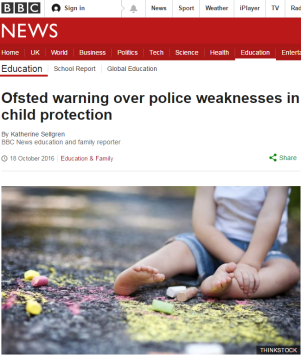 police weaknesses in child protection. HMCI Sir Michael Wilshaw in writing to the Chief of Constabulary, Sir Thomas Winsor, said there were cases where police officers had failed to attend key meetings about child protection or visits with social workers. In a number of forces there were delays in flagging up domestic abuse cases to the local council. In one case, an Ofsted inspector questioned a police decision to close a case even though “there was clear evidence that the children concerned had suffered non-accidental injuries”.
This week’s blog is not out to lambast anyone specific, be that the Police, the Judiciary, local authorities, or indeed public service in general. But I can’t help notice in my contact with the various public bodies and statutory authorities that austerity measures are having a dramatic and negative effect on service delivery and the ability to have human interaction with professionals. This is evident at local authority level, where there seems no longer any redundancy staffing built-in, such that when a key worker goes on leave for whatever reason, you have to await their return. Further more, as unitary authorities outsource services to other authorities and agencies; in our case for example, legal services and building control already sit with Wokingham, and children’s services are due to move to Achieving for Children (AfC), a community interest company originally set-up to service another Royal Borough, that of Richmond.
I don’t doubt that accountability structures can be put in place to ensure the citizens of Maidenhead continue to be well served, but as with all kinds of franchise delivery, the problems don’t a rise until the service begins to fail. Commuters on the Paddington line might be happier now we have lost FGW and gained GWR, but down on Southern Railway, their well publicised chaos continues unabated. If things could get worse down there, recently the service has announced a further reduction in timeable by 15%, so that, as Southern states, without any hint of irony, that these cuts will provide their “passengers [with] more certainty”. In a very clear editorial in ‘The Conversation’ this summer, franchising in rail is given a very strong ‘pasting’, and whilst I am not an expert in train lines, it does seem to me that failure there is made much more difficult because of the industry’s fragmentation.
Education is a people-based business, and sits within Children’s services more generally. The mantra for the last 13 years has been that ‘Every child matters’, and none of us doubt that here at Claires Court. In the machine age

IBM Watson avatar
, where computers are replacing humans in so many ways, it might seem realistic to see how artificial intelligence can be used to replace the human previously employed. What’s interesting is that, since IBM’s Deep Blue beat Gary Kasparov in 1997, that match being the first defeat of a reigning world chess champion to a computer under tournament conditions.The Deep Blue project inspired a more recent grand challenge at IBM: building a computer that could beat the champions at a more complicated game, Jeopardy! Over three nights in February 2011, this machine—named Watson—took on two of the all-time most successful human players of the game and beat them in front of millions of television viewers. The technology in Watson was a substantial step forward from Deep Blue and earlier machines because it had software that could process and reason about natural language, then rely on the massive supply of information poured into it in the months before the competition. Watson demonstrated that a whole new generation of human – machine interactions will be possible*. As the IBM Watson website makes clear, “Watson is a technology that understands all forms of data and reasons and learns at scale”.
The trouble is with this second industrial revolution that we are in, in which humans are not able to handle data as well as machines, it’s so easy to implement cuts by losing the humans, because the machines can give everyone the semblance of things working normally when all runs well. The Docklands Light Railway is an excellent example, and no doubt soon so will self drive cars prove more than a match for city traffic. But for ‘flow’ to work successfully, conditions must be normal, and have pre-set boundaries that are difficult or even impossible to break. In children’s services, everything is variable, and there are simply no fixed constants at all. Specifically, homes are no longer nuclear families with extended support from families nearby. Housing is no longer a given, and worse still the minds of both adults and children no longer work in predictable ways. In my first 10 years of teaching, I don’t recall hearing ‘issues about adolescent mental health’ but my goodness me, it was self evident that teenage boys were not as assured and confident as their female peers. Matters have deteriorated heavily in more recent decades. and now parents with children under the age of 10 are consistently finding their children showing significant signs of anxiety. As recent NHS statistics show, a quarter of a million children under the age of 18 were in contact with mental health services in June 2016.

It is interesting to note from the graph that there are more boys than girls struggling across 3 of the 4 age ranges. The trajectory for the 2 genders is very different, with boys later cognitive development meaning that some boys don’t develop the coping strategies as readily as girls in the younger years. As pressures mount so the girls’ coping strategies break down, and an ‘explosion’ in problems in the adolescent years arise, whilst the boys problems don’t get worse. At Claires Court, this probably explains too why we get a greater interest in our more intensively staffed provision for boys under the age of 11; parents being made very aware by their own sons from quite an early age that all is not well. Honestly, I am pretty certain that we get too much of the wrong diagnosis of ‘learning difficulty’ for boys at an early stage, with the actual issue being anxiety and subsequent misaligned coping strategy giving rise to the problems seen in the classroom. Give the same young boy more support, effective hands-on learning, more physical exercise focussed on sports, more collaborative and engaging activities and the ‘learning needs’ readily diminish if not ‘vanish’.
Perhaps as I have demonstrated, all the above ‘Big Data’ handling feedback means we can more clearly identify problems and trends, but only so long as we have the ‘intelligent’ human to hand. What we have learned even more from the Watson experiment is that whilst machines can always beat individuals in competitive challenge, humans with machines can always beat machines alone. And therein lies the rub; with so many public organisations being depopulated, and with the diminishing human community spread into a diaspora disconnected by the franchise process, who in the end is going to watch and implement the human interventions across this set of disconnected networks?

Sumerian classroom 2000 BCE
As our school servers sit chugging away, night and day, with self-refreshing utilities keeping our registers, bus lists, pupil tracking and so forth up to date and tickety-boo, it’s true they don’t need the office lights on and us humans can switch them off and go home to enjoy our work-life balance, hem-hem. The reality of the machine age is that we desperately need to keep people up-skilled and engaged, and this is not about more university graduates with higher levels of qualifications. Classrooms have not changed in physical space and dimensions for 4 millennia

1600 ACE
and more; William Shakespeare is well documented as a reluctant learner, as he is said to have crept ‘like a snail unwillingly to school’. Whilst pedagogy might change, the requirement for human-human interaction to grow and nurture health minds and bodies remains an enduring need for success. I see no difference or variation in that need in other areas of children’s services; nursing and social care also need humans to manage the interventions required.
In a world full of light pollution, we are constantly reminded to ‘switch off the lights so we can see the stars’! Equally, in the march of the machines ever onwards, the last thing we should be doing is ‘turning off the lights” – for our society to thrive, we need humans switched on and involved!
*Source http://www-03.ibm.com/ibm/history/ibm100/us/en/icons/deepblue/
 ‘responsibilities’) have to write and publish their
 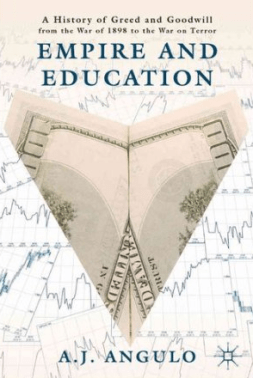 A. J. Angulo is the Elizabeth Singleton Endowed Professor of Education and a professor of history (by courtesy) at Winthrop University. He is the author of Empire and Education: A History of Greed and Goodwill from the War of 1898 to the War on Terror. This summer, he wrote an excellent summary article of his thinking for the Guardian newspaper, in which he highlighted problems appearing in the States, with the arrival of for-profit companies pedalling university diplomas to those least knowledgeable in the value of same, and most gullible in terms of paying their way for a qualification not worth the diploma parchment it was printed on. The
 rapidly, a History degree at Bristol now
  hardware in question is outmoded and no longer updatable. Our early Samsung Chromebooks are 5 years old this Christmas, and still working as well as they did on the first day of opening. The issues is that their systems architecture is unlikely to support the next updates of Chrome browser in 2017. Shame, as my little black chrome book is and remains an amazing workhorse. The beautiful thing about the human mind is that it is capable of such extraordinary and unfathomable activities that it seems never in need of a policy to limit its capabilities and define its limitations. In practical terms, whilst we have over the last 50 year worked out that many more than a privileged few are capable of pursuing an education to graduate status and beyond, we are resetting our expectations in terms of who can/needs to bear the cost of the residential component, and whether distance learning away from the factory face actually delivers the skills development that the job/employer/customer needs.
 up too, in the 21st century we need to be adaptable, engaged and willing to take on new, and often as yet to be defined challenges. Education does not have such a single purpose, any more than work and play has, but it needs to support the very and many purposes individuals and society needs for their future development.
 e walk and torches for the return in the dark) and there are a number of lovely events and side shows happening over the next 2 hours before Star Fireworks set off their first display of the new 2016-17 season. They are the current reigning British Champions of Champions, and we get to see all the new ‘whizz-bangs that have been created for the new display season, fresh delivered from their place of manufacture – China.
 am acquiring funding for an exhibition or worthwhile work – journals and projects not weddings! — He’d probably be interested. He has been pretty full on with this and it’s been exhausting for us all in various ways so definite possibilities preferred please to avoid more overload.
 paradox is very evident to the current teenagers; reading such an article informs them that free sex, drugs and rock and roll were universally available, and not just limited to the new young. As the Profumo affair (1963) up at our local stately home, Cliveden, demonstrated, there was an awful lot going on throughout society, including government ministers, sex and Russian spies. As the magazine article concludes:

 The trouble with the Age of Reason is that it held no checks and balances. Power was in the hands of the mighty, and practices such as slavery, torture and worse were the order of the day. States tinkered with democracy, but tyrants largely ruled the roost. To this day, we still know that Reason per se does not go far enough. If reason alone was sufficient, you would not need to learn the Highway code, because intellect should suffice. Any learner knows the folly of that. Here’s some current practices that seem reasonable but are disastrous:
 When mankind entered the Age of Enlightenment, all sorts of new beliefs started to emerge, not developed intuitively by the survivors of the societies what went before. The Sixteenth and Seventeenth centuries provide sufficient wealth for philosophers to have time to think, playwrights produce the complete works etc.; all sorts of changes started to occur, which led to the various revolutions, agrarian, industrial and political that permit us now to find ourselves where we are and who we are. Almost 400 years ago , the philosopher
  Schools and Society more generally need both to be reasonable and to be enlightened, and there is a delicate balance to be struck. What we must not do is tip over into the all-reason category, because then only the children of the privileged can rise out of slavery, nor offer only enlightenment, because actually I want to know that there is an order of things for driving on the road, for example. Education needs to be broad, balanced and beneficial to all in receipt, and in turn those new learners need to acquire the motivation to extend their interests into their society and offer value back in return. At a time when entering service, be that the military, the police, education, healthcare and local government is at a worrying low, I do recognise my responsibility as a school principal to engender in our youngsters the willingness to serve others above self. And to get some great exam results. And above all to find happiness in who they are!

 Maidenhead…perhaps
 od humour.
  We have had other fantastic visitors this week, meeting differing groups of our children dependent upon age and stage. At our secondary girls sports celebration on Monday night,
  At our junior girls prize giving, Julia Immonen, founder of the
 The headmaster of our Junior School, Justin Spanswick, spoke on Wednesday this week of the extraordinary damage wrought on our state primary schools. Now almost 50% of our children have failed to achieve the target expected of them for English and Maths. “Was that their fault?” he asked. “Certainly not”, he continued, and then explained that the sudden change in ground rules for assessing what’s needed to pass was not caused by the teachers or the children, but by the Secretaries of States misplaced trust in whim and fancy, rather than grounded in pedagogic evidence and academic understanding. This unnecessary mania for testing is set to reach new lows when the new Year 7s could be asked to resit these tests to ensure that catch up with the standards required. That’s 50% of them, Theresa, and that would add insult to injury.
 The Henley Standard published this report of the race shortly after it was raced at 3.50pm on Sunday 3 July 2016.
 Hitting the wall of sound at Enclosures both crews increase the rate. Claires Court push through to a length lead. Can Windsor boys respond? Claires Court seize the initiaitive at the Grandstand and push through to the line. Both crews lift again in the last 30 strokes of the race and Claires Court hold on to the length distance they gained. Gladitorial racing at its best.
 A Principled view