Where have all the readers gone?

In a recent OECD report, the UK was ranked 47th out of 65 nations in a table based on the number of teenagers who pick up a book, newspaper or magazine on a daily basis.  It seems from the Data that only four-in-10 teenagers in this country fail to read for enjoyment outside school.  The Daily Telegraphy reports that our secondary pupils are less likely to read than those who live in Kazakhstan, Albania, Indonesia and Peru.  This is the kind of news that should make Teachers and Parents more than  a little concerned. Reading for pleasure is the guaranteed way of improving vocabulary, comprehension, reflection, wisdom and well-being.  With so much evidence in the UK that children’s learning has been brought to its knees, it’s probably time some best practice got some noise in the blog.

There is a nice Arnold Lobel children’s story about the value of friendship, involving the central cast in his children’s book ‘Frog and Toad Are Friends’ (1970). Toad loses a button, and takes Frog on a previous journey, on a thankless and zany search for the missing button.  On returning home, the button is discovered and the Toad, now somewhat chagrined, makes Frog a coat as reward for his troubles, covered with all the buttons they found on the way!  Young children listen to fables such as this fascinated, not just by the superficial story, but by the insights into a deeper understanding of the human condition reading such stories brings.  And they’ll remember the tale for a lifetime.  Such reading is known as deep reading, the same type of reading style you need to adopt for reading poetry, Shakespeare and good literature. Slowing down, losing yourself in the text, immersing in the ideas that such an activity brings to the surface  is the essence of deep reading.

But the kind of reading described here is wholly different to the parallel skill we need to ensure our pupils develop, that being the ability to skim across the digital highway, to make choices of appropriate information  in a sea of data, so that we can synthesise, analyse and evaluate, to make intelligent and informed answer for our solution to a complex problem.  Now this ability to graze is not one brought to the surface by the arrival of the world-wide web, indeed it goes back to the time of Caxton, with the invention of the printing press and the tide of publications that then followed.  It’s just so much easier now to ‘crop’ the answers without needing to understand them.

For what the web offers our children is instant knowledge for questions posed, “I’ll google it, Sir”, followed by click, download and ‘present’.  Such a response was visible in the homework produced anew, when Encarta first appeared for the PC’s hard drive, when photocopiers appeared in libraries, indeed when Britannica arrived in the home library and of course before that, at each stage when technology arrived to make ‘work’ less onerous. If there is a repository of knowledge available somewhere nearby, then we’ll suspend judgment on its usefulness and just ‘own’ that work as if our own.  Job done, time to move on to something more important than ‘copying’ from the ‘board’.  Hmmm.

So here’s the rub; pretty much of all of a child’s life at school in the UK has been determined by the short-term goals of reaching a level, maintain that level in tests and assessments and them raising up a step to the next level from one age group transfer to the next. As a secondary school, all primary ‘feeders’ are able to tell us that their output always reaches Level 4 in English, often Level 5.  I am not the only secondary school leader who feels that the Literacy strategy, well-intentioned for sure, has produced a Houdini trick of monumental proportions, conning us that their children are well-educated, when they are just well ‘tested’. Children may come into Year 7 very well ‘levelled’, but no way equipped with the skills to read and write properly.

And the problem is of course that the children have been encouraged along the way by both praise and fortune; they have done what has been asked of them and success has followed.  What a pity we did not actually ensure that they learned for themselves what pleasures and pitfalls exist when undertaking depth studies; times when children are left to their own devices by the teacher in the classroom, architect of course of the learning environment but not of the instructor forcing in the knowledge. During my early years of headship, Year 6 pupils would arrive at Claires Court for interview, carrying with them their folder called ‘Topic’.  The best would be able to take me through a marvelous journey of discovery, threading historical, scientific and geographical ideas, stitched together with good language and great handwriting – no wordprocessing in those days.

So looking forward, our secondary schools have to loosen their curriculum, ensure there are plenty of discovery days for children to visits and explore real places where history happened, where geography and science are being made, but couple that with ordered time in the classroom, where actually the children have the opportunity to sit and read. It’s odd now in our target infested world, just how many children feel that they have the right to interrupt and misbehave in class; such behavior immediately destroys the environment in which such deep reading and contemplation happens.  You can see at a glance though why countries with much lower standards of living have better readers; the night-time distractions of PC and games machine simply don’t exist, and family values can’t include the installation of flat screens and wireless home networks to permit 24 hour edutainment on demand.

Parents need to brave enough to ensure that over  an hour before lights out, children are withdrawn from electronic gadgetry, not just PC or games machine, but TV and sound system too. Deprived of stimulation, the inquisitive mind will turn to easy reading, any reading, often repetitive, through which a love of reading slowly, and for pleasure is developed. Picture the acquisition of any complex skill; it takes time and care to get it right, but once learned, never unlearned.  And for such rules to be hard-wired into the family psyche, we need parents know this – not just a ‘nice to do if we were not so busy’ but a ‘need to do for our child’s whole emotional and intellectual well-being’.  How hard an ask is that?

Posted in Uncategorized | 2 Comments

Going Google within Claires Court Schools

During the next few weeks, the next steps of our development of ICT innovation are made.

Firstly, we are bringing on stream 100 net books for class usage at schools and college, most of which have been provided through funds raised by our PTA committees.  The model we have chose to use is the HP 100e, a robust made-for-education machine that should serve us well for 3 years or so.  They come on a 24 station trolley, and connect to the network wired trolley wirelessly.

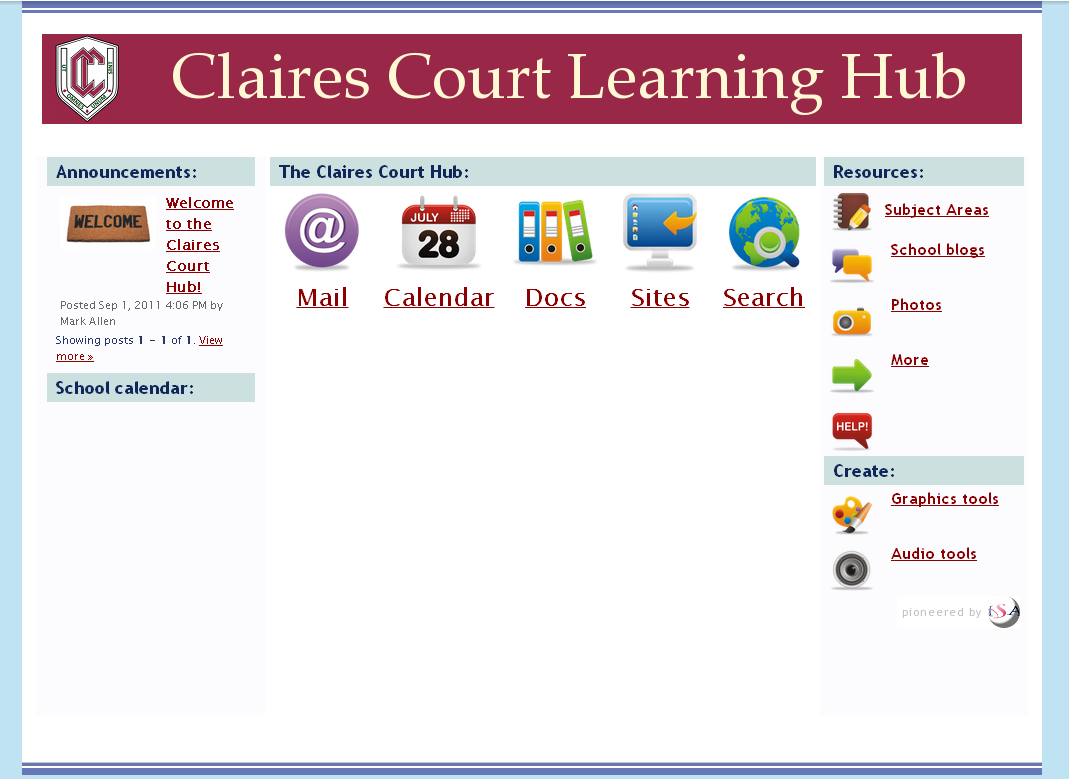
Secondly,  we have pioneered the development of a Learning Hub for Schools based on the tools aggregated under the Google Apps for Education banner.  We are hosting the first 2 open access pilot courses in the UK  for these softwares this coming weekend, and our service based at http://www.clairescourt.net will provide a whole virtual school domain for pupils and staff, up in the Cloud.


Once enrolled into the service, our pupils will have access to a host of Google tools, such as Docs, Sites, Calendar and GMail, yet protected from the outside world as all of the tools only work internally.  External emails don’t come in any more than internal ones escape. As

our Year 6 pupils found in their trial last year, the tools allow for effective collaboration on projects, presentations and publications.  The Claires Court Hub will also provide unprecedented access between teachers and pupils should we close for any reason. Families won’t need to worry about downloading any software locally at home; providing they have access to the Internet, not only can they access documents and notices, but they also have access to the softwares needed to edit or create anew.

Each Hub member has loads of private storage space for files, plus links through to the other services the school provides, such as Taecanet Springboard and MyMaths.  During the next few months, the 6 pioneer schools in the country using this service will no doubt grow, share experiences and benefit from all the benefits of being in a large Google supported network.

You can find out more about Google Apps for Education here – http://www.google.com/apps/intl/en/edu/ – and if you want to take part in one of our 7 training events this Autumn, just let me know.

And finally, apparently the joke voted number 1 from this year’s Edinburgh fringe – by Nick Helm“I needed a password eight characters long so I picked Snow White and the Seven Dwarves.”  In the list the Telegraph published, I preferred Tim Vine – “Crime in multi-storey car parks. That is wrong on so many different levels.”

LOL!


Posted in Uncategorized | Leave a comment

Nice to hit the Headlines

Those who know me recognise I have ‘previous’ in this area.  As Chairman of ISA in 2002, during our Annual Conference, I called for the end of Key Stage 1 and 2 Assessments. At the time, it was sufficiently interesting that national press and regional radio cottoned on.  What concerned me then, and what concerns me now, is for a curriculum to inspire, there must be time for pupils’ interest, aptitude and skills to grow.  At some stage during the development of Assessment & Learning over the past 40 years, we have got much of it right.  The trouble is, when we have for English (for example) we haven’t for Maths, yet when reorganisation happens it happens across the board – moving the target for Maths onto some shorter term functional assessments might be a good thing (can they pass a Numeracy paper for example, such as the Proficiency in Arithmetic test run by the AEB in the 80s and early 90s), but that’s not the way forward to assess creative writing.  You don’t move dartboards so that wayward arrows hit the bull!

Anyway, you can read the whole Press release below – of course I am hugely proud of our pupils’ achievements, boys and girls, and I say that all the time, but they and I know too that by and large their education has been diminished by the repetitive testing they have endured to 16+.  And they get to continue that way to 18 too.  Now in some ways, modules for A levels has led to significant improvements in tracking pupil progress in the final 2 years of pre-University education, with no GAP Year 12 enjoyed by the lazier student. Exam boards have learned from the past and have reduced numbers of modules, and with only three or four subjects on the table, the demands are less onerous.  The key failure however that still arises at this level is that we simply don’t have confidence in the assessment process.  If a 41 out of 50 raw mark can be published as 73%, regressed by the exam board so that it reports fewer A grades, natural justice is not served.  Of course you have got to take account of the difference in difficulty of papers and find some mechanism for adjustment, so that one season’s A matches another in a subject, but Chief Examiners across the land confirm privately that this regression is more than that.  Political masters will not see grade inflation, so force this tinkering which discredits the process, because the assumption is that the Raw score mark is correct. Now actually for many subjects, up to a 10% variation can happen in the natural way of things.  One candidates tightly drawn and constructed arguments might actually be too good for an inexperienced marker to see. So 41 could actually be 45, and score 85% say, confidently into the A band!

Any way, such arcane discussion about Exam board practice rather takes me away from the main thrust of this message, which is that the curriculum assessment must support education not damage it!

Claires Court Schools – GCSE results 2011

Core statistics.

113 candidates sat 1138 GCSEs, pass rate 99.8% (A*-G), 80% pass rate A*-C.

87% of candidates gained 5 or more GCSE higher grade passes, and 76% including English and Mathematics.  

Commentary

Claires Court remains unusual as an Independent school in that we are not selective on Academic ability.  For some of our pupils, gaining a hatful of A* and A grades is the target, and for many others, securing a higher grade pass alone is the result they seek, opening as those do access to A level and equivalent courses at Sixth Form level. Once again I am delighted to report excellent GCSE results for our boys and girls, gaining similar results in recent years with 87% gaining 5 or more GCSEs including English and Maths.  With individuals actually averaging over 8 GCSE higher grades ahead, most are have made their major target, being now well set for A level courses in our own sixth form and elsewhere.  We consider ‘outstanding scholarship performances’ to be for all candidates with at least 5A grades, and 21 of our pupils have reached that standard.  Best male was Joe Curran who gained 5A* and 2 As, best girl was Michaela Lawson who gained 4A* and 5As. Other Star candidates include Headboy Ben Aldren and Head Girl Jo Beck who both gained 8A*/A, Kirah Bradley and Chester Camm both gained 3A* and 1A in Maths and the sciences, with Chester gaining an A grade in A level computing adding a real extra to his challenge to be our best number cruncher!  Sarah Allerton, Aaron Bhalla, Alex Corrigall, Alex Fyfe, Ashleigh Richards, Jessica Evans, Ellie Griffiths all gained at least 6 or more A*/A, with English, English Literature, History Maths, Sciences Religious Studies, Physical Education and Spanish leading the way at departmental level across both boys and girls. 

More generally, it is really pleasing to see that the nation’s focus has returned to encouraging pupils to pursue traditional subject-based disciplines, recognisably our ‘offer’ at Claires Court..  Personally I believe most young men and women are best prepared for A level and University by following subjects that are known to be rigorous and that encourage depth of thought and application of skills to answer challenging questions.  Longer term, we are not best served by modular examinations that stretch from age 14 to 18, which inevitably focusses attention on the ‘test’; students need time to develop and take responsibility for their learning, develop innovation and excitement in equal measure for their studies.  Of the leading world nations, we are the only one that requires such intensive examination throughout the secondary phase.  It is time to dispatch GCSEs and other public assessments prior to 18 to the past; such awards don’t tell employers anything about a young adult’s ability to work, they encourage specialisation too early before learners actually know what’s good for them, and they detract from the broader purpose that schools have to educate their children fully for their futures!  Not withstanding these reservations about GCSEs in general, I am very proud of all of our pupils’ achievements this year; in academy, sport, the arts and community involvement, Claires Court’s 16+ cohort are well set to play their full part for the future.

Posted in Uncategorized | 1 Comment

Closing thoughts at the end of our Summer Term 2011

As our Golden Jubilee year comes to an end, it’s nice to reflect on the many events enlivened by our celebrations, from the formal occasions such as Speech Days and Concerts, through to the major social events of the school year. Many of the staff and pupils have become very closely attached to their Jubilee Pins too, made possible thanks to the generosity of our two Parent/Teacher bodies.

This term, three major events have helped bring our school community closer together: the May Ball, the Summer Fete and most recently, the Golden Jubilee Finale at our Taplow playing fields last Saturday. The College PTA and the Claires Court & Ridgeway Society have worked extraordinarily hard on our behalf this term, organising events, clothing sales and fund raising in equal measure. I am delighted to report that their efforts have been rewarded, not just by the enthusiasm with which you have supported their work through ticket sales and attendance at events, but also in raising some £25,000 to provide medals, other prizes and awards, and considerable capital for the provision of new sailing boats, computer trolleys and floodlights to come while more safeshades, a scull, cricket nets and sewing machines are just a few of the myriad contributions made over the past year. At the end of this academic year, Amanda Howman and Dermot Woolliscroft, the Chair and Treasurer of the College PTA, and Chris Basley, vice-chair of the Ridgeway Committee, are standing down having served with great distinction for a number of years. Vacancies on our PTA committees exist, their Annual General Meetings will take place in September at Ridgeway and all parents interested in assisting this valuable work are invited to put their names forward for election. The AGMs are followed by a short combined social event at which the Society Award is presented to those pupils or parents who have made a significant contribution to our development as a school.

With the reporting of public examination results still to come, I am sure there will be good news for many. Meantime, one of our Year 9 girls at the College, Amber Hill, has performed with such distinction with her shotgun that she has been selected to shoot for the England Ladies Skeet team this autumn. Fellow College Year 9 athlete, Ellie Rayer, has continued in outstanding form after winning the U15 National Indoor Multi- Event Championship at Sheffield; is now ISA U15 champion at 200m, Javelin and Relay, came 2nd in the Southern Multi-Event Championship and will compete in the All England Schools finals in September. Despite the copious rain since half term, the boys have been able to shine at their cricket with the Under 15 side winning the County Vase, defeating Newbury’s Park House in the final. Congratulations must also go to our past pupils now graduating from University; to Phil Clapp (Reading) and Guy Swadling (Loughborough) persevering with Rowing and Rugby (championship side Esher) respectively as they seek further sporting honours, and most notably to Josh Cremin (Southampton) and Luke Selzer (Warwick) who have both gained firsts in their Biochemistry and Physics Degrees. Josh is moving on to the University of Cambridge where he has won a salaried research post, studying mitochondrial proteins for his PhD while Luke is staying at Warwick, where he has a Doctorate research post into Solar Flares. Before then, Luke who is also a talented artist, will be stewarding our summer exhibition of Claires Court Art and Photography in the Nicholsons Centre in Maidenhead alongside former pupils, Amanda Frith and Peter Robinson.  

It seems that no week goes by without the various weekly bulletins carrying announcements of some extraordinary achievement or other by our pupils. For many, this can only happen because of the work of exceptional teachers and coaches across our sites. I have already written at length of Mrs Lizbeth Green’s retirement after 7 years of distinguished service as Head of the College. Already, her successor, Paul Bevis, has become a well known face as he has eased himself in to various gatherings and meetings this term, and we look forward to a new chapter in the College’s History from September. Mrs Green departs in particularly good company this summer. Richard Milner-Smith, one of her assistant heads and a figure well known across the secondary year groups and the Sixth Form for his outstanding Geography teaching and sports coaching, departs to take up the deputy headship of another independent school, Moyles Court, in Hampshire. Mrs Margaret Taylor is retiring after 20 years as class teacher of Year 4. Mrs Sally Woodhead is also retiring from her position as ICT teacher. Stepping down from Ridgeway after 28 years as Special Needs Co-ordinator is Eileen Goford, an institution in her own right for leading learning, Eileen also founded and has continued to lead Ridgeway’s extraordinary chess provision, bringing on county and national champions with the best playing for England. Ridgeway has won the Berkshire Primary Schools Chess Association’s ‘A’ League for seven of the last nine years, and is the only name on the Under 9 cup! Also retiring from Ridgeway are Marion Bintcliffe, another remarkable teacher, after 13 years’ service most recently of Year 5 and founder of our Chembakolli day, and Louise Walker after 8 years leading our Reception class and an ace athletics and cross country specialist. From Claires Court, Chris Hill retires after 7 years teaching English and Fishing, one of the stalwarts of the Claires Court kitchen gardening fraternity and lead chef on the Year 9 outdoor education week. Also moving to develop his career in new directions is Julian Bown after 19 years of instructing our tyro and more experienced drummers and director of our accomplished Samba Band. A full list of those leaving us from each site can be found on the relevant end of term bulletin that accompanies this newsletter.

Given the concern currently being expressed about the ethics and morals of British journalism, I hope those in our own community feel that we do our best to live up to the values that we promote – we certainly try hard! Schools are learning places and that does not happen without failing – win or lose, our teachers and administrators have provided brilliant support throughout the year and for this Hugh and I are extraordinarily grateful. In particular, we appreciated the call of duty to remain at work this last month when the consultation over publicly funded retirement benefits lapsed into confrontation at national level. Please be sympathetic to both sides of the argument when discussion comes to a head later this year – in the meantime, I know we can continue to rely upon the loyalty of our staff to work your sons and daughters to their very best! You can find more about our school life and matters educational from my blog, A Principled View, (see http://www.clairescourt.com for links) in which I have some fun as well as express some cogent views on my educational life. This Jubilee year closed with a wonderful celebration at our Taplow playing fields, in which 800 or so families, teachers and support staff enjoyed the atmosphere, the music, the food and all the side shows and activities, blessed by some welcome sunny weather. The event gave many a first sight of our new playing fields, coming on nicely in this warm but wet summer.  Among more immediate projects planned for the summer break include the enclosing of the courtyard at Claires Court to give more internal floor space off the dining room and an expanded Room 8 above, a remodelling of the top floor at Ridgeway to house a revamped library and an ICT provision for a full class, and at College the completion of the Hall refurbishment, replacement of the screen to the Lower School ground floor entrance from the Junior playground, and a remodelling of the lobby, dining room and first floor in the main house of the College.

It is worth pausing here to reflect that the main house of the College celebrates its 120th birthday in the autumn. When opened in September of that year, it provided purpose built accommodation for the then Principal, Andrew Millar-Inglis, who ran Norfolk Park School from his premises at Inglewood on The Crescent. The College main house, Library and IT classroom are therefore probably the oldest school buildings in Maidenhead still in use. If this is not reason enough for  celebration, then consider the advertising in the autumn of 1891 of the “new” Maidenhead College which stated that it was “established as Norfolk Park School [in] 1861.” We have not yet been able to verify this claim (the Maidenhead Advertiser only began publication in 1869) but if true, then September sees us with a 150th celebration on our hands! The copy also boasts of “Modern Premises. Experienced Teaching. Individual Attention. Moderate Terms.” claims that we believe we continue to deliver today.

So we close this year with 1005 pupils, 116 teachers, 124 support staff and last but not least, two very proud School Principals; as 2 of the first 19 pupils attending Claires Court Preparatory School for Boys in 1960, we have seen how far our enterprise has travelled, from small boarding school to major independent spanning all ages and abilities, over the intervening years. Our aim for the next 50 is to become the finest non-selective independent school in the world; and with the incredible support of you, our parents, our pupils and our staff, I hope we’ll get there rather more quickly than that!  

Posted in Possibly related posts | Leave a comment

The gap between the UK and the USA just widened a little more…

Oscar Wilde wrote: “We have really everything in common with America nowadays except, of course, language.” (The Canterville Ghost – 1887).

124 years later, I suspect that we are also separated by our literacy.  In my recent reading around the use of ICT in education, I have become unnerved by the news that so many schools, colleges and education districts stateside have removed hardbacks from their offer, because they have switched to eBooks instead. Some US Independent schools have paid for their move to iPads by removing the cost of text book provision.  Obviously because I blog, I am used to reading and writing on-line, I love the fact that eMaterial is easy to search, mark up and link. But that does not mean that such skills and utilities replace the printed word, merely supplement it.  Across the globe now, University research is showing that proper books are needed for deep reading, and their students report that with screen alone, they have trouble “learning, retaining, and concentrating” – see here for one such study – http://goo.gl/oLOII.

It gets worse of course.  Now the same authorities are not using pen and ink in the classroom, they don’t believe junior school should teach handwriting. I understand that over 40 states have now removed this from a requirement in their taught curriculum.  I can’t understand why responsible authorities would remove the acquisition of such a skill as a requirement.  If children don’t learn to write, how on earth are they going to work in the real world, particularly when they are ‘powered’ down.  Typing is simply not the same as writing; the fine motor control we develop as we learn to shape letters and characters is essential in all disciplines, practical as well as academic. No learning activity is successful unless it has purpose; the huge benefits that are gained by acquiring scripting skills far exceed just the skill of writing information down. For me, probably the most important benefit of teaching handwriting is that it links directly to ‘disciplined learning’ – in which children are rewarded by the quality and accuracy of outcomes.  As a post on the American website “Teach handwriting” concludes “The lack of teaching proper handwriting from elementary school first grade is just one major mistake in education; the prevailing attitude seems to be that school is “fun”, let’s just not challenge those “poor kids” As a result it is obvious they have no discipline, no focus, no desire , can’t write, can’t read, can’t calculate, can’t retain information”.

Following a BBC Newsround report this week that that pupils living in Indiana in America don’t have to do handwriting lessons anymore, children were asked to give comment to this news.  I have cropped the replies up to 15 July 2011 here – http://goo.gl/MuEml . The almost universal response from children encourages me hugely – it’s not just about the importance of writing itself, but about what your writing says about you too! As one young correspondent, Duan concludes: “In China handwriting skills are even more important than in other countries- handwritten Chinese words look more beautiful than words typed on computers”.  Many years ago in the sixties, my mother Josephine Wilding moved Claires Court from cursive hand to italic; perhaps not so good for flourishing signatures, but excellent in terms of efficiency and time-management. The jury will remain out on which is the best for speed and accuracy – cursive, italic or block; partly because as we know, the more academically high achieving  you are, the less readable your hand – this must be true because no-one can read the handwriting of Doctors in general practice :0)!

If books are gone, and handwriting practice is ‘off’ the curriculum, then what’s the position on teaching spelling stateside? The obvious answer is that teachers have given up on this too, but that’s not right. Teachers in US schools remain serious about teaching spelling, I think because it better fits their psyche to test, it’s easy to demonstrate that a ‘good job’ is being done.  Ny the way, there are approximately 600,000 words in the English language. That  means, if the average person uses 10,000 words on a regular basis, there are about 590,000 words which he uses less frequently, which usually means they won’t be spelled well.  “It clear that establishing an effective spelling curriculum requires an integration of the three basic approaches to spelling instruction: Phonetics instruction, memorization of high frequency word lists, and using functional writing to master spelling words and skills. It is not simply a matter of combining one or two of these approaches, it requires a balanced integration of all three approaches” or so writes Beverly L. Adams-Gordon, Washington-based teacher and author, mainly on writing and spelling, Whilst there may be good focus on the acquisition of spelling skills now, in the 1990s there was a huge push to reduce the ‘pain’ for children, based it seems on the all-conquering arrival of the electronic spell-checker. As a humorous warning to users not to put too much faith in them , Jerrold H. Zar had this to say in 1991 (subsequently expanded in 1992 with help):

Candidate for a Pullet Surprise

I have a spelling checker,

It came with my PC.

It plane lee marks four my revue

Miss steaks aye can knot sea.


Eye ran this poem threw it,

Your sure reel glad two no.

Its vary polished in it’s weigh.

My checker tolled me sew.


A checker is a bless sing,

It freeze yew lodes of thyme.

It helps me right awl stiles two reed,

And aides me when eye rime.


Each frays come posed up on my screen

Eye trussed too bee a joule.

The checker pours o’er every word

To cheque sum spelling rule.


Bee fore a veiling checker’s

Hour spelling mite decline,

And if we’re lacks oar have a laps,

We wood bee maid too wine.


Butt now bee cause my spelling

Is checked with such grate flare,

Their are know fault’s with in my cite,

Of nun eye am a wear.


Now spelling does knot phase me,

It does knot bring a tier.

My pay purrs awl due glad den

With wrapped word’s fare as hear.


To rite with care is quite a feet

Of witch won should bee proud,

And wee mussed dew the best wee can,

Sew flaw’s are knot aloud.


Sow ewe can sea why aye dew prays

Such soft wear four pea seas,

And why eye brake in two averse

Buy righting want too pleas.


by Mark Eckman and Jerrold H. Zar

Back here in Blighty, good schools still take all three aspect of teaching literacy seriously, and real books continue to live at the heart of our work. At the end of term speech days, the prep. School audiences received two treats; at the boys’, headmaster Jeff Watkins read extracts from It’s a book in which a big ape clarifies for a clever donkey what you can and can’t do with a book (get a taste of that here – http://goo.gl/yVVF7 ), whilst at the girls’, Author Helen Pielichaty warned our leaving Year 6s of what lies ahead at secondary school, by reading from her ‘Simone’s diary’ , a perspective from a sharp Year girl following the transition. Marvelously Helen blogged about her impending arrival at the College, and gave feedback too – read that here:  http://goo.gl/3l36K .

The English Language, whether of the US or UK variety, wriggles about left, right and centre. I have absolutely no doubt that on both sides of the pond, good schools teach English, the acquisition of its skills and the understanding of its literature seriously well.  When whole states decide to eliminate curriculum essentials, it has to be a worry.  I’ll close with a serious warning from Charles Duncombe, one of Britain’s serious entrepreneurs given last Thursday “Poor spelling is costing the UK millions of pounds in lost revenue for internet businesses”.  His fears are backed up across the CBI and industry at large – “42% of employers are not satisfied with the basic reading and writing skills of school and college leavers and almost half have had to invest in remedial training to get their staff’s skills up to scratch”.  Sadly, I am not surprised!

Posted in Possibly related posts, Uncategorized | 2 Comments

Fifty years old and still counting – a work in progress…

Date:  9 July 2011

Time:  2 pm to 8 pm

Time of this entry 10 pm, Monday 11 July 2011.

When a school celebrates its 50th birthday…

First upload of pictures has happened, two more to follow, here’s an animoto of some of the pictures – http://goo.gl/AuQev

With so many lovely people, families, friends joining us to celebrate our Golden Jubilee finale, it seems sensible to let their words speak for us in this context:

“Just a short note to say thank you very much for such a lovely day on Saturday, and all the hard work that must have gone into organising everything.  We had a lovely time amongst lovely friends!! ”

” I’m sorry I didn’t see you to thank you personally on Saturday.  I had a great, relaxing time – thank you very much for arranging the day.”

“A big ‘thank you’ for a lovely afternoon on Saturday – R and I enjoyed it very much – as did everyone there!  Well done to the organisers too!!

“Just a massively large thank you from our family for such a fabulous day on Saturday. It was brilliant and a lovely way for us to remember your fabulous school. Do please pass on our thanks to all those involved for a job seriously well done.”

“Just to say that Saturday was lovely – such a civilised way to spend an afternoon.  Good food and the Jazz Band and Steel Band were great.  Many thanks.”

“Many thanks for a super afternoon on Saturday. So pleased weather held out. It was a great event.”

“Just a brief note to say thank you for a most enjoyable end of Jubilee Celebrations party on Saturday.  We thoroughly enjoyed the atmosphere, the music, the food and all the side shows and activities.  All in all a very appropriate end to the years celebrations and for our family a fitting end to our association with Claires Court.”


Posted in Uncategorized | Leave a comment

Reaching for the “Cloud” – ‘Going Google’.

During the last academic year, we’ve been accelerating our use of collaborative working at Claires Court, using those young pioneers at Ridgeway and College to test Google.docs big time.  Here’s Year 3 at work, writing about films they like and World book day (just beneath the Vikings – also a co-ed experience!) – http://goo.gl/t8aIF. Given the 2 mile gap between sites, using shared documents like this is an obvious one to engender the collaborative juices.I’ve been using Google.docs for a host of tasks, for example coordinating the updating of ‘homework’ defaulting, managing entries for the ISA London West athletics tournament and sharing results, certificates and national team selection, and managing my personal calendar, to name but three really quite complex activities.  But don’t just hear it from me – have a read of the reports and watch the short video on this link, and see what others think – http://goo.gl/2Txi3.‘Going Google’ however has not been an easy decision in education terms as it seems. After all, the biggest productivity player in education for 2 decades has been Mircrosoft, and with a sales pitch that includes the belief that ‘nobody has ever got sacked for choosing Office’, it has been difficult for others to break into the classroom.  Google.docs have been with us for some time now (4 years or so), and bit by bit have built a remarkable suite of tools called Google Apps for Education that seem second to none. In essence though the biggest problem to overcome has been to provide training for specialists (2 sessions this year in the world only tells you just how tough it is to get hands-on).  And even if that training is available by distance learning – http://goo.gl/qhFpM– that doesn’t actually mean the ‘vision’ of what needs to be achieved is in any way clear. Until now.Here’s a picture of our prototype dashboard for teachers and children for September 2011 – http://goo.gl/e9eKY.  Study the picture carefully, and accept that any of the buttons, widgets and apps will connect to the appropriate google tool or space behind.  Third party software links through a single, sign in protocol through the More button.  The Calendar is set at the whole school, year and class level, and of course any individual can add their own event to their calendar without affecting the parents above.  So long as teachers or pupils have an internet connection with browser, they’ll be able to access their dashboard, using PC, Tablet, Wii, iPod or phone.In the document area, you can see a variety of files, some of which are personal to the individual, some they have shared with others to view and/or edit, and others which have come their way from their teacher or other collaborator.  Please bear in mind that you don’t need to email your work to anyone – all you need to do is ‘share’ it with the person you wish to read it, and they get an email that triggers ‘go look’.  For GCSE and 6th Form studies, collaborative documents in google.share transform monitoring, assessment and feedback.  As a teacher, I no longer have to worry about receiving and email with an attachment, whether that attachment is small enough to squeeze through my email provider, or indeed whether the message has even been sent.  And what’s even better is that uploading documents in other formats doesn’t present google.docs with a problem, because it translates them into readable form.

I sound like a Google sales person; of course I have come across plenty of teething issues, but bit by bit these are being ironed out, and the time for delay is over. So I’ve been Going Google in 2011, switching my various bits of kit from MS to GG. The phone’s a google phone, so’s the slate and so’s the browser. This document is written on–line in google.docs, because if I break off and start again somewhere else, I don’t have to worry where the file is or what’s the latest version – it’s this one here, in front of me when I go back to Google to find it – and you can see it too here – http://goo.gl/mbCgg.  And if I don’t like what I have written, I can roll back the file revisions on-line ‘til I get to the bit I was happy with.

And the best bit is this – for the time being and for the foreseeable future, these services are free to the end user, without nasty pop-ups and unsuitable advertising too.  My google i.d. serves as my log-in for a whole host of other third party service providers already as well, ones I regularly use in my teaching, such as Wallwisher, SurveyMonkey and the Chrome webstore. ‘Webstore’ I hear you ask, ‘What’s that?’
It’s an on-line market place for millions of free educational products, from eBooks to study aids.  I found StudyStack there this morning – enjoy.

Posted in Uncategorized | 3 Comments

Ever tried. Ever failed. No matter. Try Again. Fail again. Fail better.

Samuel Beckett, the Irish poet and playwright penned these words in 1983 (Worstward Ho), and I can’t say they caught my attention then. Beckett as a writer seems to me someone you have to keep trying until you develop the taste, like Campari or Green olives. I first came across Beckett when my Sixth Form Society at school read “Waiting for Godot” whilst drinking Retsina with the Head of English, Billy Bell, and to be honest, both seemed unpalatable, but we persevered.  After all, Greek or otherwise, wine is wine.

My point at using ‘Fail again, Fail better’ at assembly and at meetings the last few weeks has been to highlight to children and their teachers, that life does not start out perfect, there has been no divine right to receive success, and from conversations had over the years, those who in the end succeed have done so having first learned to cope with failure, and to handle that outcome really rather frequently.  The latest example is of course another man of Ireland, Rory Mcilroy, whose extraordinary failure to convert a 4 shot lead at the Masters this year required just one more attendance at a major to be dispelled.

It seems particularly important to put across this view in Education, to work with colleagues to ensure that it is hard wired into a teacher’s psyche. Children will come and go (they always grow up on us); a teacher’s career is like ‘Groundhog day’, a cycle of repetitious activity which we hope should lead to transformative activity for a child’s life expectations. I have been watching all of my Heads of Department teach this month, and what they all have in common (so far) is an extraordinary patience with their pupils. Meticulous planning does not mean inflexible scheduling, and the many great lessons I have seen have had the children mainly in charge, being given the responsibility for their learning and in taking it, making real progress.

The latest report on the 11+ SATs in England by Lord Bew comes to the conclusion that its creative writing test for children should be scrapped, something that has been self-evident to their teachers since the implementation of KS testing over 20 years ago. I remember attending a seminar on teaching creative writing in school at the time, and the structures children were expected to put in place to score heavily led teaching to become formulaic and quite obviously stifle the very creativity it sought to promote. As previous reviews have identified, the major requirement teachers need to meet if they are to develop this talent is to find sufficient time for their young charges to write.  In short, like pretty much everything else in the classroom, the rationing of time to an activity is likely to lead to underperformance. I remember the great irony for most state primary schools as their curriculum was expanded, was that their numeracy hour was reduced to 50 minutes to fit it all in.

Beckett’s life story seems straight out of the creative writer’s top draw; a man who excelled at school and University in Dublin, and at cricket to the extent that he was mentioned in Wisden, managed a mental breakdown in his twenties whilst publishing his first novels, and almost stabbed to death in Paris in 1939, before joining the resistance during the war for which he won the Croix de Guerre.  A couple of decades of eminence follow in which his greatest works were written, in both French and English, before his career was almost fatally damaged by the award of the Nobel Prize for Literature in 1969. Anticipating that her intensely private husband would be saddled with fame from that moment on, his wife, Suzanne  called the award a “catastrophe”!  He died shortly after her death, in 1989 from emphysema.

In researching about Beckett, I came across a nice quote from his brother, no doubt trying to encourage Samuel out of his doldrums in the ‘30s, during which period success was relative, suffering too perhaps a little in the shadow of his great friend, James Joyce, when publishers preferred to leave Beckett’s minimalist writings unpurchased.  Francis wrote “Why can’t you write the way people want?” And there’s the rub, now as then. If only children did as we asked, their (and our) lives would be so much easier, and success, fame and fortune would be assured. As if…Beckett’s own story reminds us all that nothing comes easily, and that life is there to be lived despite an unpromising background. A fellow Irishman, our previous Registrar, Anita Roberts, taught me long ago that “Life’s hard and then you die” – said of course with that twinkle in the eye that all of their nation share.

Posted in Possibly related posts | Leave a comment

Ordinary people doing extraordinary things…

…takes my breath away, and makes me proud to lead  my school.

Being in charge at the start of any academic year is an onerous responsibility – the who, what, where, when, why and how of school planning has to be tested throughout the organisation, ensuring that at every level, we actually have a plan.  Knowing what we are going to do to monitor and review the plan in the light of time and circumstance, and giving time and space for that review to happen are key parts of my work. Sounds boring of course, but then here’s the bite…

As any school term comes to an end, our work builds to a crescendo of activity, and as each year builds to an end so the opportunities for me to enjoy what we do, to witness the shades, tones, variety and spice of school life grow too. By the way, most who know me professionally understand that I have a passion for educational research; with Claires Court covering every age and type of day education to be found in England, I do tend to compare and contrast what we do against norms to be found elsewhere.  Our target remains to be outstanding in what we do, so the comparisons can make colleagues within CCS feel the collar tighten! I’ll give three examples of that joy of my work, and you’ll have to be the judge of my idea of fun!

I look forward to the publication of AR’s annual report on “What kids are reading” (not on-line) – read a blog here: http://www.ransom.co.uk/blog/?p=501– and I share the reports once it’s in with my English teaching and Library colleagues. The report is a bit skewed, as the books have to well known enough to be available digitally on the AR system, and I don’t extrapolate too far from the evidence they give. The concern growing (in the nation as well as in the report) is that our children are learning to read well, but as they hit the teenage years, children make choices that cause their reading age to regress quite severely; the easier and shorted the read the better is the stark conclusion. However, what fascinates me more is what children write about, and we’ve a number of projects on-going which encourage such writing, one of which being our Year 6 girls mob-written summer novel.

I say ‘novel’ but it’s really more a collection of short stories; this year’s edition is entitled ‘The  Dice Strikes 6’. We are into the third edition of the work, featuring the remarkably familiar sounding J.K Wilding, the bad tempered school proprietor, whose ground-hog day mission remains to recover a pair of lost dice stolen from him by the then Year 6 two years ago, the dice passing on to successive generations on girls in the prep. top year. An all-seeing, wise though often rather grumpy Mr Carruthers also populates the story; as form teacher of Year 6 he’s inevitably part of the narrative and like JK, an adult male likely to have much of his dignity removed by the emotional and descriptive work collaborated on by a group of 11 year old girls. Suffice it to say that I have been presented with this year’s book, and it’s a hoot!  Once it has been digitised, I’ll share the link. No great work of literature perhaps, but Year 6 have had a lot of fun, writing!

Underpinning extraordinary amounts of what we do is our mission to teach about creativity. Having bigged up the girls, it is only fair I point out the boys are no less active as story builders, and here’s how they done it recently using paints and camera –  http://goo.gl/nvYmq.  It is always going to be a big issue that some get to go on cricket tour and others can’t; if the alternatives come out as cool as our recent provision has, then it’s difficult for any to get upset.  The two adults in the picture series are Ridgeway’s Art teacher Martin Goddard and our Artist in Residence, Frances Ackland-Snow. Frances is leading our summer development of the Arts award through our Summer camp programme, a really exciting development now jumping down to the primary years, and one she is helping us to pioneer.  A lot of OfSTED ‘speak’ talks about giving pupils opportunities to take responsibility for their own learning; I’d always hope we do that well, but whether you’d actually leave that task to the Zombie boys of Film club, I’m not so certain.

Every year, including this Jubilee one, our Parents, Teachers and pupils collaborate to host a summer fete, this year held on Saturday 18 June. The great danger with any Saturday in the Summer is that it will of course clash with so many other events, so we have to be really inventive to ensure its ‘attractions’ are worth the visit by a school community willing to spend. Sure it is a fundraiser for our PTAs, but more importantly it provides our community, past and present, to come to school and enjoy some fun. You can see some photos I took on the day here – http://goo.gl/ONya3 . The novelties this year include a Dodgem car arena, and (I suspect an ISA school first) an inflatable ‘Pub’. Amusingly it was pointed out to me that the Pub seemed to be on occasion overpopulated by school staff, though since the senior boys’ staff were deployed to ‘people’ it, that seemed a base accusation. Suffice it to say that both were a great ‘hit’, not unsurprisingly so when the weather went foul and our visitors sought indoor attractions for shelter!

The highlights will continue every day to the end of term, across sports, drama, music, academic or recreational, often both. Off-stage now, most of my work is ensuring we are setting up the best we can for the next academic year; close to deadline activities such as new staff and pupils to be interviewed and welcomed into our community, critical path analysis of calendar and timetable creation so we create a plan for tomorrow that looks as or more effective than that for today. But the on-stage bit just couldn’t be better; I am delighted by the achievements of those I work with, both adults and children, employees and customers alike. When two dads, Felipe Foy and Chris Basley, give up their day job for the week to ensure we have an extraordinary funfare established to celebrate our Golden 50 years of achievement, I am genuinely humbled by their extraordinary efforts on our behalf.  Talk about ‘ordinary’? – talk about ‘extraordinary’, please!

The highlights will continue every day to the end of term, across sports, drama, music, academic or recreational, often both. Off-stage now, most of my work is ensuring we are setting up the best we can for the next academic year; close to deadline activities such as new staff and pupils to be interviewed and welcomed into our community, critical path analysis of calendar and timetable creation so we create a plan for tomorrow that looks as or more effective than that for today. But the on-stage bit just couldn’t be better; I am delighted by the achievements of those I work with, both adults and children, employees and customers alike. When two dads, Felipe Foy and Chris Basley, give up their day job for the week to ensure we have an extraordinary funfare established to celebrate our Golden 50 years of achievement, I am genuinely humbled by their extraordinary efforts on our behalf.  Talk about ‘ordinary’? – talk about ‘extraordinary’, please!

Posted in Uncategorized | Leave a comment

The dogmas of the quiet past, are inadequate to the stormy present.

In my efforts to understand and contribute in the rapidly changing world involving learning, my research is both wide ranging and eclectic.  Which it needs to be,  because none of us have any idea where the next good idea that takes hold is going to come from. Married to a Historian to her bone marrow, I am often humbled by my wife, Jenny’s grasp of the sweep of History. We spent half-term down near Dartmoor, and made our first foray into the rocks near Hound tor. It’s an extraordinary place, not least because of the impressive pile of rocks and boulders that give this pile its name, and as legend has it, Conon Doyle the inspiration for ‘The Hound of the Baskervilles’.  As we wandered around the surrounding moor, we came across the footings of a deserted village, Houndtor, well written up I discover on the internet (http://www.legendarydartmoor.co.uk/hound_sett.htm), and nearby across the way a much later granite quarry of the 1820s, well served at the time by a tramway, built of the same indestructible material (http://goo.gl/0DZLA ).

One place, 2 completely contrasting deserted centres of conurbation, one listed in the Domesday book, the other responsible for the stones that make up  part of the British Museum amongst many fine buildings nearer to the quarry in Devon, both falling foul of changing times and technologies. The medieval village it is thought failed largely due to the rapidly worsening weather of the time, making grain harvest impossible, with perhaps a final sweep of the Black Death to depopulate it completely.  Five hunder years later, however lovely Devon granite was in the 1850s, it came at a much higher price than that quarried further west in Cornwall, and the quarry and its workings were abandoned pretty much immediately.  The granite rails that made the tramway were no longer as easy to manipulate and use as the new ‘Iron’ rails, and so were abandoned too.

Around the time of the closure of the Haytor granite quarry, across the pond in Washington, Abraham Lincoln was preparing his annual message to Congress for December 1, 1862.  Whilst it turned out was a mainly routine report (if anything can be regarded as such during a period of extraordinary civil war), it was within this message that Lincoln gave first voice to his controversial measures such as voluntary colonization of slaves and compensated emancipation (in short, his proposal to pay the Slave plantations off).  He chose to soften Congress to his plan through this great rhetoric: “We can succeed only by concert. It is not “can any of us imagine better?” but, “can we all do better?” The dogmas of the quiet past, are inadequate to the stormy present. The occasion is piled high with difficulty, and we must rise — with the occasion. As our case is new, so we must think anew, and act anew. We must disenthrall ourselves, and then we shall save our country”

Moving on 150 years, and surveying the current educational landscape, I can’t help feel we could do with some one of Lincoln’s courage and stature to help bring some sense out of what seems little better than a scrap heap of granite chippings! It’s depressing to read that teenage literacy is plumbing new depths; we are making good progress apparently up to Year 5, but beyond then, the books of choice to read are those that are easy and short! Now my essay is not just about a lack of interest in books such as those written by Conon Doyle, but the formidable problem that has developed over the past twenty years as we have tried to open up higher tiers of study to our pupils. It seems contrary, but by making specifications so clear about what needs to be studied for Science or History or English, we have reduced the canon of work to be studied, such that reading in depth per se is no longer a requirement either for study at school, or dare I suggest at University too.  And if the situation seems to be a concern at the top of the educational tree, it looks even more worrying for those in charge of schools at the start of the process.

“Thousands of children ‘not ready for school’ at five” is the headline from this weekend’s Daily Telegraph, going on to claim that  Children are failing to develop vital physical and communication skills after being robbed of interaction with mothers and fathers during the early years.  The paper reports that these are the findings of Sally Goddard Blythe, director of the Institute for Neuro-Physiological Psychology in Chester, said many early developmental problems could be overcome with old fashioned one-on-one interaction between parents and children.  The worrying bit on this doom-mongering is that Ofsted’s research doesn’t actually back this up entirely; reported in the same article, Ofsted claimed earlier this year that growing numbers of schoolchildren were diagnosed as having special needs when they were actually “no different” to other pupils.

And here’s the rub; throughout our travels in the west country over half-term, I saw children and families at recreation together; some were tethered with ropes as they climbed the more serious granite Tors, other were just flying their kites, or crabbing on the jetties, all seriously engaged and enjoying the moment. It is the frequency of such interactions that learning happens, between peoples working together. As I sit and write, a solitary activity it must be said in the early hours of the morning, I do believe that Mrs Goddard Blythe has it right; it’s the interaction that is key, not the passive entertainment that is often easier to just receive.  Reading takes effort, as does climbing or fishing; they are skills to be acquired, and for which no excuses must be made.  There will be those for whom reasonable adjustment needs to be made, but a rock to be climbed won’t get easier by cladding it in scaffolding, or a Kite to be flown if its lead made shorter. Be sure in your parenting and you’ll be rewarded by your children’s achievements. As one Dad made clear to his small son who was rejoicing in his collection of estuary crabs, all scuttling in tangles in the bottom of the bucket. “Why must I put them back, Dad?” squealed the boy. “the crabs have their life to lead too” replied his father.  And I thought  “so that others can have the fun of catching them too”.  And we were both right!

Posted in Uncategorized | Leave a comment