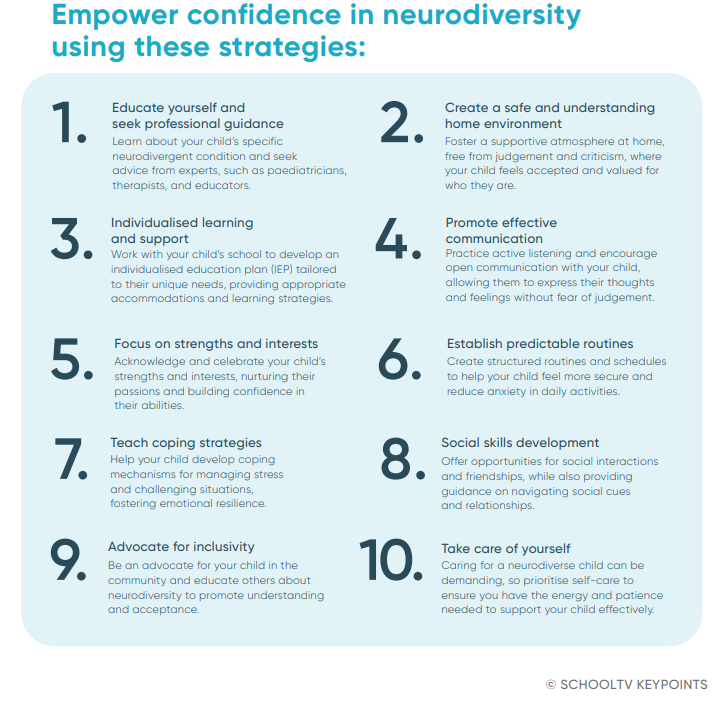
The summer break gives staff, families and our wider school community a break from the tyranny of school routines. We know for some though that breaks in routine are a curse, not a blessing, part of the widely accepted condition that as humans, we are actually very different! Neurodivergence as a concept emerged in the education sphere as recently as the 1990s, and in many ways those whose set-up is divergent from the norm (neurotypical) are still often treated using the ‘deficit’ model, i.e. there is something ‘missing, rather than just being different. Our special report this month is on Neurodiversity and published on the school’s TV service. The report can be found here on the school’s schools website – https://clairescourt.uk.schooltv.me/newsletter/neurodiversity
Neurodiversity emphasises the natural variation in how an individual’s brain functions and how they perceive and interact with the world, leading to diverse ways of learning and communicating. While most young people are neurotypical, some exhibit variations in brain development, such as ADHD, autism or dyslexia, making them neurodivergent.
Embracing neurodiversity involves accepting, celebrating, and supporting neurodivergent children and adolescents without attempting to change or treat their differences. Using respectful language, challenging unhelpful attitudes, avoiding assumptions, and actively promoting inclusivity can help embrace neurodiversity effectively.
Acknowledging the unique ways neurodiverse young people do things and then adapting tasks and activities to ensure their full participation will encourage them to develop strategies that feel natural to them. It will help improve their mental health, wellbeing and sense of self. By recognising and nurturing their strengths, parents and caregivers can contribute to building an inclusive and compassionate society where all young people can thrive.
Learning more about neurodiversity, equips caregivers with insights into effective communication techniques, educational strategies, and parenting approaches tailored to the specific needs of their neurodivergent child. We hope you take time to reflect on the information offered in this month’s edition, and we always welcome your feedback.
If you do have any concerns about the wellbeing of your child, please contact the school when we are back in session for further information or if urgent, please do seek help from a medical professional.
Thirteen years ago, the future direction of English Education was changed by the appointment of Michael Gove as Secretary of State for Education. With the simple click of a question to an AI bot, I can publish the following ‘lowlights’ of his tenure to 2014, in terms of those as they affected the classroom:
Gove’s introduction of the new National Curriculum was met with criticism for its rushed implementation and lack of consultation with educators.
Lack of consultation: Gove was criticized for his top-down approach and limited consultation with educators, parents, and other stakeholders in the education sector.
Decline in creative subjects: The narrowing of the curriculum and emphasis on core academic subjects resulted in a reduced focus on arts, music, and other creative subjects.
Increased emphasis on exams: Gove’s focus on exam results and league tables created a high-pressure environment for both students and teachers, resulting in teaching to the test.
Widening attainment gap: Despite the government’s intention to reduce the attainment gap, under Gove’s tenure, there were concerns about a widening gap between disadvantaged students and their peers.
Removal of mandatory sex education: Gove’s decision to remove the requirement for mandatory sex education in schools was criticized for neglecting the importance of comprehensive sexual education.
In addition, the wider environment of education was seriously damaged as well
Strained teacher relations: His confrontational style and criticism of teachers led to strained relationships with the teaching profession, leading to low morale and strikes.
Funding cuts: Budget reductions in education during Gove’s tenure led to a strain on resources and impacted the quality of education in some schools.
Increased academization: Gove’s promotion of academies and free schools led to concerns about accountability, lack of local authority control, and potential inequality in education provision.
Scrapping of Building Schools for the Future: Gove’s decision to cancel the Building Schools for the Future program resulted in the cancellation of numerous school building projects and left some schools in need of repair and expansion.
The ‘bot’ also summarises 10 possible highlights, and I’ll refer to those later, but ‘mid-flow’ so to speak, there’s nothing to admire about Gove’s bravery in risk taking and radical reform agenda.
The source material for ChatGTP predates the last 2 years, but I can certainly confirm that the arc of 24 months since continues to be very unkind to Mr Gove and the choices he made for our children’s future. Our current Chief Inspector of schools, Amanda Spielman, addressed the House of Lords Education committee yesterday and ‘blamed’ specialisation available at 14 for GCSE, and that we had not yet learned how to make ‘harder subjects’ attractive to girls at 16+ – Spielman, 62, told the committee: “I think some of the people who’ve looked very hard at things like girls’ take-up of subjects like physics have recognised that there is a strand that’s down to individual choice and how you make it attractive to girls to opt for triple science rather than double science. It is a real conundrum without taking away that permissiveness that is a very deeply ingrained property of our system.”
Ms Spielman compounds the felonies from where Mr Gove left off. What the Gove reforms have done is to cause school curricular development to come to a juddering halt. By driving through content reform coupled with the regression to examination is to at a stroke limit the ability of researchers to check whether the reforms have worked for about a decade – back in May 2017, Lord Baker (formerly Secretary of State for Education under Margaret Thatcher) launched an alternative set of proposals in the light of the available evidence then of the ever-onward march of technology and the need for skills development to match. Do please bear in mind that Baker’s reforms in the 1980s supported the development of the GCSEs we now enjoy, uniting a school population that had been previously divided by the 25% who followed O levels and the majority left behind taking either Certificate of Second Education (CSE) or other lower level vocational courses. You can read Lord Baker’s reform agenda here, which makes some very telling points, but in no way is deliverable without establishing an agreement that there is a core methodology that teachers, instructors, educators and parents need to adopt.
Throughout the development of humanity, we have required multiple pathways for the successful development of children’s knowledge, skills and understanding. Genuinely successful schools throughout the world know this, and so apply the clear principles of providing Alternative Instruction within and around the curriculum. The essence of the excellent Early Years Foundation covers 7 stages, and they do really cover the piece, and demand of course that EYFS leaders keep separate the various areas, because they need to be delivered in a rainbow spectrum of ways : Communication and language development. … Physical development. … Personal, social, and emotional development. … Literacy development. … Mathematics. … Understanding the world. … Expressive arts and design.
The trouble is of course, is the Gove/Spielman approach is to ‘inspect’ the success of settings (nurseries/schools) covering this stage (and all the others of primary, secondary and sixth form) via measurable outcomes. No credence at all is given to the successful elements of the programme that are simply unmeasurable. Even worse, you see that inspecting agencies and commercial providers reduce the elements of their approach by combining sections (even if they are uncomfortable cohabitees) thus changing the priorities of the teachers accordingly – here’s one commercial product providers derivative =Literacy, Mathematics, Understanding the World and Expressive Arts and Design.
Correctly spotted dear reader, the setting has been let off having to worry about some of the ABSOLUTE fundamentals that drive successful child development, such as speaking, listening, sharing, collaborating, engaging physically, failing, falling and resilience building. A very good friend and highly respected researcher in her own rights, Professor Pat Preedy has railed against the DfE’s failure to include physical movement and assessments of same in the foundation stage, and even produced for schools a free-to-use resource programme, Movement for Learning, for schools to adopt if they lack the confidence of their own knowledge in this area. Sadly the programme was disrupted by C19 epidemic, DfE lost interest it seems and with so much changeover at the top of Secretaries of State, it’s unclear how this can be reprioritized for the nation.
The requirements for the Alternative Instruction model in schools is so obvious, and we have always needed those AIs to keep up with other developments in society, be they academic, social, technological or even collaborative against individual. How does the latest incarnation of AI fit within my model and what recommendations do I make for schools seeking to adapt?
The most important skills children need to acquire in schools is ‘good oracy’, which is all about speaking and listening out loud together. If children can listen to others, speak about and share their ideas then we have the elements of a successful workplace too. We’ve been running Merlyn Mind, an AI classroom tool in our primary or secondary classrooms for almost 2 years now, and as we merge our junior school classes onto one site in September, we will have Merlyn in every classroom from Year 3 to Year 6. The AI engine (built from the IBM Watson project) only focusses on the data set the teachers wish the children to use, and as a consequence is both safe and enables some genuine child autonomy to their learning. If childrens’ junior education is supported by ubiquitous keyboard & screen, then IT ceases to be a subject that children can fail and becomes yet another tool in their ‘pencil case’.
When 17 Ukrainian children joined our school last May, they had none or very little English, and family backgrounds either completely absent (the children were unaccompanied) or with just a mother, herself with no english either. Educationally, pretty well every one was slipped into the correct year for their age, all were provided with a chromebook, and most had a mobile phone as well. And guess what – almost all the children quickly and successfully embedded into their peer group. Google Translate did most of the heavy lifting, fine tuning from an amazing EAL teacher we have on the staff hlped ,assively of course, who also helped some of the mothers with their baby steps into our language too. The oldest students switched in to those subjects at Sixth Form which were visual or suitably creative to meed those skills, or into content familiar areas such as Business Studies for which the separation by language was perhaps less obviously because of the world-wide harmonisation of trade, marketing and commerce. All 17 are now consummate users of technology, and are capable of asking and answering complex questions in both languages.
Technological change will continue to be with us, as long as humanity is there to push the boundaries. Some technologies are eternal, the wheel for example, others such as the fountain pen one now to be found as an affectation if still in use, yet others typewriters a footnote in history. Of course society needs to worry about cheating, after all even prime ministers can be found out for breaking the rules, so teachers must not set homeworks for children to complete which just require a cut/paste/ask Siri approach. Teaching techniques can be changed (flipping the learning) so that the students are asked to carry out activities at home which are information gathering and skills rehearsal, so that lesson time is used to demonstrate those skills and synthesise some new questions for the next steps along the way. Flipping doesn’t suit many situations and can be ‘gamed’, so having a diversity of approaches in the style bank ensures learning stays active, real and dynamic. Perhaps my biggest caution is to avoid the top&tail approach, where students of design and technology are marked for their design ideas but never make anything, as often can be the case in Food & Nutrition, where their ability to read a product label in a supermarket is valued more than their understanding and physical ability to prepare edible and tasty food safely. I’ve given some obvious examples, but it’s just as likely that children will learn and follow revision guides in English Literature as opposed to reading the book and making their own views clear.
Having lived through Cold War, I am very aware of how dangerous a weaponised world is, though given we survived that with only a few casualties, war used to be a whole lot more dangerous of course. As the use of Artificial Intelligence moves through the gears, from physical holes in physical tokens (paper ticker-tape) to digital ‘tokens’ enabling data to be searched, captured, reshaped and formed into a response in different outputs – the latter very much in its infancy. What we do know is that for IA to work, the algorithm must be able to take risks; as a consequence it frequently writes factually incorrect material, often with the ‘sources’ completely made up, even ignoring the instructions you give it! As a consequence, and in whatever domain decision makers, quality assurers and integrity checkers work, they’ll need to have the educational background and experience in the specific industry concerned. That’s why it is so dangerous for successful business leaders to jump channels, even more dangerous when they leave the sector and enter for example into surgery or social work with no practical experience.
Every adult decision maker has a view about education, as in whatever way they have been a child, they have learned ‘stuff’, and most of that happened in schools! Unfortunately, any individual’s memories of what worked for them are in no way scientifically endorsed, and certainly cannot be extrapolated out into successful approach for the wider society at large. What the chief inspector of schools should be saying is that ‘no matter what subject a child chooses to pursue when educational choices are available, those channels have to include lots of different skills, technologies and approaches. Focussing specifically on my school, every artist will use hands, crayon, brush, camera, screen and develop both analogue and digital skills. Sporting activities will include physical athleticism, and include mathematical reasoning, data handling and instructional coaching techniques. Actors and musicians will perform, learn, practice, record, digitise, blend their (and others) work, in-front and back-stage. My research groups of 14/15 year olds in Higher Project Qualification have used Artificial Intelligence and Alternative Instructional approaches, gathered insights into ethics and journalism, learned more about the ‘real world’ because of their research than they would have done if they had set out to study the ‘real world’.
So to conclude, all children and adults must be able to follow the same broad spectrum approach through their chosen years of education. Current education leaders call this levelling-up, but all too often they design an next stage model that embraces levelling down. DfE and Oftsed’s activities almost always do both, because they proscribe too much, fund it too little, and blame those who are are successful across the age range as taking unfair advantage in some way or other. The easy A2I (aid to information) for my recommendation is to pursue the healthiest approach you can find, which will include lots of variety and yet seek to be well-balanced.
Appendix – Gove’s 10 Good things from ChatGPT and my commentary to the right.
10 possibly Good Things
1. Focus on core subjects: Gove’s emphasis on core academic subjects aimed to ensure a strong foundation of knowledge in subjects like English, mathematics, and science.
Sadly mission creep moved over all the major curriculum areas, so we saw the destruction of the broad based, arts, crafts, design, drama, music and technological strands, losing massive amounts of subject expertise in the process.
2. Increased school autonomy: His promotion of academies and free schools provided greater autonomy and flexibility to individual schools to innovate and respond to local needs.
Autonomy only really works when you are winning and get the financial resources to back it up. Vulnerable schools have really struggled to recover from the loss of local authority leadership and expertise.
3. Introduction of the English Baccalaureate: Gove’s introduction of the English Baccalaureate (EBacc) aimed to encourage students to study a broader range of subjects, including humanities and languages.
This is said to be good, but as identified everywhere else narrowed and constricted choice and opportunity.
4. Higher standards for teachers: Gove’s reforms included raising the entry requirements for teaching programs, aiming to attract high-quality individuals into the teaching profession.
The teacher shortage is now so acute, across the country, Gove’s rhetoric was never followed up with the professional pay grade to go with the aspiration.
5. Phonics emphasis in primary education: Gove’s support for the use of systematic phonics instruction in primary schools aimed to improve early literacy skills.
I quote from an unbiased international journalist: A different approachWe found that England’s emphasis on synthetic phonics is different compared to high performing English language countries in the Programme for International Student Assessment (PISA) tests. None of these other countries mandate synthetic phonics. Canada has consistently performed the best of English language dominant nations in the PISA tests. Canada’s approach at national and state level is very different from England’s because it emphasizes whole texts, and phonics is not emphasized as much. The approach to teaching reading in England means that children in England are unlikely to be learning to read as effectively as they should be. Teachers, children, and their parents need a more balanced approach to the teaching of reading.
6. Curriculum reform: The introduction of a new National Curriculum, although controversial, aimed to provide a more rigorous and coherent framework for teaching and learning.
The reform really meant narrowing, focussing resources on a thinner, less diverse curriculum, to be pursued to indicate ‘we as a country’ had returned to being ‘academic’.
7. Increased focus on school discipline: Gove’s reforms aimed to improve school discipline and behaviour, supporting teachers in maintaining a conducive learning environment.
This did not need Mr Gove’s reforms – it’s self-evidently true that ‘well-behaved’ schools do better in exams. The Government behaviour Tsar, Tom Bennett often damns ‘trendy’ teaching, including using digital tools as being ‘trendy techniques’. 50% of Bennet’s recommendations are good, but even he doesn’t know which 50%!
8. Free school meals provision: Gove supported the extension of free school meals for all infants in English primary schools, aiming to improve child nutrition and well-being.
But Gove never funded the expansion, and nor has anyone else subsequently; Marcus Rashford has led the ‘call-out’ on government here and still we fail!
9. Teacher training reforms: Gove’s reforms included the establishment of School Direct, a teacher training program that aimed to improve the quality of teacher training and classroom practice.
The byline for this programme is ‘Teach First, Do Something better in Government next’. We’ve a growing number of trainees who have entered teaching by the side door, stay just long enough to validate their credentials and then move on into government roles and corporate networks. The conspiracy theorists are worried here
10. Recognition of character education: Gove emphasized the importance of character education, focusing on personal and social development alongside academic achievement.
The principles of Chracter Education are very worthy, but really alongside the other components within the teacher’s toolkit be woven into the work we do. Teachers need to be directed in some areas though – how ‘green’ or ‘woke’ can we permit our ‘agenda’ to be without troubling society and its norms of behaviour and accepted approaches.
So, over the last 2 days at Claires Court Junior Boys, 2 casts of some 90 boys led by our Head of Music Emma Stevenson pulled of 4 showings of the most amazing junior school production I have ever attended. The scale of difficulty cannot be overemphasised, singing in tongues, moving choreographically with mechanical costumes, acting in the spirit of the great emotions the storyline brings and staying in character throughout, one cast of stars being the supporting cast for the other and performing faultlessly for 2 hours. Honestly it brought more than a few prickles to my skin and tears to my eyes. In short, I and 4 audiences were genuinely blown away and of course transported to the plains of Africa, where the story is set.
For the most complex of human activities to be successful, they have to be rehearsed, iteratively repeated for many hours before they become second nature. Early steps are slow, because the new pathways that need to be created linking all the senses, fine and gross motor control and body movements take time to get learned and embedded. We now know this arises because the learning process lays fatty sheaths around the nerve axons, enabling the messages to travel faster, quicker and more autonomously. The hardest thing to learn is to play a musical instrument, yet in turn because it gives you visual and auditory feedback, the repeated hours of practice lay down even thicker layers of insulation, essentially brining mastery to the instrument.
Teaching is not the requirement by the way, but learning and practice are, and in recent UK studies, researches have been able to prove that 3 hours of instrumental practice quickly make you 10-15% cleverer. What’s not to like, I hear you say, and I’d say ‘nothing’ – it’s a slam dunk and we have not needed 21st century research to confirm that which educators have known for generations. What is required is the time, space and culture around children’s learning environment (that’s a grand set of words for school), and that space must be open enough not just for the teaching to happen but for there to be the time and space for the learning to happen too.
Whether you look at my junior or senior school provision, children’s extended day stretches from 8 til 5pm and beyond, with so many opportunities for informal rehearsal and private practice. The science of learning makes it quite obvious that mechanical dragooning can cause troops to stay in line, but that’s not the same as creating a major stage production with 9 and 10 normal mortals, who need to be able to practice their roars and squeaks in their own ways.
It’s of course a huge responsibility to run a school and make sure the environment is fit for learning; it’s a great pride I take in realising that my colleagues are so capable of demonstrating every working week that the evidence of children, boys and girls getting cleverer is self-evident for all to see. In the Lion King, Pumbaa the Warthog teaches us all his core philosophy of life – Hakuna Matata. I leave the lyrics of this for you to read – I’m off on half-term to enjoy my own next steps in the Circle of Life:
Hakuna Matata! What a wonderful phrase Hakuna Matata! Ain’t no passing craze It means no worries For the rest of your days It’s our problem-free philosophy Hakuna Matata!
Because parenting doesn’t come with instructions, SchoolTV is a wellbeing resource implemented at our school to help support you in the challenges of modern-day parenting. Parenting is a learning journey and it’s easy to feel stressed and overwhelmed when faced with raising happy, well and resilient young people today.
Every family has experienced some sort of difficulty or adversity in recent times, some more than others. As mental health concerns continue to rise, there have been some alarming statistics reported in relation to the mental health and wellbeing of young people. Unfortunately, the blueprint for parenting is often based on our own experiences, but this is no longer fit for purpose in raising children as citizens of tomorrow. Parents and caregivers play a vital role in providing the guidance needed to support children and adolescents as they reframe their worries and focus more on the things they can control in their life.
In this Special Report, we are seeking parent participation through a short survey. The survey is designed to provide a barometer to help gauge the state of student wellbeing within our community. We encourage you to take a few moments to complete the survey as this will help our school know the nature and extent of your concerns and determine how best we can support families in the months ahead. Responses remain anonymous and will only be reported on an aggregated basis. You are asked to base your responses on observations made in the last 12 months.
By working together we can continue to build relationships, foster connections, enable understanding and break down barriers as we navigate a pathway towards better mental health and wellbeing for all students. Please reflect on the information offered in this Special Report, and as always, we welcome your feedback. If this raises any concerns for you or your child, please reach out to the school or seek professional medical advice.
We hope you take time to reflect on the information offered in this Special Report, and as always, we welcome your feedback.
If you do have any concerns about the wellbeing of your child, please contact the school for further information or seek medical or professional help.
The PTA are delighted to announce that the table reservations for the annual ball are now available. So, get your table guests ready! We have managed to keep the ticket prices the same as last year at £85 each which gives you a three course meal and a great evening.
Each table will require a designated ‘Table Leader’. As ‘Table Leader’ you will be required to coordinate the payment for the other guests on the table.
‘Table Leaders’ must reserve a table for either 10 or 12 people by sending an email to pta.ccgs@gmail.com including ‘Table Leader’ name, table of 10 or 12 and contact number.
For those that do not have enough to make up a table of 10 we can create a mixer table with other guests. Please advise this via email pta.ccgs@gmail.com
Information on how to pay for the table will follow but this year we will have a dedicated payment system.
On receipt of payment and nearer the time, the table leader will receive a booking form which needs to be returned with guest names and allergy information.
So, please, PLEASE, PLEASE consider joining our Summer BIG TOP ball. The funds that the PTA make available through their efforts have this year made the most remarkable difference to
Our 17 Ukrainian students (now 14), who found the safest of settings for themselves at Claires Court, and our work with English tuition, pastoral support through the employment of a Ukrainian national qualified teacher to support teaching and learning and also family communications;
a host of projects at local level, most recently at Seniors, the most modern of keyboards to implement our new creative music opportunities for boys and girls;
our many and various community activities in school, social events, prize giving and speech days, through the provision of human hands to support, funds to provide awards and prizes as well as
the central background to the PTA Foundation activities, including the arrangements that enable the Summer Ball, the Fete and Christmas market and the Autumn Fireworks event.
I’ve worked with the PTA board (in the main made up of current and former parents), amazing people led brilliantly by their President, Phyllis Avery MBE, and now more than ever, their efforts deserve our 200% support!!!
The TES (Times Educational Supplement as was) is the profession’s major journal which is dedicated to supporting the world’s teachers. “Our mission is to enable great teaching by helping educators to find the tools and technology they need.” This week TES published the ‘School Wellbeing report’, which is largely reporting back for the teaching professionals and their views aligned to their work. The report reminds its readers that we do have to worry about retention of colleagues within the sector, though is optimistic in confirming that teachers do wish to care for the children and colleagues they work with, and that good relationships are key to successful outcomes arising.
Regular readers of my blog will know that the school has recently adopted SchoolsTV to provide its own media channel providing a one stop shop for parents and our community, which will over the next few months provide we hope a concerted approach to declutter the advice the now certainly can overwhelm us, and to provide a sense of calm and focus to our lived experience.
I walk. Not every night, because I might very much have been on my feet at work and at home doing ‘other’ things. But when I walk, sometimes I let my brain do the ‘talking’, and step by relentless step for the 45 minutes or so the ‘white noise’ settles down and my thoughts and priorities seem more aligned. As often as not though, I’ll stick a podcast on, and listen to BBC or some other channel that I find of interest and value. I’ve always been a bit geeky, so science and/or history work best for me, building knowledge and understanding in equal measure.
From a professional point of view, I like a range of podcasters and include ‘The Therapy Edit’ with Anna Mathur in my channel listings. After a seizure I experienced last August, I recognised I had ceased to value sleep sufficiently, and so I have recovered same by banning my phone from the bedroom and by imposing a 60 minute shutdown on use of digital screens inc TV before going to bed. I’ve also recognised that alcohol needs to be consumed on a minority of days and in moderation for the same reasons – both badly affect the hormonal balance, the biological cycles when sleep happens and exclude the natural routines that good sleep hygiene requires. You can catch Mathur talking to Dr Ranj Singh on this Sleep podcast, and (skipping the first 2 minutes of Lloyds bank advertising) gives you a good insight into the topic as well as Mathur’s easy listening style. Our own SchoolTV channel covers the full sweep of advice here.
More recently I have caught Anna Mathur (a pyscho therapist) being referenced by Fiona Cowood writing in the Telegraph in an article she has entitled “You could do a lot worse than being a lazy parent – and here’s how’. Sadly the article is behind a pay wall, but it highlights the fabulous advice that parents of children in the 2020s need to heed more of, which is “Do less”. That’s not an admonition of the work focussed beasts we may have become (I’ve always worked flat out), but actually advice to parents to adopt a lazier more hands-off style of parenting. Mathur makes the same point in the article, highlighting the twin curses being the ‘guilt’ and ‘too much research’.
The rise in mental health disorders reported both here and across the pond is linked the child’s loss of freedoms and abilities to roam. Dr Vyas-Lee, co-founder of the mental health clinic Kove writes “We definitely have a problem with children’s resilience; it’s about building up a tolerance for things being hard or difficult. If you never fall, or if everytime you call someone catches you, where is the resilience building?’ She continues “It’s useful to be reminded that allowing our kids to fail is good for them. It’s much better to spend 20 minutes one to one with your children that to give yourself over to their every whim day in, day out. Mathur adds “Children’s brains need to be bored, because those are the cracks where creativity, resilience and self-esteem grow.’
Of course life’s problems are more than just the above, but having had our lives turned upside down by #lockdown, #austerity and #working_from_home, we do need to reconvene and sort out getting the compartments of a well-ordered life back into place. Working from home is often a great reality for many adults, so separating workspace and playspace is vital, and enabling switchovers from one phae to the next is vital. Mealtimes need to become properly re-established ; the number of families that have abandoned eating together causes as much alarm in my mind as poor sleep hygiene and excessive screentime.
All of the experts I list above and so many more shine a light on us all to ‘DO LESS, RELAX, TAKE SOME TIME, SLEEP WELL’. And how did my Easter break go you might ask? A mix of schoolwork, carpentry, allotment, family time and much sleep too, thank you.
Claires Court’s own primary and secondary Wellbeing survey will be further advertised next Friday, once we have every body back into the ‘swim’ – catch that here on https://clairescourt.uk.schooltv.me/, Primary or Secondary.
In terms of general participation and elite competition, Claires Court has returned in full, firing on all cylinders with (to name but a few) the Senior Music concert on Monday evening this week, our House cross country championships, and the huge success of the senior sailing squad in winning the National Schools Sailing Team racing championships a weekend ago. The children and staff are clearly benefiting from the myriad opportunities we now have in a post covid world – alas too many to mention all in this note.
We welcomed back Mr Justin Spanswick earlier this week as our independent safeguarding advisor. Mr Spanswick brings back with him newly acquired knowledge of the wider educational world, one in which he is making a very strong mark which we are all proud of. He was able to spend some time on all sites, as well as visit our ‘burgeoning outpost’ of talent based at the National Sports Centre at Bisham.
I have been invited to represent Claires Court as part of an interest group of digital experts from across the globe, at the House of Lords on Wednesday afternoon. Here I will be highlighting our ongoing digital technology journey and our baby steps with Merlyn Mind into the use of Artificial Intelligence in the classroom. AI is clearly a game changer, and will permit even closer the fine tuning of teaching and learning to meet individual needs. However, one of the major lessons learned from the enforced lock-down of schools is that children need to work with others, to collaborate and to create the ‘intellectual biome’ that makes schools such vibrant places in which they can both learn and enjoy their childhood.
We recognise your needs as parents when you ask for our advice, telling us of your frustrating searches through many online tools for pertinent videos or the experience of others. We are delighted to announce the launch of Claires Court’s SchoolTV channel providing a substantial database of helpful information and advice for parents – https://clairescourt.uk.schooltv.me/. For now we are just one of a dozen or so schools in the UK embracing this service, but it will rapidly grow. As it does, we will commence focussing the resources so you can quickly see where we as a school are currently putting emphasis. Please take the opportunity over the Easter break and give the site a good reconnoitre – as ever, I’d love to hear your feedback – jtw@clairescourt.net.
Our inaugural survey starts with ‘The Wellbeing Barometer’ Special Report – whilst there are plenty of other special reports published, we are starting with only 2, and on the same topic. Please choose either primary or secondary for the age and stage of your children.
‘The Wellbeing Barometer’ requires parent, guardian and caregiver participation to answer a series of multiple choice survey questions. The information gathered will enable our school to establish a baseline of student wellbeing and assist in focussing on some of the key issues concerning families in order to highlight where further assistance may be required. Responses to all poll questions remain anonymous and will only be reported on an aggregated basis.
Responses to all poll questions remain anonymous and will only be reported on an aggregated basis.
Beyond that, when Easter’s out and the Summer term is in, we’ll return to look at the outcomes of this special pair of reports.
In the meantime, if you can, please enjoy some R&R over the next 2 weeks and see you back at school on Wednesday 19 April 2023.
As our charity weeks of activity commence at Claires Court, sadly it seems we have disasters requiring support across the globe. Being proactive in our help not just facilitates the support services now to be further resourced, but helps reuilding the resilience of local communities as well as their reserves of physical items and safety of their families.
The photo above shows Malawians in Blantyre impacted by Storm Freddy. A great colleague, friend and former pupil Charlie Bretherton is leading from the front to rebuild his school and wider community – if you can, please do help, a huge, epic crisis.
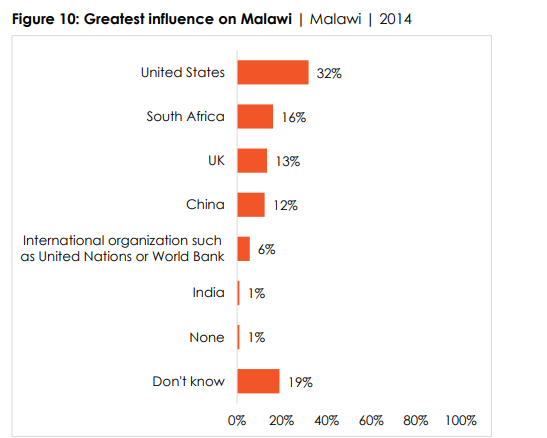
Malwai is one of the great British Empire colonies and now member of the British Commonwealth. As Britain choses to ease its support of its former colonies, it leaves the country prey to the attractions offered by other world powers, such as China. Now indebted to the Chinese, the Malawi government needs all the help it can get, and the UK’s influence is 3rd only behind USA and South Africa. You can read a sensible scholarly article on the current state of the nation here.
I am very much in the camp of invest now in Foreign Aid to reduce the longer term calls on our country’s generosity when displaced refugees make it through to migration at Dover. We have for example almost 400 doctors and nurses from Malawi, and schools such as Hillview International school, where Charlie is headteacher are providing amazing routes to academic success that in the long term will benefit both English speaking nations. Here’s his voice from their website:
“
I am delighted to welcome you to our school. At Hillview International School we offer, with pride, an exceptional education from Pre-Nursery through to IGCSE, in which individual and community relationships are cultivated, where innovative learning platforms and pedagogies are used and where values and character are nurtured alongside academic development.
As the only single streamed school in the Blantyre area, we offer low student/teacher ratios and excellent levels of individual attention within a beautiful campus allowing a seamless transition from Nursery to Primary and High School.
At Hillview we aim to provide exceptionally high standards of education in line with the National Curriculum of England and the Cambridge International Curriculum. Our sporting and club experiences are designed to challenge and delight children.
Our Nursery, Primary and High Schools are a mix of modern and traditional well equipped and spacious classrooms, with a focus on developing the whole child’s potential through exciting learning, sports and family inclusion, ensuring children are at the heart of all we do. With our caring and dedicated staff teams, supportive governors and involved parents we have created a happy and engaging place to work and learn.
Please do not hesitate to get in touch for an opportunity to meet, visit the school or enquire more about our schools and their facilities.
I look forward to meeting you and welcoming you into the Hillview family.
Our fundamental aim for Claires Court has always been to ensure parity of education, opportunity and equality through the breadth of the curriculum and our teaching practice. To oversee this in the primary phase, last year we promoted Mrs Kirby to the new position of Head of Juniors (Boys, Girls and Nursery). Since then, together with her leadership team, she has successfully developed the junior curriculum including forest school opportunities, increasing the mixed sporting fixtures played and offering joint educational off-site visits.
We have now reached an exciting point where, with the junior curriculum united, we can accommodate both boys and girls to share the same space as well. After discussion with Mrs Kirby, our intention is therefore to relocate Junior Girls to the Junior Boys site at Ridgeway from the start of the Autumn Term, September 2023. The Nursery, Senior Girls and the Sixth Form will remain at College Avenue and Senior Boys at Ray Mill Road East by the river. The current space used by Junior Girls will be allocated to the growing needs of our Senior Girls and Sixth Form and all our school sites will continue to benefit from future investment and improvements.
Future developments
From September 2023, our new Reception classes will be coeducational with both boys and girls taught together. We will continue to teach your child/ren in a single sex capacity until they leave the school in Year 6 and we aim for Claires Court Juniors to be fully coeducational from 2029. Senior Boys and Senior Girls will remain gender separated and there are no plans to alter this or the arrangements for the coed Nursery and Sixth Form.
What changes will there be for my child?
We know this may come as a surprise to you and we want to reassure you that there will be no change to your child’s education. The only difference will be the space they learn in and they will now share social times such as break, lunch, pre and post school activities.
Staffing
Our staffing and leadership structure will not change as a result of this move and you will have the chance to meet the teachers who will be teaching your children across the curriculum in due course.
Uniform
We will undertake a review of our uniform, aided by both pupils and parents. The likely timeline for this is to start during the next Academic Year (2023/24) for full introduction in 2025.
Practical Matters
We know that there will be many questions so please join Mrs Kirby on an online Google Meet at 1pm on Wednesday 1 March (this will also be recorded for those who cannot join). Please can any questions be sent in advance (by the end of Monday 27 February) to juniors@clairescourt.net and Mrs Kirby will endeavour to answer them for you online. If you would prefer to speak to us, or a member of the leadership team, to discuss any individual circumstances, please contact the same email address and Mrs Aquilina will arrange a convenient time.
For information in advance, Mrs Kirby will be covering;
The planned integration of both boys and girls together
Practical information; Drop off/pick up arrangements, changing facilities, extra curricular activities and uniform
Classroom developments
A date for parents to visit
Mrs Kirby will be personally announcing this news to our junior pupils tomorrow (Friday, 24 February) in special assemblies. She will explain how we will support the transition to learning together and answer any questions that the children have.
As many of you will know, our previous plan was to move all our operations on to a new campus at Ridgeway. Although this was denied, our strategic aim still remains in that we would like to educate the Juniors on the same site together. Coupled with a changing market and an expressed wish for a coed environment at this level, we are fortunate to have the capacity and agility to respond to this exciting opportunity.
On Thursday evening, the Principals broadcast the above content to the school staff body, and we are so delighted with the overwhelmingly positive reception our news has bring…
Hugh Wilding, Administrative Principal James Wilding, Academic Principal
A family in our community run a brilliant bakery and coffee shop in Maidenhead. They have family, friends and relatives in the region affected by the recent earthquake. I am pleased to share this with you all. Please be generous.
“Dear Mr. Wilding,
I wanted to get in touch with you asking for a potential help from Claires Court Schools for our fund raising event at bakedd artisan bakery for the people who are suffering from the recent earthquake that happened in East part of Turkey.
As we have posted on our social media and announced on BBC Berkshire and Maidenhead Advertiser, we will be organising a fund raiser event at bakedd tomorrow and we will donate all our sales proceeds to a non profit charity called Ahbap (https://ahbap.org) who are helping the people in need.
I would like to ask if you would be able to execute a donation event like Free Jeans day at Claires Court Schools to help us spread the word and help to create more donations for us to send to Turkey.
We are planning to send all the donations and the sales proceeds by Monday next week, that’s why it is such a short notice.
This is what happened @bakedd yesterday🙏🙏🙏 We don’t know where to start ….
First of all we would like to thank our team for their outstanding efforts and their generous contributions to our donation campaign. To YOU our wonderful bakedd community who have not left us alone since the day we opened, You are all AMAZING!!! To our friends, to everyone who heard our interview on the radio and came to donate, to the owner of @riodeli2020 who unexpectedly handed us an envelope with a smiling face, to our young friends at @popeyesgrooming who would support us whenever we needed them, To @wessexpharmacy , to @prestoitalian , to Mr Wilding from @clairescourtschool ,@woodfloorjunkie In total we raised 🌟£8683.40🌟through our sales proceeds and the generous donations yesterday !!!!! We will keep the donation box on our counter until Saturday and send all the money to @ahbap charity on Monday… THANK YOU 🙏 Gul & Emre & Serdar #turkeyearthquake #ahbap







 A Principled view