Most parents love sharing photos of their children with friends and family. But remember – pictures you share online could be out there for ever. Learn how to protect your child whilst staying social.
Are you a ‘sharent’?
For many children online life begins before birth, when their excited parents-to-be post ultrasound images on social media. A recent report stated that 42% of parents share photos of their children online, with half of these parents posting photos at least once a month (Ofcom, 2017). For parent bloggers the frequency of posting photos is likely to be more.
The internet can provide fantastic tools for sharing special moments from your child’s early years with family and friends. And online parenting forums, networks and blogs often provide valuable support and reassurance through parenting’s ups and downs.
But before you share, give thought to exactly who can see photos and comments featuring your child, and how this online footprint might affect your child in years to come.
What should you consider?
Who’s looking? When did you last check your privacy settings? On most social networks the default is that any other service user can access your pictures, which may also appear in internet search results. Remember that anyone who can see a photo can also download or screenshot it, and could go on to share it.
What else are you sharing? You might be sharing more than what’s in the post. As default, many cameras, phones and apps tag posts and photos with ‘meta-data’ which can include location details and other identifying information. This is potentially risky for any child, but poses particular risks for vulnerable children such as those who have been fostered or adopted and could be sought online by members of their birth family.
Ownership Under the terms and conditions of most social networks, when you share a photo you licence the network to use and reproduce your image, and grant it the right to licence it for use by third parties. It could be used for commercial purposes, a point deliberately highlighted by the Danish company Koppie Koppie, which sold mugs featuring freely downloaded pictures of young children. Another online activity which has distressed parents and carers is the ‘Baby Role Play’game played by some Instagram users, who repost photographs of other people’s children and create fictional identities based on them.
Their digital tattoo Every publically accessible image or comment featuring your child contributes to a public image which will follow them into the future. That apocalyptic nappy incident might make for a hilarious tweet now, but if it comes to light when they’re older, how could it affect the way they feel about themselves, or you, or how others see them? Could their online childhood become an issue if they are seeking a job, or a relationship, or even election to public office?
Your child’s right to privacy Psychologist Aric Sigman has expressed concerns about the impact on children of the eroding boundaries between private and public online: “Part of the way a child forms their identity involves having private information about themselves that remains private.”
Parent bloggers
If you’ve set up a blog to share your parenting experiences with a wider audience, you’ve probably already given plenty of thought to issues like your child’s privacy, managing their digital footprint, ownership and copyright, and commercialism.
Strategies adopted by some successful bloggers include: anonymising their own and their child’s identities; involving their child in the material you create and only posting material they are happy with; and carefully monitoring their child’s online presence, for example by checking their name in search aggregator services or setting up a Google Alert for their name.
Dear Reader, before current parents being to froth at the mouth at my choice of Blog title for the new Decade of the 21st Century, I must quickly make clear that the title is not of my making, but the words written by Katharine Birbalsingh, headmistress and founder of Michaela Community School, Wembley Park. I’ve met Katharine on a couple of occasions in the distant past, just when she was articulating what kind of Free school she would like to establish, and indeed we loaned her the projection kit so she could run some presentations for potential future parents.
It’s my *byline to confirm that this approach is particularly important in the 2020s, at a time when family, society, life itself might possibly be becoming even more complicated. Going back to the 1960s, when I was growing up as a child reaching for his teenage years, my extended family and real friends tended to put me right when I was in disagreement with my father or mother, or indeed any one of the many teachers who had responsibility for my care at school. Inevitably I was contained within a bubble of societal expectations that constrained and informed my actions. Obviously I knew by Summer of 1966 that England was the best football side in the world, that ‘pop’ music was a new medium in which I could become an expert way ahead of my parents, that ‘free love’ was something to find out more about, because ‘it’ was all over the popular press and that if I did wander off into the woods, I was unlikely to meet something nasty there. The nearest point of call to the ‘matrix’ was the red telephone box down the road, and a punishingly high cash tariff in loose change should you actually choose to make a call.
I have a very clear memory that by age 17 (when I completed my A levels) many good habits had become permanently ingrained. Good handwriting was completely expected of me, and I show colleagues now my exercise books when I was aged 8 and 9, and they are amazed at the high quality of fountain pen ink writing therein. We spent hours learning to handwrite, and every lesson we took was a handwriting lesson. Mathematics was a different language, and learning to draw diagrams, using a fountain pen upside down, with a ruler equally inverted, to keep the ink lines thin and to prevent capillary attraction of the liquid to the wood was a skill we had to master. Without calculators we had to master the use of logarithm tables and slide rules, antiquated mechanical devices that were more than a nod to the alethiometer of ‘His Dark Material’s’ fame. I don’t joke when I say that the craft skills to pass A level Sciences were really quite intense; the practicals were monstrously difficult, making extensive use of the laboratory apparatus seen as a backdrop to Frankenstein movies and their ilk. In short, as there were few opportunities to waste time, we learned to like practicing using the protractor and draw accurately, because work demanded it and we did not actually like having to ‘DO IT AGAIN’!
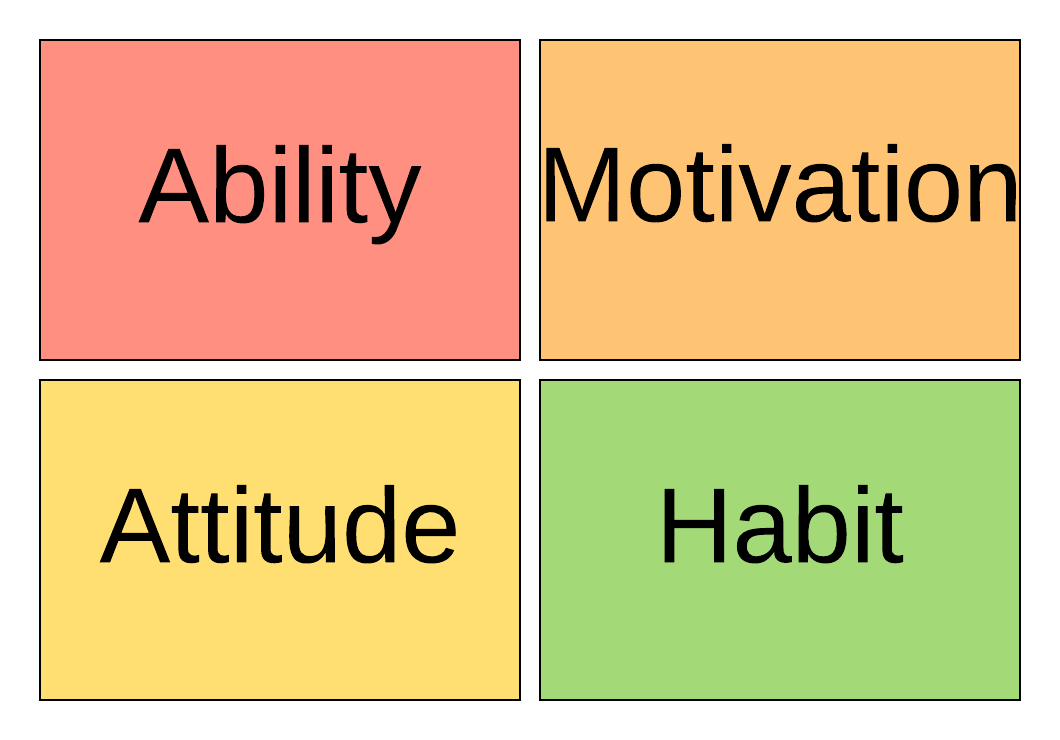
It seems to me there are 4 quadrants to success at school, those best shown by the graphic below:
At my first assembly of the term this morning, I re-introduced this image to Senior Boys, highlighting that none of us can achieve our ambitions unless we learn the value of each of all 4 elements. The greatest in every field of human endeavour always reference the value of practice in making a skill or ability perfect and permanent. Once a bike has been learned to ride, or a car driven, the skills are in place and can be readily recalled. But getting there is the journey that needs to be made, involving the falling off, the bruising of knees, the knocked bumper or a red light ‘run’. I shared a showreel of the latest ‘Alumni recruits’ to my staircase showreel, all stills except a short video of Tim Harbour creating his music track ‘Made of Paper‘ to emphasise this point. But I could have shown other of this term’s recruits, Phil Clapp choosing to break the Skierg World record , or Michael Mcquhae’s B-Reel company’s film work, this one giving athletes a platform for their own voice, or how Anton Jerges managed to recreate the League of Legends battle arena across 3000 square metres of ExCel London including a 500 person LAN gaming area, live streaming, and global broadcasts, linked in with live announcements from Global HQ in the US, live performances and an after show party. Gulp.
The skills, talents, imagination and perspiration on show highlight just how much of success comes down to repetitive hard work, put in over a sustained period of time. Yes of course there are some short cuts, but that’s of the cut-and-paste variety when iterative activities are needed. What’s emerged in recent years across the world is a sense that learners should be able make use of short cuts to avoid the hard yards that otherwise help shape the learning experience. The epidemic rise of plagiarism for university and school coursework is one of the most obvious signs that cheating is supported in ways it has not been hithertoo. This Guardian article highlights the growth in legitimate private tuition outside of schools in the country, with somewhere between 27% and 41% making use of such services, and highlights just how big an ‘arms race’ now exists to raise achievement on paper. The same newspaper carried this story last month of the exponential rise in cheating through the use of technology in exam rooms in schools, plus the hacking of school systems to steal exam papers and the use of social media to ‘sell’ cheat sheets to exam candidates.
Parents and Schools are clearly entitled to disagree with the methods being used in school, and such conflict is often a useful safety mechanism that leads to school improvement. Conflict is not Combat though; here’s Birbalsingh on the matter ” When you go marching in to “give that teacher a piece of your mind”, all you are doing is letting off steam and seemingly taking your child’s side. Yes, teachers make mistakes. But do you really want to win the battle and lose the war? Do not underestimate the power of the relationship between teacher and pupil and how much you as a parent can influence it. Sometimes waiting, biting your tongue and thinking is the best strategy. “
She goes on to write “Children depend on their parents to expect the very best of them. Being a good parent does not mean indulging your child’s every whim. It means making sensible decisions and pushing back when your child is behaving like a child. Kids are kids. It is what makes them so adorable. But a good parent needs to trust their school if the child is to succeed.“
Why consensus between school and home is more important than ever in the 2020s is because children are not less supported then before, but supported differently by the countless thousands of opinions out there they can secure from their extended virtual ‘friends’ to demonstrate the clear ‘unreasonableness of family and school’. With so many more families being divided and united in different ways, through divorce, separation and repartnering, ‘kids’ are pretty good at squeezing through the gaps and getting their own way between parents and/or schools who might be in disagreement. It’s scary too how quickly children can find short-cuts on the ‘net’, and learn really quickly that the ‘answers are out there’, just ‘copy and paste’ to pass the mark, or ‘pay the money’ for drugs and worse to be dropped outside your house. The explosion in modern day slavery, county lines, exploitation and ‘underage’ pornography has made children more vulnerable than ever. As the letter I endorsed from every secondary headteacher to their communities in Buckinghamshire made clear, the epidemic is real, here and in every layer of our community.
Whether you are a parent or teacher, neither or perhaps even both, it’s worth bearing in mind that consensus and agreement builds harmony amongst adults, tightens our ranks and provides for a better safety net for all. And if ever there was a cautionary tale to be told on how inventing new solutions develops new problems, it is in the rise of Conflict Resolution Careers in the world of work! In the past I would have called this solving arguments and providing solutions, but it’s clearly become a big business in the adult workplace, and inevitably is cascading into family and school life too. Company executives now talk of an epidemic of conflict emerging, perhaps because ‘conflict managers’ need ‘conflicts’ to resolve. Schools may for ever been regarded as ‘conflict zones’ but actually they are not; education may be the most complex of all human activities, but children and teachers value hugely fairness and the value of arbitration and peace-making. In recent days I can speak out firmly in favour of our own parent community who have communicated rapidly and honestly on matters of concern taking place over the Christmas break, because children (or parents) have put themselves at risk and trusting (rightly) that sharing such information precipitates the ‘right’ support ‘right’, and from the get-go.
I sense that as we enter the twenties our country has reached a consensus (even if pro-tem) about its future, and has now resolved to do its best. I was heartened at the close of today’s assembly that boys young and old came to speak to me about their hopes and optimisms, and thank me for starting off the decade on such a positive note. That’s good noticing and well done them.
Today’s assembly show-real of ideas can be found here. The short football film was to highlight the arrival of ball skills that can only arise through hours of practice.
Our Carol Services follow a shortened version of the Service of Nine Lessons with Carols, first drawn up by Edward Benson when Bishop of Truro for use in his cathedral. It was simplified and adapted for use in the chapel of King’s College, Cambridge, in 1918 by the Dean, Eric Milner-White, who wrote this opening to our service:
“Beloved in Christ, be it this Christmastide our care and delight to hear again the message of the angels, and in heart and mind to go even unto Bethlehem and see this thing which is come to pass, and the Babe lying in a manger. Therefore let us read and mark in Holy Scripture the tale of the loving purposes of God from the first days of our disobedience unto the glorious redemption brought us by this Holy Child.”
Below I write the Bidding prayers used today, spoken in different ways by either Aiden & Grace or Josh & Issy, superbly and most movingly.
“The story of Jesus Christ and his birth 2000 years ago is one of the greatest stories ever told, known across the globe. Whilst Bethlehem of Galilee was the town of his birth, his country was known then as Judea, which whilst known as a Kingdom (as Britain is today), with its monarch King Herod, the power of the land was held by the colonising Roman Army, governed by Quirinius. Quirinius was governor of the neighbouring country, Syria and had been given the task by the Roman Emperor, Augustus to carry out a census of the numbers of people living in Judea, for the purposes of government to collect taxes from the population. Compared with Joseph, Mary and their baby Jesus, our own circumstances seem fairly comfortable really. Yet much of the recent election story has been on similar themes, on providing services for health and education, to shelter the homeless and to worry about refugees and support their presence in our country. The Christmas message of the birth of our Lord Jesus Christ promises us peace on earth and goodwill among all his people.“
“Let’s us also recognise that our new national government, together with its partner international organisations play their part to support and provide all of our citizens here in the UK and across the world, with comfort, hope, medical aid and human rights support. We ask that all those with power and influence will work together to make it possible to live in security and peace. Lord hear us“
“We as individuals can play our part; as our Sixth Form so ably demonstrated through their choice to visit The Gambia, doing their best through the raising of funds and materials, to work in the new school being developed in Brufut over half-term .
It’s been a year since we first spoke of the actions of Greta Thunberg, a15-year-old teenager who travelled to Katowice, Poland, on 3 December to speak in person at the UN climate change summit. Since then she has become one of the best known faces on the planet; now 16-years old, Greta has visited the UN in Washington and travelled back to Madrid last Friday, to speak once again to the annual United Nations climate change conference.
Teenage climate activist Greta Thunberg no longer wishes the world to listen to her, a privileged white girl speaking about the plight of many nations across the southern part of planet earth whose nations are being decimated by climate change. She states that It is time for the world to listen to the voices of the many countries calling for those of us in the developed west to help by changing our actions. ‘Whilst people write about me, they will be writing about climate change’ she says, ‘And the movement is getting bigger and bigger’ but of course that does not translate into political action.
We ask that we each may be given the strength to make good choices for the planet in all that we do, and that our new government too respond to the national will of this country to make a difference for the better, be that by pressing ahead to become carbon neutral quickly, or through the assistance of other nations who need emergency support and funds for further sustainable development. Lord hear us”
“The physical world continues to be both unpredictable and dangerous, from the terrible forest fires in the Amazon, California and Australia to the recent volcanic eruption in New Zealand. Whilst we can do little about earthquakes and flooding, we can work to make more ethical choices, to value the Forests and Oceans for their ecology rather than for the farming of their wildlife for our consumption.
Whilst we are at school and have the opportunity to shape our future learning, help us focus on gaining the skills to do the right things right, how to farm sustainably, tavel economically, how to comfort and console, and above all to have empathy the strength of will and the generosity of spirit for other less fortunate than us . Lord hear us.”
“This last 12 months has seen no improvement in the personal safety of men and women in our country. Whilst for many of us crime does not affect our daily work, when it does, its impact can be devastating and life changing.
Let us pray for all those communities trapped in the cycle of abuse and exploitation and give as much support as we can to those who try to support and rebuild the lives of the vulnerable and traumatised victims of crime. Let us hold in the highest esteem those who choose to work to protect us, the police, ambulance and hospital services and those who work in prisons or choose to assist in the rehabilitation of offenders. Lord hear us.”
“Let us give encouragement to all organisations and individuals dedicated to bringing about racial harmony in our workplaces, parishes, communities and in our world. We can do this through our prayers, time, skills and resources. May those in power strive to be diligent in their duties and courageous in the face of the challenges and experiences they will encounter in such work. Let us pray for the courage to speak out in communities where racial tensions persist. Lord hear us.”
“We ask too that our efforts with these gifts of hampers and clothing reach and assist some of the poor, cold and helpless, the lonely and the unloved, aged and young alike here locally in Maidenhead; all those who cannot call upon a roof for shelter or upon a house in which to make a home. Lord hear us.”
In conclusion:
“When you come to Jesus Christ with your whole heart, your search for peace of mind will be over. He will give peace, and a calm that comes only from trusting Him. You will be able to say with the poet:
Letter supported by the Buckinghamshire Association of Secondary Headteachers. 10 December 2019
The following text is extracted from a letter sent this week to all families in Bucks, from the headteachers of all the Buckinghamshire secondary schools, as the heads are very concerned about the rise in the use of drugs by young people and the carrying and potential danger of knives in the local area. I have amended the text solely to include our borough and those of the Thames Valley, which are facing identical problems.
At Claires Court, we share these concerns, and our pastoral and PHSEE programmes aim to cover many of these elements from an educative point of view. All of the local schools in the region take an extremely strong approach to drug misuse and parents are asked to keep in close touch with their respective school if they have any concerns of this sort. Schools, families and local services and the police need to work together to educate young people to resist and not become caught up in this insidious problem.
Many areas in the Thames Valley are affluent and this may well be contributing to the increased availability and use of drugs. Peer pressure is usually the main reason that young people get involved in drug use and, after alcohol, cannabis in its various forms, including the vaping of THC (the active chemical component of cannabis oil) is the main drug used, though it often serves as an entry-level drug, providing a gateway to other, more dangerous drugs, over time.
Additionally, there has been an alarming growth in the use of other drugs by young people, including ketamine and cocaine. The local police patrol areas known to be used by young people for anti-social behaviour and for the purpose of selling or consuming drugs. Police also target people involved in dealing drugs. In conjunction with Thames Valley Police and partner agencies we have provided the following information, which you might find helpful.
Drug classifications: Under the Misuse of Drugs Act 1971, illegal drugs are placed into one of three classes – A, B or C. This is broadly based on the harm they cause, either to the user, or to society when they are misused. The class into which a drug is placed affects the maximum penalty for an offence involving the drug. For example, Class A drugs attract the most severe penalty as they are considered likely to cause the most serious harm. Drugs controlled under the Misuse of Drugs Act are illegal to possess, produce, sell or give away.
Cannabis: Cannabis (also known as marijuana, weed, pot, dope or grass) is the most widely used illegal drug in the UK. The effects of cannabis vary from person to person: ● you may feel chilled out, relaxed and happy ● some people get the giggles or become more talkative ● hunger pangs (“the munchies”) are common ● colours may look more intense and music may sound better ● time may feel like it’s slowing down Cannabis can have other effects too: ● if you’re not used to it, you may feel faint or sick ● it can make you sleepy and lethargic ● it can affect your memory ● it makes some people feel confused, anxious or paranoid, and some experience panic attacks and hallucinations – this is more common with stronger forms of cannabis like skunk or sinsemilla ● it interferes with your ability to drive safely.
If you use cannabis regularly, it can make you demotivated and uninterested in other things going on in your life, such as education or work. Long-term use can affect your ability to learn and concentrate and if you mix cannabis with tobacco to smoke it, you risk getting tobacco-related lung diseases, such as lung cancer and chronic pulmonary obstructive disease (COPD). The risk of harm from cannabis, including the risk of schizophrenia (Mental Health), is higher if you start using it regularly in your teens. One reason for this is that, during the teenage years, the brain is still growing and forming its connections, and cannabis interferes with this process*.
What is THC? Tetrahydrocannabinol (THC) is the main psychoactive compound in marijuana/cannabis so is a class B drug. Why is THC so dangerous? THC bought illegally is always unsafe, especially because it can also have unknown additives within the vape chemical. Some of these are capable of inducing extreme suicidal actions and psychotic episodes, even after just a few puffs. Some of the additives have been shown to induce psychotic episodes in up to 85% of those who took the substance.
How is THC taken? Using a cartridge in a vape pen. This is becoming commonplace with young people. Why is THC popular? It is almost odourless and gives an instant high lasting for several minutes. THC oil is illegal and, therefore, cannot be used legally in e-cigarettes. Its use can result in a criminal record.
Ketamine: Ketamine is a very powerful anaesthetic that can cause serious harm. Taking ketamine can be fatal, particularly if it is mixed with other drugs. It has many physical and mental health risks. It is used as a hallucinogen, and commonly taken by sniffing (snorting) the powder, swallowed in a cigarette paper parcel (bombing), rubbed under the tongue (dabbing) or by injecting into the bloodstream. It is a class B drug which means it’s illegal to have for yourself, give away or sell.
Escalation and Consequences: 32% of people between the ages of 16 and 24 become frequent users after having experienced cannabis for the first time. The maximum prison sentence just for possession of a class B drug is 5 years. Giving or supplying drugs to someone else, even friends, can result in up to a 14 year prison sentence and/or an unlimited fine. Is your child regularly asking for money?
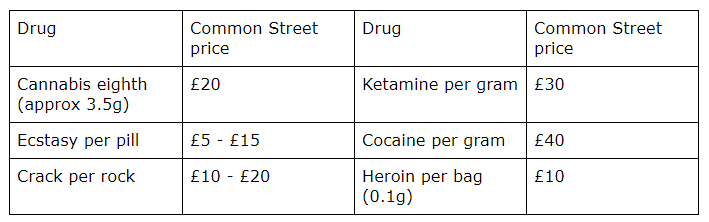
An indication of current street prices for some drugs:
Recreational drug use: A major opportunity for drug supply and experimentation is at private parties in students’ homes. Music Festivals are increasingly seen as a dangerous place for young people, when it comes to exposure to drugs, which is now commonplace at such events. Nitrous oxide (laughing gas) is also increasingly used in canister form and has been widely available at summer festivals. When mixed with alcohol it is extremely dangerous. Crime at festivals is now a major problem for Police and parents need to think hard about the age at which they allow their children to attend festivals. If you do allow your children to go, we’d urge you to have a frank and open conversation about drugs and the likelihood of crime scenarios.
The impact of social media: Parents need to understand that connecting to a source of illegal drugs no longer requires establishing a relationship with someone supplying; nor even having a contact number. Signing up to an Instagram feed or linking on Snapchat or WhatsApp app or numerous other platforms would enable anyone interested to receive constant updates several times a day on what is available locally and pricing. From that point, purchase and delivery is one or two clicks. Like any product, purchase can be made cashless through app or money transfer, delivery within minutes to any point.
Pricing of most illegal drugs, including Class A drugs, is within the scope of the normal average U.K. pocket money for a teenager. Moreover, within a message group, seeing one person commit to buying a drug, soon followed by another, normalises the activity and dehumanises a profound and high risk decision, making spread of drug activity within a peer group more likely and harder to resist as an individual.
Alcohol supply: It is an offence to supply alcohol to someone under 18. The exception to this is if they are aged 16 or over; are dining on licensed premises and are accompanied by an adult. This still only permits the consumption of beer, cider or wine. Anyone found guilty of alcohol supply may face a court appearance, a fine or imprisonment. Parents are now the main providers of alcohol for this age group (60%). Giving alcohol to your children’s friends (who are under the age of 18) in your house is not an offence, neither is buying alcohol for your own child if they are aged under 18, but you should act responsibly when allowing your children and their friends to drink in your home and you should consider strict parental supervision.
Knife crime: In addition to concerns over drugs we are seeing an increase in knife crime among our young people. Much of this is associated with wider criminal activity with clear links to drug supply and use. The possible consequences of knife crime are clear, and we would urge parents to act on any suspicions or concerns that you may have.
Given the Police advice and guidance about what would appear to be an increasingly worrying national picture, we feel it would be useful if all parents were to sit down with their children and discuss these issues relating to drugs. Although your GP may not be readily available, please always include them in the loop, as they have much experience in this area and can provide the most immediate support you might need.
Should you require any support for a child you are concerned about or are thinking about your own drug use, please consider contacting one of the various services shown below:
Bucks: SwitchBucks is a drug service for young people in Buckinghamshire. Tel: 01494 527000 email: switchbucks@cranstoun.org.uk Website: cranstoun.org/switch-bucks
One Recovery Bucks is the adult substance misuse service for Buckinghamshire. They also provide family and carer support for those who are impacted by other people’s use. 0300 772 9672 and https://onerecoverybucks.org/
RBWM: If you live in the Royal Borough of Windsor & Maidenhead and are experiencing problems with alcohol and/ or drugs, you can contact Resilience for a free and confidential service. Resilience offers a range of services which can help you to safely reduce or stop your alcohol and/or drug use. Please call the Resilience team direct on 01628 796733, email: admin@resilience-rbwm.org.uk
Young people’s substance misuse service: This service is for under-18s who need help with their drug or alcohol use, and also supports young people who have a family member with a drug or alcohol problem. Tel: 07766 628970 or email: YouthServices@achievingforchildren.org.uk.
The following blog arose from my attendance at the ISC Digital Strategy conference, on whose organising committee I sit and make a contribution. The 2019 Digital Strategy magazine can be found here, and my article on our school’s contribution can be found on pp27-30.
At the close of the 2019, Ian Yorston, Head of Digital Strategy at Radley College set a closing challenge in asking us to look at the purpose of education for humans, and how we should respond to the challenges posed by working in a ‘digital’ world, and then the ‘virtual’ world beyond. From the panel members, perhaps the firmest agreed response for educational direction to our children in our schools was that by Mark Anderson (@ICTevangelist) – “Above all, be kind”.
At my school we run a PSHE course through secondary, the focus being ‘Exploring being Human’, with 5 modules (Learning, Kindness, Relationships, Mindfulness and Resilience). I suspect we wish the success criteria for all of these to be the same; that our students (and staff) get to learn to know what they think and do about each – in short, improving their meta-cognition and understanding meta-purpose.
Ian Yorston’s 3 Humans have already become 4 (the Hybrid), with the arrival of combination people/machines, though the spectacles, hearing aid and pacemaker have been joined by both robot and biological augmentations. Assisting our children through these ideas has always been one of the great purposes of literature, whether that be Aesop’s fables, Gulliver’s travels, Pinochio, ‘I Robot’ etc. You’ll recall that even at the dawn of writing as the first information technology, Socarates railed against it, ‘Your invention will enable them to hear many things without being properly taught, and they will imagine that they have come to know much while for the most part they will know nothing. And they will be difficult to get along with, since they will merely appear to be wise instead of really being so.”1
Through the focus of our Digital Strategy ideas and the locus of our 2019 conference, I think we have explored some of the key features and tensions in education, as well as showcased some of the possibilities for the future. This is the great ‘win’ in running a conference where thought leaders come together and think collectively in short rapid bursts. I did not attend the conference to be entertained but to learn, to become more aware and it has dawned on me ‘to be metacognitive about my next metapurpose’. To understand how AI is assisting humans just now, this article courtesy LinkedIn is worth a read:
Forbes continues their story on the Power of Purpose and Saqib Shaikh shares stories of people impacted by Seeing AI. (Part 2) https://lnkd.in/g9Jknbj
I know for certain why I won’t permit Year 11 and below pupils’ own small screens in use in my school; because the tendancy is for such screens to be always on and provide unfiltered and unfettered access to stimulants that engage and divert children’s attention. Adolescent addiction to screens is a major concern, because of the way they stimulate through dopamine release, though we know their digital tools can be of immense value. That’s why we provide wall-to-wall chromebooks at schools, so that access to the tools and data in the cloud is reliably available, within our ‘walled garden’ of @clairescourt.net of course
Soldiers in conflict are now routinely provided with stimulants to ensure they are alert, more responsive and perceptive, and learn better in the same way we also medicate children with ADHD to gain similar improvements. We would not agree that all of our children should be medicated in this way because we know that running engaging and exciting lessons causes the same positive dopamine response, aiding learning without the need for chemical stimulant. Nor do we wish our students to suffer the raft of problems the soldiers post conflict now have to cope with, as indicated by the huge spike in PTSD in our veterans. Correlation is not causation of course, but whatever we do we must aim to align positive educational outcomes with positive ways of working and, where possible, spot and block recommended solutions that encourage inappropriate endorphin release during the active learning cycle.2
At boarding school, I was caned relentlessly, and can’t and don’t speak of my alma mater with any affection at all. It was the arrival at university, where I encountered for the first time in 5 years a learning environment that was not built on fear and loathing, where I rediscovered my love for learning first gained at the prep school, where I now lead. Sir Anthony Seldon is surely right now in shining a light on the apparent peer-group requirement that University students should engage in social drug taking on entry to their first year.3 Seldon argues powerfully that these late adolescents are only emerging adults and need stronger pastoral care than currently on offer. I feel we should keep our light shone fully on emerging technologies, specifically where they are suggested as lubricants for learning, not just because they could be ‘snake oil’ but because they will remove our students from the childhood they deserve to enjoy for a little longer.
I am told that some secondary state sector colleagues are in a new frenzy around the curriculum because their regulator Ofsted are requiring them to gather the arts and technologies anew. They no longer have the benefits of a ‘benign state’ providing them with one already prescribed. Many independent schools have this frenzy too, but they won’t shout the odds of course because “why, how and what we teach” has always been our responsibility. As cloud technology is now used though across the piece in our best schools, I suspect we have the courage to determine that children in our schools can enjoy their childhood with the support of this set of tools, not in spite of them, gathering all the benefits that biology, technology and hybridisation can bring. In the same way a ‘reveille’ can be a gentle shake or a trumpet blast, I feel the ISC Digital Strategy leaders can be ‘Heralds’ for 2020 too, optimistic for the future for all children in our schools’.
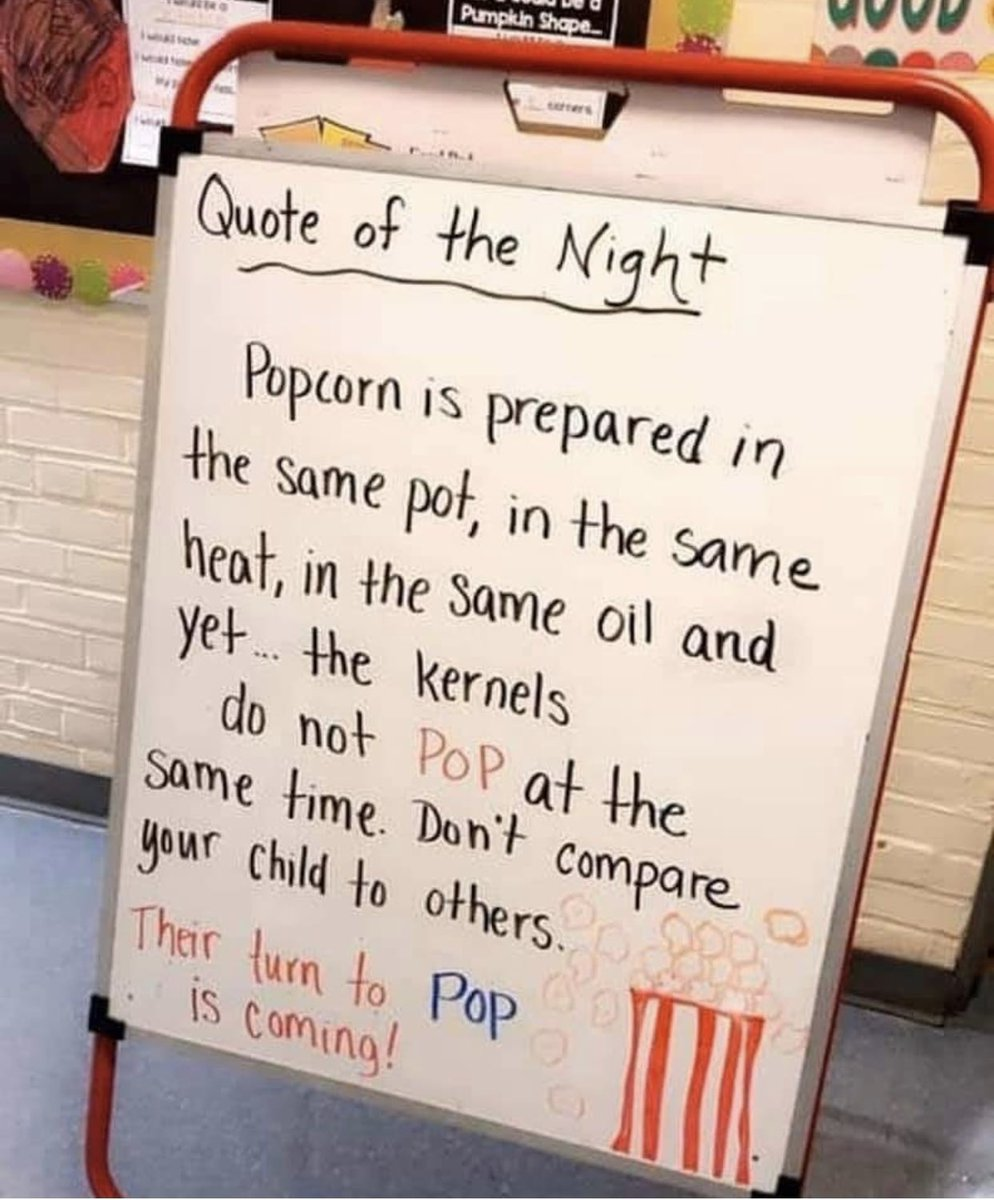
One of the reason why the social media service Twitter suits professionals in Education is that you can trim your channel to include those other educators who also choose to post on social media on matters that interest you. I loved the ‘Parent evening’ board that ‘popped’ into my stream this week, which highlights the core drivers of those in education – those we teach are capable of amazing things, and where some don’t show that capability, it’s just that they can’t do it ‘YET’.
It’s that time of year again where at almost every level ‘Learners’ in education are starting to worry about forthcoming results. University applications have to be completed for selection for next Autumn, 11+ results and secondary schools entrance exams are under way, to sort ‘the chosen’ from the rest, and even at my own grandson’s age, application for nursery aged 1 has to be in (before conception perhaps) in order to secure the place for the toddler’s first shakey steps in a collective learning environment.
Claires Court has been pioneering a whole range of different ways of doing things for generations, and by different, I think I mean parent and learner friendly. Switching into a universal and timeless set of values has helped those of all faiths and none have greater trust in our philosophical approach to human development. Pioneering a skills & knowledge based approach to the curriculum has assisted us in ensuring that our children ‘can do’ irrespective of the challenges posed to them at each age and stage. Moving to cloud-based applications, services or resources made available to users on demand via the Internet wherever they are in the world has enabled a surefooted move into the use of mobile technologies for anytime, anywhere learning.
Many national governments have put all their faith in measuring secondary students performance by outcomes, most notable here in England via GCSEs and A levels. These 2 sets of secondary public exams both come at the end of 2 years of work for which the candidates are specifically prepared. The government has changed the style of these assessments three times since 2000, the most recent changes requiring the candidates to work smarter and harder than hitherto. The results are to be rationed, which means that if the entire cohort work harder then previously, actually their efforts won’t be rewarded with the results they hope for, because only 3%, 25%, 65% can gain the grade for which they strive.
I’m a great fan of Masterchef, mental chewing gum this time of year after a busy day at work. The wannabe chefs have to trust that the ingredients, machinery, ovens and recipes all work as expected, and where they get it wrong, ‘duck overcooked’ or ‘chilli taste too overpowering’ they know they’ve made the mistake and can learn from it. It’s true in education too; watching Commedia dell’Arte mask making on Arts afternoon with Year 9 yesterday, I was bowled over by the boys’ understanding of how their ‘new face’ will show the emotions needed for the part to be played – Animal Farm, Friday afternoon 14 February 2020 by the way, please contact me if you wish to attend.
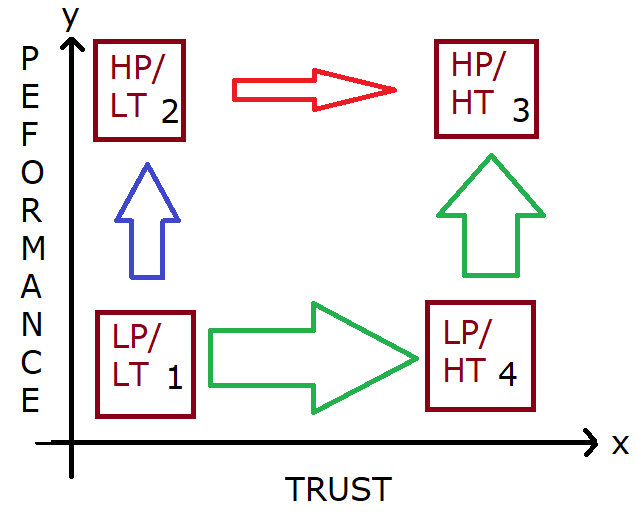
Trust in what emotions look like goes hand in hand with effective group collaborative activity. Small gestures during rehearsals and final performances keeps events out of trouble and steers for final success. Plenty of opportunities ensures that practice not only makes perfect but makes permanent, so that as the steps get more demanding, so the footfall makes permanent. The author and performance consultant, Simon Sinek has attracted a worldwide following for his understanding on successful organisational cultures and what makes for great leadership, and I love his ‘graphical representation for the kind of people we might wish to develop – shown in my sketch below.
I guess we can all see that the individual we would wish in our team is Box 3, the High Performing / High Trust individual, and the one we want on our side is Box 1. What’s interesting is that the Box 2 person will always be disliked, whereas the Box 4 person not only can make a good contribution to the team, but can be coached and developed into the great team player you are looking for. Sinek’s experience (and mine it must be said) is that you can’t ever coach trustworthiness into a fully formed adult – inherently and repeatedly they will always let you down. The coloured arrows indicate what’s possible, the red indicating NOT. You can watch a short clip of Sinek’s ideas here – https://www.youtube.com/watch?v=YPDmNaEG8v4
The point of this blog is to highlight why setting work that is too hard and testing too often in schools at the expense of building trust and cooperation causes a failure of purpose. When the children know we are supporting them and trust that we will help them build the skills, then they will trust us and give of their best. That journey into trust along the ‘x’ axis is essential – inevitably they will then be able to take risks and build the skills they need, and move up to the position of High Performance and High Trust later on in life. In short, that’s how to ensure they ‘pop’ at the right time!
The first half of the Autumn Term at Claires Court has been all about settling in the new boys and girls, establishing more broadly for all what the objectives for the year are to be and then progress with the business of ensuring our school community gets on with its learning , the stretch of acquiring new skills, developing talents, rising to the many challenges that form part of the modern education landscape, whilst… recovering from the initial failure of our planning applications for a new campus whilst… buckling up our seatbelts, because of course UK PLC was due to leave Europe on the 31 October 2019.
Fair do’s, when all said and done, our 2 week half-term fits our educational ecosystem quite well. The school days are long, the diverse activities and commitments take their toll, and it’s nice to have a decent length of time in which to run a wide range of educational trips and give all those taking part a breather too. Blow me down, whilst school’s out, the Prime Minister has decided that ‘Divorce’ can wait a while longer; he’s going to the British public to seek a full mandate for his many and varied policies beyond Brexit. Well good luck to Boris, and he may very will swing the country behind his message, but I for one can’t really see past the ‘Leaving Europe’ bit, because in that major political decision lies the relative affluence of our country for the next 5 years or so.
Inevitably I spend almost all my working time with and around young people and their teachers. What’s been so frustrating for us all over the past 3 years is that whilst the political landscape has been in gridlock over the ‘Deal/No deal’ debate, the wider real world has been waking up to a range of regional and world wide calamities the like of which we have not seen before in my lifetime. If we can just take the UK-wide struggle we are having to ensure we have effective business, welfare, care and community structures which have had to face the brunt of austerity cuts and privatisations, it seems ludicrous for the country’s leadership to be ‘fiddling’ whilst the ‘house burns down’. Politically I have always been a radical liberal, enjoying that freedom to make my own choices because I have been able to rely on the wider society to be well ordered and serving of the public. Our public servants, be they teachers, medics, the police, local and government service or the armed forces can only work well if the funds and resources are there, and they have clearly diminished beyond the point of profit/loss.
It’s difficult to be anything other than horrified by the emerging outcomes from the Grenfell enquiry and all that means for all the other tower blocks in the land clad in similar clothing, and for the fire and emergency services that simply couldn’t cope that day. In terms of law and order, cutting so deep into the Police service has meant that personal, violent crime is more obviously affecting the young and crime more broadly in terms of trafficking people or drugs lights up our newspapers far too frequently. More broadly, cutting back on legal aid has permitted a dramatic erosion of civil liberties and opportunities to make challenge, with justice per se becoming the preserve of the rich or its lack becoming the friend of the criminal. The sight of politicians visiting schools and hospitals has always been seen as a win-win photo opportunity for the political candidates canvassing for our vote; not so any more, with so many existing institutions clearly starved of the funds they need to keep their bricks, mortar and softer services in good repair. It’s no surprise to see the professionals, patients and parents giving new meaning to the words ‘having a go’ on their celebrity guests for the hour or so.
Pulling out the focus further onto the international landscape, and it’s equally clear that the world is crying out and in pain. From the many and varied regional conflicts and aggressions to the whole climate change phenomenon, humanity seems hell bent on its own destruction, and there probably isn’t anything we can do about it personally. And right on cue, the latest BBC BioPic, ‘Seven worlds, One Planet’ has started on TV to remind us all how small we actually are compared with Mother Earth, but nevertheless our impact as a species has been to the utter detriment of all the others. TV shows, as with all data-streams are shown to entertain and inform, and in Sir David Attenborough as broadcaster, we all feel we have a narrator with integrity, who will ‘tell it right’ and guide us to behave in a less harmful way to the environment in which we live. Long live this national treasure!
Integrity is something that seems to have been in as short supply as money as the various governments of the past 10 years have sought to steer us as a nation through the choppy economic landscape brought about by the banking crash of 2007/8. Promises seem easier to make and harder to keep than ever, be they cheap ones such as ‘We are leaving on the 31st’ or big number ones such as ‘We send £350 million to EU a week, let’s fund our NHS instead’. Leadership seems to me to so much more than just winning an election, and yet this is exactly what we are faced with in 6 weeks time. We are required to choose a party member to represent our interests in Parliament; in making that cross on the ballot box, we then keep our fingers crossed too that the party they stand for will win sufficient seats to be the leading party in the House of Commons and thus become the governing party of the country.
Whatever my politics, I am a democrat, so I will indeed trust in the ballot box and mark my card accordingly. If Theresa May, our local MP, had won the last Brexit round in March, then I have no doubt I would have been free to vote on all the other policy stand points I have itemised above, and the political parties would have been presenting a balanced beauty parade in my view. Sadly Brexit still looms largest, and it will dominate. I’d clearly love to see it swept from the table in one blow, so that we could indeed use the otherwise-to-be-wasted cash on supporting the obvious spending increase on public services to come, whoever we elect. If the young people I work with are to be listened to, they really want the Extinction Rebellion to grow, that global environmental movement which aims to compel government action to avoid tipping points in the climate system, biodiversity loss, and the risk of social and ecological collapse.
From my time at university where I studied the Biological sciences and ‘discovered’ Ecology, I’ve understood the very careful balance that humanity needs to walk to keep its impact in check. We genuinely have all those balancing mechanisms in play now, and the rest of the world remains full of admiration for our country’s way of working. Whilst we can’t see it because of the ‘fog of political war’, the institutions that make our country great are all still there, and genuinely just need a spell of true leadership to permit them all to be nourished back to good health. Perhaps a slight tweak on our school values will indeed help us all with how we place our vote, for if we can fill parliament with 650 members who abide by these, whatever their politics, our government will thrive:
” Responsibility for ourselves, Respect for others (who may have different views and needs), Loyalty to our country (above party) and Integrity above all (we promise not to lie)”.
Claires Court’s senior school prize giving was held on Thursday, our annual celebration of the last academic year’s main achievements, scholastic, social, spiritual, sporting and service. If you’d like to watch the event, you can see that here on the school’s YouTube channel – https://youtu.be/bwPOS5-jOho – fyi, our Principal guest was Dr Peter Woodroffe, former pupil and now Deputy CEO of the Independent Schools Association (ISA).
Given our long term commitment to RBWM, we invite all the leaders of the local community with whom we engage, including all of our elected council members and important council employees. Our local ‘relations’ so to speak stretch across the sports clubs we partner with, such as Maidenhead Rowing club and Phoenix Rugby Club, major social welfare organisations such as Lions and Rotary, through to the Chamber of Commerce and local newspaper editors. It was with great pleasure we welcomed Simon Dudley, just recently stepped down as leader of the council and as our local member for Riverside, in which the Senior Boys school sits. We’ll be having a by-election soon for his replacement, and it will be interesting to see who get’s elected in his place. I copy below Simon Dudley’s tweet from the event, great affirmation from a person of such influence.
Cllr Dudley’s support for our own school’s planning application to consolidate onto one site did us little good it seems, with so many of the local planning counsellors speaking against our proposals. More broadly, it’s fair to say the borough’s entire planning management seems in complete disarray, what with RBWM Planning manager Jeni Jackson now resigning and the Mayor calling an extraordinary general meeting of the RBWM Council for 23 October, at which the Borough Local Plan BLP) submitted version will be reopened or as likely, withdrawn.
The problem with the BLP is that it seems it was submitted prematurely, before so much of the detailed consultations and evidence gathering had been completed. As one example of many, the BLP included a plot of open green belt land near our Junior school, just the other side of the Railway bridge on Cannon Lane, known as plot HA22, despite the fact that it sits as a ‘bale-out’ area for planes taking off from White Waltham aerodrome! In her most recent letter to the National Inspector of the RBWM BLPsv, Louise Phillips. Ms jackson writes “Further thought has been given to the proposed allocation of the site for housing in the light of the agreed safeguarding position with the Airfield. The Council intends to consult on a recommended proposed change to remove this as a housing site allocation from the Borough Local Plan. This would resolve the conflict with the Neighbourhood Plan designation as Local Green Space and respond to the Regulation 20 representation from the owners and operators of the Airfield”.
The political landscape of Maidenhead has been completely redrawn by the emergence of ‘The Borough First’ party, formed from previously affiliated councillors of the Conservative party, angry at the railroading through of the BLP without sufficient local discussion. One major iconic piece of land, that of Maidenhead Golf club, has been included, the proposal including the building of 2000 houses and a secondary school on the 150 acres of mature woodland, with views that stretch across the Thames Valley to Windsor Castle. With the local council completely redrawn, it will be fascinating to see how what the new shape of Maidenhead will look like in 2020.
As this is our shared back yard with Maidenhead, here our my thoughts on the adjustments needed, both to the wider Borough plan, to include the missing strategic infrastructure Mrs Phillips has recognised are absent from the BLP, as well as our own movement to a one site solution for the school. For Maidenhead to hit its required housing solution by 2033, some 13,000 houses must be built. Whilst local planning continues to suggest it only has to find 7000 dwellings/houses in the remaining 10 years, in reality it is so far behind in the release of new housing that actually double those numbers are needed. Moreover, as it has planned none of the additional infrastructure required, it’s hasn’t yet placed a new sewage plant nor roadways to serve the new housing estates. One of the unique features of the plan is that it envisages half the housing load being built in our existing gardens, and that for half the other half, the flood plain will serve as a suitable place to build. The latter has the Environment agency ‘frothing’ so to speak, for with the change in our weather climate, when the ‘wets’ come they’ll be coming in typhoons, so using higher land out of the flood plain is their alternative solution for RBWM.
For our town, with the high ground to the west and north west in the ‘green belt’, the solution can only be to reopen the consultation on its usage, and the Mayor has already suggested that has to happen, by calling an extraordinary meeting of the Brough council for Wednesday 23 October. The major additional road infrastructure needed to help carry the load of the North-South traffic as it passes around Maidenhead are additional roads to the Braywick Road (A308), running from the A404 at Bisham south through the town to Bray and Windsor. The obvious solution is to upgrade the B3024 and adjacent Drift Road which run parallel to the A308, around the south west of Holyport from Oakley Green and Ascot through to White Waltham and Twyford. The final link from White Waltham to the A4 would be completed by adopting the road along the edge of the aerodrome, connecting it the major road over the railway at Westacott Way, before joining the A4 at Maidenhead Thicket. Whether national and local government will find the funds for that relief road improvement yet is for others to decide, but for sure, until that happens, the pressure on the local roads around Woodlands Park, Holyport, Bray and Maidenhead by the Railway station cannot be relieved.
As for the school, inside that great geographical arc around Maidenhead I have described by way of road infrastructures, the land involved has only 4 ‘owners’, RBWM, the National Trust, the Copas Family (Farms) and the Prior family (Summerleaze gravel), apart from that which we own, 60 acres on Cannon Lane. Given the ‘locked-in’ nature of the other land, the only destination that we can target is our edge of settlement-land where Claires Court Junior Boys sits. The compelling ‘very special circumstances’ case remains, and it needs to be heard fully, either through re-application to the RBWM Borough wide planning committee or by appeal to the Secretary of State. You can read that case here – link – and our closing letter to RBWM planning here. Please do give me direct feedback if you wish on these ideas, for Claires Court is a major education provider and employer in our own back yard, and we have every intention of serving Maidenhead for generations to come.
Followers of Claires Court school and its enthusiasm to develop a new campus for its pupils, staff and families will know by now that the RBWM planning committee on Wednesday night (28.8.2019) rejected our enabling applications for the school, our new playing fields with our partner Maidenhead Hockey club, together with the housing that would in part fund the new development.
It’s probably true that most planning applications of this nature are refused at this hurdle; for ‘us’ applicants who feel (as we do) that ours has ‘great weight’, we have the rights to make appeal against this decision to the national inspectorate. Pleasingly in principle, we may proceed to the next stage, for which there is no additional fee. Since wednesday, the ‘team’ is considering its various options, of course, and will take steps accordingly.
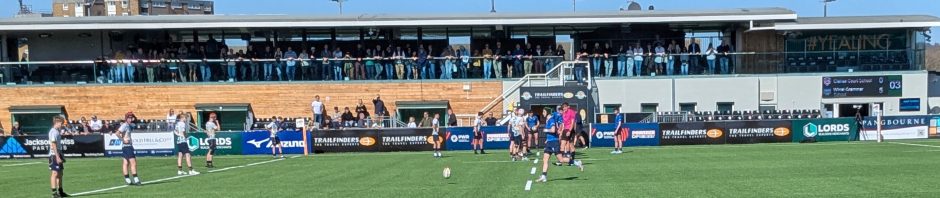
My brother Hugh, Dave Taylor from the Hockey club, Andy Black from PRP (our planning advisor) and Elkie Russell (Berkeley Homes) spoke with passion and focus; despite the very short time we had available (Dave and I had to share 180 seconds on our playing field proposals for example), all of our supporting speakers gave of their absolute best, and I am deeply proud that we were able to present our case so coherently.
Two other supporters deserve especial mention this morning, those being Charlie Stay and Gabby Lindley. Charlie had agreed to speak to committee on her experiences as a student with us; during the day, whilst working in our summer camp she ‘lost’ her voice, so her good friend Gabby stood in on the evening with 5 minutes notice and gave her speech for her. I print below Charlie’s speech (the 1 minute version), for wider audience review:
“My name is Charlie Stay, and I have just completed my degree at Reading University, gaining a 2/1 in English Literature.
I entered a local secondary school in Year 7 in 2007; I have special educational needs, now identified as Dyslexia, that were not recognised and a growing health issue of anxiety, leading to school refusal. My father was a trooper in the Household cavalry, serving in Bosnia and Afghanistan, my mother a nursery teacher; my parents no longer recognised my 12 year old self as their daughter and felt they had no option other than to find a school in which my learning needs could be identified and met, and I joined Claires Court into Year 8 in September 2008.
The school’s whole provision enabled me to flourish academically, because they recognised my learning needs and met them. I grew in confidence, socially because I loved taking part in the arts, dance, dama, sport and many other extra curricular activities the school offers. My peer group of girls did just as well, and now include Olympians, GB Hockey players, fellow graduates from Uni and through my life in the Sixth Form I have made many lifelong friends, boys and girls.
The school is an amazing place, with its inclusive ethos of providing for special needs children and weaving them into every element of school life, I felt then as I do now, that my learning is different not difficult; my strengths as a graduate lie not just in writing and the analysis of literature, but also in the ability to understand end create in film and media, key requirements in the new economies in which UK PLC leads the world.
I urge members to consider my story, one so similar to many others within Claires Court, a school that utterly deserves to modernise its facilities and bring the boys and girls together onto one campus, thus securing its long term future.“
Watchers on the big screen upstairs saw that when Gabby delivered these words last night, they report that for the first time the panel members paid full attention to our case, and it was nice for her to receive such positive mention from councillors at the time, even though they utterly disagreed with our proposition shortly thereafter. Well done Gabby and Charlie indeed.
I am so proud of my teaching staff and of the pupils who have benefited so positively whilst in our case and subsequently whilst at Uni and/or work. If failing at this hurdle was going to daunt me, Charlie’s spoken words by Gabby inspired me instead. School returns from Monday, and the phony war of planning argument will be replaced by the challenge once more of running and working in an outstanding school alongside so many amazing people, young and old alike.
They have been at this since 2013, and despite the RBWM planners ‘ protestations that the draft Borough Local Plan submitted version is the working solution, national planning inspector, many local pressure groups and neighbouring local authorities have begged to differ. And yesterday we learned the Mayor has called this Extraordinary full council meeting for the 23 October to restart the consultation process…


 A Principled view