Defending our title…@henleyroyalregatta

HRR2016

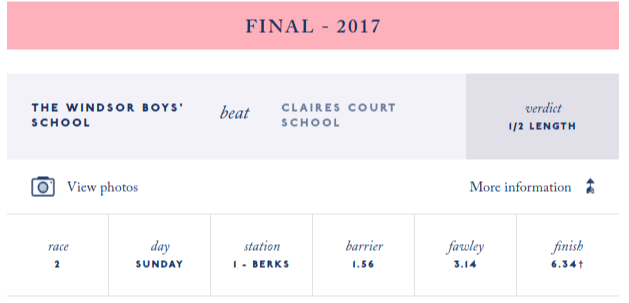
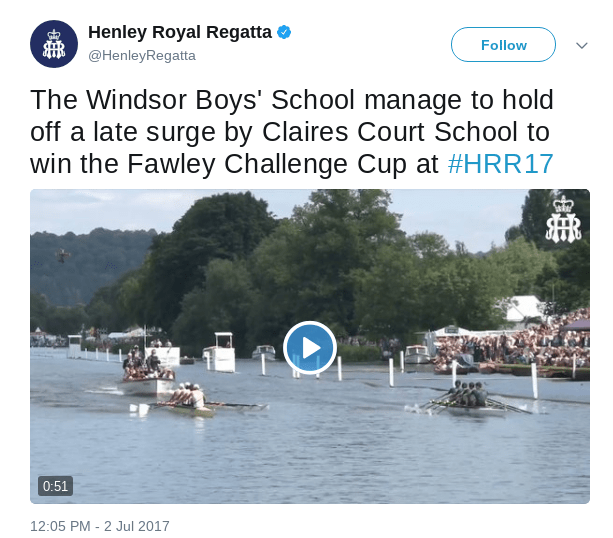
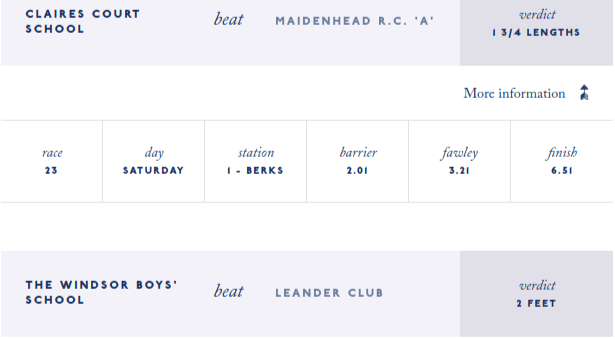
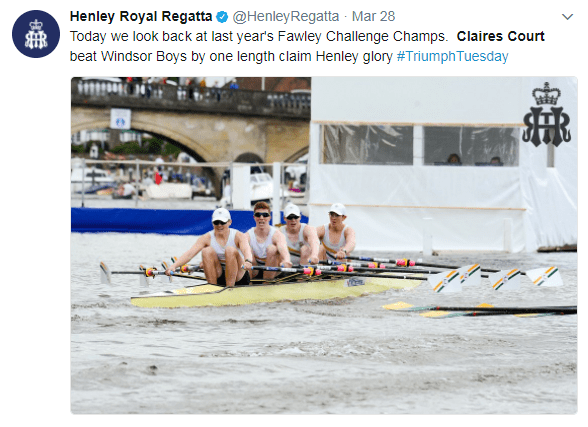
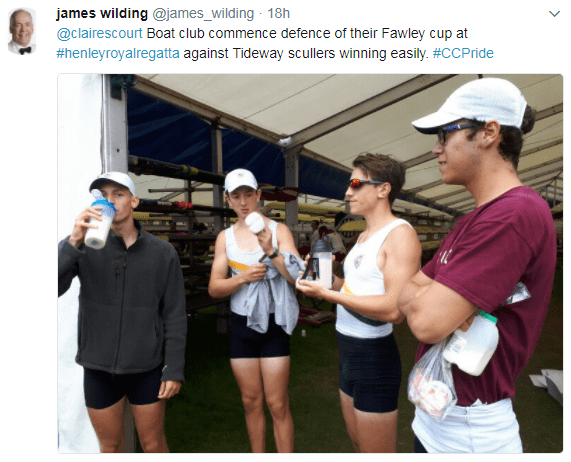
It’s Friday 30 June, and yesterday close to 7pm, the Claires Court coxless quad beat Tideway scullers to commence their defence of the Fawley cup won last year for the first time by Claires Court.

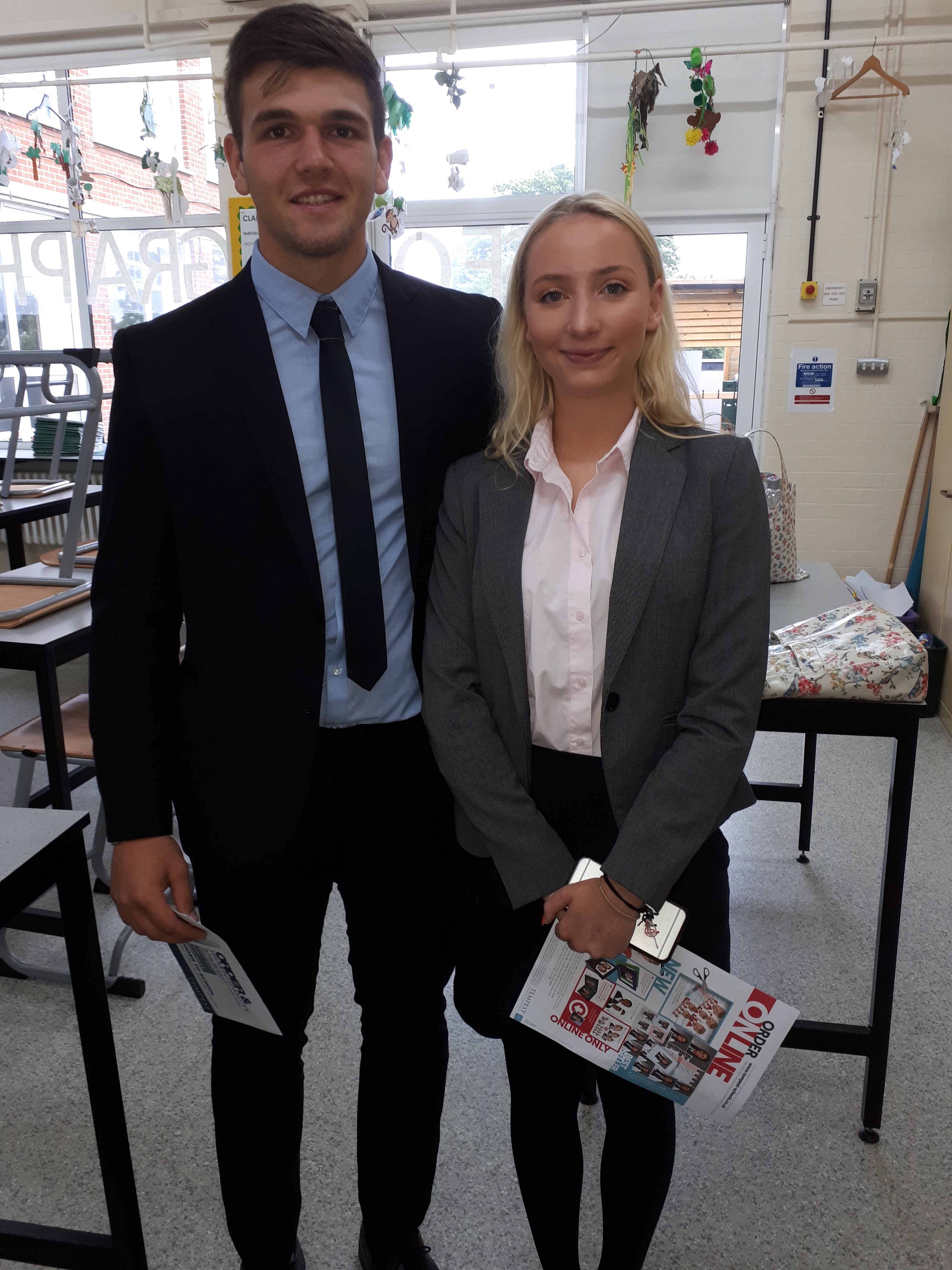
This year’s quad consist of Oliver Costley, Jack Jesseman, Henry Osborne and Callum Perera and they looked really good after their excellent win (very easily in HRR parlance yesterday.

HRR2017

Today they take on Globe Rowing Club at 5:50pm. If you’re able to get over to Henley to watch the boys and give them a cheer that’d be great. Failing that, as always, you will be able to watch the race on YouTube. Link below….

HRR2017Globe
Good luck to both crews of course, and we hope the Claires Court Quad will make the weekend’ rowing – #CCPride
Posted in Possibly related posts | Leave a comment

Talking about and taking responsibility…

GlobeI was due to write this week about our considered reaction as a school to the various terrorist atrocities over the last few weeks.  It is certainly not our wish to cause our families to fret about choices we make.  For example, this coming week’s trip to the Globe theatre on the South bank for our Year 6 girls has been cancelled;  the excursion involved some bankside walking near Borough Market, traffic is not yet free flowing in the area, and it seemed more appropriate to swap this Macbeth day in London for a Macbeth day in Maidenhead instead.  It is important of course that we still handle difficult conversations about terror and man’s inhumanity to man, and not duck such issues; sufficient to say that there is enough within the Bard’s own writing of murder, mayhem and sorcery to cause our pupils to reflect upon such barbarous matters.  Each activity we undertake goes through our Health & Safety prism, and all additional activities, particularly those that involve different and unfamiliar situations, including residential components are given the most detailed scrutiny. Our work here is independently inspected at least 3 times a year by a Health & Safety specialist, he sits on our H&S committee meetings and engages closely with events throughout the year, including our PTA activities up to and including fireworks, and produces written reports for the attention of the Principals, to which we are required to take action and make response.  If not, he will indeed ‘blow the whistle’ on us and report us to the appropriate authorities.

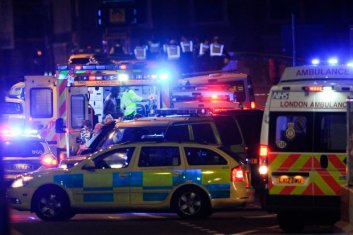
The appalling images from the Grenfell Tower inferno are still fresh in all of our minds, and we are learning more hour by hour of the extraordinary bravery of the emergency services during the conflagration.  It’s one thing to be trained as a first responder, quite another to learn how to use police shields to keep fire grenwell-residents-816861and ambulance crews protected from the showering, flaming debris from the building. Speculation on fault and blame is rife; given the area has had been covered by such mixed political masters over the past 15 or so years, it’s unwise to point a finger.  Suffice it to say, other public servants are going to be in the spotlight in months, perhaps years, for actions that are polar opposites to those decisive and life-saving behaviours we have seen this last week.
If I see a common theme between all these ghastly incidents, and my more normal daily correspondence with normal life here in Maidenhead, it is that we have, bit by bit, seen the winnowing away of specialist support services previously reliably provided by locally accountable public servants and their services. We welcomed PC Graham Slater

20170613_114508 (1)

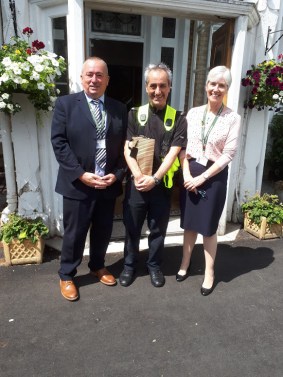
PC Graham Slater at our front door at Senior Boys

into the Senior Boys school earlier this week, for many years the specialist schools Liaison officer for RBWM, and a real expert in supporting more difficult matters cor which schools quite regularly need support.  Whenever we have had any boy-on-boy physical violence in recent years, PC SLater has been informed, and as appropriate visited the school, met with those involved, including parents as appropriate. And it’s not just the boys, but girls and on occasion adults themselves needing some support and guidance across the Claires Court community, and PC Slater has been outstanding.  Police Liaison services have been restructured, the body count too low now to justify dedicated support, and so the service now falls to the local beat officer where the schools are to be found. The picture shows headmaster John Rayer, and school Receptionist Sharon Adams (formerly a WPC herself) together presenting PC Slater with a token of our esteem. We will miss his wise words and counsel, and so will all of our many schools; is such continued replacement of specialists by generalists really the way forward in our normal walks of life?

Children’s services are no longer under the direct control of our borough; outsourced to a triumvirate including Kingston and Richmond. Adult services have already gone this way, as have legal services, to be found in Wokingham borough.  The Town Hall’s extensive additional premises have slowly been emptied, all part of a carefully considered plan to keep costs low by reducing headcount and outsourcing where possible.  I do wonder now when even our military forces are utterly reliant on part-time volunteers how this will all end?  Will our 2 new aircraft carriers ever actually find the personnel to sail them when the time comes?  In part this last election carried this dilemma to the public: if you want 1b563efc5db3c040bbe056fbfb5b6924better public services, “in some way or other they’ll need to be paid for, whether that be by 1p a £1 on income tax, or a new ‘dementia’ tax to be applied to those with property services”.


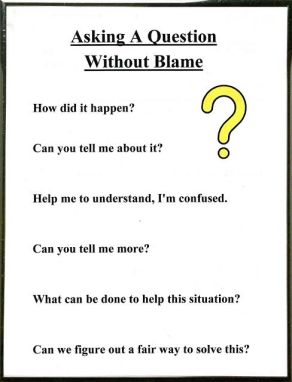
In a lot of my writing in education, be that about teaching, learning, management or even parenting, I talk about ‘good noticing’. It’s really important now we go about our duties, not just as professionals in service but as citizens of our country with our ‘eyes wide open’ , and remembers whilst we do, to ask difficult questions. The best questions to ask are those that carry with them ‘No Blame’ , as shown in the picture here.


As a language, we are indebted to Rudyard Kipling for much good literature and poetry. Kipling’s Jungle book is perhaps the most influential piece of his work that all children know.  I particularly like though his short stanza – 6 honest serving- men:

“I Keep six honest serving-men:
(They taught me all I knew)
Their names are What and Where and When
And How and Why and Who”

As we continue to ask questions and wonder ‘Why and How?’, let’s keep all those that serve us in focus, and keep good watch on what they say and do.  We may not be in positions of elected responsibility, but those who are need to bear their responsibilities honestly and honourably.  Oh, and on those matters of finding excuse,  it was Kipling who also introduced us to a central message about taking responsibility

“We have forty million reasons for failure, but not a single excuse.”


Posted in Possibly related posts | Leave a comment

Returning our attention to our own…

One of the most important features visible in successful educational institutions is ‘good noticing’.  I was taught this in two ways, one by virtue of bitter experience when I had let something slip (often an issue in a busy life) and had to spend much time afterwards 710kFGB-yAL‘mopping up’.  It’s so much better to focus on noticing things well the first time around, this playing to the old proverb ‘a stitch in time saves nine’.  Obviously, good noticing is needed almost everywhere, but its connotations can often be negative, even if the purpose is supposed to be ‘good’. Big brother CCTV cameras have come into their own in every walk of life; they have permitted us to track those involved in the recent terrorist outrages, find out where they have been prior to the events, and even perhaps arrest others associates supporters. Being spied upon often has negative connotations, and has certainly brought into a range of public workplaces such as the NHS a fear of being found out for making a mistake and thus being labelled unprofessional or worse. Here’s the Nursing times writing about that 3 years ago – https://goo.gl/D4AzCB.

cw-pic3The second way I learned this was through the excellent research work of Chris Watkins of the Institute of Education London, now sadly retired. Chris’ teaching definition is as follows: Noticing. This is the first step: to stimulate and credit learners with the fact that they direct their attention and that this is a key building block. It can develop further into a focus on one’s own activity: that key element of noticing what you are doing while you are doing it.
Here’s Chris writing* a bit more about ‘noticing’ in 2014:

We might underestimate young people’s noticing: a teacher in a West London school put a sign up at the front of her classroom for 5/6 year olds, saying “What have you noticed
today?”. She reported back to the project group “I soon took that down!”. “Why?”
“Because they noticed so much and it took ages for them to tell me it all”. 

Helping children learn how to notice things is a real art, and building in them the capacity to notice something about their own actions and ways of thinking is an incredibly important way of rapidly improving their own learning. We call such activities, thinking-about-thinking, or to use a grown -up word, ‘metacognition’. It is not that metacognition assists us to learn from our mistakes, actually far from it. What good noticing in this context permits us to do is to learn more quickly what it is that we do that leads to successful learning.  Obviously teachers notice things in they their pupils’ work all the time, but given the number of things they will notice in a whole host of children, the process of telling each child what they have noticed is both laborious and time consuming, and far less productive then enabling the child to think for themselves and rewarding them for so doing when true metacognitive activity takes place.

The trouble is for all of us is that our attention is so easily grabbed by that which is arresting, alarming or plain horrific, and we have had plenty of that in recent weeks. I’m writing this on the day after the General Election, and I can’t help but noticing that whilst Theresa May has gone to see the Queen to ask her permission to form a new government, she seems not to have won the electoral mandate she set out to achieve 7 weeks ago. It’s not that Jeremy Corbyn has won, because actually the polls show the Conservatives have won the majority vote and the most seats of all the parties who stood. What Corbyn has  brought to everyone’s attention is a whole raft of issues with regards to our current provision in public service where chronic mismatched funding and bad policy decisions are pointing to the near collapse of vital services.  T

he fact that the Labour manifesto captured every single populist cri de coeur going inevitably was going to attract the young and idealistic to their campaign.  Knowing they were never likely to get elected meant they could be as full of largesse as any, and in costing the budget for them to make the numbers look good is not the same as actually making the budget work.  Good luck to Mr Corbyn and his fellow travellers, because their good noticing of the range of deficit issues was not matched by the government of the day, who in my view so crassly underestimated the intelligence of the electorate.

Whatever the merits of the parties at the election, we can’t help but have noticed the incredible publiMembers of the emergency services attendc support that has risen to wash over the police, emergency and health care workers that have had to deal with such horrific events during this period. Bravery and duty are on show every day in our public services, yet all too often unseen and because of that unreported. The ‘thin blue line’ must not be permitted to get any thinner, and if there is one policy from the Liberal party I am prepared to support, it’s the increase in income tax to fund world class public services.

Anyway, it’s back to school and good noticing within for me. As a school leader, I can’t do much about that outside my remit, but if there’s a call to action all need to notice and heed it is to return to work and strive to improve.  Let’s stand up and ‘notice’ that well – to be the best we can be. keep-calm-and-be-the-best-we-can-be


*Chris Watkins (2015) Metalearning in Classrooms

Posted in Possibly related posts | 1 Comment

Talking about terrorist attacks with young people – a dilemma for us all.

At the close of the first  half of term, my blog was a straightforward statement from the Deputy Chief Constable of the Thames Valley police, stating the heightened position of the National Terrorism Threat, being raised to critical following the Manchester arena bombing at the close of the Ariana Grande concert. 10 days onwards, and whilst the threat level had been reduced, our country has experienced a second horrific incident at and near London Bridge on Saturday evening.

Like so many of us, I have tried to stay in touch with as much of the unfolding news around the tragedies as they have occurred, and follow with interest the reactions of the communities concerned, the wider press and subsequent publicity.  With the very wide age and range of children in our school, we are really aware that their experiences are going to be very different.  With secondary and Sixth Form pupils, we have engaged very directly with the events and aftermaths, and will continue to do because their experiences with family and on-line are feeding many lines on information and a diversity of approach.  This is all happening at the time of a general election, and the senior school community is very much embracing the opportunity to study the news and discuss the issues.

The younger the child, the greater care we are taking, and we are sensitive that parents will need good information on how we are tackling these issues (if and when we do), so they can stay in step and work with us to allay fears and calm nerves.  The BBC have provided good, immediate advice for schools and families, here, which we have in use already, and as and when those that support our work provide further, more focussed advice, we’ll share that too.

School leadership across the Claires Court sites is meeting on Thursday this week to discuss further the ramifications of the events so far, discuss further our routines for safety and critical incidents, and check our calendar activity to see if there are any forthcoming events we should cancel in the light of their proximity to areas of risk.  I will be writing further to all parents on Friday this next week (16 June) to confirm outcomes from our deliberations and highlight any additional preventative measures we are putting in place to assist our school and community to feel safer.

Such has been the unexpected nature of the outrages we have seen this year so far, I don’t feel it is our role to talk up the dangers alone. As Catherine Vale writes in the Guardian last Friday:

“Show them the good:  Terror attacks are frightening, and the immediate aftermath can be confusing and overwhelming for young people. But where there is violence there is also good: emergency responders on the scene; civilians offering their homes to strangers; blood donors queuing up round the block; and taxi drivers offering free rides. Reminding young people of this can help alleviate students’ fear and put the events in perspective.”

And despite the ghastliness of the news, we can be inspired by those around us who have been able to make response already.  Scooter Braun, Ariana Grande’s manager spoke these words last night at Old Trafford during the benefit concert for the victims of the first tragedy, referencing the terrible London Bridge attacks which took place on 3 June :

‘As we saw yesterday, evil will test us, it will show it’s face again, but because of you we can say we will be ready, we will be fearless, we will be great and we will honour our children. Because we owe it to those children whose futures were ripped away from them to be brave.

‘They demand our bravery. Hatred will never win, fear will never divide us, because on this day we all stood with Manchester.’


Posted in Possibly related posts | Leave a comment

National Terrorism Threat Level Raised to Critical

59258fb7863fe
The message below was received from the Thames Valley Police, with forward messaging to parents requested.  I publish that message in full:
“As you will no doubt be aware, on Tuesday night the Prime Minister confirmed that the national terrorist threat has been raised to critical. This change means that an attack could be imminent. At this time there is no intelligence to suggest a specific threat to the Thames Valley area. Our priority is to protect the communities of the Thames Valley and visitors to our area. We have put in place additional armed and unarmed officers at key locations. This is very much focused on crowded places, including transport hubs and shopping centres. Don’t be alarmed if you see more armed police officers both on foot and in vehicles.  For operational reasons we are not confirming details of locations, tactics and numbers of police officers on duty, to ensure the effectiveness of our deployments. We will continue to work with our partners and event organisers to assess the planned events where we may need to enhance our presence.”

83066869_dcc-john-campbell-2Deputy Chief Constable John Campbell said:

“I would like to reassure you that the move to critical is something that we prepare for. We will continually review our deployments and take all possible steps to keep people safe within Oxfordshire, Buckinghamshire and Berkshire.
At this time we need everyone to remain alert but not alarmed.  We need your help to help us protect our communities and disrupt those who seek to harm us. I would urge you to contact the police straight away if you believe that someone is acting suspiciously.
Our officers and staff will continue to provide a visible presence in our communities and we have the specialist resources in place to respond in an emergency.”

Our Police liaison officer, PC Graham Slater writes “I have also included below, a couple of useful links covering advice on how to tackle any fears or anxiety our young people may be experiencing following events this week. You may wish to pass these on to parents.”
Posted in Possibly related posts | Leave a comment

Questions of the Prime Minister…

Mark Hookham, correspondent from The Sunday TiSFquestionsmes, came to speak to some of our Sixth Form students last week, asking them “What do young people want from, or want to know about, Theresa May.   He posed the sThe_Sunday_Times_logo_310ame questions to the PM on Satruday, and the Sunday Times covered some of those in their Sunday paper edition.

I have cut and pasted the series below:

May we ask . . . Pupils pose PMQs

Who is your favourite artist and why?
Alasdair Butler, 19

Stanley Spencer, who was one of the great British 20th-century artists. He was born and brought up and painted a lot in my constituency. If you’ve seen his Glasgow shipyard Second World War paintings, they’re absolutely incredible. We now have a Stanley Spencer that has been lent to No 10. I had a print on my wall as home secretary, too.

Have you ever suffered or known others who have suffered from mental health problems?
Alastair Roberts-Rhodes, 19, and Flora Gault, 18

I have known people who have suffered from mental health issues. There was a young woman I met recently who explained that, when she was at school, nobody had really known how to deal with her mental health problems. She had been grateful that one teacher had been able to help her. Because the teacher was a head of sixth form and had a small office, she was able to provide the girl with a space to which she could go when she was worried or anxious. But that was all she was able to do.

It is examples like that that show why we need to ensure there is a member of staff trained in every school who knows what to do.

I have known friends and family affected. I’ve not been in a position where there was a direct expectation for me to assist, but I have seen that there are often within families people who don’t quite know how to respond to those sorts of problems.

What is the worst book you’ve read?
Camilla Slais, 17

I’m tempted to say the draft Labour manifesto for the 2017 general election.

Has your thinking ever changed because of a novel?
Alasdair Butler, 19

A book that brought something home to me was The Boy in the Striped Pyjamas [published in 2006 by the Irish writer John Boyne].

It is a very, very cleverly written book and a very well-written book, and what it brings home is the absolute horror of the Holocaust.

Has your faith ever got in the way of any policy you have had to agree to?
Sally Price, 17

No, I don’t think it has got in the way. But I got a strong feeling from being brought up in a vicarage of the importance of public service.

What is on your bucket list?
Flora Gault, 18

I genuinely don’t have a bucket list. My approach is to just get on and do what you’re faced with every day.

Talking to the students on Monday, it was quite clear just how thrilled they were by seeing their questions answered.  “When you read the Prime Minister in print asking your questions, which are much closer to the topics that fill our conversation every day, you feel you have got to know her just a little bit better”.

Therein lies the difficult rub for our politicians, that being the failure of elections to gather the interest and engagement of the young. It was evidently the case with Brexit, as the Sky Data exit poll showed last year:Skydatapoll

As no data was actually taken on the age of those who actually voted, Sky data don’t suggest their statistics are fool-proof, but they’ll be pretty close. Guardian young journalist Hannah Jane Parkinson wrote an excellent article on the failure of youth to cast their vote 28 June 2016.  Entitled “Young People are so bad at voting“, she strikes close to the heart of the matter:

“But what is most disheartening is when people do not vote because they feel politicians do nothing for them. Often, the people who do not vote are right: politicians have done nothing for them. But, quite frankly, that is because under the current system, politicians won’t do anything for the people who do not vote. Politicians implement policies for the people who return them to power. Older people vote.”

And why: see triple-lock pensions, free bus passes and TV licences, protection from cuts.

We can get a handle on where this ‘youth inertia’ comes from this Douglas Adams ‘quote’

“1.Anything that is in the world when you’re born is normal and ordinary and is just a natural part of the way the world works.

2. Anything that’s invented between when you’re fifteen and thirty-five is new and exciting and revolutionary and you can probably get a career in it.

3. Anything invented after you’re thirty-five is against the natural order of things.”

What is so evident is that new and exciting sets out as young adults become truly independent, with a belief that they can shape the world. It’s only after a few years getting a bloody nose on the rocks of life that adults begin to realise they need to organise and get political.  And the danger of course is that with the vast majority of those of the age of 35 becoming increasingly conservative, changing the status-quo becomes really difficult.

Last Thursday afternoon at the ISA Heads conference in York, Times journalist spoke with great humour and honesty about just how much ‘Nothing matters’ when it comes to elections.   Philip Collins is a leader writer for The Times, also chairman of trustees at the independent think tank Demos. Before joining The Times he was the chief speech writer for the prime minister, Tony Blair, the director of the Social Market Foundation think tank, and an equity strategist at two investment banks.  In short, Collins knows ‘stuff’, and his take of things is very adjacent to Adams’. ‘Parties that get elected in the UK hold the centre ground, and you can see that over the past 70 years since WW2′. Despite all the hot air and headlines of copy writers and media gurus, there seems nothing politicians can say to sway the voter in the run-up to elections.  Collins predicted Labour will win circa 180 seats, and he has an interesting about the chances of Jeremy Corbyn surviving.  More than 195 and everyone will think he’s been a success, and less than 170 and the Corbynistas in Parliament will be in the majority,

Since Collins’ talk last Thursday, the major parties have released their manifestos, and it is pretty obvious which politician (and party) has tried to strike the middle, stable, reliable and sensible ground, staying out of the limelight and clear of controversy. “Lurches to the left and to the right must be avoided at all costs” suggests Collins, but writing in the Times on Sunday, he is  mourns the lack of real guts in the Labour manifesto.

The really damning critique is not that the Labour Party is red in tooth and claw. It is that it is toothless and clueless. Mr Corbyn’s political ideas were stale when he first had them 40 years ago. This is a document that, at 45 pages, is long because they didn’t have the wit to write a short one. Reheated, rehashed, resigned, a sermon to the converted. The foreign policy section is too vague to be the precise terms of surrender that the leader desired but “extremely cautious” about nuclear deterrence means he doesn’t understand it. Military action when other options have “been exhausted” means “never”.

Just in case my readers feel I am a tad biased in my coverage, here’s the same Collins writing today about the Conservative Manifesto:

Trying to decipher what this general election is about, there is a lot of noise and not much of a signal. Theresa May’s approach to campaigning — avoiding the public and the pesky journalists with their questions — reflects really badly on her fragility. The Tory manifesto is said to be light on anything so conventional as actual policies. Better to promise nothing and be sure to deliver it. You have to search for a clue to what is going on and, on your behalf, I think I have found it. There is nothing going on.”

And there you have it dear reader, a choice of 3 ways forward:

1. The empty rhetoric that is a sure fire ‘winner’, or

2. Shroud waving by the clueless, or

3. Some genuine concern for  good news and concern for others from the youth of  today.

Sadly, I don’t think the third way is going to surface our young voters generally, but it would be nice to think Alasdair, Camilla, Flora and Sally would make their vote count, perhaps seeing something for them in policies that might arrest the ever rising cost of University Education. As the Independent made clear in March, we now have the highest tuition fees in the world, and they are set to rise further next year. Spotting the policies that benefit the young is what’s needed if they are to be attracted en masse into the polling booths. I quote Collins again: “Unless we find a way of changing the way young people choose to vote, nothing else matters.  The grown-ups know how they are going to vote already, and the older they are, the more certain they are.”


Posted in Possibly related posts | Leave a comment

“…for the twenty-first century we will have to do more than just improve literacy and numeracy skills.”

20 years ago, in the DfE white paper 1997 White Paper, Excellence in Schools, the DfEE wrote the following:” If we are to prepare successfully for the twenty-first century we will have to do more than just improve literacy and numeracy skills. We need a broad,
flexible and motivating education that recognises the different talents of all children and delivers excellence for everyone.”  From that position paper, a whole series of changes came about in UK schools, including the birthing a broader offer for Sixth Formers, Curriculum 2000, and the establishment of the sponsored academies programme. 20 years on, and almost all the ideas have either perished or had their day. A levels have been rolled back to be the 3 subject gold standard, the modular approach being abandoned in favour of terminal examinations, and the massive expansion of the Academies programme sees these new schools and their multi-academy trust structures to be no more effective than the local authorities they were to replace. You can read the Education Policy Institute (EPI) research on the latter here: http://epi.org.uk/wp-content/uploads/2016/09/Academies-consolidated-presentation-FINAL.pdf

I write this blog update shortly after the declaration of the next general election, and the inevitable declaration by all parties that they will improve education further if elected. The current Conservative government have their next white paper ready to be published, and if the pollsters are to be believed, this White paper will soon see the light of day in early July. More structural change will be promised, including the establishment of new grammar schools and more Free schools, and the final pieces of the Excellence in Schools Agenda expunged.

It’s difficult to believe that successive governments want to reshape education when they come to power. Nothing seems ever to be left in place long enough to discern whether the ‘improvements’ planned are happening, and ‘evidence’ arising from schools and policy research departments ignore almost completely by the incoming successful politicians. At the time of writing, I have just listened to David Laws, the former Schools’ minister, now Chief Executive of the EPI speak at the ISA annual conference in York. In a frank discussion with us, he bemoaned the fact that politicians can force curriculum content change in schools, such as what History should be studied and what books should be read, despite all the evidence to the contrary of its efficacy.  He made specific mention of the abilities and frailties of Michael Gove, Secretary of State for Education 220px-david_laws_mp_2008during the coalition government’s term of office, weaknesses including his determination to meddle in matters despite advice. Mr Laws worried his audience more than a little, at the spectre of a returning MG into DfE after this election, if only Theresa May could find it in her heart to forgive him!

The Prime Minister’s strapline for her party is to provide ‘strong and stable’ government. What’s clear from the international evidence is that great things are happening in our good schools, be they state or independent. The ‘best’ we have in our schools are performing at the same level as the best in China and the Far East in terms of academic attainment, AND in addition we are providing a really creative, well qualified graduate flow of skilled innovators into UK PLC. The failure of our education system to remove the long tail of poor achievement from those at the bottom of the economic spectrum is challenging indeed, but we won’t be able to tackle this solely in our state schools situated in those areas of the country where expectations for work and social improvement are low.

It’s interesting to note that schools local to RBWM also show long tails of low achievement, yet the area has very high employment statistics. And herein lies the rub: the growth of the ‘gig’ economy, lots of self-employment has helped bridge the employment gap, yet provides little in the way of opportunities for self-improvement to those so employed.  There are no apprenticeships in the ‘gig’ economy, and no investment then in the acquisition of additional skills that the workers could gain along the way.  We are currently advertising for permanent staff to join our household teams, and few applications arise simply because of the ‘full’ employment status of the area.  And of course, available workers, living elsewhere in the country cannot ‘get on their bikes’ to Maidenhead, because the availability and cost of accommodation makes relocation much more difficult.

The one major breakthrough on the horizon is the arrival of the modern apprenticeships, and as part of this exercise we have applied to become an Apprenticeship Training provider. With a school-full of well qualified teachers and instructors, we will be able to adjust our mission to include work-force development for all of our staff, whatever their role. The application process is tortuous, complex and opaque, perhaps to ensure that ‘fraudulent’ providers are discouraged. But I see a very real promise available that Claires Court can continue to contribute to ‘Excellence in Schools’ not just by serving its pupils as well as we do, but in addition by developing the skills of the non-academic work force we employ in similar manner. ‘Night school’ has largely disappeared, so re-birthing training opportunities for employees is an excellent way forward, and I hope to report that our efforts to ‘provide for apprentices’ has at long last been realised. That’s a positive result we expect to hear in June, whatever the outcomes of the General Election.

Posted in Possibly related posts | Leave a comment

Fake news – hitting all schools, pupils and parents near you

2017 is going to be the year of Fake News clearly, because of course Mr Trump, Mr Putin and Mr Assad would have it so.  Everywhere the news is reported, someone seems to claim that the facts not true, or visa versa, or both.

Fake News

From the internet IT magazine ‘The Register’


The reality is much more nuanced that this, with most of the practical news being precisely that we would expect, accurately and honestly reported. The trouble is that good, old honest ‘News’ as such does not sell papers. Sensation, involving either royalty or celebrity causes so many more ‘clicks’ on the internet, which in turn attract the advertisers who fund the sites in the first place.

We do need to be concerned though. Try this headline from many of this week’s papers:

Blue whale

Most schools received this message from safeguarding agencies keen to alert their communities to an apparent surge of suicides caused by an App or on-line challenge.  We picked up the warnings, but something didn’t quite feel right; we emailed our local  police liaison who also agreed, and after some further research, it emerged that the story is an Urban Myth that originally surfaced in 2015 and has come back to challenge us. What is always true is that:

There are so many other ghastly media transmissions out there of concern. For example, Netflix currently have a TV drama 13 Reasons Why series currently available, heavily criticised for glamorising teenage suicide.  Even the innocent social medias and ‘chat rooms’ rapidly attract addictive traits amongst adolescent users.  In short, the best advice schools can give, repeatedly until the Internet closes is:

‘Parents should take a close interest in their children’s use of technology, social media and ‘screen time’, and encourage all such activity takes place in family supervised space.’

The trouble is that we can ‘trivialise’ concerns such as the Blue Whale challenge around young people, because risk-taking behaviours are hard-wired into adolescents and young adults, and the prevalence of suicide in this cohort is a serious concern.  It is after all the most likely reason for men aged 20 to 35 to die.  Fortunately, though every death in the school age cohort is a tragedy, it’s at much lower levels, and at the same time, the peer group are very aware of the risks and ‘alerts’ to us adults in school are much quicker to surface.

Fake News education

It’s interesting to note just how many ‘new’ responsibilities are coming to schools these days, as the above direction from the OECD indicates. Personally, I don’t think studying ‘Fake News’ in school is the best place, in part because really good ‘Fake News’ is so difficult to spot!  The RED top newspapers have been carrying such stories every since their introduction.  Back in 1986, I had the unenvious privilege of supporting a child at school whose father was accused (falsely as the Leveson enquiry in 2012 discovered) of eating a pet-

freddiehamster

What on earth can you say when such papers choose to publish stories that are just so sensational?  The damage to the family, the awful impact at school on friendships and inevitable isolation that followed were really distressing. Max Clifford told the Leveson Inquiry into media ethics that The Sun ran the now infamous headline ‘Freddie Star Ate my Hamster’ on its front page on March 13, 1986 with his permission, despite the story being untrue.

What was so sad is that Mr Clifford allowed the story to go ahead in order to drum up publicity for the comedian ahead of a tour.

My biggest caution to schools, pupils and parents is that all this ‘stuff’ is really not ‘normal’.  The more we give the oxygen of publicity to false stories and fake headlines, the more likely the easily-impressed will be.  Obviously we need to talk around the value of finding out the truth and acting for the best, but a rich, deep and broad curriculum has this content anyway.  I have just finished teaching the Black Death to Year 7, and the havoc that major plague brought to Europe makes for gruesome learning.  The UK did not recover its population numbers for over 400 years!  History classes are always full of discussion and analysis of what’s truth and what’s not, with the study of ‘propoganda’ high on the 20th century hit list.

the-black-death

Pieter Bruegel the Elder – 1562 – 200+ years after the Black Death plague

And it’s not just History studying ‘truth’. Whether it be in English from the study of any Shakespeare or Dickens’ works, Art, Sciences, Humanities and such like, all human life is there, in full glory, technicolour and gore. The best defence for all of our children in schools is to provide them with an education that challenges and inspires, and permits them to explore anger, sorrow, lies and deceit and all those other human emotions and frailties, recovery from which bStarry starry nightuilds the resilience they need to survive in the much harsher world of adulthood that lies ahead.

If there’s one anecdote I can recall from my own school experience that assisted me in understanding what was ‘real’ about suicide, it was learning  the story of Vincent Van Gogh’s life and death, who to this day inspires many of our artists in school.  As I was leaving sixth form back in 1971, in exploring the lyrics of Don Mclean’s Vincent with my friends, I came to terms that mental illness existed and was tragic, but something I did not need to own myself.  Listening to the song, whilst studying his paintings, I recall a coming of age. And that’s not ‘Fake news’.

Posted in Possibly related posts | Leave a comment

Somewhere a place for us…

The opening video to this post shows 2 of our Sixth Formers, Jack Jesseman (Y13) and Niamh Bates (Y12) singing at the Senior Commemoration service at the end of last term 4 weeks ago. Readers might be familiar with the original 1957 West Side story version, or perhaps the Pet Shop Boys remix from 20 years ago.  If not, then at least they’ll know the Romeo and Juliet original by William Shakespeare, in which we learn of the tragic love and deaths of 2 lovers separated by the enmity between their families, the Montagues and Capulets in Verona. West Side story transposes the tale to the Upper West Side neighborhood in New York City in the mid-1950s, with two teenage street gangs of different ethnic backgrounds, the Sharks, from Puerto Rico, and the Jets, a white gang.

(Spoiler alert) Unlike in the original, where both our young lovers die, in West side story, Maria cannot bring herself to commit further violence, and her choice to grieve and claim peace on of the most moving final scenes in theatre ever. As she cradles her dying love, Tony in her arms, she reprises Somewhere:

Somewhere

As I write, another well known family are sharing their grief for their loss of their own 3500mother, tragically killed 20 years ago in a car crash.  Of course I refer to Harry and William Windsor, the sons of Princess Diana and becoming I suspect in their own way almost as well known and loved as their mother.  What Prince Harry has done this last week, and supported so ably by the Duke and Duchess of Cambridge is to call-out about their own grieving for their mother, and talk openly about the stress and uncomfortable lack of well being still around their loss.  Simon Wessely writes really well about this in Wednesday’s Guardian newspaper “Princes William and Harry break mental health taboos for a new generation” and it’s a good read.

Parents and Friends of the Claires Court community regularly ask about our own break from service, “How have the holidays gone” etc.  Whilst I always reply “fabulous”, because it is such a privilege to be able to take such regular rest breaks,  in truth I always want to add the little ‘rider’ (second spoiler alert) that we teachers don’t just take a break. This Easter, the entire faculty (200+) spent Friday morning after the end of term looking at the ways we could further promote kindness and compassion in our school. Rachael Williams and Louise Hankinson, experts in the field of counselling services and psychotherapy engaged us in their thinking on the vexed issue of mental well-being.  Whilst it is clear that we are seeing an exponential growth in support requirements, both in school and in the wider society at larger, in many ways such exposure is evidence of a healthier society than perhaps one driven by the ‘stiff upper lip rule’.  The slide below shows you the challenge set to us here:

Session 3- Compassion in school.pptx (1)

Many of the discussions we have had in school are about updating what we do. The first pro-social behaviour initiative we ran across 10 years here covered the 1990s, at a time when it was agreed across the UK that the use of violence to discipline children had no place in schools.  Corporal punishment ceased at Claires Court back before 1986, and was outlawed in 1998 in all UK schools, but the belief persisted that physical punishment was part of the educative and disciplinary process, and was often viewed as ‘character building’.  To this day, there remains at the parenting level that a smack for very young children helps modify children’s behaviour, and for the under 2s there is modest evidence that it works. However, since there is also plenty of evidence that there are many other ways of inculcating acceptable behaviour patterns in the young that don’t involve the use of physical violence, no-one actually seriously advocates its use at all any more.

The therapeutic approach we have adopted to assist in our community when individuals feel challenged is known as Acceptance and Therapy Commitment, ACT, and we use this in combination with our Values programme and Learning approach, the Claires Court Essentials. As Academic Principal, I ensure our staff continuing professional development programme has 12 days reserved a year, and we need to use every hour of that time to keep up to speed with curriculum development in the face of national challenges and required changes to examinations. But suffice it to say this; we are spending increasing amounts of time, the most costly of all resources to the issue of providing ‘a place for all of us’ , together with ‘time to learn, time to care’.

So as a bright new day opens on our Summer Term 2017, expect there to be a lot of talk about kindness around amongst my colleagues and in my blogs. There is no longer public debate needed about whether it is a good thing to speak out and be honest about one’s feelings.  What Harry and William have demonstrated however is that, whatever the hurts they faced, (and boy have they faced more in their short lives than ever the rest of us have), they have got on and recognised they have part to play in making the world a better place for themselves and for us all.  They have not looked for special treatment, and though they can’t help being privileged by their birth, they have demonstrated a selflessness which we can all admire.  Above all, they have avoided blaming others for their situation, mindful of the need to distance themselves from unhelpful thoughts, reactions and sensations.

These by the way are the key purposes of our Commemoration Service, held every year, held to ensure we become and remain mindful of the need to serve our Commonwealth, be that local, national or across the Commonwealth, whilst recognising the passing of those in our community who have done just that, but lost their lives and passed away over the past 12 months.


Posted in Possibly related posts | Leave a comment

“If we are victorious in one more battle … we shall be utterly ruined.”

The headline is from the Greek historian Plutarch’s account of the battle of Asculum in Apulia (the heel of the boot in Italy) that gave us the phrase “pyrrhic victory”, the kind of victory won at such cost to life, limb and friendship, that you almost wish you’d lost.

I can’t help that the current government of the day is looking at a very good deal of its national policies and wondering a little as Laurel might ask of Hardy “Well , here’s another nice mess you’ve gotten me into!”  I could be referring to military matters, such as the new Aircraft carriers that don’t have sailors, or destroyers whose engines don’t work, or the Army more generally that simply can’t recruit to NHS matters, the Prison or Police Service or indeed to Social Care almost anywhere – we do seem have almost insoluble problems.

As you might guess, I am choosing to write about the government’s decisions over the last 2 decades to provide for schools the financial independence so they can get on and manage their affairs. When I entered the profession in the mid 1970s, local authorities were just beginning to give schools the opportunity to enjoy the benefits of local financial management of their budget and these became enshrined across the country from 1988. You can read more of the historical perspectives around these choices here in a National College of Teaching and Leadership module, and it makes an easy read.

NCTLimage

Put simply, over the last 30 years the industry has become fragmented in a myriad of small business units (over 30,000), and some have learned how to manage their affairs really well. Plenty have struggled to make the most of being a business as well as an education provider, and those schools in the main tend to be in more challenging areas where greater resources are needed and where the supply of willing graduate labour to work is hard to find.

It’s no secret that London has done really well, recovering from an incredibly low point it hit in the late 1990s.  Back in 2003, the then Secretary of State, Estelle Morris launched the London Challenge, led by its first Schools Commissioner, Sir Tim Brighouse, himself fresh from his successes in England’s second city, Birmingham.   I quote from an excellent article from the 2013 Guardian Newspaper:

” The London Challenge had a simple moral imperative: to have every young person in London receive a good, or better, education. Along with additional funding, a minister with specific responsibility for London schools was appointed. These two factors, supported by a single policy objective and a first-class team of officials in the Department for Education, gave the project a head start. The credibility of, and respect for, Tim Brighouse were crucial in getting local authorities, schools and teachers to believe in the project’s goal, and to secure their support. Their involvement in shaping the project ensured it was seen not as yet another top-down initiative but as one that included the ideas of key players.
The key components of the London Challenge were a close focus on raising the quality of school leadership and on the quality of teaching and learning. This focus was achieved through a leadership training programme for existing and aspirant leaders, and professional development and support for teachers seeking to improve their teaching. Another important part of the London Challenge was the detailed use of data, not only about the school overall but about the performance of individual subject departments and of students from ethnic groups.  The data was used to create “families” of schools with common characteristics. This enabled the London Challenge advisers to make clear to schools that their performance could not be defended on the grounds of being different in some way from every other school: there was no hiding place.”

On a personal perspective, I learned a lot from Tim Brighouse’s work, probably most specifically about bis ‘Butterfly effect‘ whereby High Impact/Low Effort interventions

CCC Jigsaw

could be made in schools.  Here’s Sir Tim on his small creatures: “My favourite sport – collecting ‘butterflies’ of good school practice – derives from chaos theory which is best illustrated by an example:  that if sufficient butterflies whirr their wings in the Amazonian rain forests, then it can set off a chain of climate change that eventually can cause a tornado in the United States.”

We bought multiple copies of his small book (2006) on School Improvement, Essential Pieces: The jigsaw of a successful school  and and shared them around our leadership group. 11 years later, we have much to thank Sir Tim for at Claires Court, as you’ll recognise from this small ‘piece’ from his puzzle, in which he identified the need to be communicative, collaborative and creative!

From the evidence from the London Challenge, the concept developed of Multi-Academy Trusts, which could build families of schools sharing the same kinds of pupils and characteristics, supporting each other , with direct challenge spin-offs to Manchester and the Black Country.  In truth, one of the major reasons why the London Challenge was so successful is the extra heavy funding London schools received in order to meet the genuine ‘challenges’ Sir Tim and his team discovered. Long past the Challenge’s closure in 2011, London has continued to enjoy that much heavier spending, and it is now the single most successful city in the land.

And now comes the crunch: schools across the country, be they in local authority hands or academy ownership have adopted many of these really successful ideas pioneered in London’s schools, though have not received much of the additional funding needed to ensure the programmes are full embedded and developed.  In parts of the country, such as those very near me in Wokingham and West Berkshire, funding has barely moved, so headteachers have had to be particularly creative to meet the growth in activity needed to truly make their schools successful.

From 2010 austerity struck, though it was said that education was to be protected. In some ways it was, but the growing numbers of pupils entering primary schools are now moving into secondary, so schools have been required to do more with the same money. In 2016, schools saw an increase in their employer contributions to both NI and pensions, and in 2017, tax rises in rates and apprenticeship charges add to the costs. So the net revenue available to schools is shrinking, at a time when an ageing work force is retiring more rapidly, recent entrants are staying for a shorter time (less than  5 years, and new recruitment has been well under target for years.

And finally, schools are now facing a readjustment of the monies they receive for each pupil. It is said that more than 50% of schools are going to gain a little or stay static, but in that large minority of schools, revenue is going to shrink, and for London schools, really by quite a lot. We now have the perfect scenario, as seen in BCE279: the schools are set facing the government, much as King Pyrrhus of Epirus did against Consul Publius Decius Mus and his  Roman army back in 279 BC at the battle of Asculum in Apulia.  Whoever wins this titanic struggle of provision against costs, there will be no victory worth celebrating. For schools to cut back their staffing so they have a working budget for the next 3 years, they will have to cut all the programmes and increased staffing levels needed to ensure the provision identified by the London Challenge remains secure. This is why 1 local headteacher, Mary Sandell of The Forest School resigned so publicly last month, and why others are going quietly into retirement or relocation for similar reasons.  The growth in new schools and expansion in existing schools is also badly affected by the sheer lack of teachers available in the locality. As with Pyrrhus, the state sector finds its friends are being cut down to the left and the right, is shorn of new troops to provide replacement and of resources to re-equip.  And from central command it hears some very odd and conflicting messages; one that what the country needs are new grammar schools, the other that schools can employ unqualified teachers to fill the roles needed in schools.

PyrrhicPeople unqualified for the role are no more fit to teach than they are to work in hospitals or prisons, to detect crime or manage dementia, to bear arms in the military or to sail aircraft carriers. Government can call the shots as much as it likes, but they need to be carefully crafted and well thought out.  If not, it may indeed win the perceived battle its sees to conquer our financial crisis, but it will emerge when it declares its victory over austerity without the well-educated workforce we need to populate our industries, public or private on which we place our trust to provide for our defence, our health, our care and safety, or the future education of our children.

Posted in Possibly related posts | Leave a comment