Ordinary people doing extraordinary things…

…takes my breath away, and makes me proud to lead  my school.

Being in charge at the start of any academic year is an onerous responsibility – the who, what, where, when, why and how of school planning has to be tested throughout the organisation, ensuring that at every level, we actually have a plan.  Knowing what we are going to do to monitor and review the plan in the light of time and circumstance, and giving time and space for that review to happen are key parts of my work. Sounds boring of course, but then here’s the bite…

As any school term comes to an end, our work builds to a crescendo of activity, and as each year builds to an end so the opportunities for me to enjoy what we do, to witness the shades, tones, variety and spice of school life grow too. By the way, most who know me professionally understand that I have a passion for educational research; with Claires Court covering every age and type of day education to be found in England, I do tend to compare and contrast what we do against norms to be found elsewhere.  Our target remains to be outstanding in what we do, so the comparisons can make colleagues within CCS feel the collar tighten! I’ll give three examples of that joy of my work, and you’ll have to be the judge of my idea of fun!
I look forward to the publication of AR’s annual report on “What kids are reading” (not on-line) – read a blog here: http://www.ransom.co.uk/blog/?p=501– and I share the reports once it’s in with my English teaching and Library colleagues. The report is a bit skewed, as the books have to well known enough to be available digitally on the AR system, and I don’t extrapolate too far from the evidence they give. The concern growing (in the nation as well as in the report) is that our children are learning to read well, but as they hit the teenage years, children make choices that cause their reading age to regress quite severely; the easier and shorted the read the better is the stark conclusion. However, what fascinates me more is what children write about, and we’ve a number of projects on-going which encourage such writing, one of which being our Year 6 girls mob-written summer novel.

I say ‘novel’ but it’s really more a collection of short stories; this year’s edition is entitled ‘The  Dice Strikes 6’. We are into the third edition of the work, featuring the remarkably familiar sounding J.K Wilding, the bad tempered school proprietor, whose ground-hog day mission remains to recover a pair of lost dice stolen from him by the then Year 6 two years ago, the dice passing on to successive generations on girls in the prep. top year. An all-seeing, wise though often rather grumpy Mr Carruthers also populates the story; as form teacher of Year 6 he’s inevitably part of the narrative and like JK, an adult male likely to have much of his dignity removed by the emotional and descriptive work collaborated on by a group of 11 year old girls. Suffice it to say that I have been presented with this year’s book, and it’s a hoot!  Once it has been digitised, I’ll share the link. No great work of literature perhaps, but Year 6 have had a lot of fun, writing!

Underpinning extraordinary amounts of what we do is our mission to teach about creativity. Having bigged up the girls, it is only fair I point out the boys are no less active as story builders, and here’s how they done it recently using paints and camera –  http://goo.gl/nvYmq.  It is always going to be a big issue that some get to go on cricket tour and others can’t; if the alternatives come out as cool as our recent provision has, then it’s difficult for any to get upset.  The two adults in the picture series are Ridgeway’s Art teacher Martin Goddard and our Artist in Residence, Frances Ackland-Snow. Frances is leading our summer development of the Arts award through our Summer camp programme, a really exciting development now jumping down to the primary years, and one she is helping us to pioneer.  A lot of OfSTED ‘speak’ talks about giving pupils opportunities to take responsibility for their own learning; I’d always hope we do that well, but whether you’d actually leave that task to the Zombie boys of Film club, I’m not so certain.

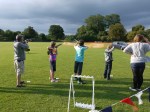
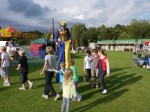
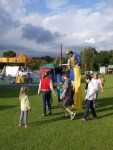
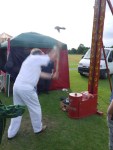
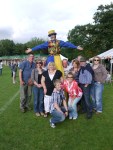
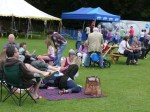
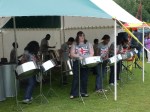
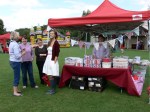
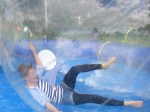
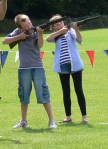
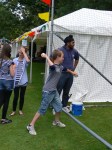
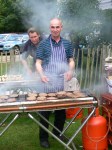
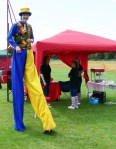
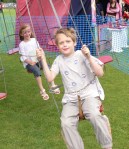
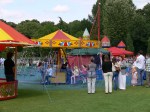
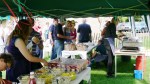
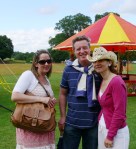
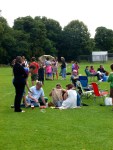
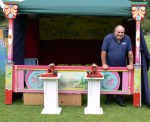
Every year, including this Jubilee one, our Parents, Teachers and pupils collaborate to host a summer fete, this year held on Saturday 18 June. The great danger with any Saturday in the Summer is that it will of course clash with so many other events, so we have to be really inventive to ensure its ‘attractions’ are worth the visit by a school community willing to spend. Sure it is a fundraiser for our PTAs, but more importantly it provides our community, past and present, to come to school and enjoy some fun. You can see some photos I took on the day here – http://goo.gl/ONya3 . The novelties this year include a Dodgem car arena, and (I suspect an ISA school first) an inflatable ‘Pub’. Amusingly it was pointed out to me that the Pub seemed to be on occasion overpopulated by school staff, though since the senior boys’ staff were deployed to ‘people’ it, that seemed a base accusation. Suffice it to say that both were a great ‘hit’, not unsurprisingly so when the weather went foul and our visitors sought indoor attractions for shelter!

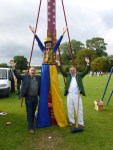
The highlights will continue every day to the end of term, across sports, drama, music, academic or recreational, often both. Off-stage now, most of my work is ensuring we are setting up the best we can for the next academic year; close to deadline activities such as new staff and pupils to be interviewed and welcomed into our community, critical path analysis of calendar and timetable creation so we create a plan for tomorrow that looks as or more effective than that for today. But the on-stage bit just couldn’t be better; I am delighted by the achievements of those I work with, both adults and children, employees and customers alike. When two dads, Felipe Foy and Chris Basley, give up their day job for the week to ensure we have an extraordinary funfare established to celebrate our Golden 50 years of achievement, I am genuinely humbled by their extraordinary efforts on our behalf.  Talk about ‘ordinary’? – talk about ‘extraordinary’, please!

The highlights will continue every day to the end of term, across sports, drama, music, academic or recreational, often both. Off-stage now, most of my work is ensuring we are setting up the best we can for the next academic year; close to deadline activities such as new staff and pupils to be interviewed and welcomed into our community, critical path analysis of calendar and timetable creation so we create a plan for tomorrow that looks as or more effective than that for today. But the on-stage bit just couldn’t be better; I am delighted by the achievements of those I work with, both adults and children, employees and customers alike. When two dads, Felipe Foy and Chris Basley, give up their day job for the week to ensure we have an extraordinary funfare established to celebrate our Golden 50 years of achievement, I am genuinely humbled by their extraordinary efforts on our behalf.  Talk about ‘ordinary’? – talk about ‘extraordinary’, please!

Posted in Uncategorized | Leave a comment

The dogmas of the quiet past, are inadequate to the stormy present.

In my efforts to understand and contribute in the rapidly changing world involving learning, my research is both wide ranging and eclectic.  Which it needs to be,  because none of us have any idea where the next good idea that takes hold is going to come from. Married to a Historian to her bone marrow, I am often humbled by my wife, Jenny’s grasp of the sweep of History. We spent half-term down near Dartmoor, and made our first foray into the rocks near Hound tor. It’s an extraordinary place, not least because of the impressive pile of rocks and boulders that give this pile its name, and as legend has it, Conon Doyle the inspiration for ‘The Hound of the Baskervilles’.  As we wandered around the surrounding moor, we came across the footings of a deserted village, Houndtor, well written up I discover on the internet (http://www.legendarydartmoor.co.uk/hound_sett.htm), and nearby across the way a much later granite quarry of the 1820s, well served at the time by a tramway, built of the same indestructible material (http://goo.gl/0DZLA ).

One place, 2 completely contrasting deserted centres of conurbation, one listed in the Domesday book, the other responsible for the stones that make up  part of the British Museum amongst many fine buildings nearer to the quarry in Devon, both falling foul of changing times and technologies. The medieval village it is thought failed largely due to the rapidly worsening weather of the time, making grain harvest impossible, with perhaps a final sweep of the Black Death to depopulate it completely.  Five hunder years later, however lovely Devon granite was in the 1850s, it came at a much higher price than that quarried further west in Cornwall, and the quarry and its workings were abandoned pretty much immediately.  The granite rails that made the tramway were no longer as easy to manipulate and use as the new ‘Iron’ rails, and so were abandoned too.

Around the time of the closure of the Haytor granite quarry, across the pond in Washington, Abraham Lincoln was preparing his annual message to Congress for December 1, 1862.  Whilst it turned out was a mainly routine report (if anything can be regarded as such during a period of extraordinary civil war), it was within this message that Lincoln gave first voice to his controversial measures such as voluntary colonization of slaves and compensated emancipation (in short, his proposal to pay the Slave plantations off).  He chose to soften Congress to his plan through this great rhetoric: “We can succeed only by concert. It is not “can any of us imagine better?” but, “can we all do better?” The dogmas of the quiet past, are inadequate to the stormy present. The occasion is piled high with difficulty, and we must rise — with the occasion. As our case is new, so we must think anew, and act anew. We must disenthrall ourselves, and then we shall save our country”

Moving on 150 years, and surveying the current educational landscape, I can’t help feel we could do with some one of Lincoln’s courage and stature to help bring some sense out of what seems little better than a scrap heap of granite chippings! It’s depressing to read that teenage literacy is plumbing new depths; we are making good progress apparently up to Year 5, but beyond then, the books of choice to read are those that are easy and short! Now my essay is not just about a lack of interest in books such as those written by Conon Doyle, but the formidable problem that has developed over the past twenty years as we have tried to open up higher tiers of study to our pupils. It seems contrary, but by making specifications so clear about what needs to be studied for Science or History or English, we have reduced the canon of work to be studied, such that reading in depth per se is no longer a requirement either for study at school, or dare I suggest at University too.  And if the situation seems to be a concern at the top of the educational tree, it looks even more worrying for those in charge of schools at the start of the process.

“Thousands of children ‘not ready for school’ at five” is the headline from this weekend’s Daily Telegraph, going on to claim that  Children are failing to develop vital physical and communication skills after being robbed of interaction with mothers and fathers during the early years.  The paper reports that these are the findings of Sally Goddard Blythe, director of the Institute for Neuro-Physiological Psychology in Chester, said many early developmental problems could be overcome with old fashioned one-on-one interaction between parents and children.  The worrying bit on this doom-mongering is that Ofsted’s research doesn’t actually back this up entirely; reported in the same article, Ofsted claimed earlier this year that growing numbers of schoolchildren were diagnosed as having special needs when they were actually “no different” to other pupils.

And here’s the rub; throughout our travels in the west country over half-term, I saw children and families at recreation together; some were tethered with ropes as they climbed the more serious granite Tors, other were just flying their kites, or crabbing on the jetties, all seriously engaged and enjoying the moment. It is the frequency of such interactions that learning happens, between peoples working together. As I sit and write, a solitary activity it must be said in the early hours of the morning, I do believe that Mrs Goddard Blythe has it right; it’s the interaction that is key, not the passive entertainment that is often easier to just receive.  Reading takes effort, as does climbing or fishing; they are skills to be acquired, and for which no excuses must be made.  There will be those for whom reasonable adjustment needs to be made, but a rock to be climbed won’t get easier by cladding it in scaffolding, or a Kite to be flown if its lead made shorter. Be sure in your parenting and you’ll be rewarded by your children’s achievements. As one Dad made clear to his small son who was rejoicing in his collection of estuary crabs, all scuttling in tangles in the bottom of the bucket. “Why must I put them back, Dad?” squealed the boy. “the crabs have their life to lead too” replied his father.  And I thought  “so that others can have the fun of catching them too”.  And we were both right!

Posted in Uncategorized | Leave a comment

When Headlines aren’t News!

There is no one way to improve schools, and since the time of Socrates and Plato, those who think about teaching and learning have known this. After every election when there is a change of party in power, the ‘new brooms’ come out to ‘sweep and clean and housekeep’.  The current coalition government’s education policy is steered by Michael Gove, who seems intent on radical change without necessarily checking whether such ‘improvements’ are supported by appropriate empirical evidence.

So yesterday, when the Headlines appeared on the BBC that ‘Teacher comments ‘more effective than smaller classes’, followed by the clarification that ‘Quality feedback from teachers is more effective in raising grades than homework, uniforms and smaller classes, a Durham University study says’, you might have been forgiven for thinking that some new, earth shattering discovery had been made.  Today’s papers such as the Telegraph and Guardian amplify the story too, but in different ways. The latest research has been funded by the Sutton Trust, who contracted Steve Higgins, Professor of Education at Durham University to summarise current findings; you can see their press release here –  http://goo.gl/OMeXG and download the report at the bottom of the page or from here – http://goo.gl/GwRgb.

The Telegraph picks on that aspect of research that suggests the growing use of learning support assistants has no effect on standards, and points out that the imposition of setting by academic ability and hairlines rules on uniform could actually have a negative impact upon pupils’ results.  The Guardian includes a nice summary on the effects of homework “It is certainly the case that schools whose pupils do homework tend to be successful schools. However it is less clear that the homework is the reason why they are successful!”

Academic Departments with Claires Court have been working on these issues for many years now, because the initial research that highlighted these issues stretches back to the 1960s, and has been reinforced over the last half-century with repeatable research showing just this. What has changed in the last decade, through the publication of “The Hidden Lives of Learners by Graham Nuttall” and subsequent aggregations of world research on the matter by John Hattie et al, most notably “Visible Learning” is that we know if there is one thing you should support your learners with, it is good feedback. Now that’s not just about marking their work, indeed running through an essay and correcting all the mistakes is likely to be the last thing that is meant!  The following paragraph is an extract from the report:

Feedback is information given to the learner and/or the teacher about the learner’s performance relative to the learning goals which then redirects or refocuses either the teachers or the learners actions to achieve the goal. It can be about the learning activity or task itself, about the process of the task or activity, about the student’s management of their own learning or their self-regulation or about them as individuals  e.g.“good girl”) Research suggests that feedback is best directed at the task and  rocess level. Research suggests that it should be:

• about challenging tasks or goals (rather than easy ones);

• given sparingly (i.e. needs to be meaningful);

• more important to give feedback about what is right than what is wrong;

• important to be as specific as you can and, if possible, compare what they are doing right now with what they have done wrong before; and

• it should encourage them, and not threaten their self-esteem.

Like all headlines in the Press, what the ‘News’ today is trying to do is ‘bitesize’ the report into something that steels your attention and ‘sells’ the paper. If you choose to read the whole report, it actually covers the whole breadth of issues that over the last decade educationalists and politicians have sampled to steer the way for school improvement. From the impact of after school clubs to sports training, one-to-one tuition to class size, the evidence is sorted and ranked in terms of effectiveness. And top of the heap is giving effective feedback – so the simple message is, ‘if you want to get the biggest bang for your buck’, put your efforts in to improving that!

Please read the report and perhaps recognise that if only the nation could afford classes to be smaller than 20 and schools to be of modest size, big enough to have specialist colleagues yet intimate enough so all are known and valued as members of the community, then pretty much everything else would follow in terms of school improvement. Tight knit communities aren’t scruffy, that look after each other, even the most vulnerable or eccentric, they rally together well as a team when threatened, but usually enjoy enough personal space so what they can develop their own interests and aptitudes.  Teachers will have time for some on-to-one, ‘learning conversations’ will happen as a natural by-product of  daily routing, when teachers and pupils sit down for lunch, or walk the playground together and so on. The arts, sports, creative and linguistic activities will be part of the busy schedule, particularly for the younger children, and the imposition of a one-size-fits-all is both unnecessary and inappropriate.

For the next three weeks, our departments are going through a whole range of internal inspection activities, scrutinising work, visiting other teachers’ lessons, talking about learning and giving feedback – none of that is scheduled in the public school calendar, which of course highlights at least a major event a day happening for 6 weeks. If you want something done, find busy people! That sounds ever so much like the recipe that most independent schools seek to provide, and certainly an incredibly good fit to that you can see within Claires Court most working days of the year!

Posted in Possibly related posts | Leave a comment

What on earth is going on…

Each week, I write to a private audience of over 400 teachers and fellow professionals in Independent Schools, in a newsletter to highlight topical issues in education. The network is known as the ISANet, and as my latest is almost entirely topical on national issues, I thought I would share it live so to speak.

Half-Term Newsletter 23 May 2011 

Dear colleagues

It beginning to get a bit hard to write a suitable digest each Monday night to inform, highlight, extend and occasionally amuse – this is because no week now passes without many massive news hits that have direct impact upon schools!

ISC are up in front of the Upper Tribunal, sitting at the Royal Courts of Justice in London to challenge the Charity Commission’s ‘narrow’ definition of Public Benefit.  It’s quite obvious that this case is far more explosive than some might suggest – http://goo.gl/BV3RB gives you a flavour of the sharp debate.  As a proprietor, I am watching this very carefully indeed, as this is an ill-wind, a court case to have been avoided like the plague.  In the current climate, we don’t need yet more bad news about private education.

Sticking with the BBC site, here’s the news of the proposed new East London Free School sponsored by a whole bunch of Public Schools for the sub £25k family income earners – http://goo.gl/mme1y.  What strikes me about such a proposal is that as a one off, with a shared address book of the rich and famous London Livery companies or peoples, I’ll not be surprised if it doesn’t take off – but where on earth is the scalability of such projects?  Yep, they’ll all study from 8pm to 5pm, follow compulsory activities such as debating and public speaking, play sport and serve the community, as if schools don’t do this now?

Following in similar drift, Mr Gove is now suggesting that popular state schools should be allowed to scale up indefinitely, with the obvious result that the weaker failing schools will be allowed to do just that – fail. It will be those with sharp elbows that get first on the bus to swap places, and those that know least that will get swallowed up in the swamp. I thought the whole point about the consistent development of outstanding schools in the recent past was that to continue to get the money, they’d have to take the failing schools under their wings. This new policy smacks of Titanic type ‘fitting-out’, only providing enough lifeboats for the First Class passengers.

It is extraordinary isn’t it; despite none of the current coalition government coming from a teaching background, they all seem remarkably rich with initiatives – David Willetts’ short-lived idea that the rich could bypass UCAS selection by paying the ‘foreign’ tuition fee seemed a perfect idea until it hit the press – here’s what the Mumsnet shriek looked like – http://goo.gl/VHqQ3

As Theresa Ward and Paul Bevis comment on the ISANet, we are ill-served by the recent glaring headlines that the Council of Europe want to see radio-waves removed from our schools, or at least those generated by the wi-fi networks and by mobile phones.  This seems classic bad science, almost dare I say as bad as the Rapture moment that failed to arrive this weekend – as Kiwis spotted first that the earth did not end after all on Saturday, here a link from down under to follow that – http://goo.gl/YHmVY. The problem about the EMR stuff messing with children’s brains is that it was front page of the Telegraph, so it must be true!  For a balanced view of this, please go to your ISANet and read a little more –  or here http://goo.gl/WyeRQ. The thing we do know as teachers is that we would not give our children mobile phones under secondary school age – and most of us find it incomprehensible that children much younger are permitted to have so much contact with their microwaves – see here from the horror movie – http://youtu.be/V94shlqPlSI.

Final piece of doom on the Government cuts comes from the BBC – which gets my BATA vote for best easy to access news service on the Web – this is the story about childcare tax credits which look doomed from 2013 – http://goo.gl/dhCY1.

It does seem to me to be extraordinary that the early noughties might be looked back upon as the Halcyon days of consensual politics in education, when government listened to the early years educators, developed some really joined-up excellent EYFS care and associated funding and ensured above all that the incredibly diligent early years professional staff engaged in training and support to lead our provision from a cottage industry of all-sorts to being the envy of the developed world, or at least that bit of it that needed early years care. After a decade of incredible, careful and well planned steps, our Nursery provision now is being decimated by the inclusion of just 4 year olds in state primary provision. You can find some enlightened professional opinion on this matter in the UK, just across the Scottish boarders as it happens, where the debate continues to rage that children should stay that extra year til 6 in Nursery – http://goo.gl/piUWE!

To conclude, I do believe that the challenge consenting, co-ordinating amazing independent schools such as ours are under real threat from the current tide of negativity.  Every day, amazing things happen in our schools; pupils and teachers come together and work, learn, inspire, perspire and yes cry with frustration when stuff doesn’t go well, but that’s the creative process. And what we do is a precious commodity, carefully honed over many years by dedicated families working hand in glove with very special places we call ‘ISA’ schools.  If you feel like joining your voice to mine, please add to the blog on the ISANet, or of course below on this ‘Principled View’.

James Wilding

jtw@clairescourt.com

Posted in Uncategorized | Leave a comment

Does one syllable make all that difference…

I have wondered whether the right wing stateside have considered Obama more of a threat to the American way of life than Osama. I can’t begin to imagine the pressure Mr President is under, forced to release the details of his birth; now the certificate is out in full, it seems Donald Trump and others wish to pursue this further, suggesting that the artefact is a forgery, “It’s very inventive computer art!” says arch opponent, a lead lawyer at the head of the ‘birther’ movement, Orly Taitz. We await the Court’s decision, and come what may, this is a story that will run and run. It is clear that for some, Barak Obama could never be a natural born American, and remains undeserving to serve his country as its First citizen and Commander-in-chief.

Now one has authorised the execution of the other, does that resolve the argument, or does it mean Mr President is given a month off before he is once again at the sharp end of such politics? What frightens me is that Obama’s more recent actions, approving the execution of Osama bin Laden, have led to an outpouring of extraordinary gratuitous celebration.  A week ago, the American journalist, David Sirota wrote an excellent piece for Salon, in which two paragraphs really caught my drift. The first highlights the widely held view across the western world about the burning of books, flags, buildings, lootings and the general celebration of death. After all, we fought a world war against such tyrannies.

“For decades, we have held in contempt those who actively celebrate death. When we’ve seen video footage of foreigners cheering terrorist attacks against America, we have ignored their insistence that they are celebrating merely because we have occupied their nations and killed their people. Instead, we have been rightly disgusted — not only because they are lauding the death of our innocents, but because, more fundamentally, they are celebrating death itself. That latter part had been anathema to a nation built on the presumption that life is an “unalienable right.”

To be honest, if that were all David wrote, I’d be worried. But he has caught a real mood shift in younger people across the United States, arising since the Twin Towers disaster, who really do wish to see the body count matched piece by piece. I can’t forget the images of the dead bodies of Sadam’s sons paraded across the screens, nor the Heinz variety of justifications that approved the internments without trial in Guantanamo Bay nor, for that matter, the lamentable behaviour of troops from across the NATO forces caught up more generally in the inhumane treatment of prisoners of war.

“This is bin Laden’s lamentable victory: He has changed America’s psyche from one that saw violence as a regrettable-if-sometimes-necessary act into one that finds orgasmic euphoria in news of bloodshed. In other words, he’s helped drag us down into his sick nihilism by making us like too many other bellicose societies in history — the ones that aggressively cheer on killing, as long as it is the Bad Guy that is being killed.”

As I regularly lead School assemblies that focus on the challenges we face as we strive to become better humans working in a society that genuinely serves our collective needs, the Ob/sama paradox is a really tough nut to crack. Is it possible for a nation to legitimise murder without trial? I was born just after the West had spent 4 years managing the Nuremburg trials, at which the Nazis were appropriately held to account by a Judiciary as independent  as we could muster. If nothing else, will an independent inquest hear the case for the as yet unexplained shooting of a wanted terrorist?

Posted in Uncategorized | Tagged , , , , , | 2 Comments

Writer’s block…

It has been a few weeks since my last proper blog, and after yet another stupidly busy week, your humble servant remains short of his ‘muse’. It is often this way, I find, one month has me almost frothing at the mouth ‘cos I have so much to say, and others (such as this May) it seems best to leave all the others to do the talking.

It is not that the stories have gone walk-about. In fact, what with Royal Weddings, Bin Laden’s execution and the recent AV referendum, the in-tray seems overflowing with useful material.  And yet the words don’t flow.

It’s not that I don’t know why the faucet has switched off; indeed I am so certain I know the answer, I am testing my hypothesis on the ‘morrow. The truth is that I missing contact with my pupils, what with the short 2, 3 and 4 day weeks we have had, and my own commitments to the Independent Schools’ Inspectorate taking me away last week for 3 days to work on one of their teams in a London school.

Of course at the school I have been inspecting, I had loads of contact with children, but professional integrity prevents me from writing about their school and their contribution to its success. What was particularly exciting was to speak to pupils I don’t know about their work and play, and because their responses were very different to those I usually hear, I can’t wait to get back to CC and test the zeitgeist.

So in 24 hours or so, the writer will return within and I’ll be able to post anew.  Suffice it to say this for the time being (and to wet your appetite): young people in their exam years really do recognise the pressures they are under and as readily acknowledge the pressures their parents face too. Many uncertainties are arising from different directions, be that the fragile UK economy, the exam system, university entrance and fee rises, a fragile planet and man’s footprint on it.

We’ll do well to remember that learners know well over half of what we ever hope to teach them anyway, and assisting them to find their voice and take control of their learning has never been more important. Good academic results are essential, but successful adults have so much more going for them than just some A grades, and they find time to do so much in spite of the rhetoric that we are all time poor.

Now, where’s that razor to sharpen my quill, I had it around me just a moment or so ago?

Posted in Uncategorized | Leave a comment

It’s all about the school holidays…

…goes the 1950’s cry to attract graduates into the teaching profession. In short, the subtext said, work hard in term-time, and 14 weeks of holiday leave arrives all too frequently to compensate the wage-slave.

Claires Court Schools has an official 3 week break this Easter, so that’s all right then, and the tradition over our 50 years of existence continues… except of course it doesn’t actually.  Yep that’s right, ‘skools out from Wednesday, though that means the staff now get to work on other things, like training, marking and some r&r too – just 12 days outside of Bank hols!

Anyone who ever attends a staff meeting in education anywhere (and lots of businesses never have such events) knows that if the meetings are long, AOB is even longer.  Teachers care (no, really) and extraordinary time is spent checking, counter checking and holding-to-account everything we do after the end of term, and under AOB, all sorts of questions emerge that will immediately, or in due course, make schools change for the better. You see, it gets hard-wired in this ‘marking’ thing, after all, our normal workforce are both amazing and alarming in equal measure (the children that is) and we need to clock them in and clock them out with a precision that most unionised workforces would have got rid of, you guessed it, 50 years ago.  And that hard-wired stuff also allows and encourages teachers to look North to ‘da management’ and cause some further important reflection by their bosses as well.

Just by the by, I love the way Google tells us stuff we never knew, so we can then relate as an urban truth and seem wise.  If you stick the two words, industrial and education into google,  you’ll find all sorts of entertainment, not least from YouTube’s great oeuvre – see this for starters http://bit.ly/8JdcYb .

You don’t have to be a Sir Ken Robinson to know that actually there are schools better than those that Pink Floyd lined up for their contribution to the scholastic debate (ok, I live in hope that a broader audience need a link to another brick – http://bit.ly/gcMBHI)

So at CCS, the students (16+) and pupils (Y11 and below) were disappeared yesterday and the teaching staff are reflecting today really quite thoroughly on what we do,  and studying tomorrow with 2 of the country’s leading educators (both for practice and philosophy), Margaret Goldthorpe (http://www.margaretgoldthorpe.co.uk) and Neil MacKay (http://www.actiondyslexia.co.uk). Maggie’s philosophical ideas are fab for running schools – ‘when due to meet with parents, ask for 6 good things the child has done that week’ – stunning advice really, ‘cos every teacher I have ever met will tell you about personal shortcomings (adult or child), and Neil’s are (perhaps) even more powerful because he demonstrates (with seriously good academic research) that both parents and teachers are usually wrong about what a child can achieve within normal class groupings.

So apart from the staff training then, the ‘skool’ is set for sleep … not so fast sonny!

Those who row are on training camp from Thursday to Sunday, those who sail are away this weekend at regatta, those who ‘gold’ explore are away from Monday to Friday and those that ski are away next weekend for a week. Holiday club will be welcoming some 100 children on a daily basis to have ‘some fun’ and actually anyone with some public examinations needs to get stuck into some serious revision ‘cos within the month they are starting that set of tests and trials. Such activity demands that school leaders, middle managers and plain teaching & coaching staff are on duty, and I am privileged to run an organisation within which people genuinely understand that they either know their place and settle back ‘for a break’ or step up ‘to the mark’.

What’s true of course is that our staff do stop working (in terms of ‘face-time’) with their pupils, and they (both of them, adults and children) deserve that break. Holidays aren’t just about parents picking up the load, but more importantly, giving children contact time with other adults, preferably family, be that grandparents, uncles and aunts or whoever. When I was born and bred, children were there to be seen but not heard, which is the antithesis of what they need (I hear you cry), but in one of those strange ways, is an exception that proves the rule. 50 years ago (ok, it is the schools’ golden jubilee, so I need to have some product placement in my blog) children had huge contact with their parents, who needed to invent a post watershed rule (no TV/DVD/PC/iPo/ad) that gave the grown-ups a break (from their children).

What is absolutely true in 2011 is that the majority of CCS parents don’t have the full-on contact with their children of yesteryear, and the silent majority (I read the PQs, so I know) really welcome their children back from school, to deprogram them from ‘instruction’ and recover the lovely ‘peeps’ that live together and actually have some fun.  Much of the time, I suspect it is the children deprogramming the parents from their corporate culture that actually happens, a sort of naïve groundswell from the 5th column. It amazes me how many parents seem to run their children by clipboard, as if they are employees rather than kiddees!

But for an equal number, an asymmetric life that matches school is not possible, so the hols. need further respite care for the working parent, and that is what causes me to post this essay for the working parent.  Please, please find an opportunity to talk to your children; they have been in (my) school since the turn of the New Year and they have grown apace and are now even more interesting and entertaining than hitherto.  There is not a ‘tomorrow’ you are saving yourself for to ‘hear this good news’.  Hear it today, and avail yourself of this voucher which will change your life for the better.

Oh, by the way, I have ensured the voucher links to an explanation too – that’s the teacher in me!  I’ll just need to chase down those missing homeworks in the detention book then…

Posted in Uncategorized | Leave a comment

A little bit of History does you good!

In Tuesday’s Guardian (29/3/2011), Niall Ferguson, the eminent Historian now at Harvard and often on our TV screens too, leads another attack on the teaching of History in our schools.  His article is entitled ‘History has never been so unpopular’ and introduces with the lead ‘According to Ofsted, history is successful in schools. Not so, says controversial historian Niall Ferguson: the inspectors are missing the ruination of the subject’. More here http://bit.ly/hYPU56

You’ll gather this got my blood boiling and led me to post the following

“In general, we have to accept the contention that History needs to be a required in depth subject to GCSE for children to understand its important place in their curriculum and education. When the last Labour government made taking a language optional past 14 (aka age 12/13 given the compression now allowed for the KS3 curriculum into just Years 7&8), Language take-up dropped like a stone, and even selective state grammar schools allowed pupils to drop a language with parental consent. The Linguist version of a Ferguson can always produce a list of vocab and people that in his view pupils should know (panache and Molière), and equally traduce the examples actually used (buying a S-Bahn ticket in Berlin), the core facts of learning are that pupils need long term sustained contact with the subject. 

I don’t reject OfSted’s findings; indeed married to a History teacher in an Independent school, I ride shotgun on lots of useful History and Language trips on their arc of travel across time and place, and I see vast numbers of state-side contemporaries similarly engaged. There have never been a raft of well qualified male and female graduates entering the profession in these two disciplines, and one of the main reasons for both subjects’ failings is that the professional and monetary reward for good graduates is so much higher in other professions.  Teaching History and Languages to children, particularly adolescents, is really hard, they do have to learn facts and memorise rules and structures.  What kills the subjects is the act of sticking them in a league table to measure performance, this against other subjects which are optional and are set to attract children who are talented and interested in the vocational outcomes, such as Art, Drama and Sport.

I am sure that if we had provided a surfeit of great Historians and Linguists to the profession over generations, we would not see both subjects in such short supply at GCSE and A level.  But please do remember that education is always battered by the storms of a countries economic woes – the clarion call is out there too for great innovation in technology, for schools to unleash their pupils creativity in arts and sports – our national cricket side could do so much better if only the sport were played more frequently in schools.  So government has pulled schools hither and thither in an effort to ensure this mechanised form of education provides feedstock for the nation’s needs.  Oh and of course just now, despite their best intentions, there aren’t actually many jobs for the talented successful outcomes of our system to apply for, let alone engage with, leading to another repeating cycle of concern about a ‘lost generation’.

The great education systems of Europe, led by Finland, allow horses for courses, withdrawal into academic and vocation strands by choice (not selection) and have more effective joined-up educational provision for those with special needs. It’s curious that in the madness that is led by Michael Gove, we might see some fundamental simplifications happening to bring History back to the fore in the state sector. As far as Niall Ferguson’s commentary goes – keep it up too; but bear in mind that his work is characterised by ‘panache’ – with or without the accent – ‘style over substance’ and ‘ ‘frothy weak ale’!

P.S. Does any now where the reference below originally comes from?

It’s like Irwin’s dream; teaching kids to fool the examiner into thinking they know what they’re talking about

Posted in Uncategorized | Leave a comment

For the Fallen

“Every intelligent person in the world knew that disaster was impending but knew no way to avoid it.” H.G.Wells

I have converted pictures taken on our visit with text and some background images in a new Animoto – view that here – http://bit.ly/fUHxVC

An early photograph from Tyne Cot, 1924

Over the past 10 years, I have traveled with our History department on their Year 10 field trip to Ypres. I can’t really explain quite how valuable the trip is for those concerned, offering as it does a unique mix of activity for the pupils studying the First World War.

The remarkable museum “In Flanders Fields” is situated in the Cloth Hall at the centre of Ypres, which looks in better shape now than it did after the artillery had finished with it in 1914. And as you walk into the museum, H.G.Wells stark commentary reminds us that now as then, war is a bloody business that no-one can control. An hour or so spent in the museum allows the visitor to explore the life and times of one character during and after the war period, mine was an Albert Wheeler, who fought and survived the war, and whose wish to be laid to rest after his death (1982) with his comrades in Flanders was permitted through the scattering of his ashes amongst his comrades, south east of Ypres in the village of Zillebeke.

I make no bones about the success of the trip; you only have to see the purposeful nature of the cemetery survey to see how moved the pupils are.  “Choose two epitaphs you find moving” is the task, and within minutes you can see the boys and girls are drawn into the individual stories of grief and pride that such words elicit. At Tyne Cot, the row on row of white headstones, most inscribed simply “A soldier of the Great War” and then much lower down under a simply cross “Known unto God” can’t help but move the visitor. Near the central memorial cross, built over a concrete Pill Box, there are several individual graves of both British and German soldiers, buried it seems where they fell, helping the visitor remember that both sides lost their finest men in the conflict.

Tyne Cot Cemetery is the resting place of 11,954 soldiers of the Commonwealth Forces. This is the largest number of burials contained in any Commonwealth cemetery of either the First or Second World War. It is the largest Commonwealth military cemetery in the world. The dates of death of the soldiers buried at Tyne Cot cemetery cover a period of four years, from October 1914 to September 1918 inclusive.” In addition, on the walls at the rear of the cemetery, some 33,783 names of the UK forces lost after 15 August 1917 are listed, together with 1,176 New Zealanders lost in battles fought nearby throughout the war.

The King’s Speech has recently won Oscars and Baftas and much acclaim for the courage shown by King George V1 as he struggled to master a devastating stammer. His father, George V had to show extraordinary courage throughout his reign, not just because of the devastating effect the Great War had upon so many towns and villages in his kingdom.  After the War, King George toured the various cemeteries in Flanders and wrote this on 11 May 1922 on visiting Tyne Cot “We can truly say that the whole circuit of the Earth is girdled with the graves of our dead. In the course of my pilgrimage, I have many times asked myself whether there can be more potent advocates of peace upon Earth through the years to come, than this massed multitude of silent witnesses to the desolation of war.”

Langemark German Military cemetery is much newer than Tyne Cot, very much a moving project throughout the last century to bring together disparate groups of German graves into one major memorial. Whilst it began as a cemetery during 1915, it grew after both wars and the oaks planted in 1930 now provide a lofty cover to what is a remarkably different memorial to the fallen, far less majestic and yet full of the same pathos; at both sites, one can’t help but mourn.

Sanctuary Wood ought to be as gloomy, being former British trenches overrun on a number of occasions by the German army, and a place under which no doubt many human remains still could be found. Somehow though it’s not, despite the carcasses of shattered trees that still adorn the landscape, the sheer exuberance of young visitors running through the trenches, jumping the gaps and running underground in the linking tunnels helps bring light and life to what must have been a god-forsaken place. Between Langemark and Sanctuary wood we pass Hellfire Corner, arguably the most dangerous place on the front, where troops pass through at the run, horses at the gallop and lorries as flat out as mud and technology would allow.

At 8pm, we stand under the Menin Gate, the major memorial for those lost without grave before 15 August 1917 in the UK forces. There’s always a huge crowd, and some planned short ceremony from school, forces unit or other brigade laying wreaths in between the Bugle blasts of the Belgian Fire brigade who host the daily event. This year for some reason, the lights were out, making it an even more poignant memory of the ultimate sacrifice made by those we stand to remember. There’s not really a lot to see or hear, crowds being what they are, but when the bugles blow and the crowd hushes, it’s clear we have all that same thought, a sense of loss but firm resolve that we will abide by Laurence Binyon’s direction in his poem For the Fallen.

“They shall grow not old, as we that are left grow old:

Age shall not weary them, nor the years contemn.

At the going down of the sun and in the morning

We will remember them”

Posted in Uncategorized | Leave a comment

What the FRSA…

…are they all about?

I joined the RSA some 20 years ago, when it became clear to me I needed some cross-‘business meets theory’ support above and beyond that which my professional sector of education was giving me. I needed the support of a couple of existing Fellows then to support my application, and apart from agreeing to subscribe some £250 a year, I was made a Fellow and I have stayed connected ever since.  The Chief Exec. of the RSA, Matthew Taylor writes this in the Times Educational Supplement recently “It is important to develop skills that cross subjects and specialisms, skills that will be useful for all and in all walks of life” , and that’s certainly what my Fellowship has helped me gather, through its quarterly magazine, its events and projects.

The RSA objectives include enabling the Fellowship to be a powerful force for social good and civic innovation, and that’s certainly part of my raison d’etre for engaging so widely and across the piece in education.  I rather like Mr Taylor’s 21st animation that describes our current strapline of 21st Century enlightenment in some excellent thought-provoking and challenging ways – you can watch his talk here http://bit.ly/d1RFvF, brilliantly illustrated by the people from Cognitive media. I have already written about the humbling nature of Headship; what seemed so obvious in the first few years of running a school may remain just as clear, but the sheer scale of the complexity of human development means that the mission becomes really rather complex. To be able to step outside of my goldfish bowl, study, work and engage with others of greater experience, intellect and vision has been incredibly helpful.

So when RSA added a Twitter steam, I decided to tune into that, as I had previously to their LinkedIn network, providing all sorts of thoughts and links to research. A recent question posted on the RSA comment area asked Fellows to distinguish between Learning, Knowledge and Wisdom, and it set me to reply as follows:

“Jamie’s Dream school TV on Wednesday nights has become part of my required viewing. Alvin Hall, the American financial trainer, hit close last week when he was prepared to accept that Jamie’s students were clever, but not that they were intelligent.

Consider learning to drive. Long before any student actually learns to drive a car, most reckon they’ll be really good – ‘clever’ at the driving thing.  Stick them behind the wheel and pretty soon they’ll be humbled that they don’t actually know how to drive

We learn how to drive a car, a complex series of mechanical activities that bit by bit we make subconscious so that we can then pass a driving test, and then actually get into the whole process of transporting ourselves from A to B, and worry a lot more about other more important things. Learning is all about cognition, the result of perception, learning and reasoning, by which we acquire new skills or knowledge. Knowledge is an outcome of learning, it can be measured by tests; we learn the Highway Code as part of the driving test, we don’t actually have to understand what lies behind the code, and regular rehearsal will help us tick the right boxes.  Superficial knowledge acquired this way becomes deeper as we become more experienced drivers, as we make more mistakes and learn from them, as we experience new conditions and control our responses as a result. Wisdom of the driver accumulates from many such sustained experiences, where knowledge meets common sense.

People who are clever learn quickly, they seem to be able to manage with fewer instructions and fewer rehearsals, they’ll not often be in the resit class either. But that does not make them intelligent, the process by which we learn from experience and from which wisdom develops.  Where and why learners fail is when their willingness to work is less than their attention span; the learner has not been willing to suborn their own desires to the needs of the teacher or the group. Of course the teacher must learn their craft skills, pace and vary the learning activities to just stretch the pupil enough so new experiences are gained, but not so rapidly to disenfranchise and disconnect. Watching Alvin worry all night about how he could present difficult challenges to his charges in just hard enough ways was great; seeing him connect across the pond to another teacher who give insight and craft skill for the task ahead is precisely what we do. I have done that for this writing, connecting not just to colleagues but to Google, Princeton and Wikipedia to check that what might seem clever has some signs of intelligence, and that as a piece might impart some wisdom. But hey, what do I know?”

The nice thing of course is that others following the stream join in, add their thoughts, polish mine, even of course disagree. Essentially I have found virtual RSA a 21st century coffee shop of the enlightenment, from which over 300 years ago, modern behemoths such as Lloyds of London commenced their commerce. I don’t know many Fellows, but what I do share with them is a powerful urge to do good, be influential and shape society. As the American anthropologist Margaret Mead argued

“Never doubt that a small group of thoughtful, committed citizens can change the world. Indeed, it is the only thing that ever has”.

Posted in Uncategorized | 1 Comment