For the Fallen

“Every intelligent person in the world knew that disaster was impending but knew no way to avoid it.” H.G.Wells
I have converted pictures taken on our visit with text and some background images in a new Animoto – view that here – http://bit.ly/fUHxVC

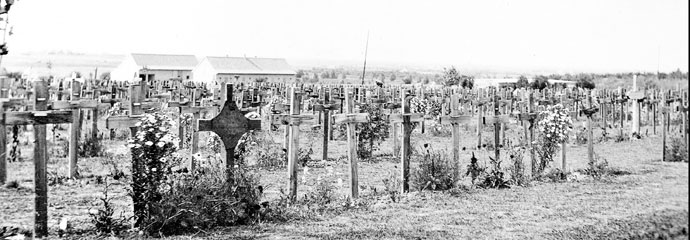
An early photograph from Tyne Cot, 1924

Over the past 10 years, I have traveled with our History department on their Year 10 field trip to Ypres. I can’t really explain quite how valuable the trip is for those concerned, offering as it does a unique mix of activity for the pupils studying the First World War.

The remarkable museum “In Flanders Fields” is situated in the Cloth Hall at the centre of Ypres, which looks in better shape now than it did after the artillery had finished with it in 1914. And as you walk into the museum, H.G.Wells stark commentary reminds us that now as then, war is a bloody business that no-one can control. An hour or so spent in the museum allows the visitor to explore the life and times of one character during and after the war period, mine was an Albert Wheeler, who fought and survived the war, and whose wish to be laid to rest after his death (1982) with his comrades in Flanders was permitted through the scattering of his ashes amongst his comrades, south east of Ypres in the village of Zillebeke.

I make no bones about the success of the trip; you only have to see the purposeful nature of the cemetery survey to see how moved the pupils are.  “Choose two epitaphs you find moving” is the task, and within minutes you can see the boys and girls are drawn into the individual stories of grief and pride that such words elicit. At Tyne Cot, the row on row of white headstones, most inscribed simply “A soldier of the Great War” and then much lower down under a simply cross “Known unto God” can’t help but move the visitor. Near the central memorial cross, built over a concrete Pill Box, there are several individual graves of both British and German soldiers, buried it seems where they fell, helping the visitor remember that both sides lost their finest men in the conflict.

Tyne Cot Cemetery is the resting place of 11,954 soldiers of the Commonwealth Forces. This is the largest number of burials contained in any Commonwealth cemetery of either the First or Second World War. It is the largest Commonwealth military cemetery in the world. The dates of death of the soldiers buried at Tyne Cot cemetery cover a period of four years, from October 1914 to September 1918 inclusive.” In addition, on the walls at the rear of the cemetery, some 33,783 names of the UK forces lost after 15 August 1917 are listed, together with 1,176 New Zealanders lost in battles fought nearby throughout the war.
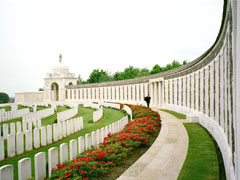
The King’s Speech has recently won Oscars and Baftas and much acclaim for the courage shown by King George V1 as he struggled to master a devastating stammer. His father, George V had to show extraordinary courage throughout his reign, not just because of the devastating effect the Great War had upon so many towns and villages in his kingdom.  After the War, King George toured the various cemeteries in Flanders and wrote this on 11 May 1922 on visiting Tyne Cot “We can truly say that the whole circuit of the Earth is girdled with the graves of our dead. In the course of my pilgrimage, I have many times asked myself whether there can be more potent advocates of peace upon Earth through the years to come, than this massed multitude of silent witnesses to the desolation of war.”

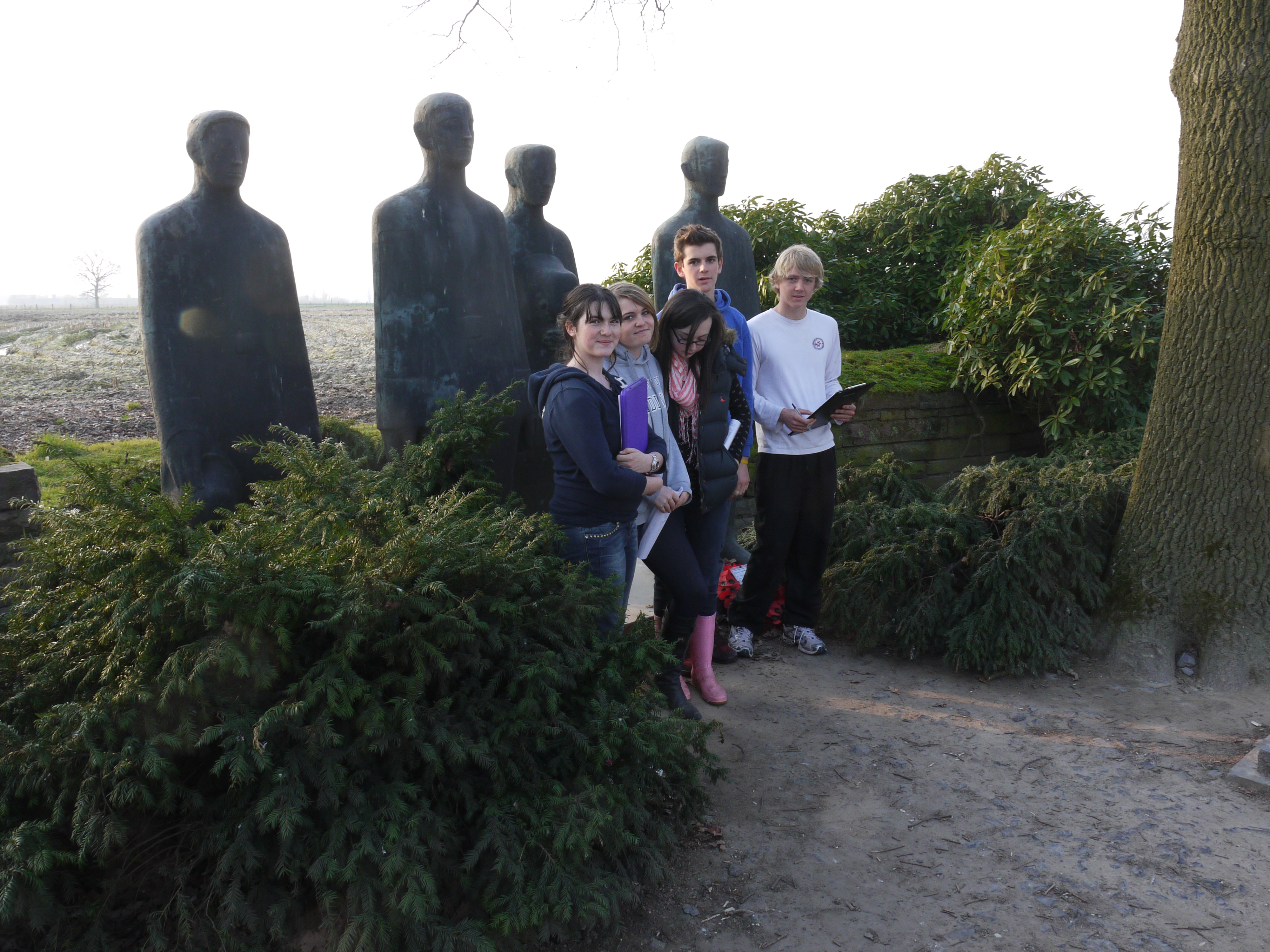
Langemark German Military cemetery is much newer than Tyne Cot, very much a moving project throughout the last century to bring together disparate groups of German graves into one major memorial. Whilst it began as a cemetery during 1915, it grew after both wars and the oaks planted in 1930 now provide a lofty cover to what is a remarkably different memorial to the fallen, far less majestic and yet full of the same pathos; at both sites, one can’t help but mourn.
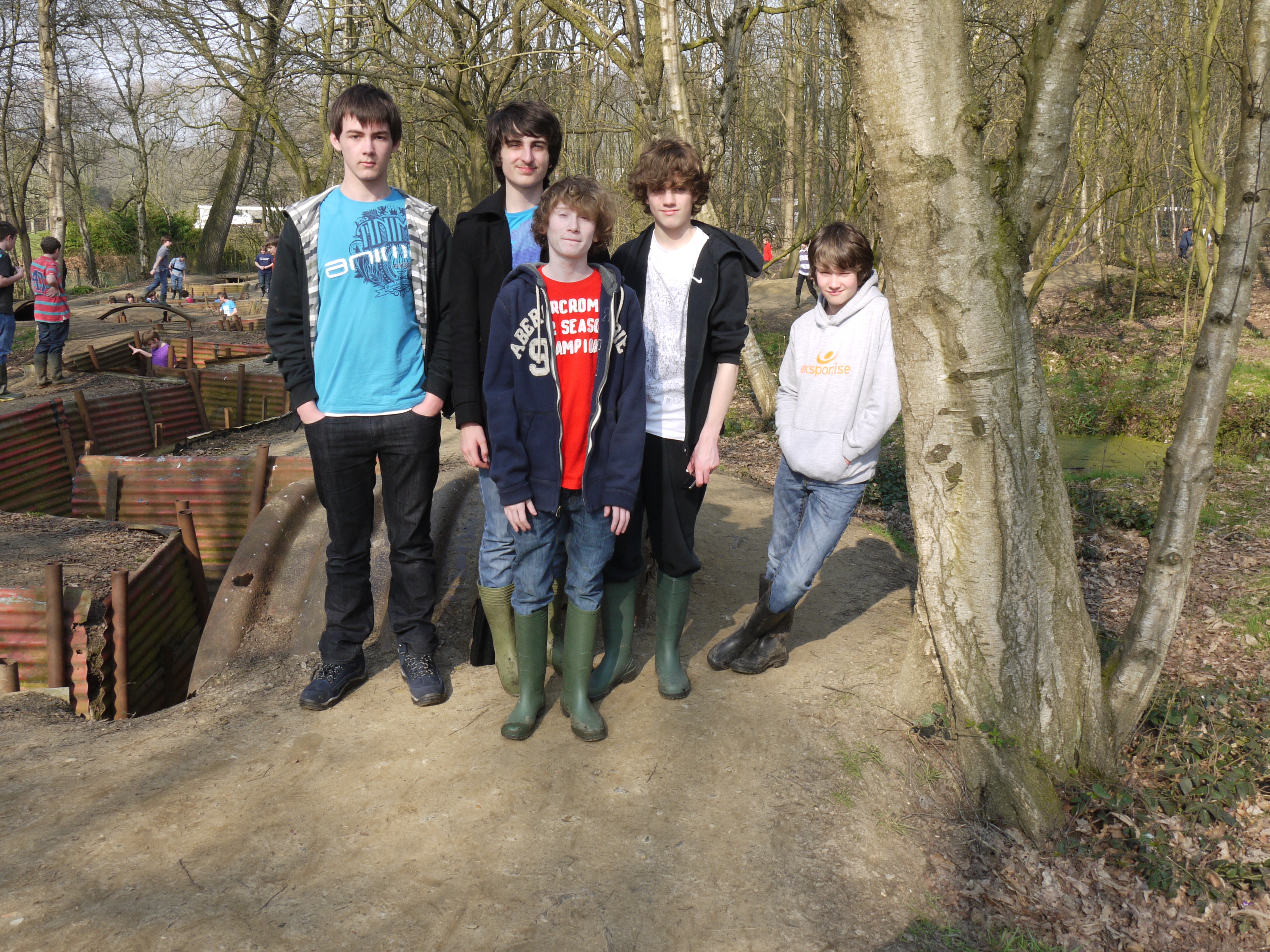
Sanctuary Wood ought to be as gloomy, being former British trenches overrun on a number of occasions by the German army, and a place under which no doubt many human remains still could be found. Somehow though it’s not, despite the carcasses of shattered trees that still adorn the landscape, the sheer exuberance of young visitors running through the trenches, jumping the gaps and running underground in the linking tunnels helps bring light and life to what must have been a god-forsaken place. Between Langemark and Sanctuary wood we pass Hellfire Corner, arguably the most dangerous place on the front, where troops pass through at the run, horses at the gallop and lorries as flat out as mud and technology would allow.
At 8pm, we stand under the Menin Gate, the major memorial for those lost without grave before 15 August 1917 in the UK forces. There’s always a huge crowd, and some planned short ceremony from school, forces unit or other brigade laying wreaths in between the Bugle blasts of the Belgian Fire brigade who host the daily event. This year for some reason, the lights were out, making it an even more poignant memory of the ultimate sacrifice made by those we stand to remember. There’s not really a lot to see or hear, crowds being what they are, but when the bugles blow and the crowd hushes, it’s clear we have all that same thought, a sense of loss but firm resolve that we will abide by Laurence Binyon’s direction in his poem For the Fallen.

“They shall grow not old, as we that are left grow old:

Age shall not weary them, nor the years contemn.

At the going down of the sun and in the morning

We will remember them”

Posted in Uncategorized | Leave a comment

What the FRSA…

…are they all about?

I joined the RSA some 20 years ago, when it became clear to me I needed some cross-‘business meets theory’ support above and beyond that which my professional sector of education was giving me. I needed the support of a couple of existing Fellows then to support my application, and apart from agreeing to subscribe some £250 a year, I was made a Fellow and I have stayed connected ever since.  The Chief Exec. of the RSA, Matthew Taylor writes this in the Times Educational Supplement recently “It is important to develop skills that cross subjects and specialisms, skills that will be useful for all and in all walks of life” , and that’s certainly what my Fellowship has helped me gather, through its quarterly magazine, its events and projects.

The RSA objectives include enabling the Fellowship to be a powerful force for social good and civic innovation, and that’s certainly part of my raison d’etre for engaging so widely and across the piece in education.  I rather like Mr Taylor’s 21st animation that describes our current strapline of 21st Century enlightenment in some excellent thought-provoking and challenging ways – you can watch his talk here http://bit.ly/d1RFvF, brilliantly illustrated by the people from Cognitive media. I have already written about the humbling nature of Headship; what seemed so obvious in the first few years of running a school may remain just as clear, but the sheer scale of the complexity of human development means that the mission becomes really rather complex. To be able to step outside of my goldfish bowl, study, work and engage with others of greater experience, intellect and vision has been incredibly helpful.

So when RSA added a Twitter steam, I decided to tune into that, as I had previously to their LinkedIn network, providing all sorts of thoughts and links to research. A recent question posted on the RSA comment area asked Fellows to distinguish between Learning, Knowledge and Wisdom, and it set me to reply as follows:

“Jamie’s Dream school TV on Wednesday nights has become part of my required viewing. Alvin Hall, the American financial trainer, hit close last week when he was prepared to accept that Jamie’s students were clever, but not that they were intelligent.

Consider learning to drive. Long before any student actually learns to drive a car, most reckon they’ll be really good – ‘clever’ at the driving thing.  Stick them behind the wheel and pretty soon they’ll be humbled that they don’t actually know how to drive

We learn how to drive a car, a complex series of mechanical activities that bit by bit we make subconscious so that we can then pass a driving test, and then actually get into the whole process of transporting ourselves from A to B, and worry a lot more about other more important things. Learning is all about cognition, the result of perception, learning and reasoning, by which we acquire new skills or knowledge. Knowledge is an outcome of learning, it can be measured by tests; we learn the Highway Code as part of the driving test, we don’t actually have to understand what lies behind the code, and regular rehearsal will help us tick the right boxes.  Superficial knowledge acquired this way becomes deeper as we become more experienced drivers, as we make more mistakes and learn from them, as we experience new conditions and control our responses as a result. Wisdom of the driver accumulates from many such sustained experiences, where knowledge meets common sense.

People who are clever learn quickly, they seem to be able to manage with fewer instructions and fewer rehearsals, they’ll not often be in the resit class either. But that does not make them intelligent, the process by which we learn from experience and from which wisdom develops.  Where and why learners fail is when their willingness to work is less than their attention span; the learner has not been willing to suborn their own desires to the needs of the teacher or the group. Of course the teacher must learn their craft skills, pace and vary the learning activities to just stretch the pupil enough so new experiences are gained, but not so rapidly to disenfranchise and disconnect. Watching Alvin worry all night about how he could present difficult challenges to his charges in just hard enough ways was great; seeing him connect across the pond to another teacher who give insight and craft skill for the task ahead is precisely what we do. I have done that for this writing, connecting not just to colleagues but to Google, Princeton and Wikipedia to check that what might seem clever has some signs of intelligence, and that as a piece might impart some wisdom. But hey, what do I know?”

The nice thing of course is that others following the stream join in, add their thoughts, polish mine, even of course disagree. Essentially I have found virtual RSA a 21st century coffee shop of the enlightenment, from which over 300 years ago, modern behemoths such as Lloyds of London commenced their commerce. I don’t know many Fellows, but what I do share with them is a powerful urge to do good, be influential and shape society. As the American anthropologist Margaret Mead argued

“Never doubt that a small group of thoughtful, committed citizens can change the world. Indeed, it is the only thing that ever has”.

Posted in Uncategorized | 1 Comment

4 years with a G-Wiz

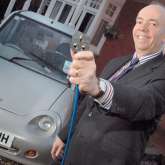
Now not everything that I write about relates to education, though you could be forgiven that from my recent blog entries. For a couple of weeks recently, I have been seen riding around in a petrol Hyundai 1.2, and rumours have been growing that I have ditched the electric car.  I can’t say I was that happy that the Advertiser decided to chase me for a story about the installation of charging points for electric cars in their car parks. You can read more about that here – http://bit.ly/f19mwN, and the rather embarrassing picture that goes with it.

I first bought the G-Wiz back in February 2007, partly because I had decided my old BMW estate was not the car to use for short 2 mile journeys about my daily business. In truth, the project has worked way better than I initially thought, as the old Beamer lasted a further 4 years before it was finally pensioned off as an engineer’s van just before Christmas. Now the BMW cost me about £1 a mile, inc petrol, servicing and parts, and since I have completed 9000 miles in my little car, it has more than repaid the initial £8k it cost me, and has cost me little by way of larger electric bills.

History has it that I have needed rescuing twice, once on the way back from servicing in Southall, when Goingreen had failed to charge it fully before letting me have it back, and once after running around the prep.schools in GX/Beaconsfield. Now our legendary Head of Rowing, Henry Cremin was the valiant knight on both occasions, though the second time, he chose to tow me at 45 miles an hour across the Widbrook plain on the road from Cookham back to Maidenhead.  I can only say the experience was really surreal, I in my little silver car being dragged behind one of the school’s minibusses on a tow rope, feeling all the world as in control as a balloon does on the end of a string. It made a great assembly the next day, with Henry switching the minibus for his Harley, and driving into the hall where a surprised school assembly had already found me and my G-Wiz, lights ablaze!

Anyway, the mystery disappearance of the car was revealed this Monday, when I returned to school after the car had taken on a new battery pack to last another 4 years. Have no doubt, the G-Wiz is arguably the world’s worst car, with a top range of 48 miles an hour in warm weather and little more than a dozen when I have left it off charge over a frosty night.  Build quality is as good as Jeremy Clarkson suggest in Top gear (not), and it has the rise experience of a supermarket trolley on a travelator. But let’s be fair, I did not buy it for vanity, but for practicality.  In this week when the world wakes up that nuclear energy might not be all we would wish for and petrol nudges towards 140p a litre, I can honestly say that Sir’s Noddy car is as economic and green as I could wish.  Nothing is faster around the town’s roundabouts, it parks up almost anywhere, it’s instantly recognisable so everyone knows where I am and, with a current resale value of over 5k, I am quids in as well, so it’s no surprise that every time I use my G-Wiz, there is a smile all over my face.


Posted in Possibly related posts | 1 Comment

It’s all about reading…

Following my first blog about the Learning Frontiers event I attended in Shoreditch, in which I was able to make a contribution (http://bit.ly/i6bk2U -69min28secs onwards), I have a little more to add. When I thrust forward into headship, I had the courage of a lion and the pride to go with that. 30 years on, I have learned that school leadership is a humbling profession, and above all to be successful you need to have the blinkers off, and gather every idea possible to ensure your school remains on top of its game.
The best schools (or should I say the best school leaders) don’t waste a moment disparaging their peers, locally or nationally, and it has been the most remarkable feature of organised Independent education in England that we have pleaded with government for ever (particularly since the introduction of league tables) to consign school comparisons to the bin. Internationally though, our country’s performance is compared against the rest, through the OECD PISA survey, which by the way rates the UK Independent schools grouping as the best providers in the world. Talking about success in Nations, OECD report that “the share of top performers – those students who attain reading proficiency level 5 or 6 in reading – increased in Japan, Korea and the partner economy Hong Kong-china such that these countries now have the largest proportions of high-achieving students among the countries participating in the 2009 assessment”. Rather than complain about that independent judgement (be that on best schools or best countries), allow for a moment that OECD’s reasoning might be true. Is there a comparative model of like provision against which we could test that judgement?
We are in the season of University rankings, and the latest to appear is the THES list of the best Universities in the World by reputation. Only academics who had published more than 50 research papers and had worked in universities for more than 16 years were asked to take part in the survey, so we are looking at a pretty privileged electorate. The answers reveal that the UK as a nation sits second only to the States in terms of numbers in the top 100 (45 plays 12), with Japan a distant third (5). The point about such tables is that the criteria often change, but the overall outcomes don’t., so well done Cambridge, Oxford, Imperial, University College, LSE and Edinburgh for making the top 50 as well.
The absence of great Universities such as Durham, Brimingham, York is perhaps as inexplicable as the presence of Sheffield in the reputation list, but here’s the broader picture. It’s not just having great Universities in the top 10, top 50, top 200 that’s the point, it is that we have all of our Universities striving to be the best, and in what ever myriad of ways they can find, encouraged of course and stimulated by the outstanding examples of those Universities leading the way. The best University for Engineering, for Town Planning, for Hospitality management or for great arts is going to be a different name, and the very independence of our Universities means that we have built excellence through diversity, and as a nation we should be deeply proud of just how egalitarian (in comparison with the States, Japan or France for example) entry into our higher education system is.
The UK Independent Schools Council group is not made up of schools that select their intake from the privileged elite. I can say this with certainty because the greater volume by school numbers of our sector accommodates those in the age range 5 to 14, engaged in working with children of all abilities, with their results unannounced to any authority or any table anywhere, encompassing over twelve hundred schools. Less than half that number even get close to educating 16 year olds, let alone an A level cohort. Of course all of our leading Independent schools by academic reputation do select for their A level cohort, and as a body of school educating at this level, we represent 7% of the country educating 25% of the nation at A level getting 50+% of the top grades. But that’s not to say that all of our Sixth forms are selective, and some like mine actually have a balanced mission, educating for excellence sure, but also offering pupils the chance to pursue A levels where other centres (state and independent) won’t permit.
I don’t think any of us would wish to argue that in order to achieve great things, you have to have centres of excellence. We know that the outstanding outcomes from the Royal Ballet School, Chetham’s School of Music or the Manchester United Football academy are without parallel. The various Cathedral choir schools are equally phenomenal, as are the schools for full-time education in the performing Arts. Almost all in these categories I could mention are truly independent schools, but whether they receive state funding or not depends entirely upon the legacy by which they were created. In the last decade, again irrespective of state or independent funding, we have seen a growth in understanding on how to achieve excellence, and I don’t doubt that we’ll see Oscars and International awards & caps going to alumni from all school backgrounds.
But none of the above is about the engagement of all of the pupils, or at least most of them anyway. I run a school of 1000 pupils in which every one must be treated as special because that’s my brief, funded as I am by their parents. Our nursery is as free the nursery funding allows, with up to 100 children making their first educational steps in life, and no-one rails at us at this stage about operating a system to nurture the privileged elite. Nevertheless, the outcomes for those that stay all the way through Claires Court are extraordinarily good, both in terms of academy, in specialism, in roundedness and in common sense. I don’t think for a moment that other centres are not capable of excellence, but I do have a phenomenal confidence from the data we generate that the longer pupils are in our school, the better the outcomes for them. As one recent ex-pat correspondent writes about her son’s current Sixth Form education in a centre of excellence abroad “The personal touches are what makes (CCS) so special, the Headmaster here would never know each child’s name, the extra opportunities you offer, like the public speaking etc. are invaluable to everyone whatever their abilities. Your school seeks to bring out the best in everyone and that can only be a good thing.”
I understand that school visionaries such as Toby Young are capable of selling their vision on a one horse pony trick such as Latin. In making clear why Acton and Hammersmith needs a new free school, and one that includes an ancient language he said “to deny children an education in the classics means they are never on the same footing as their independent school peers” or some such comment, and at his new free school, all will study Latin to age 14. Sure my school offers Latin, teaching it from Year 5, but from Year 7 it’s an option and by Year 9 a minority interest group, and I certainly understand why our own pupils move out into more vocational subjects such as Business Studies, Drama and Technology (be that Design, Food or Music).
What all centres of excellence must do is try harder to engage all learners, or at least most of them most of the time, and I think many in the Shoreditch audience feared that Mr Young’s new school will find life a bit bouncy in Year 9 if all (irrespective of academic ability or persuasion) are required to study Latin still as a compulsory part of the curriculum. What Katherine Birbalsingh saw from her prism of deputy headship (in a school that sacked her and which now has been sacked itself, closing at the end of the summer term), is similar to that we dear viewers can see watching Jamie Oliver’s dream school on Channel 4, namely this; engaging many young people today is not done by being brilliant as a writer, actor, publicist or musician. Great teaching is an extraordinary talent, developed over a number of years and given to people who have worked at it, not born with it. For far too long, we have concentrated on things we can measure in education, the examination results for pupils, and not sufficiently on the qualities that make for great learning environments. Jamie’s dream pupils are a school’s worst nightmares, boys and girls who simply won’t shut up, who feel they have a divine right to chat, disrupt, ignore and cavort, irrespective of time and place. This last Wednesday’s episode in a London theatre, where they were to watch their teacher, Simon Callow perform, they managed to upset the rest of the audience with their lack of respect or even empathy with the production itsefl!.  This is sadly all too familiar a sight for those of us who go to ‘school’ performances, where whole year groups from different centres seem to vie with each other to outrage and disrupt.
During my opportunity to speak at the Learningwithoutfrontiers conference, I made a bold statement that the Education profession does actually know what works to raise achievement, and for a summary of some readable recent research on this, do read the OECD digest from the 2009 survey (http://bit.ly/haZzCn). There are some pretty clear words in its final conclusion, which are “enjoyment of reading tends to have deteriorated, especially among boys, signalling the challenge for schools to engage students in reading activities that 15-year-olds find relevant and interesting”. Academic achievement in schools rises when children engage in reading activities, period. So whatever interested parties in education might wish (students, parents or teachers), there is no substitute for reading, though there might be for the medium of transmission, it’s ok to repalce the book with a screen. The PISA report ends “Overall, aspects of classroom discipline have also improved. thus there is no evidence to justify the notion that students are becoming progressively more disengaged from school”. So it won’t surprise you that I really do believe that reading is of paramount importance, whatever the ability of the learner, and that we’ll continue to invest in Libraries and events such as World Book day to celebrate reading. And it won’t surprise you to know that the most successful Universities in the World, be they Harvard, MIT, Cambridge, Tokyo, Oxford et al, also still ask their students to ‘read’ for a degree.

Posted in Uncategorized | Tagged , , , , | 1 Comment

The soft bigotry of low expectations

This phrase first entered regular usage when George W Bush exercised it regularly during his Presidency. I heard it again on Thursday evening this week, from Donald Clark, e-learning entrepreneur and one of 6 contributors to the Learning without frontiers seminar focussing leading educationalists on “What should be taught in our schools”.  The informal evening of discussion and debate also featured Katharine Birbalsingh (teacher and author), Toby Young (journalist and author), Dr Ralph Townsend (Headmaster Winchester College), Dawn Hallybone (senior teacher), and Tristram Shepard (online educational publisher.  You can hear the transcript to the whole event here, (http://bit.ly/gXNRQS) and each of the speakers did really well, though not necessarily answering the question posed!  I was fortunate enough to be asked to make a contribution, and you can hear that at 69min28secs into the track.

Evenings such as these arise when government calls for national review of provision, and that’s precisely what is going on now, not just because the current national curriculum is to be overhauled, but also because separate review has been called on the ‘new’ idea from Mr Gove, namely the EBacc. All over the nation, teachers of creative and technological subjects are collaborating to make impassioned plea to ensure these subjects are retained post review.  There is no doubt that the drive back to the academic by Mr Gove is set to remove some spurious 4 GCSE equivalent portfolios from the GCSE curriculum, and to focus all schools on the general principles that children aged 16 should have a core of academic knowledge underpinning their qualifications. What seems silly is the idea that creative subjects have no value; the one thing the English curriculum has done over the last 40 years is to encourage sufficient breadth so our base of creative and designers has been broad enough, indeed providing today for large numbers of highly paid and rewarded jobs and ensuring that UKPLC is at the forefront of innovation in the world. 

By the time the main contributions had come to a close, there was broad scale agreement on one thing, that of pupils behaviour, and that’s where teacher and author Kate Birbalsingh really caught the mood, words to the effect  “I don’t really mind what the government wants to include in the curriculum, what I want is for classroom behaviour to be good enough for the children within to learn something, anything”. Kate is attributed as ‘damming the state sector’ but nothing could be further from the truth. Out loud and in print (To Miss with Love, Penguin), she makes it clear that children deserve to be taught well and rigorously, and that if our education is to improve, we must demand above all that classes are orderly places. What is taught in them must also be of value, and that’s where a separation begins between those that believe Shakespeare and a Language have a part to play, and those that believe their charges should be permitted to concentrate more obviously on the subjects they want to do, and that they should be allowed to drop the bard and verb tests. 

In all schools, both state and independent, we have seen a dramatic rise in unacceptable behaviour amongst the early teenage years over the last 10 years or so. Part of the problem seems to lie in the developing ‘virtual network’ to which our children belong, where posting pictures and videos of the lewd and unacceptable normalises such activity and makes it difficult it seems for adults to express disapproval before it’s too late. Many children have become consummate consumers of such rubbish, and through bravado encourage others in like manner. Whereas before, careful parenting kept their charges away from such poor influence, now it resides within their homes, indeed often in the child’s own bedroom, and its effect is corrosive on minds and bodies. In schools such as ours, we’ll cope, because we have such great support from home, where once alerted the problem can be contained.  But it’s the not knowing to start with that clearly upsets the family applecart, that an innocent child’s head is so quickly turned by such trash. 

Claires Court does not select academically in the way that its rivals in the area do, but we have strong selection on grounds of behaviour. What we’ll not brook is bad behaviour and we won’t accept it as normal, and that is sometimes a really hard ask with families where boundaries have already relaxed. What George Bush was referring when he referenced ‘ soft bigotry of low expectations’ was an explanation of why the down-and-out could never achieve, justifying inaction from educators in schools. What the 21st century parent and teacher must guard against is permitting low expectations to creep in with regards to the conduct of children. As adults, we know when we must scrub up and equally when we can let our hair down; children simply don’t know the difference, hence the need to teach them the range of good manners required in society, from dress to politeness, from hairstyle to language, from writing to organisation, they are all of a piece. So any curriculum we choose to bring in for the future must have at its heart subjects that require disciplined learning. And both teachers and parents will need to accept that means some hard graft in school and at home, for which there is no excuse allowed; but given a balanced approach, there will be still sufficient play for Jack or Jill to enjoy life to the full!

Posted in Uncategorized | 1 Comment

Swifter, Higher, Stronger

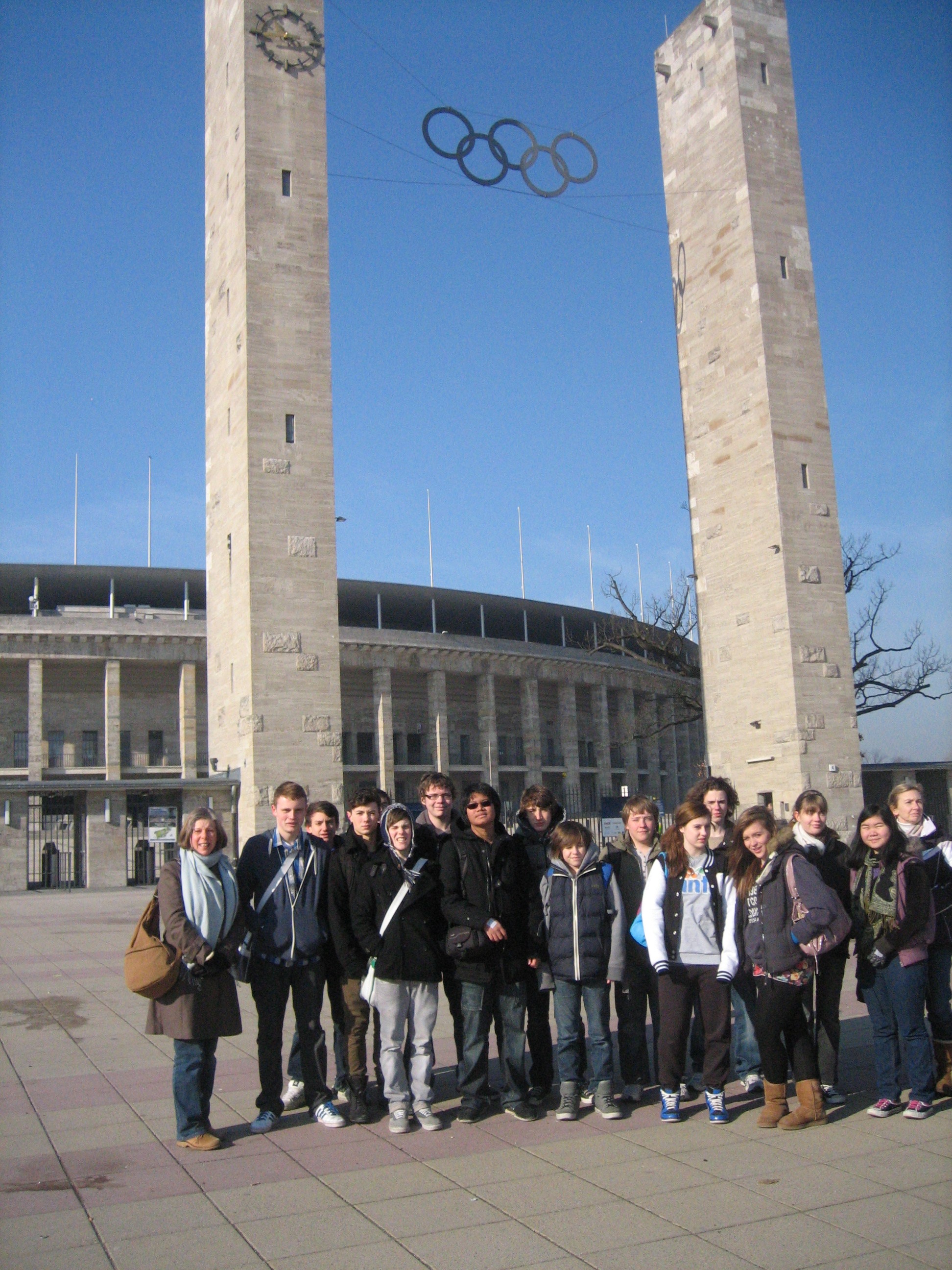
Our final day of the Y11 History trip to Berlin in the February half-term 2011 saw us journeying 30km to the west to visit the Olympic stadium, designed by Werner March for the Summer games of 1936, in which Jesse Owens starred.  Completely refurbished for the FIFA World cup in 2006, it is makes for a great visit, tying in elements of the glory of the Third Reich with the modern era.  The greater area around the stadium is known as the Reichssportfeld and it includes an extraordinary, huge seated open arena for Polo and other major field sports.  The stunning stonework and statues from the 30s remain, and the main stadium has grown modern seating and a roof!

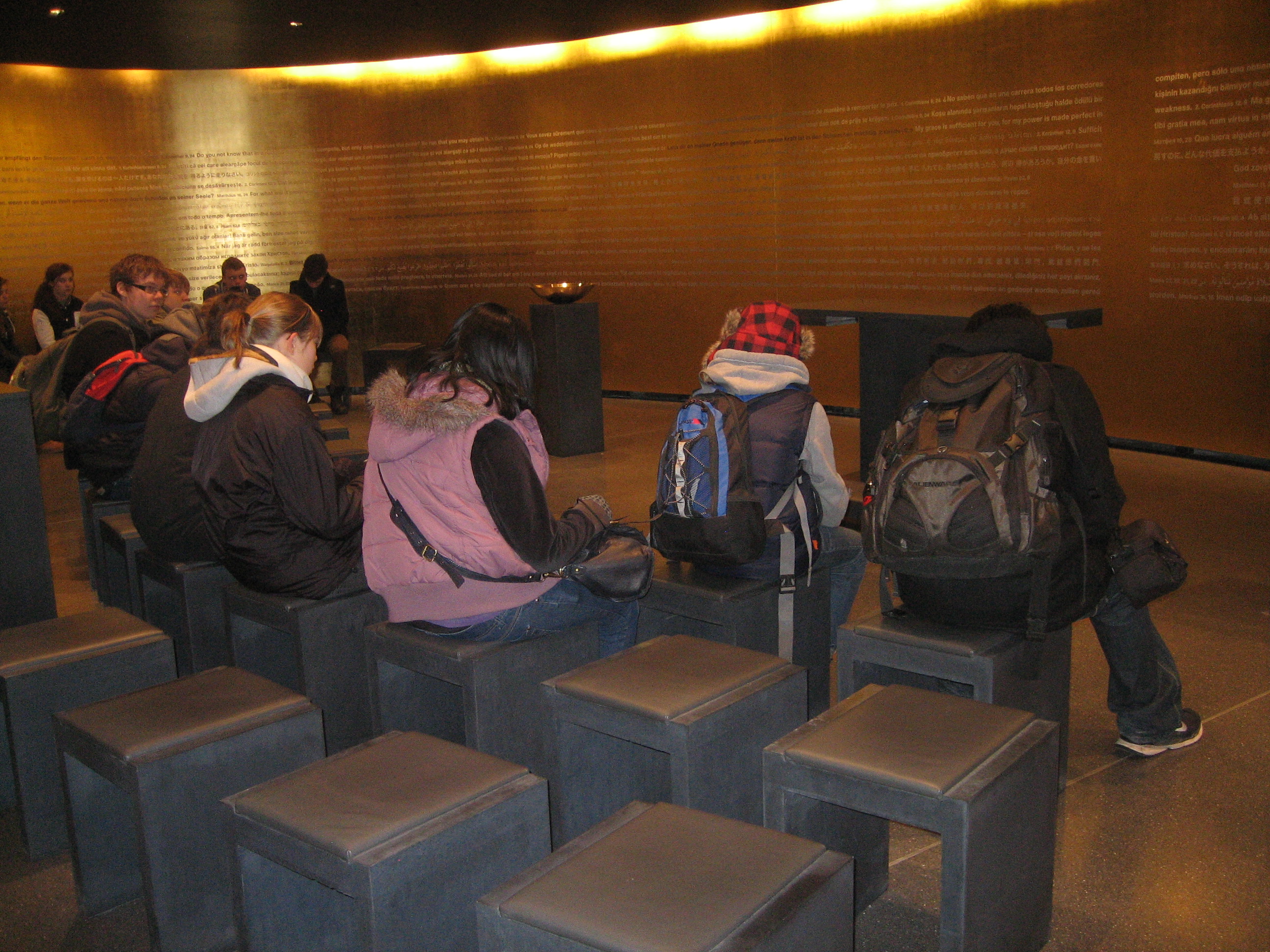
Current occupants of the stadium are Hertha BSC, recently relegated from the Bundesliga. The stadium is also still used for major athletics events, including the 2009 World championships, during which Usain  Bolt further lowered his own 100 m and 200 m world records to 9.58 s and 19.19 s respectively. So when we were able to visit the changing rooms, the VIP areas and stand on the balcony where trophies and medals are issued, we were of course able to feel ‘champions’ for the day.  At the heart of the stadium now is a remarkable chapel, in the shape of the stadium proper, and open for all faiths, photograph taken during our visit.

Throughout our visit to Berlin, we were reliant on our own shoe leather and the Berlin metro system, the U- and S- Bahns. What marks out the U-Bahn in my mind from the rest of Europe is that it travels across much of Berlin on a raised track above the street so you get to sight-see as well as move from A to B.  The reason for the sky-drive harks back to the nineteenth century, when the city fathers were vying with London to build the world’s best sewers, and they did not want that project jeopardised by the trains! The S-Bahn routes are rather more like our suburban tracks out to the dormitories, but they do cross the city centre and those central stations are all great works of their Bismarckian forbears and worth a look for that reason alone.  Outside, amazing numbers of bicycles give testament to the citizens willingness to forebear the car, and to be honest, for the pedestrian this is a capital city that is relatively easy to walk through, and seems to have rather less traffic than your average UK town.

I have yet to visit the east end of London, to see our new Olympic Park at Newham, and I have no doubt I will be overwhelmed by the sheer scale of the achievement. Baron de Coubertin, the founder of the modern games wrote that ‘‘the most important thing in the Olympic Games is not to win but to take part”, whilst charging the competitors through the Olympic motto “Citius, Altius, Fortius.” What I feel I gained from our trip to Berlin this half-term was a participation in fellowship, a better understanding of the frailty of man, greater empathy with our fellow Europeans, and a sense of real solidarity that we do indeed need to be swifter, higher and stronger in all that we do.

OK – post return, here is my animoto mash-up of the trip – enjoy.

http://animoto.com/play/Pat6VJ7hXd0Z2wZwMphk0A

Posted in Uncategorized | Leave a comment

All that is necessary for evil to triumph…

begins one of those great quotations any could use to inspire a trip to Berlin. These days, defined by the 21st century, the visitor to Germany’s capital can only marvel at the extraordinary vitality of one of Europe’s greatest cities.  The investment in major public buildings, the universal coverage of its mass transport system (Train, U-&S-Bahn, tram and bus) , the quality of its walkways and bike lanes and above all the omnipresence of fast food of every description (still have to check out Currywurst) could convince any that bad times have never been part of the equation.

That Berlin has a dark side is put well beyond question by the authorities who have established many major memorials to the ill-treatment of its citizens.  One of my favorites is the Stasi museum, in which James Bond-like gadgets developed behind the Iron curtain by Erich Honecker and his cronies are shown as part of the installations in their party headquarters.  A very much more recent edition is the Holocaust memorial just south of the Brendenburg gate, a vast field of stone bocks beneath which are halls where individual and family stories of loss during the Nazi extermination  programme of the Jews are told from across Europe.

35 km north of Berlin is the town of Oranienburg where the first internment camp was established for Hitler’s opponents and for those elements of society deemed unsuitable such as communists,homosexuals and gypsies. Heinrich Himmler ordered the building of a model camp in the nearby village of Sachsenhausen, one that was then exported throughout the axis territories, including the industrial manufacturing factories for weapons and armaments. Indeed one of the Heinkel bombers was assembled in the units outside the camp from 1942 onwards.  You can get a sense of the awfulness of the camp from this Youtube video – 

More than 200 000 were imprisoned here by the Nazis of which some 50 000 were brutally murdered – as opposed to Auschwitz which served the policy of racial genocide, Sachsenhausen victims were a mix of political opponents and then only later groups defined as racially or biologically inferior – increasingly from the newly occupied territories of Nazi dominated Europe. In 1938, in order to show the world that these new camps were not commiting atrocities, journalists and the Red Cross were invited to view the facilities.  Despite careful screening and choreographed tours, what the camp commander could not hide was the sheer terror the inmates showed for their tormentors, treated as they had been with such ferocious inhumanity.  The medical blocks still stand today and detail case after case of the most extraordinary butchery caused by doctors on their patients.

A journalist working for BBC Australia in 1938 reported back that whilst he had been a pacifist prior to his visit, he could now see complete justification for opposing the Nazi regime with military force, because the hell for their opponents had been revealed at Sachsenhausen.  And this is very much the message that prevails across the various impressive exhibits and displays at the camp, preserved as a national memorial by the East German government in 1956, and much improved as a visitor destination over the past 10 years.  In the kitchen block in the centre, there is now a 30 minute video showing some rare archive footage of prisoners at the camp, and a research centre too where the archives can be checked from a bank of desktop stations.

So we are reminded by the quote attributed to Edmund Burke, the great Irish political philosopher writing in 1770, “All that is necessary for evil to triumph is for good men to do nothing”.  Our group of Y11 pupils found this visit to Sachsenhausen the most moving of the trip, with the reinforcement of the personal family tragedies documented so well in  the museums we visited elsewhere.  We can always question whether the modern conflicts in Afghanistan and Iraq of the last decade are justified, and we have current inquiries reviewing those decisions to report this year. I feel sure however our pupils returned to England with a great sense of pride that their country did indeed stand up and say something back in 1939.

Posted in Uncategorized | Leave a comment

Three men in a …

…boat is a gentle story of companions paddling up the River Thames from London to Oxford in the twilight of the Victorian era. In the travels of our History department to Berlin, this story came to mind on a number of occasions, not least because many of the images both cities use to this day hark back to that period, when they were great rivals and competed in all aspects of technology.  Across both cities, the skylines still show the great Railway stations of that age, and their major  city stations are embedded in the street maps to this day.

Yesterday, we went underground with a historian from the Beliner Unterwelten group, whose remit it remains to ‘show off’ the underground treasures of Berlin. Back in the days of sewer building in the mid 19th century, Berlin and London both planned for services to manage the largest  city in the world.  In terms of effluent, London may have got there, but rather oddly Germany did not. As they say, 2 world wars and a Russian occupation rather did for the expansionist dreams of those german city planners, and Berlin is little larger than 150 year ago, and frankly (we were told) there is not enough waste water coming down the tubes to keep them clear these days!
It is extraordinary just how proud people can be of waterways built to take away our waste. There seem to be countless different tours available to the time-rich tourist in Berlin, able to paddle even along these waterways that flow silently beneath Germany’s capital city, though apparently you do need to be very wary when it is half-time during the football season and all that Pilsner beer drank before the game needs to find relief.  Indeed the cathedrals built to manage our water seem to be in great shape and worthy of a visit all of their own.

Of course this knowledge was a by-product of the real reason we had gone ‘underground’, to view the german civilian ‘Bunker’ provision, so that the population could survive everything Bomber Harris and his planes could throw at them. It seems the word ‘Bunker’ was misused deliberately, meaning apparently that the shelters were bomb-proof. Unlike London’ underground, the Berlin trains run very close to the surface and there was little chance that a tunnel full of loyal citizens would survive a hit in any way.  No more than 50cm of concrete separated the upper layers of the transport system from the air above, and with British bombs designed to crash through 5m of the suff before they exploded, you can only imagine the carnage.  Which we did of course, the 2011 pupils on the Y11 trip to Berlin, and we did not feel very good about it.

Indeed, as we wandered through a warren of interlinking passages we learned of man’s inhumanity to man, the veil of deceit that was required to keep hope alive when all around seemed hopeless. The bunkers contained nursery facilities to ensure the much need children of the Reich could be born safely, and indeed they were, as our guide proudly informed us, because now in their late sixties, visitors return this railway station to find the birthing suite named Gesundbrunnen on their birth certificate!  The walls were painted with a toxic mix of luminous and radioactive paint, so the hard pressed doctors could make and mend whilst underground, that fluoresce visible today as a party trick for visitors to see.

In Jerome K Jerome’s elegant tale of life afloat on the water without a care, they have with them an imaginary dog, Montmorency, to whom is attached some blame and some fame, in roughly equal measure. Now we could all do with such advice, to shift the focus and dodge  the responsibility, and it might seem to readers of the Daily Press that our Teutonic cousins have struggled to accept their responsibilities in this regard.  In my view, nothing could be further from the truth. For the third time now, I have listened to intelligent and well qualified tour guides tell in different ways the appalling tales of life in Berlin under the Nazis. They leave us in no doubt that the citizens had elected and then gullibly accepted a tyranny that became of such monstrous proportions that it sought to destroy everything in its path.

It is certainly the case that the citizens of Berlin have had their city’s life chances badly damaged by the events of the 20th century. Equally it appears, without the determination of three extraordinary men, Churchill, Roosevelt and Stalin, we would not have seen the destruction of the Nazi regime, and for that the free world must be truly grateful. Because what Berlin also does so well is to highlight just how dreadful were the effects of that Nazi programme to exterminate all in their path. Of course I do not wish to belittle the most important of the holocausts, that of the Jews, but it was in Berlin that the exterminations began from 1933, of trade unionists, of liberals and communists, of authors and engineers, chemists and engineers that thought differently. And that is something clearly modern Berliners do not wish to let die, and indeed celebrates in their memorials as well as any societies, a love of living and a tolerance of all, irrespective of gender, faith, political belief or other persuasion. As visitors we have walked their streets, viewed their memorials and galleries, and it cannot be clearer; whilst huge black clouds covered the past of Europe in misery for 60 years, they have gone now, not least because outstanding example is made for teaching about the rights of man on every corner.

I am not quite sure what they feel about virtual dogs though…

Posted in Uncategorized | Leave a comment

A quick scamper up the Reichstag

Not that long ago, the casual visitor to the German Parliament building in Berlin would be able to join a 100 metre queue and wait their turn to be hurled to the cupola on the top of the Reichstag, the whole building redeveloped by Norman Foster when he was contracted to renew again this seat of German democracy in the unified capital of Berlin a decade or so ago. Now the CCS Year 11 History trip of 2011 knew we had been required to write to the ‘Office for the Parliament’ to make special request to visit, as the authorities have tightened their security procedures in the light of an increased terrorist threat.

What we had not appreciated is that there now exists around the Reichstag an exclusion zone of steel of 50 metres or so, well protected by the Polizei and with huge signs informing all that the building is closed.  There are a couple of unglamorous small portacabins at the side, at which a mêlée of electric blue jackets carrying an ‘Information’ label on the back sought to deal with the broken-hearted tourists, whose idea of a short break included a quick scamper up to the roof to look across the Berlin skyscape.

Blow me down, if when we arrived we didn’t get spotted immediately for a school group of 18 led by a Mrs Wilding. We were whisked through the fourth full body search of the day (don’t get me started on Luton airport), chaperoned over to the front entrance where we faced our fifth strip and luggage scan, and then engaged by a most articulate tourist guide named Helga. Actually I am lying about the name, but in every way, her Teutonic care of her English students was lived up to this first class billing. We visited the catacombs, touched Adolf Hitler’s letter box and a few hundred others, read the graffiti left on the wall by the Russian liberators in 1945, walked across the underground piazza that links the 6 or so parliamentary buildings, sat in the main chamber, saw members of parliament being interviewed by the press, learned why the German eagle is really a ‘fat hen’, spotted Norman Foster’ signature on the same, and witnessed at first hand just what an amazing seat for transparent government the Reichstag has become.

And then of course we took the elevator to the roof, climbed into the dome as a brilliant sun was setting to the west, colouring all around with its pink wash, and we marvelled that it had been a British architect that had created something of such engineering beauty in Germany, a land that’S home to engineers. ‘Vorsprung Durch Technik’ is their phrase we usually translate into English as ‘progress through technology’. Since the second world war, Germany has rarely had anything other than a coalition government, and it led me to muse that perhaps, in the same way it has taken Foster’s masterpiece to highlight how good government can be literally seen by everyone, we Britons could perhaps draw encouragement from the German experience that parliamentarians working together in partnership might actually be worth sticking with!

Posted in Possibly related posts | Leave a comment

To Berlin for a change in perspective

In the very recent publication by the Russell group Universities on entrance requirements (read that here – http://www.russellgroup.ac.uk/uploads/Informed-Choices-final.pdf) it is so obvious that the majority of great A level subjects such as English and History are deemed ‘door-openers’ or ‘facilitators’. The point here is that some subjects extend beyond the obvious, requiring pupils to analyse, synthesise and evaluate the evidence in front of them, be that literature or primary sources, and force a judgement in writing.

In my time, I have taught both arts and science disciplines, and I have become comfortable with the change in focus different subjects require. Almost irrespective of subject, any is enhanced by hands-on learning, and for Historians of any hue, a trip to Berlin is a trip well worth making. As I pack my bags ready for the Y11 trip to Berlin this half-term, I know I am to visit a cradle of fascism, a centre of communist rule, a monument to extermination, an Olympic Stadium, and above all a testament to the survival of the human spirit in spite of extraordinary repression.

For young men and women, who it must be said, live in a pretty perfect world, the journey back in time to review the rise and fall of the Nazis, the role of the communist state and its suppression of freedom, and those events that led from perestroika to liberation for the 16 million citizens of East Germany. The nation was one of the few in the last century that shrank during the period of ‘occupation’ by the Russians, and there seems little to admire about that period. As a modern Berlin takes its place as one of the world’s most influential capital cities, any young man or women can’t help but reflect upon how lucky we have been in England to have been born free.

As the nations of the Arab world begin to be torn asunder by the same extraordinary pressure exerted by their people tired of subjugation, our students will do well to remember that the violence we are witnessing is nothing new. Power corrupts, and absolute power corrupts absolutely. Those of us who live in the free world always need to study the lessons of the past; that’s the beauty of both Literature and History, in which the human condition is so eloquently laid out for our review. And that’s what I hope to learn with our Historians as we visit Berlin; there are no UCAS points for the trip, but do you know what, I suspect when our boys and girls are asked, they’ll agree with me that their eyes have been opened all the way by the sights and sounds that greet us.

Posted in Uncategorized | Tagged | Leave a comment