
Claires Court Academic Faculty returned for the school-wide in-service training this week, held in the Baylis Theatre at Braywick Leisure Centre in Maidenhead. In our lead presentations and age-range-specific workshops, building relationships, resilience, and quality feedback sat at the heart of our work. Our teaching and learning initiatives have consistently been innovative and, at times, ground-breaking. Notable achievements include the implementation of cloud-based learning, Forest School, ecological renovation, and ‘Fish-hero’ technology integration. Central to our approach is the ‘Diamond School’ model. This structure underpins how we educate our students, encouraging collaborative learning while preserving the benefits of single-sex classrooms during secondary education.
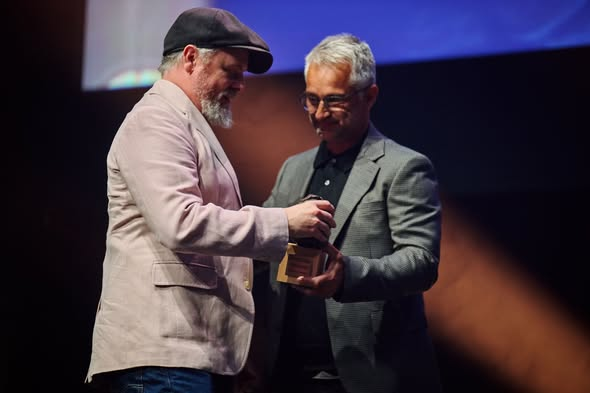
It’s encouraging to know that the Guinness Book of Records lists me as Britain’s longest-serving headteacher, leading my school since January 1981, with over 50 years in teaching and 45 years as a head/principal. I’m delighted that my advocacy for education reform and the integration of technologies such as AI in schools has earned me broader recognition. As a result, the school has become influential in promoting holistic learning, cross-sector partnerships, and innovative teaching methods, particularly within the Independent Schools sector. As a result, I will speak at a forum chaired by Emma Reynolds, MP for High Wycombe, at the Smartphone Free Childhood Meeting of Heads on 16th January 2026, as one of the schools nationally that have advocated this approach for many years.

It might be fair to suggest that I have been ‘thinking’ about education for more years than wonderful thought leaders such as Sir Ken Robinson, Simon Sinek and Rory Sutherland, but the honest reality is that I have enjoyed it hugely to learn from their research and much wider experience in the world of work and psychology of human behaviour. Not everything they hold dearly is the only truth, so (as with AI) their suggestions for improvement may turn out to be either a contradiction in terms or not the only solution.. Every step of human progress seems to open up new challenges to be overcome, most obviously on a grand scale is how our industrial development has caused global warming. In educational terms, the arrival of the biro was considered a significant improvement over the ink pen it replaced, yet for the first 8 or so years, children learn better with a pencil.See Appendix for more on learning to write
For many years, Rory Sutherland (whose talks are available on YouTube) has been highly influential in bridging the gap between rational business strategy and the irrational psychological drivers of human decision-making, making complex ideas engaging for a wide audience. I’ve put such ideas to good effect over time, but I am particularly enthralled by his ideas around making what we do magical!
| Rory Sutherland’s Key Educational PhilosophyChallenging “One Right Answer”: Sutherland argues that the school system misleads students into believing there is only one “right” logical answer to every question. He encourages schools to embrace questions with multiple oblique solutions and to teach students to experiment with “crazy” or counterintuitive ideas.Criticism of Academic Sorting: He characterises the current education system as “unfair” because it uses identical criteria for everyone, sorting individuals based on a single monolithic measure (such as IQ or exams) rather than valuing diverse and complementary strengths.Focus on Cooperation: Sutherland asserts that schools fail to assess or develop students’ ability to work cooperatively, noting that while academia is often solitary, the professional world is inherently social and collaborative. |
As a consequence, our plans for the school curriculum for the next 3 years are to increase the ‘wow’ factor even more for what happens in school, without sacrificing at all the need to ensure our students lose any quality of instruction and if anything, their academic performance even more so than they do currently. The Claires Court working week encompasses a core of between 35 nd 37 hours a week, up to 44 hours if after-school clubs are taken into account, and to develop the kind of acting, musical and sporting skills needed to excel, then as with all expertise development, the more you practice, the greater the skill and the luckier you get.
Clearly, we can’t plan to use any more of our time. As we get smarter, developing even further the positive relationships we have in school must be step 1, including the ability to bounce back from setbacks. Our curriculum is already built around content that encourages children to be curious and to collaborate on problem-solving, so scaffolding ideas and expanding the range of possible solutions is step 2. Like all who wish to make the MAGIC happen, steps 3 to 6 will have for the time being, need to remain a ‘secret’. But I certainly can give you a steer from Rory Sutherland’s address last autumn, entitled Alchemy: The Surprising Power of Ideas That Don’t Make Sense.
Of course, we all want childhood to be magical, but that does not mean constant excitement, entertainment, or fantasy. That kind of bonanza can be enjoyed at Christmas, but it quickly becomes exhausting, undermines focus and resilience and turns learning into performance rather than growth. The psychology that creates the conditions that make childhood feel alive, meaningful, and safe is about schools seeking to cultivate wonder, play & imagination, psychological safety, and provide time to linger. One of the causes of the disastrous reduction in childhood reading is the failure to get lost in a book; whether fact or fiction, the inner-voice that arises during reading takes at least 20 minutes to take over and for the words read to grow the child’s vocabulary.
The deeper reason this matters is that school shapes not just what children know, but also how they relate to effort and whether learning feels like discovery or judgment. This environment significantly influences whether the world feels inviting or hostile to them. Consequently, when childhood loses its magic too early, children may still achieve academically, but this success is often accompanied by anxiety, a persistent fear of failure, and the development of instrumental thinking—constantly asking, “What’s this for?”
So, the challenge I’ve set the team is to build on our question-based fit for the next 3 years, bearing witness to both the arrival of AI and keeping children away from screens – that magic has long since been busted. The ideal balance is not to preserve innocence indefinitely, but to allow seriousness to grow gradually as a natural progression of a child’s development. This approach introduces responsibility in a way that avoids crushing a sense of wonder, ensuring that rigour is taught through meaningful engagement rather than as a substitute for it. Ultimately, schools can successfully instil discipline without sacrificing delight, proving that academic challenge and personal joy can coexist.

Appendix 1 – On learning to write.
- Writing fluency depends on automatic motor patterns
For fluent writing, children must automate: Letter shapes, Stroke order,
Spacing, Pressure control
Early on, these motor patterns are not yet stable. Pencil use supports gradual refinement because it tolerates: Over- or under-pressure, Inconsistent stroke direction, Micro-adjustments mid-stroke
Ink, by contrast, exposes every motor error immediately, interrupting the flow needed for automation.
- Error correction without interruption
Fluency improves when children can correct errors without stopping their writing rhythm.
With a pencil: A mistake can be erased quickly, children can rewrite immediately, the motor sequence continues uninterrupted
With ink:
Errors require crossing out, children pause, hesitate, or restart, the rhythm of writing breaks, slowing fluency development.
- Reduced performance anxiety: Children are highly sensitive to permanence.
Ink introduces:
Fear of “getting it wrong”
Over-monitoring of each stroke
Slower, more cautious movements
Pencils lower emotional stakes, allowing:
Faster movement
Less conscious monitoring
More natural motor execution
Fluency emerges when movement is confident and continuous, not careful and controlled.
- Pencil friction improves proprioception
Pencils create more friction against paper than pens. This increases proprioceptive feedback—the child’s awareness of:
Hand position
Movement direction
Pressure applied
This feedback loop is essential for refining fine motor control. Ink pens glide more easily, reducing sensory information and making control harder for developing hands.
- Pressure calibration develops gradually as young children often:
Press too hard
Press too lightly
Vary pressure within a word
Pencils tolerate wide pressure variation while still producing a readable mark.
Pens require precise pressure thresholds, which:
Punish inconsistency
Cause blotting or skipping
Interrupt motor learning
- Cognitive load theory
Children have limited working memory. Early writing already demands attention to:
Letter formation
Spelling
Line orientation
Word spacing
Ink adds extra cognitive demands:
“Don’t make a mistake”
“Press just right”
“Keep it neat”
Pencils remove these constraints, allowing cognitive resources to focus on skill acquisition, which accelerates fluency.
- Developmental readiness matters
Children typically transition successfully to ink when:
Letter formation is automatic
Grip and pressure are stable
Writing speed is consistent
Self-correction is internalised
This varies widely, and so with schools that switch at age 11, the introduction of the use of pens in Year 5 and 6
In essence:
Pencils support fluency because they encourage risk-taking, support motor learning, reduce emotional and cognitive barriers and preserve writing rhythm
Ink demands mastery; pencils build it.
Some schools equate:
Ink writing = neat work = good learning
Ink produces darker, more uniform lines, which:
Photograph and photocopy better
Look more “finished” in exercise books
This can lead schools to prioritise appearance over process, even when fluency is still developing. Neatness is no measure of the quality of learning taking place.
Appendix 2 – Podcast discussion on this blog











 A Principled view