Over the 15 years I’ve been blogging, I’ve covered everything from the small & trivial to the earth-shattering and society-shaping that individuals have caused. When I posted about Will Greenwood’s work last month, https://jameswilding.blog/2026/05/08/the-cracked-pot-the-heart-of-the-game/, I’d become increasingly aware of the fragility of the professional game.
The professional rugby model is balancing on a fragile financial and existential tightrope, where high wage bills, over-reliance on volatile broadcast revenues, and severe player welfare crises leave even historic top-flight clubs vulnerable to sudden collapse. By over-professionalising, the elite game risks disconnecting entirely from its roots, as it did with Wasps Rugby club, creating an identity vacuum that strips the sport of its soul. In contrast, the clubs that survive and truly thrive will be those built from the bottom up on an unbreakable emotional infrastructure of community.
Much like the generational conveyor belt of mini and junior rugby, a club deeply woven into its local fabric creates a continuous supply of players, volunteers, and lifelong supporters. These grassroots hubs provide exactly what modern youth need most: a safe space to build resilience, learn physical motor skills, and experience the profound alchemy of belonging. Ultimately, while professional franchises can lose sponsors or drop down leagues, a community-based club possesses a resilient heart—because, as Will Greenwood beautifully noted, rugby is not just a commercial enterprise; it is people, community, and the power of noticing others, which is the only foundation strong enough to keep the lights on when the storm hits.
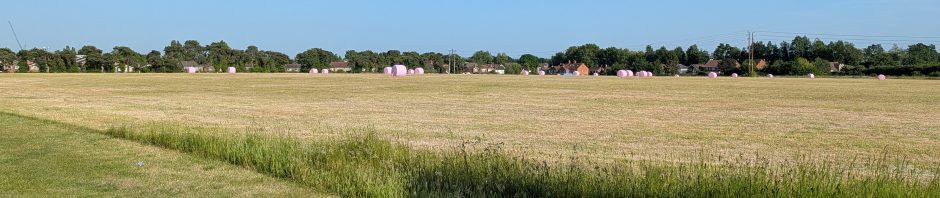
Developing the ‘Claires Court Fields’ became one of my major projects over the last decade, and now I am delighted to report that the school has indeed done ‘its bit’ to promote the grassroots of local sport, providing homes for perhaps over 1000 junior and adult players alike, for football and cricket, as well as the school’s own sporting needs. As the header of this piece shows, the playing fields and their surroundings, taken on Monday evening, 27 May 2026, were bathed in brilliant sunshine. The first crop of hay can be seen in the large pink bales, ready now for transportation into the fodder barns.
It’s difficult not to feel poetic when looking over such a landscape, and I wrote last week about the important support that school and head’s association can give when needed. My good friend John presented me with the new lyrics I’d created for ‘You’ll never walk alone’ set to a musical score. Not wishing to plagiarise Richard Roger’s music, I’ve found a new melody for the words – you can hear it here. https://suno.com/s/KotFFAhWRtPeFikR
It’s only May, and the farmer is cropping hay so early? The dramatic rise in the value of hay in the UK market is the result of a “perfect storm” of extreme weather, supply chain disruptions, and soaring production costs. Once viewed as a modest, low-margin farm byproduct, hay has skyrocketed into a highly valuable commodity, with prices doubling or even tripling across the country. Locally, that’s in part because many of the fields have gone.
Just beyond the bales is my father’s local pub, the Thatched Cottage, or ‘Thatch’, as it’s always been known, when the family lived at Ridgeway. Of an evening, Dad would walk down for a quiet beer and a chat with the locals, and we’d accompany him and at first hand see what a unifying force the hostelry was, being a ‘local’ home for all. Then, the area was surrounded by farmland, whose memory you can read in the names of the roads, estates and institutions, Barley Mead, Farmers Way and Norden Farm, for example. That’s good news for the Thatch, of course, to see so many houses hosting many possible customers, but the appeal needs to be more universal than that, and pleasingly it has become the local after-match pavilion for the adult sports clubs now based at our fields next door, a really positive example of community symbiosis.
In so many ways, local schools and the children whose education they provide face the same existential challenge, and not just because of changes in cost bases, taxation and regulation, but also due to the rapid shift in society’s demographics across much of the developed world, not unique to Maidenhead. Writing a critique on how Western civilisation finds itself in this place is not for now. The main reasons my parents were able to set up Claires Court in 1960 included the lack of sufficient school places for the burgeoning population of ‘baby boomers’. As school and education have evolved over the years, so the provision has needed to expand to cover not just the 3Rs, but also to promote challenge and opportunity, manage diversity yet retain inclusivity & health, and prepare young people for the wider world and employment opportunities, many of which may not yet exist!
As the stewardship of Claires Court has moved from one family to another, it’s worth highlighting just how important the role of the Licensed Trade Charity (LTC) is in supporting both our ambitions for education and the wider hospitality industry it champions. In an era where the economic headwinds are so severe that two pubs a day are closing their doors forever, the LTC’s mission is both honourable and urgently vital. It operates not just as an administrative body but as a protective sanctuary for a sector under siege—preserving the very places and the people behind them that have kept the British community anchored for centuries.
Ultimately, whether we look to the resilience of a community rugby club, the careful management of our agricultural land, the survival of the local hostelry, or the evolving care of our schools, we are looking at the exact same human endeavour. None of these institutions can survive if they are treated as purely transactional assets. They require heart, shared identity, and an understanding of their deep cultural values.
As the sun sets on the Claires Court fields, illuminating the pink hay bales, the “Thatch” in the background, and the spaces where thousands of children learn the alchemy of belonging, it is clear that our true strength lies in mutual support. By stepping into this educational space, the Licensed Trade Charity is expanding its circle of care, ensuring that the timeless values of service, resilience, and connection are passed down intact to the next generation. In a world of volatile change, it is this fierce defence of community life from the ground up that will ensure we keep the lights on, no matter what storms may hit.
*His series of films “Heart of the Game” about Maidenhead Rugby Football Club can be found on YouTube – https://youtu.be/LbXF3ZjjGLM?si=MSBPLR0o6rV80NGP

 A Principled view