“Doing the Right Thing Right” – There is an even greater good!

It’s 25 years since I knew I was to lead as Chairman the Independent Schools Association, and it made me concentrate on the ‘Power of words’ spoken as “Calls for Action!” At a time when politics in the UK had stabilised, our military had positively engaged in the Balkan crisis and a new century had been born, I wondered out loud, looking ahead, how things were set to be so fair for the future. In short I had adopted the new millennium positive mindset, carried through for the next 12 years to include Danny Boyle’s great opening ceremony for the 2012 London Olympic Games.

5 June 2024 saw Claires Court host for the 25th year in succession the ISA London West Athletics Championships at the then newly built Eton College Thames Valley Stadium, built for the use and development of public athletics development in the Thames Valley and beyond. The event has grown from 20+ schools to 32 present today, and from a few schools to many now able to provide teams that cover the entire age range from 8+ to 16+. Circa 1200 athletes participated today, and they demonstrated once again that the limits of human achievement have not yet been reached, establishing new athletic records at this regional level. Deputy Head Co-Curricular, Jo Cox started work on our preparations back in January, engaging 25 Claires Court staff and a considerable number of our own Sixth Form students plus over 100 volunteers from all the other schools so that we could both offer the opportunity to compete and to be selected for the ISA LW team for any of the 106 schools in our region.

So, just to be clear, a private day school in the Thames Valley has chosen to run on behalf of 106 other schools in the same geographical area a day-long track and field competition, both to give any children chosen the opportunity to run, jump or thrown, and, if they are the best, then swap team shirts and represent our area against the other 6 areas in the nation.

In 2000, under the then Labour Government, all private schools , either individually or collectively, were invited and included in local, regional and national conversations about how ‘Education, Education, Education’ could be delivered. As the incoming Chair of ISA, I then spent the next 10 years of the Labour Government as an invited and active participant member of ‘thought leadership for Education’ for the nation. ‘Bully for you’ I hear you say. I loved it, of course!

Over the past 25 years, I have always remained committed to engaging with local, regional and national conversations on Education. If you are a subscriber to my blog, you know that anyway. Below, I describe the rules of the game, the boundaries of our operation and the ‘Faustian pact’ struck by proprietors such as I and the education environment in which we operate, at least in the memory of this headteacher whose service as a school leader is now 41 years old and counting

Rules of Engagement for Education. Education is not a Business: here’s what Gemini has to say on the matter:

Profit vs. Public Good: Education is seen as a public good, necessary for a functioning society. Businesses prioritise profit, which can sometimes conflict with educational goals.
Standardization vs. Individual Needs: Businesses thrive on standardisation and efficiency. Education, however, needs to cater to individual student needs and learning styles.
Measuring Success: A business might measure success by profit margins. Education success is trickier to define; it could be test scores, graduation rates, or a student’s ability to thrive in the future.
While education isn’t a business, there is some overlap. For instance, some schools might use business practices for efficiency or fundraising.

Point 1 The key takeaway is that the core purpose of education differs fundamentally from a business.

The United Kingdom has been part of the EU from 1 January 1973 until 31 January 2020. Throughout that period, the ground rules for Education have been very clear on the matter of Value Added Tax: In 2020, certain businesses were exempt from Value Added Tax (VAT) in various countries. Here are some common examples of businesses that were VAT-exempt:

Healthcare services: Hospitals, clinics, and other healthcare providers offering medical services were typically VAT-exempt.
This includes services provided by doctors, nurses, midwives, physiotherapists, and other healthcare professionals.
Financial and insurance services: Banking, lending, and other financial services were often VAT-exempt. Insurance and reinsurance services were also generally VAT-exempt.
Education services: Schools, universities, and other educational institutions providing tuition and related services were usually VAT-exempt.
Certain cultural and social services: Activities related to culture, sports, and entertainment provided by non-profit organizations were sometimes VAT-exempt. This could include museums, libraries, and similar cultural institutions.
Supplies of land and buildings: The sale, rental, or leasing of residential or commercial real estate was often VAT-exempt.
Supplies of investment gold: The supply of investment-grade gold, such as gold bars and coins, was typically VAT-exempt.

The whole point for Services above as described is that whilst what you do as activities is regarded as non-VATable, you are not able to reclaim spent on goods and services provided for you. The landscape of EDUCATION is not BUSINESS is utterly engraved into that landscape, as is the VAT exempt rule. From 1973 to Summer 2020, that’s been the agreed framework. Honestly, there is so much more in addition embedded in the Public/Private sector shared engagement in Education over decades now, it’s difficult to list them all. Here are some examples from Education alone:

  1. SEN EHCP funding: Parents who choose with the LA and Private school that their child is best placed in the private school have to pay the Private school tuition fees, whatever they are (Element 1); the private school has to cover the first £6000 of additional EHC funding as declared in the plan (Element 2) with the LA ‘topping up’ the final Element 3, as required.
  2. Private schools winning planning permission for new buildings and facilities are required to limit their usage to a very narrow audience, usually just for the children based on the site concerned, so as to limit the use of the facilities and reduce or ameliorate their usage on surrounding neighbours and traffic infrastructure.
  3. As Private schools are not registered for VAT, then they need to ensure their business activities do not exceed £90,000 per annum.
  4. Despite the above, a whole host of activities and government initiatives invite all schools to participate, but private schools cannot benefit from the funds made available for their implementation and realisation.
  5. Whether a private school is a charity or business, it is expected and required to provide public benefit to wider society. So, please take time to properly take this in. My customers of my school, fee payers, have been expected and required to invest in the school already, despite having paid their taxes which cover the cost of a state school place for their children. AND in paying the tuition fees for their children in the school, the excess not used for covering their teaching and learning costs are also to be used for the benefit of future users, who have never invested a penny farthing in the school. Here’s an example from Sport England’s recommendation to our local authority on a small development to provide 3 tennis courts at our Junior school to be built this summer – please bear with me for labouring this point:
  6. For Clarity Sport England’s Position: Sport England raises no objection to the application because it is considered to accord with exception 5 of our Playing Fields Policy and paragraph 103 of the NPPF.
    The absence of an objection is subject to the following condition being imposed the
    local planning authority (LPA) resolve to approve the application:
    Within 6 months of the work commencing on site, a Community Use Scheme
    shall be submitted to and approved in writing by the Local Planning Authority.
    The Scheme shall include details of pricing policy, hours of use, access by nonschool users management responsibilities and include a mechanism for review.
    The approved Scheme shall be implemented upon commencement of use of the development.
    Reason: To secure well managed safe community access to the sports facility,
    to ensure sufficient benefit to the development of sport and to accord with
    RSS/UDP/LP/LDF Policy **
    If the LPA is minded to approve the application without imposing the above conditions
    then Sport England objects to the application as it is not considered to accord with any
    of the exceptions to our Playing Fields Policy or paragraph 103 of the NPPF.

June 2024 is election month in the UK (as it seems to be for 50% of the world). The Party most likely according to Pollsters to win the election is the Labour Party, whose manifesto makes it quite clear they wish to move the status of Tuition Fees from exempt to 20%. For everyone in our sector, whether placed by National, Regional or Local Authorities or indeed privately, their fees are to be taxed at 20%. The newspapers and gossip columns have filled their pages with huge volumes of writing, BBC Question time etc. filled the air waves and the latest podcast this last Tuesday afternoon from ‘When it hits the Fan’, led by David Yelland, former editor of the Sun and Simon Lewis, former trouble-shooter for the Queen and Gordon Brown,

Almost all that written, spoken or broadcast seems to carry copy of the laziest and incompetent kind, not least shaping the sector as being the sole preserve of the elite. There are 2,400 private schools in the UK, with many including membership of the 11,000 day nurseries that cover the Early years Foundation stage. Almost every parent makes use of day nurseries, their places funded by government for some of the hours those parents need. here’s what the DayNurseriesUk had to say in their state of the nation report this April.

“Nurseries across the UK have faced financial difficulties for some time. A lack of government funding and the Covid pandemic meant that many were forced to close their doors for good. For the nurseries continuing to operate, they continue to face multiple hardships. “the increase in interest rates and 9% inflation predicted for the coming months could spell disaster for many nurseries and childcare providers. Recently released government reports show that last year, half of providers were already only breaking even or making a loss while our research with providers suggests it could be much higher. They suggest that the only way for nurseries to withstand these times is to continue to increase their fees, otherwise they face permanent closure. As the government provides the majority of the funding for early years childcare through funded places for those eligible, nurseries are dependent on the government to increase this funding price to allow for rising costs.

The situation for private nurseries is then dire, and whilst there is no chance that the VAT proposed for Private schools will affect the under 4 age range, as most private schools in the 4-11 age range have a nursery, it doesn’t take a genius to work out why Junior schools are unlikely to cope with the imposition of a 20% tax on their tuition fees. Rudi Lockhart, CEO of ISA schools (660 all private, 50% charity, 50% commercial) wrote the following letter to the Times yesterday:
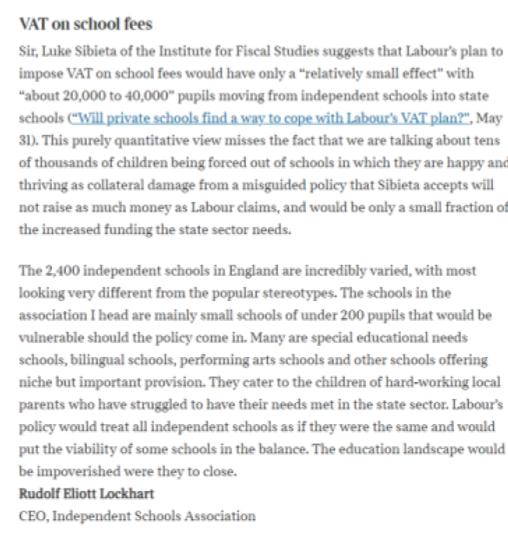
Point 2. The Labour party’s proposals to imposee VAT on Private education suggest there is the low hanging fruit of easy pickings available, from Wealthy Families who have enjoyed a tax break they don’t deserve and Elite Public Schools whose endowments will ‘mind the gap’ with ease. The reality is that the majority of independent schools number 200 pupils or less, with a nursery that is largely sustained by the ‘whole school’ wrapper that benefits the children across the younger age range. We don’t have anything like enough nursery provision already, nor do we have the spaces in the public sector to readily handle the transition of 50,000 children swapping sectors, and finally nor has the legal landscape been cleared to permit private schools to share their facilities and resources more actively with their communities to raise the missing funds, as planning permissions/development controls have always been allied to the school’s Education status, not that of commercial business.

The greater good all of us in our sector propose is to ensure the incoming government of whatever hue recommences dialogue with our sector. We have know-how, talent and expertise in abundance; choose to use it as the Blair Government did, and Education, Education, Education will thrive once more.
Posted in Possibly related posts | Tagged , , , , | 1 Comment

Using AI to write for my blog a call to all adults to vote in the forthcoming UK general election 4 July 2024

Below you can read how one of the major AI engines can write on my behalf a call to adults to use their vote in the forthcoming general election. I guess I was not the only one caught out by the sudden switch on Wednesday 23 May by Rishi Sunak to call a snap general election.

The question I asked of ChatGPT was “Using the content of JamesWilding.blog, write me 1000 words to call adults to vote in the next general election 4 July 2024”.

Over the half-term break, I’ll review below and see what I might have added or changed, so by 31 May, I’ll have an update and some indication of alternative examples that other engines might have suggested from a corpus of work that stretches back over 14 years over the life time of the conservative administration since the demise of the Labour Party.

On Tuesday 11 June at 12 noon, I am chairing an international discussion on the use of AI in schools, an area of huge interest to me over the past 36 months, more of which anon. Schools and Education more generally have really got to step up and move the dial on from the narrow commitment of the current state just to meet academic criteria and qualifications only. In our work with digital tools over the same period of time, we’ve been able to transform children and adults understanding on how technology can be used for the better, and at the same time, seen an explosion of interest in the co-curricular offer that benefits the growth of children’s well-being and self-confidence.

So onwards to ‘my call to arms’ to adults to use their vote in the forthcoming general election:
Your Voice Matters: The Importance of Voting in the July 2024 General Election

In a democracy, the most powerful tool at your disposal is your vote. As we approach the next general election on July 4, 2024, it is crucial to understand the significance of this fundamental right and why every eligible adult should exercise it. James Wilding’s insightful perspectives on civic duty and the power of individual participation highlight the imperative need for widespread voter turnout. This election is not just another date on the calendar; it is a pivotal moment that will shape the future of our nation. Here’s why your participation is essential.

1. Upholding Democratic Principles

The cornerstone of a democratic society is the active participation of its citizens. Voting is not just a right; it is a responsibility that ensures the functioning of democracy. When you vote, you are contributing to the collective decision-making process that governs our lives. The legitimacy of our government is derived from the consent of the governed, and your vote is a crucial part of that consent. By casting your ballot, you affirm the democratic principle that government should be of the people, by the people, and for the people.

2. Shaping Public Policy

Every vote has the potential to influence public policy. The representatives we elect make decisions on critical issues such as healthcare, education, the economy, and national security. These decisions have direct impacts on our daily lives and the future of our communities. For instance, consider the policies surrounding public health in recent years. The elected officials who navigated the pandemic response were chosen by voters like you. Your vote can help steer the direction of policies that affect everything from the quality of our children’s education to the safety of our neighborhoods.

3. Ensuring Representation

Voting ensures that your interests and concerns are represented in government. When you abstain from voting, you forfeit your chance to influence who represents you at the local, state, and federal levels. This can lead to a disconnect between the needs of the populace and the actions of elected officials. Diverse and comprehensive representation is crucial for addressing the varied needs of our society. Your vote helps ensure that representatives are accountable to all citizens, not just a select few.

4. Addressing Voter Apathy

Voter apathy is a significant challenge in modern democracies. Many individuals believe their single vote does not make a difference, leading to low voter turnout. However, history is replete with examples of elections decided by narrow margins. For instance, the 2000 U.S. Presidential election was decided by just a few hundred votes in Florida. Every vote counts, and your participation can be the deciding factor in a close race. By voting, you counteract the trend of apathy and encourage others to do the same.

5. Empowering Change

Elections are a powerful mechanism for change. They provide an opportunity to address systemic issues and advocate for progress. If you are dissatisfied with the current state of affairs, voting is a direct way to express your desire for change. Whether it’s advocating for social justice, environmental protection, or economic reform, your vote can help elect leaders committed to these causes. Change begins at the ballot box, and your participation is essential for driving the progress you wish to see.

6. Reflecting on Civic Responsibility

James Wilding eloquently reminds us that civic responsibility is a cornerstone of a functioning democracy. Voting is an act of civic duty that demonstrates our commitment to the greater good. It is an expression of our engagement and concern for our community and nation. By voting, we honor the sacrifices of those who fought for this right and ensure that their legacy endures. Civic responsibility is about more than just voting; it is about staying informed, engaging in discourse, and being active members of society.

7. Educating Future Generations

When adults vote, they set an example for the younger generation. It teaches the importance of civic engagement and fosters a culture of participation. Young people who see their parents and community members voting are more likely to value and exercise their own right to vote when they come of age. By voting, you contribute to a legacy of active citizenship that will inspire future generations to uphold democratic principles and participate in the electoral process.

8. Mitigating Disenfranchisement

There are ongoing efforts in various regions to disenfranchise certain voter groups. By participating in the election, you stand against these attempts and reinforce the importance of inclusive and fair elections. Every vote is a stand against disenfranchisement and a step towards a more equitable society. Ensuring high voter turnout can mitigate the impact of restrictive voting laws and protect the integrity of the democratic process.

9. Personal Empowerment

Voting is a means of personal empowerment. It allows you to voice your opinions and preferences, contributing to decisions that affect your life and community. The act of voting is a reminder that you have a stake in the future and that your views matter. This sense of empowerment can inspire further civic engagement and community involvement, leading to a more vibrant and participatory society.

10. Celebrating Freedom

Finally, voting is a celebration of freedom. In many parts of the world, people are still fighting for the right to vote. By participating in the election, you honor the freedoms and rights that come with living in a democratic society. It is a celebration of the progress we have made and a commitment to continuing the journey towards a more just and inclusive society.

Conclusion

The upcoming general election on July 4, 2024, is a critical opportunity for every eligible adult to exercise their right to vote. Your participation is essential for upholding democratic principles, shaping public policy, ensuring representation, and fostering a culture of civic responsibility. By voting, you contribute to the collective decision-making process that shapes our nation’s future. Your vote is your voice, and every voice matters. Do not let this opportunity pass you by. Make a plan to vote, encourage others to do the same, and be an active participant in the democratic process. Your future, and the future of our nation, depends on it.


Posted in Possibly related posts | Tagged , , , , | Leave a comment

“Tradition is an experiment that worked” – Emile Peynaud

As a headteacher of some 43 years and counting, I’ve met a decent number of unknown unknowns over my time, problems the genesis of which I had no insight, but for which I have had to seek understandings, pathways and solutions, if possible. I find time for the research because that’s something that interests me, often not only by diving deep within the vaults of ‘received wisdom’ but by checking out the work of commentators, reading the letters pages of newspapers, sometimes by reading Private Eye, and increasingly of course by courtesy of the small screen and its diverse offerings, including Facebook, Instagram ,TikTok and YouTube.

Boy and Man, Emile Peynaud was connected to the grape, and in post war France he became an expert at the University of Bordeaux in wine-making, becoming a professor of Oenology (Oenology is the science and study of wine and winemaking). Peynaud worked at providing scientific explanations for many problems encountered in the process of winemaking; his name used to be almost ‘spat out’ by vineyard owners and winemakers, because many of his research-based methods recommended solutions that flew in the face of previous practice. Fortunately for Peynaud, his solutions worked for the winemakers, producing not just ‘champion’ superior wines but even for the mass market, bottles of wine that as a consequence have become reliably ‘good’.

Currently in homes and schools we are facing a range of surprising problems, some arising at the toddler/pre-school stage and others unseen until the higher up the school years. For this blog, I’ll concentrate on the latter, because of course that is where I go to work each day, and perhaps like Peynaud, have had to turn traditions on their head to make sense of the problems seen and to find a new perspective in order to map routes out and where possible solutions too. Perhaps like Peynaud and grapes, in my business I’ve been connected to education Boy and Man, whose parents educated both my bother and I in the school they founded. I first entered the University (Leicester) to study Biological Sciences in 1972, leaving some 3 years later firmly connected to Genetics, Ecology, Psychology and Sociology as well. The faculty that caught my imagination in Genes and their expression was ‘cracking’ the biological code of chromosomes at the time, a place where real history was being made. Unrelated to my experience at Leicester, the biologist Richard Dawkins published his book, The Selfish Gene (1976) in which he highlighted that genetic information copied is called the replicator, and genes are the replicator for biological evolution. I quote Wikipedia here: “Dawkins proposed that the same process drives cultural evolution, in which the and he called this second replicator the “meme”. He gave as examples, tunes, catchphrases, fashions, and technologies. Like genes, memes are selfish replicators and have causal efficacy; in other words, their properties influence their chances of being copied and passed on. Some succeed because they are valuable or useful to their human hosts while others are more like viruses.” Whilst the evolutionary biological science is known as Genetics, the name for cultural science is known as Memetics. I’ll return to this later on.

The education that takes place in institutions is called ‘Schooling’. The word “school” comes from the ancient Greek word “scholē,” which interestingly meant “leisure”. In those times, leisure wasn’t seen as just relaxing, but as an opportunity for learning and discussion. So, a “scholē” was a place for these scholarly pursuits. Over time, the word traveled through Latin (schola) and Old English (scōl) to become the “school” we know today. Even though the meaning of leisure has shifted, the connection to learning stuck around. It’s important we remember that schools are not just places for learning, but spaces in which children learn how to socialise, be directed by adults specifically skilled in their role as teachers and learn how to judge how they are doing by the progress they see taking place in others.

Of course, alternatives exist such as home education or tutors, but the child will often miss out on the reflective and collaborative behaviour of working with others. We refer of course to groups of sea animals, be they dolphins or fish as ‘schools’, the group being better able to support, protect and survive in adverse circumstances. It’s interesting to note that different countries and cultures choose to start formal schooling at different ages, but nurseries for toddlers appear almost everywhere, once again because collaborative play is essential for the healthy development of children.

Over the past 25 years of this century, schooling has changed for the better really quite dramatically, not just with the arrival of new technologies but because of our growing understanding of the learning sciences. For much of the 20th century, ‘rote learning’ was the central core of educational practice. Rote learning is a memorization technique based on repetition. It’s like drilling something into your head by saying it over and over again until you can recall it without thinking. It’s focus is on memorization: The goal is to remember information exactly, often word-for-word. Repetition is key: The more you repeat something, the better you’ll recall it later. Think flashcards, reciting the alphabet or chanting nursery rhymes. Rote learning doesn’t necessarily require you to understand the material. You might be able to repeat facts but not apply them to new situations.

Memorizing multiplication tables
Learning the dates of historical events
Reciting poems or formulas
Rote learning can be helpful for:

However, we now know that learning by rote also has drawbacks: it does not promote deep understanding: You’ll often forget the information once the test is over. Not only can it be boring and repetitive, but it does not develop critical thinking skills. So, in general, rote learning is best used alongside other learning methods that encourage understanding and application. But please note, Repetitive learning is essential to creating deeper understanding, laying down neural networks that can then unconsciously, carry out the actions and recall permitting you to carry out more complex activities and processes. Learning to ride a bicycle is perhaps one of the best examples; after a period of familiarisation and complete failure, the novice cyclist learns to balance, pedal break and travel more safely, and before long, tricks and flips and things.

The arrival of smart phones into the hands of juveniles is one of those experiments for which we could have said “what could possibly go wrong”? I remember when directly involved with the ISC Digital Strategy group in 2008, Ian Yorston of Radley College spoke of the arrival of the 4th screen (film, TV, laptop and then smart phone), placing in the hands of children access to the world’s library of knowledge directly. At that time, the release of the iPhone in 2007 marked a turning point. Smartphones offered larger screens, better internet connectivity, and the ability to run apps. This paved the way for the arrival of more advanced social media experiences on mobile devices, as opposed to the early text based chat rooms that didn’t really capture people’s imagination. Very quickly afterwards, Mobile Social Media took off , around this time, a few things happened. Mobile app stores became more popular, and social media platforms like Facebook began developing dedicated mobile apps. This, combined with increasing smartphone adoption, led to a surge in social media use on smartphones.

Here’s a quick word on Generational Definitions: Demographers typically define generations by birth years that span 15-20 years. I was born in the 1950s, hence am in the ‘Baby Boomer’ generation.

Baby boomers are the generation born after World War II, typically between 1946 and 1964. They’re known for being a large population group in many countries and a breakdown of their key characteristics shows these elements:

Birth Years: 1946 to 1964 (although the exact dates can vary slightly depending on the source)
Size: They are one of the largest generations in history, in the USA and Europe at least. This had a significant impact on the economy and society.
Social Change: They came of age during a time of great social and political change, including the Civil Rights Movement and the Vietnam War.
Cultural Impact: They had a big influence on music, fashion, and culture in general.
Economy: They benefited from a strong post-war economy and enjoyed a relatively high standard of living.
Current Age: As of 2024, baby boomers are between 60 and 78 years old.

The subsequent generations fit different criteria:

Generation X (Gen X):Born between 1965 and 1980, Gen X is known for being self-reliant and resourceful. They came of age during a time of economic uncertainty and witnessed significant cultural and technological shifts.Gen Z Ending: Most definitions put the ending of Generation Z (Gen Z) around 2010 or 2012.

Millennials (Gen Y):Born between 1981 and 1996, Millennials are the first generation to grow up with digital technology. They are known for being tech-savvy, progressive, and entrepreneurial.

Generation Z (Gen Z):Born between 1997 and 2012, Gen Z is the most diverse generation yet. They are known for being socially conscious, entrepreneurial, and financially responsible.
Birth Years: With 2008 being after the established ending points for Gen Z, Gen Alpha becomes the fitting term for those born after this period.

Generation Alpha (Gen Alpha):Born after 2010, Gen Alpha is the first generation to be born entirely in the 21st century. They are still young, but they are already showing signs of being highly creative and tech-dependent.

It’s important to note that generational labels are not always set in stone, and there can be some debate about the exact birth years for each generation. However, Gen Alpha is the widely accepted term for the generation following Gen Z.

I’ll cut to the chase now. The generational label is very helpful, as it defines the memes and tropes that surround the child of that age, which we can call the generational landscape. What’s has proven to be disastrous is the placing of unprotected Smart phones in the hands of children, and here’s a clear statement of our current understanding in these matters, though the research is complex, though almost certainly now conclusive. Here’s a breakdown of the main concerns:

Screen Time vs. Other Activities: Excessive screen time can displace important activities for children’s development, like sleep, face-to-face social interaction, and physical play. These activities are crucial for emotional well-being, cognitive development, and healthy sleep patterns.
Social Comparison and Cyberbullying: Social media can be a breeding ground for social comparison, leading to feelings of inadequacy and low self-esteem, especially for tweens and teenagers who are already self-conscious. Cyberbullying can further exacerbate these issues.
Attention Fragmentation and Addiction: The constant notifications, alerts, and quick bursts of stimulation from smartphones can make it difficult for children to focus and develop sustained attention. This can also lead to addictive behaviors that interfere with daily life.
Content and Sleep Disruption: Exposure to inappropriate content online or the blue light emitted from screens can disrupt sleep patterns. Sleep is vital for mental and emotional health, so poor sleep can worsen existing problems or contribute to new ones. Above all, I think parents have massively underestimated the incredible damage caused by Smart phones to sleep.

Here’s a rule of thumb:

Preschool-aged children (3-5 years): 10-13 hours, including naps. Some preschoolers may stop napping around this age.
School-aged children (6-13 years): 9-12 hours. Younger school-aged children typically need more sleep than older ones.
Teenagers (14-17 years): 8-10 hours. Teens often struggle to get enough sleep due to biological changes and social pressures.

All of our focus in schools has been and will continue to be on promoting healthy habits and open communication to assist our children to navigate their world, analogue and digital, effectively. All of the traditions in school have flexed across the generations, and there are new traditions to be established for the current and future generations ahead. But what we know from the academic and social literature of our country and society at large is that children cannot be left on their own. Of all the books that I read at school, ‘Lord of the Flies’ by WIlliam Golding was amongst the most instructive.

William Golding’s Lord of the Flies offers a dark but valuable commentary on human nature. Here are some of the key lessons the novel teaches (Thanks Gemini for the Summary):

  • The Thin Line Between Civilization and Savagery: The boys initially try to maintain a civilized society with rules and a leader. However, when faced with fear, isolation, and the struggle for survival, their primal instincts take over. This highlights the fragility of civilization and the constant potential for violence within us.
  • The Importance of Order and Rules: Without established rules and a system of order, chaos and conflict quickly erupt. The novel shows how rules, even seemingly arbitrary ones, are essential for maintaining peace and cooperation.
  • The Power of Fear and mob mentality: Fear of the unknown (the beast) and the thrill of mob violence lead the boys to commit acts of cruelty they wouldn’t have dared to do individually. The story serves as a cautionary tale about the dangers of fear-mongering and mob mentality.
  • The Loss of Innocence: The boys enter the island as innocent children but are transformed by their experiences. The loss of innocence symbolizes the harsh realities of the world and the potential for darkness within seemingly pure individuals.
  • The Importance of Leadership: The contrasting leadership styles of Ralph and Jack offer valuable insights. Ralph prioritizes order and the good of the group, while Jack prioritizes power and personal gain. The story emphasizes the need for responsible and compassionate leadership.
  • The Human Capacity for Evil: Lord of the Flies doesn’t shy away from portraying the dark side of humanity. The boys’ descent into violence highlights our capacity for cruelty and savagery, even at a young age.

It’s important to remember that Lord of the Flies speaks only of boys, but plenty of other novels and films carry the same warnings for girls too, such as ‘Mean Girls’. Such stories don’t offer easy answers. They are both complex stories that provokes thought and discussion. Overall, both Lord of the Flies and Mean Girls explore the dark sides of human nature within different social contexts. They serve as cautionary tales about the dangers of conformity, manipulation, and the loss of innocence. What’s so important for us as adults to understand is there exist power dynamics within children’s groups that have been incredibly badly damaged through the free access to the social media influencers on-line. When our adult staff were just beginning to hear of the arrival of Andrew Tate in the winter of 2022, almost every one of our boys aged 10-13 had experienced his ‘effect’ on-line and those from Year 9 and above seemed to have bought into his rhetoric in such a short space of time. At about the same time, the University of Oxford published its research into the negative impact of social media on girls and boys, here, and what’s even more worrying is that the researchers went for the low hanging fruit of teen-agers then, and now are scrambling to check out the incredible damage being done to much younger children.

Parentkind is the national umbrella group for PTAs, and their survey this March highlighted just how strongly younger parents feel that Smartphones should be banned by the government for all under the age of 16. Their summary has this to say:

Parents back a smartphone ban
According to the poll, the vast majority (84%) of all parents who have not given their children a smartphone support a ban, with 77% of parents of primary school aged children and 58% of all parents backing a ban. The Parentkind charity says this points to worries among parents of younger children that their children will become ​“ensnared” by a smartphone once they reach secondary school.

Parents of primary school parents want protection from social media harms. The poll uncovers big gaps between parents of primary school age children and those with children at secondary school. Parents of primary school age children are much more likely than parents of secondary school age children to back a smartphone ban (77% vs 16%). Parents of primary school age children are also more likely than parents of secondary school age children to say smartphones are harmful to children and young people (94% vs 71%).

School of course has made this choice, in that we don’t see any value of phones in school. We see the value in the 4th screen, but provide the protected school ‘hub’ environment within Google Workspace, with access to the internet fully filtered. Every home has access to the same filters, and every phone can be protected just as fully, but sadly, moving adults to action on this just isn’t happening any time soon.

To conclude: Memetics, the study of how ideas spread through culture, is like a spotlight on how social media can influence us. Here’s how:

Viral ideas: Memes spread quickly on social media, and they can be funny, thought-provoking, or even harmful. By understanding memetics, we can see how social media shapes what we think about and how ideas gain traction.
Social pressure: Social media feeds are full of curated perfection, which can lead to feelings of inadequacy and pressure to conform. Memetics helps us recognize these patterns and develop a healthier relationship with online portrayals.
Shifting opinions: Memes can be used to challenge or reinforce existing beliefs. Memetics allows us to be more critical of the information we consume online and form our own informed opinions.
Social media is a powerful tool, and memetics equips us to understand its influence. It’s like learning the “language” of social media trends, so we can participate consciously and critically.

Modern cultural traditions in education are designed to make school work, to ensure consistency of approach, from which of course children benefit hugely. Schools are filled with staff whose expertise is to work with nature and nurture, to help school feel a safe place for their children, and our greatest success is to champion all of our children to be the best they can be.

Posted in Possibly related posts | Tagged , , , , | Leave a comment

“I’ve got a feeling we’re not in Kansas anymore.” – Dorothy to Toto in the Wizard of Oz

One of the most brilliant films I saw early in my childhood was the re-released film “The Wizard of Oz” (originally 1939). Put simply, in a world that was still largely black and white, TV absolutely and a lot of film too, the extraordinary and lavish nature of Oz was something else and genuinely transported us all into a mystical world, in which it must be said, not all was good.

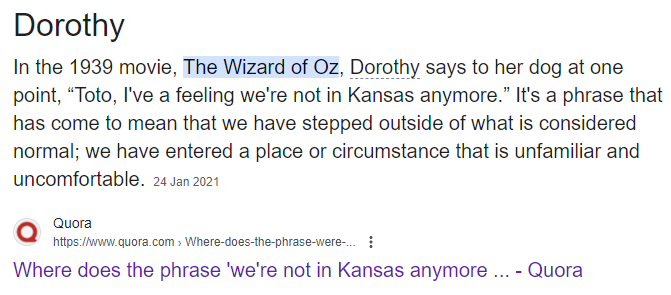
The phrase “I’ve got a feeling we’re not in Kansas anymore” has developed a different meaning since Oz has become a universal feature of life, a way in which we as adults can fret a little that the world we were born and brought up in doesn’t actually make sense. That helpful utility Quora says it straight:

As this is a blog with an educational slant, I’ll fess up that it was receipt of an urgent email from the DfE on Monday last directing me to check a host of ‘Do Now’ activities to ensure school was ready to return to work this summer term that has moved me to go political. Now the email was not personal to CC but a generic message to the whole of the School Sector – “Update to all education and childcare settings and providers”. You can read that here if you want to see what I mean. Please don’t though, because I am just using this penultimate message received last week to illustrate the point that “The DfE does not run schools”! 4 days later, another message from DfE arrived, a start of term card from the Secretary of State for Education, the Rt Hon Gillian Keegan highlighting the need for schools to improve attendance, celebrated the arrival of additional nursery places for 2 year olds, invited all Headteachers to join her for a live broadcast chat last Wednesday and finally, highlighting the need for Headteachers to remember ‘Thank a Teacher’ day.

Call me an old cynic if you like, but the reality 2 weeks later is that Independent Schools simply are not permitted to comply with the government’s wishes to share attendance data, the video link to Gillian’s Keegan was unwilling to be found as were the funds for the additional nursery places and finally, I really don’t know of a headteacher that doesn’t thank their teachers every day – we need to do just that, as the profession is under incredible pressure over the country because the teaching role has expanded so massively to include almost full wrap-around responsibility for everything to do with children plus engagement with a bureaucracy imposed on schools by the government over the past 14 years which has exploded beyond reason. It’s almost impossible to overstate just how complex the public exam system has become; Claires Court has 3 senior school centres to run, covering both GCSEs and A levels, to stretch over 8 weeks this summer, occupying of course all of our big halls in College Ave and Ray Mill Road East. Our Deputy Head Curriculum and her exam manager and 2 additional officers have to start the planning for the Summer term from 1 January, 20+ additional independent adults recruited to support all of the exams including Art to keep teachers out of temptation.

It’s not just education that faces this explosion of bureaucracy; everyone now suffers from the local planning system that has gone the same way. When we applied for our new sports hall, with associated roadway and car park at Ridgeway 21 years ago in 2003, the application to approval time took exactly 3 months and required 3 documents, attracted a correspondence summary and a 5th paper to document approval. Our current application to install a small multi user all weather surface covering 3 tennis courts has attracted 28 documents to include multiple specialist reports to date and still counting, and almost 6 months later still no approval confirmed. I won’t go on any more…

A successful, democratic system needs stable government but also stable and reasonable expectations that education, health and care can be delivered in a well coordinated matter. There is nothing visible any time soon that suggests national government will bring these matters under control, and the last thing Education needs is the continuous on-going creep of the DfE to take charge of everything over in our state schools, the complete antithesis of the freedoms the Thatcher, Major and Blair reforms brought for them from the previous 30 years. Access to children and Adolescent care services and funding has never been so rationed, almost certainly linked to the impossibly tight control the government has placed on funding for the training for future professionals in education, health, care and above all, public service in the emergency services and the military.

I’ve worked since the age of 18, including before and during my student years. At that time, we faced the 3 day week, strikes and a time of similar despair on the failure of national government to get its house in order, but we knew then that the disruption to normal was just that. My wife and I could buy a 2 bed flat as soon as we started work, and opportunities quickly opened up in the years that followed. Now, I don’t see that landscape at all, nor do the alternative Politicians waiting expectantly to take over offer anything like that, just more of the same. The Labour Party’s position to introduce a 20% tax on our tuition fees is completely unreasonable, runs in the face of all other Western democracies and will have a huge and disproportionate impact on over 100,000 children whose parents have chosen our sector because their special needs cannot be met by the state, Much the same is the case for boarding schools; of course it seems that for some families they used boarding to buy access to privilege, but in the main, parents seek residential placements for their children’ schooling because it meets those other needs that the children or parents might have, such as expert coaching in Academic disciplines, Performing Arts, Music and Sports (which cannot be delivered in a day school) or safe care for children whose parents are in the military or work abroad for UKPLC to further support our interests overseas.

Dorothy didn’t recognise Kansas, after she and her pet dog Toto had been swept over in to the magical land of Oz. Fortunately, as the story unfolds, and with the help of her 4 friends, the scarecrow, the tin woodman, the lion and the wizard, they defeat the wicked witch of the West. We too have been swept into a political landscape we no longer recognise; those that lead our country lied to us about the benefits of austerity, compounded the felony by taking us out of Europe fueled by further lies, have failed in their stewardship of our water, transport and energy services and above all in choosing to grab central control of the finances for education, health and care destroyed the local government’s powers to make a difference for the better. Strong public investment is essential to resolve the issues I have highlighted – you can’t rely on the market to return us back to ‘Kansas’; trickle down economics might eventually repave our roads and rebuild our hospitals, but it’s the investment in will, time and intellect to reduce again the waiting list for everything back from years to months to weeks and as soon as possible to days. That way we might get back to Kansas after all!

Posted in Possibly related posts | Tagged , , , , | Leave a comment

Anxiety matters… 2024 style

I write for educational reasons, professional discourse and for therapy, so I am not quite certain where this blog sits… but if you are seeking the most up-to-date information and support, go here now.

Since publishing this blog last week, our SchoolTV has published this really helpful newsletter looking at Exam Jitters, https://clairescourt.uk.schooltv.me/newsletter/exam-jitters, and it really does provide some excellent up to date support for students and parents – if your family is facing exam jitters, these linked articles and videos are worth tuning in to.

Summer Term 2024 started for academic staff on Monday 15 April, so apart from the evidence that my communications’ log suggests, work all day Wednesday, Friday and Sunday afternoon prior, my start of Summer term did too. I love what I do, and in every respect, so I have been a tad anxious about the arrival of some vegetable pea seedlings too into the greenhouse. The first set I planted out straight away at end of March into the allotment; marked ‘Winter Hardy’, I should have known better of course. The slugs of the Jubilee Allotments in Ray Mill Road West made very short work of them. Pleasingly the asparagus at the home ‘flower bed’ have shown early, and before the hail of Tuesday could smash them to the ground, Mrs W had harvested and we ate a wonderful chicken & asparagus risotto that evening, thank you. It’s Master-chef back on TV week, what were you expecting me to say?

Inviting over 300 staff back to work at close of Easter break always has its moments, and causing half of them to pack into the Senior Boys sports hall, work collaboratively together on issues on ‘safeguarding’ low level concerns, play Policy Bingo and select cards to work out which team to join for an amazing closing session on ‘what group learning really looks like’ levelled my anxieties more than somewhat. At Tuesday morning’s return to school assembly at Senior Boys, celebrating the boys and girls abilities to make ‘History Every Day’ had to be underpinned by the closing message, which is … “It’s our vibrant community that makes us different!” So I did, and you can see the introduction here.

And so the week has moved on, I’ve worked every day well past decency, including writing this postscript at Friday dead of night, and I don’t do this for medals or praise – it’s because I wan’t to start every day well prepped and ready, don’t like a hefty in-tray and above all, always want to be ‘the best I can be’.’ Those of you that know that professional workplace psychometric analysis was all the rage over 20 years ago, and I turned out in my 50s to be an extreme Pioneer, likely to lose my team on the journey if I was not careful but my saving grace was and remains that I can’t bear to let any one else down. This morning we welcomed prospective and existing parents into school for an early Summer term Open Morning visit (the pride that the Year 7 children exude showing our visitors around does make my heart sell with pride), other bits of the day include planning next Friday’s ‘Discovery Day’ for prospective Year 5s to spend a day with us, managing 2 hours of research skills conclusions for GCSE students and rushing over to Juniors at school end to act as emergency taxi driver as our tractor broke down… before a couple more hours of screen time at school and then this…

I am a university psychology graduate so ‘The New York Times’ article 2 years ago came as no surprise to me, stating what the upsides of ‘The Upside of Anxiety are: There are several benefits to having an internal alarm system, experts say’. Please read the article, because it covers this piece really well.

Above all, dear reader, please be assured (as NY Times makes clear), I have always been incredibly kind to myself. After all, I am both born and baptised a Catholic, so know my life commenced with Original Sin, and … perhaps even worse, now categorise myself as ‘lapsed’. The only way to survive such conscious faith-based damnation is to know that other traditions exist: Chelsea, Harlequins and my Golf Handicap in that ascending order of hierarchy. It appears I have many international readers, so for simplicity’s sake, for most of what happens, it’s the journey that’s important – do your best, work hard and be kind – the rest will indeed look after itself. Chelsea, Harlequins and Maidenhead Golf Club will have our victories of course, yet the next day it all starts over.

I’ve worked with so many amazing people over the years (that’s a book or series at least, not a blog post), yet one still local neighbour colleague administrator’s words that saved me 4 decades ago sit at the front of my mind every hour. When reminding of the Protestant Irish saying ‘Life is Hard and Then you Die’, Anita brought me back to ground and helped me understand what being and remaining a school for families is all about. Her son (and I taught him too) lives locally, and he exudes the same mantra too; Success, Wealth, Reputation, perhaps most important of all Integrity are built on working hard and being kind.

Thanks for reading this far. I am definitely one of the survivors of the abusive secondary schooling that was experienced by the vast majority of adolescents in the late sixties and seventies. Corporal punishment was endemic in schools, and discipline was meted out by the year above, and in like exercised onto the year below, At Douai School in 1970, Year 13 refused to carry that baton, and the institution transformed for the better as a consequence. We stopped ‘fagging’ as a privilege as a consequence, and when as a returnee for Upper Sixth for my final term of Oxbridge and Rugby, I saw a school unrecognisable to the one I entered just 4 years previously. Now, 50+ years on, as one of the older grown-ups I know, it’s worth linking to these next paragraphs from SchoolTV – genuinely there are eternal verities that younger adults learning to parent need to learn.

In the SchoolsTV latest publication on Youth Anxiety, Laverne Antrobus writes “Untreated anxiety disorders in children can lead to more serious issues in adulthood. Parents need to educate themselves so they can identify the symptoms early.” Laverne knows stuff, so please sit up and pay attention. My words, not hers, but it’s clear that shorn of faith and societal traditions, the modern parent is seeking to rear their children in a ‘perfect’ world. The last thing I’d ever want to wish on the next generation is what I’ve gone through, and my parents did the same – because they were born and lived through the depression of a decade (the thirties), the second world War and the arrival and use of Nuclear Weapons.

So please take this opportunity to engage with the research and experience of modern, forward thinking professionals who are leading the research-led thinking of our times. And for goodness sake, do have some fun – the cricket season is about to start and whatever the weather, we have some runs to score!

Posted in Possibly related posts | Tagged , , , , | Leave a comment

Spring 2024 End of Term Principals’ memo to Claires Court School community

2024’s incessant winter deluge won no friends here, seriously disrupting our various sporting programmes throughout the term. Even so, a huge diverse set of experiences still ran, nicely captured on our website newsreel here. Last week out came the sunshine, smiling on a host of enterprises, as our boys and girls raised funds for their chosen charities. We will publish the totals collected and the charities that will benefit shortly.

RBWM Planning has continued to be incredibly slow in dealing with our planning applications for additional facilities at Senior Boys (original determination deadline, 4 December 2023) and at Juniors (original determination deadline, 11 January 2024). The good news is that at least there appears to be agreement in principle to our proposals.

With Claires Court Juniors now settled at Ridgeway, we have so much to celebrate in the ongoing academic year. At the recent PTA AGM there, we recognised a range of recent achievements that the association has supported, from the success of the Combined Cadet Force and Sailing Club to our talented gymnasts, dedicated sporting touring groups and of course to the support of our 12 Ukrainian students. Year 12’s Viktoriia Habruk spoke passionately to those present about the incredible difference Claires Court has made to the lives of all of her compatriots. In recognition of her own contribution, courageous engagement and incredible success at GCSE, we have nominated Viktoriia for the Independent Schools Association’s highest honour, the Lord Lexden Prize, 2024. 

We are delighted to announce that following the appointment of Mr Richards as Head of Seniors from September, we have now appointed Mrs Vicky Ruddick as Senior Deputy Head, with specific responsibility for the Senior Girls school. Mrs Ruddick is currently Deputy Head Pastoral at Senior Girls, a well known face already in our school leadership team and will be supported with her pastoral responsibilities with the addition of new Heads of Year for Years 9 and 10. As the school moves forward, we are confident that this new leadership structure will only enhance the senior schools and we congratulate both on their appointments.

Approaching my final term leading Senior Boys, I eagerly anticipate a more balanced role as Academic Principal, working alongside Mrs Kirby, Mr Richards and Mr Hope. This adjustment will better allow me to address the challenges and opportunities ahead, including the existential threat to our sector posed by the Labour Party, which requires our focused attention and strategic planning. I would like to extend my sincere gratitude to all for your unwavering support, which has been instrumental in our achievements and will continue to be invaluable as we navigate the future together.

Breaking staff news – our congratulations go to Miss Heather Frost, teacher of Food & Nutrition on her selection for the GB Premier Dragon Boat Team for the European Championships in the Czech Republic this July!

Finally, we wish a long and restful retirement to Mrs Lorraine Downing who left us at the end of February after over 28 years’ service in Ridgeway’s kitchen, latterly as its Cook.

With best wishes for the Easter break,

Hugh and James Wilding 

Principals 

Posted in Possibly related posts | Tagged , , , , | Leave a comment

When Cognitive Dissonance meets the ChatBot – how on earth or heaven are we going to cope?

Dedicated readers of my blog may have noted a certain slowing down in terms of new post in recent months. I’d like to say that so much is going well in the world that, put simply, I don’t need to worry and write, feed and post for therapy. Lots has gone well in school of course, in recent weeks the rain has eased and ‘Bless the workers’, Cookham Bridge has reopened ahead of time – so what’s not to like.

If you wish to jump to the section on how God, the Devil and all faiths between have been captured by the Bots, jump to the end.

After years of study and multiple surveys, at long last we now know the following (according to a current Daily Telegraph survey):

“The poll of 2,496 parents in England with at least one child aged between four and 18 found that 83 per cent believe that smartphones are harmful to children. About 58 per cent back a smartphone ban for under 16s. Among primary school parents, support for a ban for under 16s was 77 per cent.”

Amongst surveys of teenagers too, who have by now experienced the mixed blessings of an always-connected culture, the majority there would agree to a ban, subject of course to everyone else accepting the ban, and returning to a previous life where the home-phone and/or meet-in-the-street activity was the way to kept contact with your peer group. In short, in the right hands and for the right reasons, the connected mobile is absolutely solving problems in the shortest and simplest of ways. Sadly, in the same hands at another time (and lots of them) the hands are scrolling through from one story to the next, each one emphasising and supporting the value systems, likes and interests of the user.

For those new to the concept of Cognitive dissonance, I asked Google Gemini AI to produce a simplification of this concept: this is what Gemini came up with:

Imagine you just bought a brand new mobile phone. It’s the latest model, with all the bells and whistles. You love the camera, the super-fast processor, and the sleek design. But there’s one problem: it drains the battery incredibly quickly.

This creates a mental conflict, a kind of cognitive dissonance. On the one hand, you believe you made a great purchase (powerful phone, beautiful design). On the other hand, the constant need to recharge disrupts your life (frustrating limitation).

This is similar to cognitive dissonance in general. It’s a mental discomfort that arises when you hold two conflicting beliefs or engage in behavior that contradicts your values. Here’s how it applies:

  • Belief 1: Mobile phones are essential for staying connected and productive.
  • Behavior: You spend hours mindlessly scrolling on social media, feeling unproductive and wasting time.

The dissonance creates a tension that you try to resolve. You might:

  • Justify your behavior: “Everyone does it” or “It’s a good way to unwind.”
  • Downplay the negative aspects: “The battery life isn’t that bad.”
  • Change your belief: Maybe phones aren’t so important after all.
  • Take action: Set limits on phone use or find more productive ways to use it.

Just like with the phone, cognitive dissonance can motivate you to change your behavior or beliefs to create a more consistent mental state.”

I am teaching Year 7 at present about the Dissolution of the Monasteries, and they very quickly understand that the evidence surfaced by Thomas Cromwell for Henry VIII did not always show that the monks in Monasteries were guilty of immorality and lax religious practices. They understand that it suited his purpose to discredit the Church of Rome, recommend the closure of the Monasteries and thus enabling Henry to acquire huge additional revenues for the Crown, his army and navy and thus strengthen England.

And after the lesson, they go back to being children, playing at break, fueling up in the canteen and clearing their minds of such History. As a peer group, they have studied together, swum in the same ‘school’ and together been able to readily judge and learn. Interesting to note, that set such work on their own, the time taken to read, learn, understand, wrestle and arise at a shared answer probably would have taken 3 or 4 times as long. Working together, thinking in the same set of limited facts and focused attention, no Cognitive Dissonance or worse still Overload. Mental well-being is maintained.

But here’s the difficulty with Social Media; like my class, groups of individuals are steadily gathered by the ‘evidence’ being displayed in the ‘stream’, but far from challenge, the stream keeps adding more of the same ‘echo chamber’ set of thoughts, so the excitement of finding a friendly stream that’s supporting you so well steadily becomes an addiction that can’t be left. AI is not replacing the teacher, ensuring balance, caution, reflection and analysis.

Modern schools have always had the purpose of being friendly places in which children learn how to challenge received wisdoms and learn how to think for themselves. I absolutely get that as parents this can feel intimidating, because it’s so much more peaceful if the homework gets done without pain. We can never teach handwriting again successfully as a country because the pain seems to high and the cost of alternative mechanisms by which to be literate are now so much lower. On the plus side, it looks as though we are developing really good dictation skills, so much so that children’s poor spelling doesn’t get caught out because that easy check on read-back allows for quick editing and review.

Back to my central point; we need both social cohesion and cognitive dissonance in the school learning situation. We need to be a safe place to learn as well as offering challenge, argument and resolution for the better. So of course mobile phones need to be off in school all day, and because everyone knows that’s the rule, they’ll both be accepting and relieved. Outside of the school, child and adolescent use needs to be regularly curtailed and more importantly, supervise. Out there in the Wild Internet, where anything and everything goes, there is far too much to lead children astray, a repeating echo chamber of AI generated content and links that is way too smart for us and creating dopamine surplus and addiction amongst us all.

For young people, here are the dangers (thanks Gemini):

Brain Development:

  • Teenagers’ brains are still under development, and excessive screen time can impact areas related to learning, memory, and attention span.

Mental Health:

  • Social media can be a breeding ground for anxiety, depression, and feelings of inadequacy, especially when teenagers compare themselves to others’ online personas.
  • Cyberbullying is another risk, which can have severe emotional consequences.

Sleep:

  • The blue light emitted by smartphones can disrupt sleep patterns, leading to fatigue and impacting mood and concentration.

Physical Health:

  • Excessive phone use can lead to a more sedentary lifestyle, increasing the risk of obesity and other health problems.
  • Text neck, a strain on the neck and shoulders from constantly looking down, is another potential physical issue.

Addiction:

  • Smartphones are designed to be engaging, and teenagers are particularly susceptible to developing compulsive behaviors. This can lead to neglecting real-world relationships and responsibilities.

Privacy:

  • Teenagers may not be fully aware of the privacy risks associated with social media and oversharing online.

Exposure to Inappropriate Content:

  • The internet can be a dangerous place, and teenagers may be exposed to inappropriate content, such as violence or pornography.

Social Skills:

  • Constant interaction through texts and social media can hinder the development of strong face-to-face communication and social skills.

Here are the rules:

  • Setting screen time limits
  • Creating phone-free zones in the house
  • Open communication about online safety and privacy
  • Encouraging other activities and hobbies
  • Being a good role model by showing healthy phone use yourself.

Conclusion.

To summarise – Cognitive Dissonance forms part of the learning process, can cause tensions but is one of the ways our brain manages internal debate to settle uncertainties, helps build learning pathways and informs future actions.

This week’s Scientific American stimulated me to write this blog, in part because of the ludicrous, unthinkable idea that AI engines such as ChatGPT can load up ‘God’ into its large language model and act as the the one supreme being, the creator and ruler of the universe. It’s been done with all the faiths, including the Bible, Islam, Confucian and includes the Delphic Oracle in its works. Of course AI is not just one ‘thing’ but I have been playing with https://bible.ai/ and it’s been really quite a ‘revelation’ – not that the Book of Revelations is actually a favourite story book of mine. To close, I asked Google Gemini what I should think of it:

“The Book of Revelation isn’t necessarily regarded badly, but it is a complex and often misinterpreted text. Here’s a breakdown of why it can be challenging:

Symbolic Language: Revelation is filled with symbolic imagery and apocalyptic visions, which can be difficult to interpret literally. This ambiguity has led to a wide range of interpretations throughout history.

Fear and Violence: The book features vivid descriptions of disasters, war, and punishment, which can be frightening or off-putting to some readers.

Focus on End Times: Some interpretations of Revelation emphasize the end of the world and apocalyptic events, which can cause anxiety or despair.

Historical Context: Understanding the historical context of the book’s writing can be helpful in interpreting its symbolism. It was written during a time of persecution for early Christians, and the imagery reflects their struggles.

Misuse by Extremists: Unfortunately, some extremist groups have used their interpretations of Revelation to justify violence or hatred.

However, there are also many positive ways to view Revelation:

  • Hope and Encouragement: Despite the imagery of destruction, Revelation also offers a message of hope and ultimate triumph of good over evil.
  • Comfort and Strength: For some believers, Revelation provides comfort and strength in the face of suffering or persecution.
  • Symbolism and Metaphor: Viewed symbolically, the book’s message can be about personal transformation, overcoming challenges, and the ultimate victory of God’s will.

Ultimately, the Book of Revelation is a complex and multifaceted text. How someone views it depends on their own religious beliefs, interpretation style, and consideration of the historical context.

Gemini may display inaccurate info, including about people, so double-check its responses. Your privacy & Gemini AppsOpens in a new window

Posted in Possibly related posts | Tagged , , , , | Leave a comment

Meeting Regulatory Compliance 2024

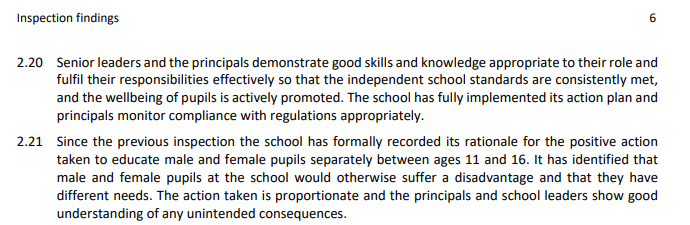
Following a recent visit by the Independent Schools Inspectorate, I am delighted to report that we were found to be fully compliant against the Independent Schools Standards Regulations, and can now look forward to a further 3 years of approved activity until our next inspection as required by the Department for Education. The full report can be read on the school website, https://www.clairescourt.com/about-us/reports-and-policies and will soon be visible on the Inspectorate’s own site too.

Very long term watchers of our school will be aware that the school has been inspected by the same Inspectorate regularly since 1990, and we have always been reported on most favourably as a consequence of those visits. Inspections are deeply stressful events, none more than those conducted following the reopening of school reviews by Ofsted and ISI after the Covid-19 pandemic. The sorry saga of that endured by Caversham Primary School in November 2022 is well amplifeied by the BBC headline Ruth Perry: Ofsted inspection ‘contributed’ to head teacher’s death. Claires Court was inspected in that same week, and had to ensure a similar delay; though the findings from the schools were very different indeed, we had made complaint to the Inspectorate about their conduct during their time with us, and had to wait umpteen months in silence whilst they examined our concerns.

Weeks of discussions with our inspectorate followed, as we examined the difficulties the inspection uncovered, not least the lack of written draft report visible until February half-term, literally 12 months ago to the day I write this blog, to then be followed by months of further wrangling with both ISI and DfE. Not withstanding the school’s prior clear commitment to provide appropriate accommodation and provision for the teaching of GCSE Food & Nutrition to boys, as documented in its proposals to DfE/ISI wef September 2023, the Reporting Inspector determined during his visit that we should have done better than this agreed timescale. Our various defences, including agreed policy provision, risk assessment on possible detriment, planning permission for new building not being agreed, or the delays caused by 2 years of pandemic, the tight restrictions on pupils crossing sites as a consequence until March 2022 may well have all been valid, but that did not mean discrimination between genders had not occurred for the few caught up in the period 2021-22.

As this new follow-up report makes clear, and not withstanding the local authority’s ongoing and perplexing delays with granting planning permission, we have both now provided the missing GCSE course for boys and proven beyond doubt that the school’s choice to maintain its Diamond shape, enabling gender separation at secondary level for boys and girls is demonstrably to the benefit of both parties.

Sufficient is now said on this matter; the Inspectorate’s own efforts in visiting the school this term, in covering many of the details of our mutual concerns so well during their visit has concluded their findings in the school’s favour. The many other excellent findings of their visit in November 2022 continue to shine through – we have at our heart the very best interests of our children. our parents and our teachers – and maintaining these endeavours into the future remains the core objective.

Posted in Possibly related posts | Tagged , , , , | Leave a comment

This month on Claires Court SchoolTV – Respectful Relationships – one of the great bonuses our PTA provide!

For this first year of provision, the Claires Court Parent Teacher Association have supported the school’s pastoral teams through the provision of this fabulous service for parents, teachers and schools.

Creating great conversations at home is really important, but all too often making sure that parents have the true facts available with which to engage their children is not that easy. This Wednesday’s Times newspaper ran a headline “In school and on medication — the truth about ADHD in children“. ADHD specialist Elizabeth Swann reported to SchoolTV that 60% of all readily available information on the Internet via search engine is completely wrong AND that the term ADHD is the 7th most searched for abbreviation via Google IN THE WORLD!

Finding a trusted news source is really important, indeed a byline of the BBC advertising for their News service itself, but in terms of children’ focussed information, having a central content resource is really important – hence the PTA support for the provision of the SchoolTV service for Claires Court.

I’ve 3 items from our SchoolTV service for your consideration: SchoolTV’s take on NeuroDiversity if that’s of interest to you, leading on from the Times headlines from Wednesday. Neurodiversity in children and adolescents is a concept celebrating the natural variation in how young minds work. It acknowledges that neurological differences, such as ADHD, autism, dyslexia, and giftedness, are not disabilities but unique aspects of human cognition, and we are so much better treating them as such rather than labels/badges to wear.

With major conflicts taking place in Ukraine and Gaza, it’s no surprise our children want to talk these through, even perhaps want to know what they can do to help and how; children can often encounter distressing images and stories of war and conflict through the 24-hour news cycle and social media. These experiences can provoke anxiety and fear in young minds whose worldviews are still forming. Traumatic events imprint strong emotional memories that can influence a child’s behaviour and perception of danger. SchoolTV have produced an excellent SPECIAL REPORT: Discussing War & Conflict , in which Dr Emma Woodward FRSA, Child Psychologist and TEDx Speaker gives you an insight on how children’s healthy brains react to distressing images and how parents can handle those difficult questions that might arise.

And finally, I point you at This month on SchoolTV – Respectful Relationships

Fostering a nurturing environment of respectful relationships within your family holds the key to not only harmonious living, but also improved academic outcomes for your children. As parents, guardians and caregivers, embracing the art of teaching children about respect at a young age sets the stage for a lifetime of healthy interactions and empathetic understanding. It will help cultivate a positive environment where communication flourishes, conflicts are resolved constructively, and bonds are fortified. Claires Court tries incredibly hard, and has an outstanding long-term reputation for care and consideration, indeed its core values include at their heart, Respect, but we certainly need every ounce of help with this that homes can bring.

Teaching children to respect themselves and others will open up avenues for both personal growth and academic achievement. Fostering an environment where respect is not just a word, but a practiced behaviour, will empower young people with essential life skills. Effective communication, active listening, and the art of compromise, will provide your child with a solid foundation that will transcend family interactions and help them collaborate effectively with peers, teachers and the broader community.

Equipping children with an understanding of healthy versus unhealthy relationships is an important aspect of their development. It will guide them to make informed choices, foster positive connections, and set boundaries that contribute to their emotional wellbeing. Understanding the nuances between healthy and unhealthy relationships provides children with the essential tools to navigate their social world, build self-esteem, and cultivate meaningful relationships.

In this edition of SchoolTV, learn how to empower young people in healthy interactions to embrace differences and forge connections that honour their self-worth. We hope you take time to reflect on the information offered in this month’s edition, and we always welcome your feedback. If you do have any concerns about the wellbeing of your child, please contact the school for further information or seek medical or professional help.

Here is the link to this month’s edition https://clairescourt.uk.schooltv.me/newsletter/respectful-relationships


Posted in Possibly related posts | Tagged , , , , | 1 Comment

Artificial Intelligence – Beyond Merlyn Mind

Discussing the presence of AI in the home, it seems that until recently, I have been one of the oddest people in the world, choosing not have enabled a Smart Assistant at home. Whether you are Apple, Amazon or Google will depend on which voice you get, those of Siri, Alexa or – yes Google. Across most households I have visited over a year or two now, the background digital assistant has been there quietly humming in the background, providing music, weather forecasts, news and indeed genuine assistance to the household, recipe advice and all sorts.

Since Merlyn Mind joined Claires Court 3 years ago as one of only 50 institutions in the world to trial AI in the classroom, we’ve been able to expand its involvement in school life with every junior classroom now equipped to provide that support for teachers. 3 boys from Year 9 (Computer Science {Cs}group who brought the school drone to our firework show) visited last term Year 6 to hear their views on the benefits and otherwise of Merlyn as currently configured for use. It’s amazing how astute our children are, how quickly they can summarise What Works Well, and Even Better If, and so fairly quickly, the #CCScDrone squad were able to report back to Merlyn as consumers.

Friday 26 January is a big day for the #CCScDroneSquad, as they are due to present to a range of industry specialists their work with Drones. They are travelling to BETT24 at the Excel centre in Stratford, London, armed with their presentation seeking sponsor support for 2 more drones, so they can develop their programme for teaching junior children about smart robots, of which of course modern drones are brilliant examples.

Specifically, they are also meeting with the US team from Merlyn, both for feedback but also to receive examples of the next generation of classroom AI, Merlyn Origin. The team are to be based on the Sunborn Hotel, seen above outside Excel, and we will feel a little like entrepreneurs entering the Dragon’s Den! You can see their presentation visible here, and we are really hopeful of learning a lot from our visit to BETT, teaming up with Merlyn and their UK partners, C-Learning, and who knows, coming back with some unexpected booty too.

PART 2 will follow after our return – Saturday 27 January 2024.

#CCCsDroneSquad arrived at BETT24, ready to meet with the team from Meryln and C-Learning. The team had chosen to hear our feedback on the use of Merlyn Mind with our Juniors in one of the board rooms on the luxury yacht hotel, Sunborn. Below shows our team under clear scrutiny, being commended for the exceptional detail that they had taken to summarise the strengths of the classroom tool, plus hear where the weaknesses lay in terms of technology limitations.

The new Merlyn Origin was shown to the team, and they were invited to interact with Marlyn’s AI directly, learning how to ask prompts both to receive answers to questions but also how to cause Merlyn to generate new content from scratch. In so doing, the boys made History, being the first children in the world to so do! Parents may not know this, but within the educational context, how data on children may be stored, recycled and reused is strictly controlled, and although Merlyn Origin was 2 months ago in the USA, its use with children has not yet been authorised. For the boys part, because they had not logged in as users of Merlyn, but being third party interrogators, the way they ask questions and improve their interactions is the major way in which Merlyn will learn how to work more successfully in the school environment. The #CCCs delegates have been charged with prompting Merlyn for the next 6 weeks over the 3 hours a week we have reserved for this research, and they’ll give further feedback through C-Learning on their findings on the new tool. Of course the researchers can’t be paid for their work, but in return for their efforts, Merlyn have agreed to provide a second DJI mini, so the team now have the agonising decision whether to buy an identical 3 mini Pro, or go for the more automated 4 mini, despite its poorer performance in windy conditions.

After 2 hours with the Merlyn team (which included a fabulous buffet lunch), the team then visited the main BETT24 exhibition, and the photos below capture some of their explorations, from tactile sand, , robotics, robot dogs, sharing their work with the team from Google and eSports.

Overall, the experience was remarkable for the #CCCs team, presentations as they had their research outcomes to an entrepreneurial company currently just completing their 1st $million dollar spend on a new innovation tool for the classroom. The school in due course will receive 20 Merlyn Origins, but receiving the first 6, for trialling in the Junior school and making a welcome return to the senior school’s science labs is really thrilling. Our squad has outstanding invitations to visit 4 junior schools to show them how drones can be used in education as well, so winning the second drone and thus getting 50% of the addition resource needed was a major step forward.

And finally, of course, if there is any reader out there willing to complete stage 2 of the #CCCsDroneSquad’s project – we need a further £700, then please do get in touch!!!

Posted in Possibly related posts | Tagged , , | 1 Comment