#WeRemember – Holocaust Memorial Assembly at Claires Court, 28 January 2019

Eight remarkable ladies have produced a remarkable short film, to support the International Holocaust Remembrance day: “Join us in ensuring the Holocaust is never forgotten – 2019 #WeRemember Campaign”. We are asked show them we’re listening. Post your ‘We Remember’ photo with the hashtag #WeRememberor send it by email to weremember@wjc.org 

As you’ll see when watching the film, all the women survived the Holocaust as children. This film formed the centrepiece of our Senior Boys assembly this morning, Monday 28 January, and you can find the full assembly presentation as short movie here – and as slide-show here. I have drawn my graphic below, and pleased to do so. Who knows whether these 8 will be back next year; they certainly don’t think so.

During my assembly, I highlighted some key features of a school child’s life under the Nazis. Children had little chance of avoiding being ‘brainwashed’, most specifically because Adolf Hitler took a personal interest in all german children, seeing as he did their part so clearly in his master plan for the German race. He stated ““Germany’s children’s hearts are mine”, and in the light of the evidence that followed, he made that a reality throughout most of Germany.

Whilst Hitler sought to win the hearts of his own nation’s children, he gave and the Nazi party gave no such affection to the children in other countries.

I concluded assembly with a reminder of one of the clear themes of this term. It is our choice whether we accept the received wisdom in the following process chart: Witness > a sense of Violation > Bypasser syndrome > Learned helplessness.

As we develop our own determination to ‘Notice Better’, we can perhaps accept the alternative: Witness > a sense of Violation > Conscience response > Elective Action.

Indeed, I don’t regard this as a choice for our society. To slightly misquote Garry Herbert: “If not us, who, if not now, when?”

Posted in Possibly related posts | Leave a comment

Into Africa – the Claires Court journey begins

Claires Court’s Global Charity for 2019

Claires Court is supporting Charity Pearl The Gambia as its global charity this year, helping to make substantial improvements to day-to-day life in the Brufut area of The Gambia.

As a result of our initial donation, the community started building a well this month to enable neighbouring villagers who haven’t had access to water so far to have water available 24 hours a day! We are pleased to announce tickets are now available to purchase for our Gambia fundraising evening, taking place on Friday 25 January from 7pm at College Avenue. Lots of curries and African drumming promised! Find out more: http://ow.ly/Cgnx30nh3Fy

The PTA and School’s decision to support Pearl in The Gambia arises from the inspiration our pupils took from last year’s global choice of Charity, that being the UWC school promoted by ISA in Pong Tek, Cambodia. Sadly, the school’s distance from the UK, number of time lines to cross and huge interest from the other 500+ ISA schools meant that our students’ ambitions to get hands-on could not be supported.

The Gambia provides us with much more scope, not least the enthusiasm that exists in The Gambia to encourage young adults with skills to travel over to promote adult education and skills acquisition amongst their youthful population. The plans for our student-led trip to the Gambia in October half-term 2019 are progressing nicely, of which more details can be obtained from the Sixth Form office via
kyh@clairescourt.net.

Posted in Possibly related posts | Leave a comment

‘Exam reforms boost private pupils in race for universities’: Observer newspaper (Sunday 30 December)

An edited version of my letter to the editor appeared in the Sunday 6 January 2019 edition. Below is the full text, with one amendment, updating QCDA name to Ofqual.

Dear Sir

Your front page headline ‘Exam reforms boost private pupils in race for universities’ (Sunday 30 December) leads an article of the worst kind of lazy journalism. 
The core argument proposed by Toby Helm is that International GCSE (IGCSE) qualifications are ‘easier’ than the latest generation of English GCSEs, which the DfE requires its state schools to use, and thus are making it harder for state pupils to get to Uni. 
The new GCSES  may have heavier content, but the % of passes at level 4 (C) and level 7 (A) remain the same as before, and as a consequence have the same level of difficulty as before. This equivalence is managed as a requirement of the exam boards by the government’s regulator, Ofqual. So actually, the exams haven’t got harder at all. 
IGCSEs are changing and developing at the same time, so that their curriculum content has become weightier, in response to the arrival of tougher A levels. These have gained heavier content to come more into line with the toughest international qualifications gained for University entry.

Given that GCSEs and IGCSEs are level 2 qualifications, whatever exams pupils are taking at 16, they don’t meet university requirements for level 3 qualifications, such as A level, which are taken 2 years later, at age 18. Surely Helm knows this?

There’s more to understand though.In the previous generation of English GCSEs, pupil studies involved taking lots of mini-tests, ‘controlled assessments’,  involving the submission of coursework, over an 18 month period, as well as terminal exams at the close. Adding in the opportunity to resit and resubmit, candidate GCSE pass rates inexorably rose, but at the expense of developing the deeper study skills needed for both Level 3 qualifications and University beyond.When (back in 2010)  Michael Gove recommended state schools should consider mimicking the independent sector by taking the more demanding IGCSEs, it was to enable state school pupils to have the opportunity to gain this more advanced skill set for higher studies.The ‘new’ GCSEs are like IGCSEs in that they are mainly terminal exam only, and have ‘heavier’ content than before; thus they are more suited to prepare children for the university entrance examinations. 


Herein lies the rub:

Like many eminent international commentators, such as Sir Ken Robinson and Professor Guy Claxton, I resent the whole trajectory of the recent reforms at both GCSE and A level, whose basic premise is to prepare children for University entrance. Education in school needs to be far broader than this, to assist children to enter adult life as emotionally well-balanced individuals, with a range of interests and passions, willing to play their part as contributing members of their community.
As one of some 500 private school secondary heads, I remain proud to provide a deep, broad and engaging school experience for my secondary and sixth form pupils. Yes, I understand my responsibilities to prepare them for University, but I take even more seriously my responsibilities to ensure my children enjoy their childhood for longer. The arts, sport, community engagement, above all fun and play must enrich children through their teenage years. This is how we can build the adults of the future, with both better skills for life and greater mental well being.

Yours faithfully

James Wilding

Academic Principal and Headteacher

Claires Court,Maidenhead

Posted in Possibly related posts | Leave a comment

A very real British ‘Brexit’ is on the cards…

Live from the Claires Court Sixth Form centre 12 noon Wed 12 December 2018

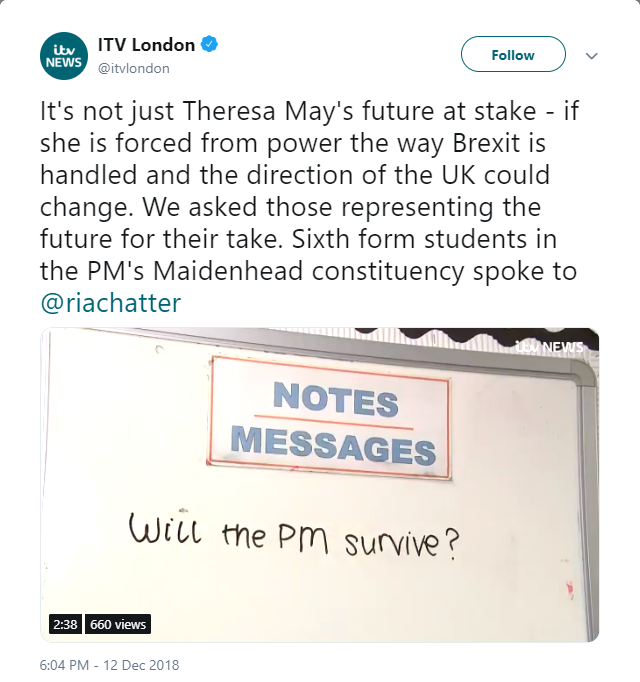
With the excitement gripping the nation this last Wednesday, and our very own local MP (aka Prime Minister Theresa May) very career at stake, the ITV news team came out from London to interview some Maidenhead Sixth Formers on their view on her chances of survival during the ‘Brexit’ vote of confidence she was facing that evening from her own Conservative party MPs. 

The students had about 20 minutes notice, and genuinely scrambled to get the chance. When spoken to afterwards, they were quite shocked that their views had been sampled – in between taking the ‘Vox Pops@ at 12 noon and appearing on the 6 o’clock news in the evening, some feel that their balanced views had been ‘clipped’ to suggest greater divergence of opinion than actually.

Ria Chatterjee, the journalist who interviewed them said:

“Great to see young people politically engaged with such strong opinions and obviously well read and knowledgeable on the issue. It’s hopeful for the future to know that young people are prepared to engage this way”.

As matters turned out, the Conservative Parliamentary party voted for Theresa May in the vote of no confidence, 200 to 117. That has ‘buttered no parsnips’ in the days that have followed, with the EU leaders saying ‘Non’ and the ragged elements from all sections of parliament remaining dominant over those MPs that continue to support the limited Brexit proposals suggested

Posted in Possibly related posts | 2 Comments

“A rising tide lifts all boats”

As many of my readers know, I currently have quite a lot on my plate, being the Academic Principal of Claires Court. We have a school of 1050+ children and 350+ staff actively going about our business, and that does in itself generate ‘busy’ things to do. In addition, we have planning developments slowly and steadily making their way through the process; not just the New Campus application up by CCJB off Cannon Lane, but also short term facility management changes for our water sport of Sailing, as despite the recent rainfall, Sheephouse lake is desperately short of water. We’ve moved a lot of our kit to Bray lake for the time being, but longer term we need to recover our Sailing Club, which means both finding a way to refill from the river whilst preventing South East water from taking so much out of the natural water table that s the usual source of water for the lake. Keeping on the water theme, and as the new header to my blog illustrates, we have a new bridge over the water at Boulters Lock, linking Ray Mill Island to the old St Regis paper mill site, opening up a whole new public amenity on the Taplow Riverside development by Barclay homes. Suddenly we all have a brilliant new walking/running ring free of pedestrian traffic joining up the riverside walk from Maidenhead Bridge to Boulters Lock.
For some time we have been working with the Environment Agency and RBWM to open up above the lock towards Cliveden for our rowing and outdoor education activities. We are taking over the former Thames Water conservancy office on the island, giving us office and dry changing facilities there, and enabling us to row, scull or kayak up past the weir onto the most beautiful reach of the River Thames. There is of course still the little matter of the weir to risk assess and manage, plus infrastructures of pontoons and storage areas to create, but it’s exciting to see long term plans such as these gently move towards fruition.
Whilst the above all sounds terrific, in addition I am preparing for my restart as day-to-day head of the Senior Boys school in January 2019, on the retirement of John Rayer at Christmas. I am learning lots now of course from John and his terrific team; though I can’t emphasise strongly enough how much I am gathering from the (now) experienced headteachers Leanne Kirby (JG) and Margaret Heywood (SG) on the College site, whilst gently assisting in the induction of our new headteachers in post, Dean Richards (JB) and Stephanie Rogers (SF). What with Anne Halpin stepping up from Holiday Activity finance to become our new Holiday club manager, the onward management of our multi-faceted teacher training programme, plus further refinement activities on all of our areas of activity, it’s no surprise to feel that the tide of work is relentlessly rolling in.
And far from feeling submerged by it, there is a huge ‘bouyancy’ and ‘willingness to pitch in’ that is genuinely exciting me. It helps of course to have Justin Spanswick at our sides, getting stuck in to his new role as Executive headteacher, and also to have the incredible support of the administration team my brother Hugh leads. But it’s more than that. We’ve spent years establishing our core ‘values’ programme, and the profound depth and quality of our work to develop a ‘question-based’ curriculum over the same decade is now evidently appreciated within the profession as well as by our pupils and parents. The incredible commitment of teaching and instructing staff to ensure stretch, challenge, exercise, competition and skill development supports our plans has led to extraordinary opportunities and outcomes for all ages within the school. The way our support teams, be they within SEN, Nursing, Library, catering and/or housekeeping just keep relentless on task inspires us daily. And it must be said, that wider of network of professionals elsewhere with whom we must engage are also now giving us the genuine credit we deserve for ‘knowing our stuff’ and giving really generously with our time.
Gary Player may have coined the phrase ‘The harder I practice, the luckier I get’, but that does not quite fit this scenario, does it? I think I prefer the concept of ‘Making positive waves’, whereby with our concerted efforts we bring the tide in, and in so doing lift all the boats and enable them to sail. Since our INSET sessions in September, I have seen so many occasions where our adults working with our children have gone the extra mile, stretched the able, been less helpful yet supportive for the idle, nurturing for the vulnerable and calming for the excited. They say ‘Making waves’
means ‘Causing a disturbance’ or even ‘Upsetting the status quo’. I’ll say Amen to both those, because in what actually is quite a drear landscape of ‘never ending bad & fake news’, in and around Claires Court we have a smile on our faces and a purpose in our steps, lifting everyone to give of and be their best selves each day.

Posted in Possibly related posts | Leave a comment

Lest we forget…

20180914_124543

What follows is more of a publication than a Blog.

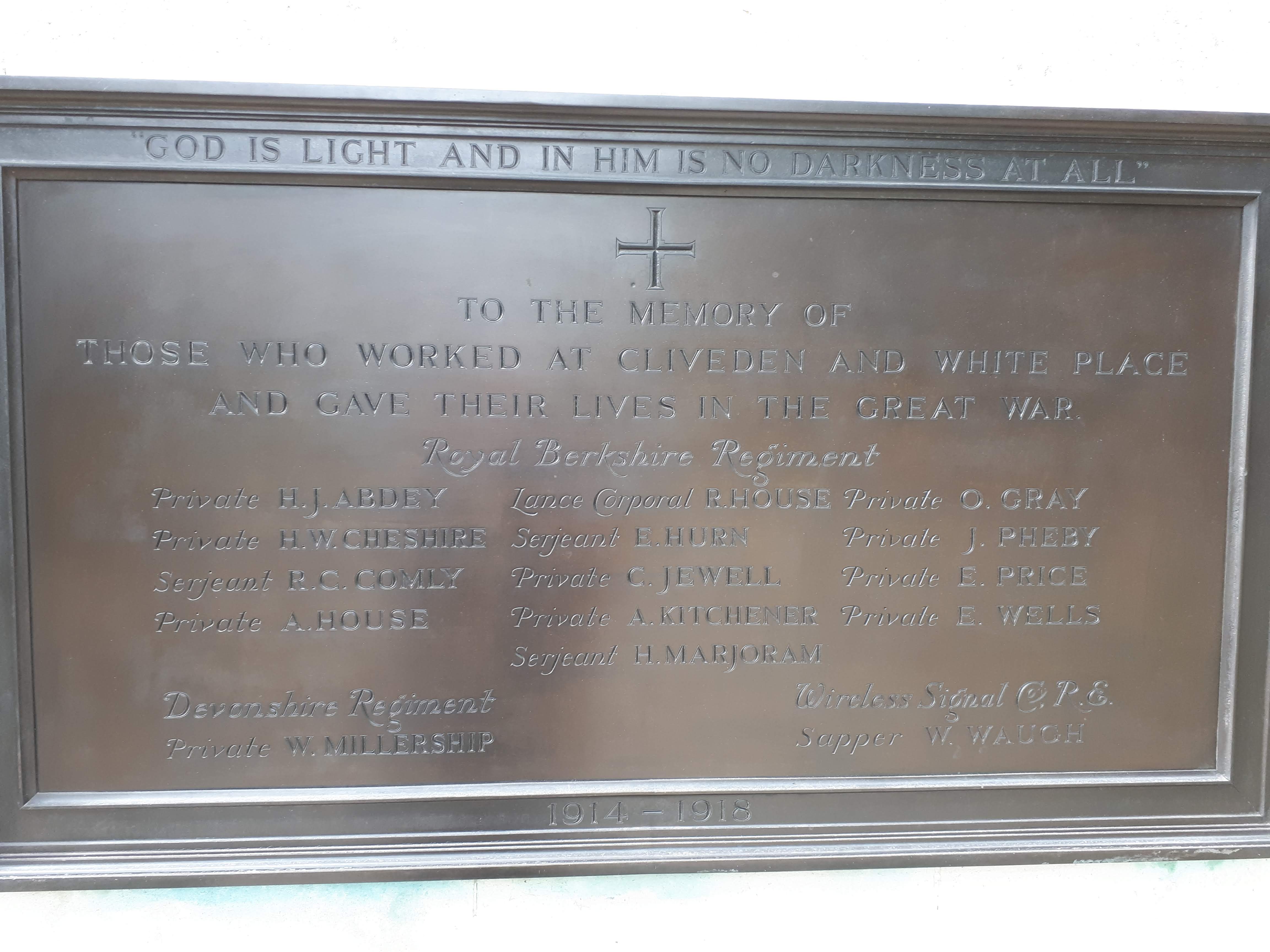
With the help of 3 boys and 4 girls whilst they were in year 10, we have successfully met the challenge given to us by the National Trust at Cliveden to find out something about the 15 Cliveden Estate workers, who lost their lives in the Great War 1914-18, and whose names are commemorated on a Brass plaque on the Octagon chapel at Cliveden.

From a range of evidence arising from research carried out over a 3 month period, we were able to provide the National Trust with the following information, for release as an original publication to commemorate the 100 year’s anniversary of the Armistice declaration on 11 November 1918.

The boys and girls are participating in a special event at Cliveden on Sunday evening, by invitation only. We are very proud and thankful of what we have been able to achieve.

Cliveden pamphlet copy
There are 15 estate workers names to be found on the Octagon Chapel memorial plaque,
Pte H.J ABDEY Pte H.W. CHESHIRE Sjt R.J. COMLEY Pte A. HOUSE L/Cpl R. HOUSE Sjt. E. HURN MM
Pte C. JEWELL Pte A. KITCHENER Sjt. H. MARJORAM MM Pte O. GRAY Pte J. PHEBY Pte. E. PRICE
Pte E. WELLS Pte W. MILLERSHIP Spr W. WAUGH MM
MM indicates award of the Military Medal
Sjt is short for Serjeant, the official spelling of the rank at the time in the British Army

James Edwin Marjoram
James Edwin Marjoram was born in 1891 in Binfield, Berkshire. He was a footman for the Cliveden Estate. Nancy, the wife of Waldorf Astor (the future Lord and Lady Astor) who owned the Cliveden Estate, loved her footman being really tall and big built. This implies that he must have been a handsome young chap. His last known address was in Windsor, Berkshire, where he lived with his beloved wife Edith Rose and daughters, Nora and Edna. When the war broke out he volunteered for service, 2 years before he would have been obliged to sign up due to conscription. His service number 11728 tells us that he joined the army at the beginning of the war (1914). He enlisted in Maidenhead, joining the Royal Berkshire Regiment (the 1st Battalion) and arrived in France on 29th November 1914.
James was obviously a good soldier, because he was awarded the Military Medal. Promoted Serjeant, unfortunately, he was killed in action, on 8th October 1918, in front of Forenville, during the Second Battle of Cambrai (one of the last battles in the war, only a month before the Armistice). So it must have been devastating for his family; he had survived four years of battle, only to die tragically at the last hurdle. James died at the young age of 27 and is buried at the Forenville Military Cemetery, Nord, France. They have a memorial here at Cliveden in the Octagonal Temple for Sjt Marjoram.

Ev Hurn
Frederick Everett Hurn was born in 1864. Formally known by his middle name (hence E Hurn on the chart), he had been a ‘regular’ in the Royal Berkshire Regiment of the British army before the First World war, evident from his army service number, serving in Egypt in the early 1890s before returning to Cliveden after the death of his first wife, Sophia in 1893. By this time, he had a four year-old son, also called Everett, who was cared for by maternal grandparents until Freddie got back. Ev lived on the Cliveden estate and had worked as a night watchman at Cliveden for William Astor before enlisting in the 1890s; it seems that he was a reliable employee, whom Astor was willing to re-employ on his return. Ev’s job as night watchman would have been to make sure all was well on the Cliveden estate after dark, a job for which he would have needed a degree of bravery, for sure! In 1901, Ev married for a second time: Clara, the sister of his first wife.


Even though he was 50 when war broke out in 1914, Ev volunteered to serve again in the 6th Battalion of the Berkshire Regiment. His previous service obviously counted for something, so he became a sergeant; we might imagine him as the ‘old soldier’ setting an example to the raw recruits in his care, and them looking to him for reassurance. By 1915 he was at the front again and during 1916 he was Mentioned in Dispatches. By late June 1916, the men of the Berkshire Regiment were in position for the big battle about to take place: the Somme. On 1 July, when the battle began, Ev’s regiment advanced with some success, despite finding themselves at the mercy of enemy fire; but Ev was killed on the first day of this campaign, which would eventually end at colossal loss of life in late November. He was awarded the Military Medal posthumously.


By this time, William Astor had gifted Cliveden to his son and daughter-in-law, Waldorf and Nancy. When Ev left for France, and subsequently died in battle, Waldorf ensured that Clara was able to remain in Taplow in decent housing, a respectable war-widow. Until her death in 1934, Lord Astor paid her rent: a mark of the respect with which Frederick Ev Hurn and his family was surely held by his former employer.

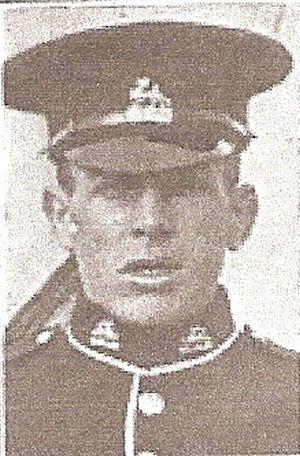
The only estate worker for whom we have a photograph is Private Herbert Abdey, also of the Royal Berkshire Regiment who died with the Royal Berkshires on 15 October 1915 following their engagement in the Battle of Loos. We also have a photograph of his brother Private Alfred Abdey, who had joined the Royal Berkshires before the war and died in an Aldershot hospital on 5 August 1914, war on Germany having been declared the previous evening.
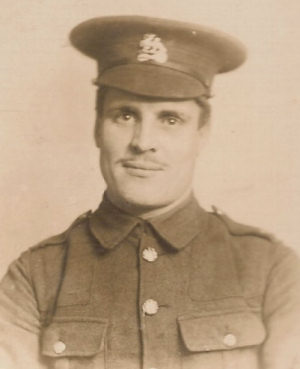
Abdey H J

Herbert Abdey

Abdey Alfred

Alfred Abdey

Original photos here – http://buckinghamshireremembers.org.uk/casualties/m5745.html

The Royal Berkshire Regiment and the Battle of the Somme.
Two of the estate workers, Serjeant Reginald Comley and Serjeant Frederick ‘Ev’ Hurn lost their lives fighting with the 6th Battalion, Royal Berkshires on the first day of the Somme, 1 July 1916. A third, Private Albert House, a reservist who had been in France with the 1st Battalion since September 1914 was killed at the end of July during the Battle of Delville Wood, one of the many subsidiary engagements of the Somme Offensive.
On 1 July 1916, Serjeants Hurn and Comley along with the 650 other soldiers of 6th Battalion, Royal Berkshire Regiment (6 RBR) were entrenched in the Somme valley, near Carnoy. Part of 53rd Brigade, itself a constituent of 18th Division, the Battalion was tasked with seizing the road between the villages of Mametz and Montauban and beyond to a distance of some 3000 metres. 6 RBR was fortunate in being under the divisional command of Maj-Gen Ivor Maxse whose training methods were at the forefront of those in the BEF. Consequently, the two Berkshire assault waves left their trenches even before the British barrage was due to end but such was the adrenalin rush that the lead company was caught by the late detonation of a huge mine at Casino Point, a German machine gun nest. As the Germans emerged from their deep dugouts they found 6 RBR already in their forward trenches and not disposed to take prisoners. Within two hours, the Battalion had secured its secondary objective and by 6.30pm reached its final objective some 2500 metres from its starting point. On the day, this was exceptional and matched only by the similar advances of 30th Division and the French 6th Army just to the south of 18th Division.


Elsewhere, the day did not go as well for the British – with 60,000 casualties of which over 18,000 were deaths, it is still ranked as the worst day in British military history. Among 78 killed in 6 RBR that day were both Hurn and Comley. Along with 6 other ranks from 6 RBR, the grave of Reginald Comley is to be found in Dantzig Alley British Cemetery, Mametz, while Freddie Hurn’s body was never found and his name is recorded among the 72,000 to be found on the Thiepval Memorial to the Missing in the Somme sector.


Medals awarded to the Cliveden 15:
Soldiers who served in France or Belgium as part of the British Expeditionary Force (BEF) between August and November 1914, had their service recognised in 1917 by the award of the ‘1914’ Star medal (known as ‘Pip’), carrying a clasp across the ribbon marked ‘5th Aug-22 Nov 1914’. The 1914-15 Star (which did not have a clasp but was also known as ‘Pip’) was awarded to all those soldiers not qualifying for the 1914 Star but who had served between 1914 and 31 December 1915. Thus was acknowledged the service of most who had joined the colours voluntarily before conscription was begun in January 1916. Both Stars were always awarded with ‘Squeak’, the British War Medal* and ‘Wilfred’, the Allied Victory Medal*, so were worn in a row of 3. Soldiers only eligible for the War and Victory medals wore them as a twosome, nicknamed ‘Mutt and Jeff’, all names being drawn from popular cartoon characters of the 1920s. These ‘campaign’ medals would be worn with any other gallantry or service medals that the wearer was entitled to.
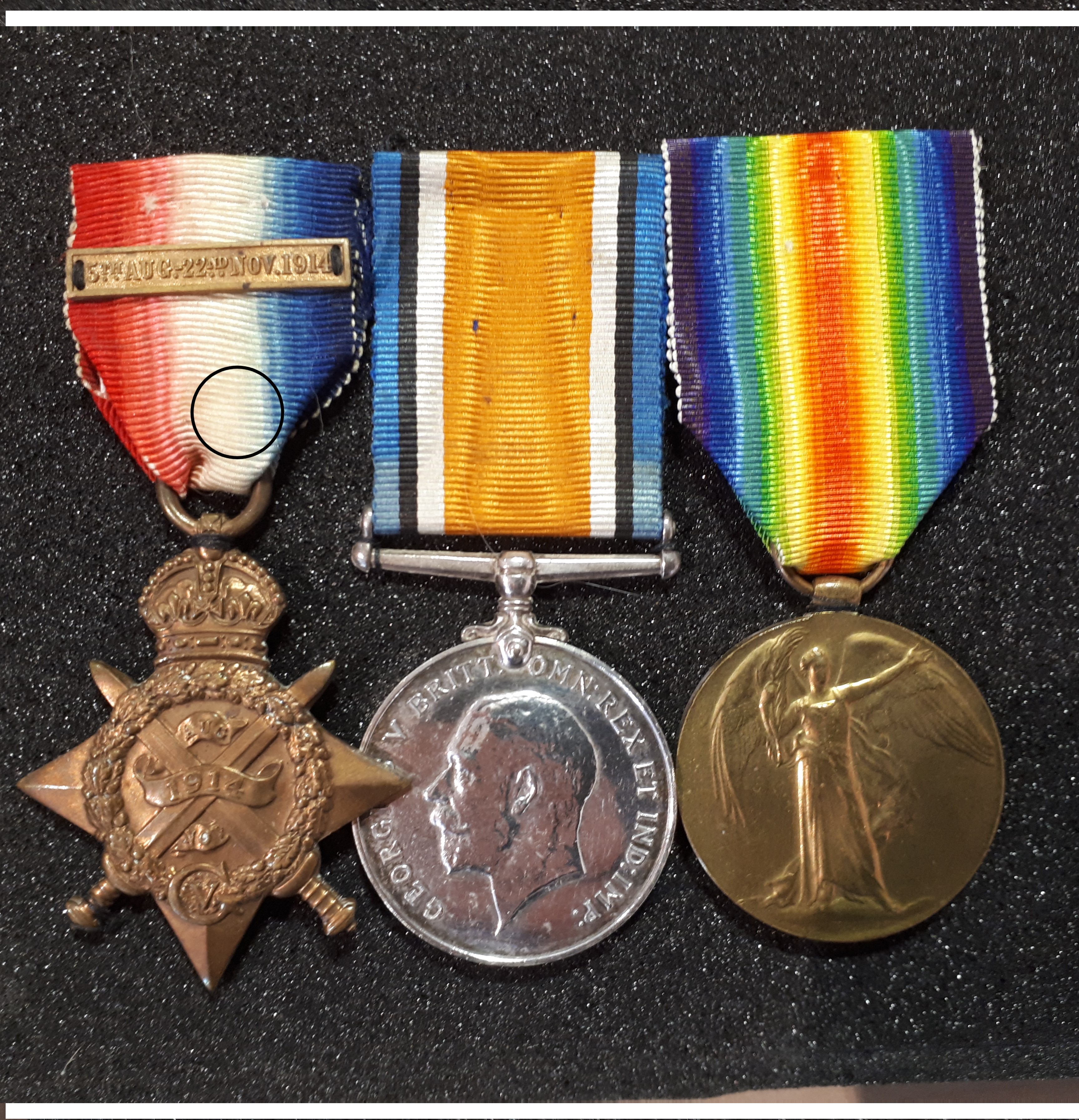
Pip, Squeak and Wilfred

Pip, Squeak and Wilfred

*The recipient’s service number, rank, name and unit were impressed on the rim of the two medals. The same details were impressed on the rear of the Star.

Timeline of the deaths against the battles mentioned

Untitled drawing

human interest narrative about the work they did on the estate

Footman (Marjoram): The first footman lays the table for each meal, serves the family breakfast either on trays in the different rooms or in the breakfast or dining room, and attends the door during the morning. In households where but a butler and one footman are kept, the two alternate in tending the door.


Gardener at the Cliveden Estate (Cheshire, Cowley, House brothers, Grey, Price) The gardeners at Cliveden house maintained the 375 acres of land. They did this using only metal and copper tools as machinery such as electric lawn mowers had not been invented yet. They also planted flowers, in particular they planted a seasonal mix of bulbs, annuals and shrubs such as gladioli, hollyhocks, tulips, pansies and azaleas.


Stable lad (Millership)

A groom or stable boy is a person were responsible for the management of horses and the care of the stables themselves. They would sweep the stables clean and prepare the horses with the correct equipment for riding. Cliveden’s stables were rebuilt during the ownership of the 1st Duke of Westminster (1868-1893), an important ‘stud’ farm for many years subsequently. .

Assistant electrical engineer (Waugh)
An electrical engineer designs, develops and maintains electrical equipment, solves problems and tests equipment. They would have worked with all kinds of electrical devices, from small items to big. After the disastrous fire 1849, which destroyed the house, Cliveden was completely rebuilt in 1851 and then extensively remodeled by Lord Astor in the 1890s who gave the estate to his son, Waldorf on his marriage to Nancy Langhorne Shaw in 1906. Nancy proceeded to redecorate the house and modernise it with electricity which became an important service throughout the house. Waugh was assistant at Cliveden to his father, Thomas.

Night watchman at Cliveden Estate (Hurn): At Cliveden Estate, a night watchman’s job would have been to guard the main building at the estate around it.

Other trades: Woodman (Pheby), Oddman (Kitchener) otherwise categorised as ‘working at Cliveden Estate (Jewell, Wells). Abdey‘s occupation at Cliveden is not known, but his parents were ‘carters’.

Sources
David Bilton, Reading in the Great War, 1914-1916 (Barnsley: Pen & Sword, 2016) n.p.

Smales, N (2015). Taplow moments : a unique history. Bicester: Words by Design.
Underwood, J.&.P. 2005. Buckinghamshire Remembers. [Online]. [June 2018]. Available from: http://buckinghamshireremembers.org.uk/memorials.htm
The Royal Berkshire Regiment Great War Project. [Online]. [September 2018]. Available from: http://www.purley.eu/RBR0000.html.
Battalion War Diaries 1914-1919, Royal Berkshire Regiment. Transcribed. The Rifles Berkshire & Wiltshire Museum. [Online]. [September 2018]. Available from: http://www.thewardrobe.org.uk/research/war-diaries/search.
Census returns, various, England & Wales. Ancestry.co.uk. [Online]. [June 2018]. Available from: https://search.ancestry.co.uk/search/db.aspx?dbid=1543
Commonwealth War Graves Commission. Cwgc.org. [Online]. [June 2018]. Available from: https://www.cwgc.org/.
Imperial War Museum. Livesofthefirstworldwar.org. [Online]. [June 2018]. Available from: https://livesofthefirstworldwar.org/home.
“Lincoln’s End,” Hitcham & Taplow Society Newsletter, #107, Spring 2017, 16b. Online edition, http://www.taplowsociety.org.uk/wp-content/uploads/2016/10/Newsletter-107-screen.pdf, accessed 25 Sep 2018

Wikipediaorg. [Online]. [29 June 2018]. Available from: https://en.wikipedia.org/wiki/Cliveden.
Grateful thanks to: Katherine Gwyn, Centre for Buckinghamshire Studies who provided details on the estate workers from the Cliveden Pay Roll book ref D158/29) AND Nick Forder, Curator of the Maidenhead Heritage centre for the medals and advice
Posted in Possibly related posts | 6 Comments

“Lies, Damn lies and Statistics…”

The website https://www.phrases.org.uk suggests that the full saying “There are three kinds of falsehoods, lies, damned lies and statistics” is from Arthur James Balfour, 1st Earl of Balfour, as quoted in the Manchester Guardian, 29th June 1892. No matter, but worth noting that the public has been very wary of government for at least 120 years on its choice of statistics to use to back its decisions or blow its own trumpet.

Screenshot Stats

Screenshot Stats2

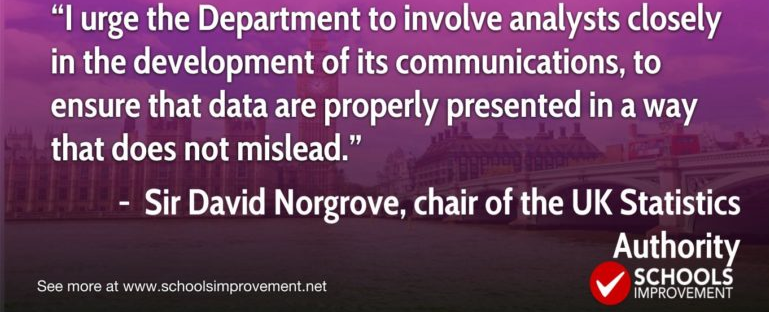
It is no surprise to any of us in Education that the UK Statistics Authority (UKSA) has now chosen to write to the Department for Education (DfE) for the fifth time; it has already done so on four occasions in the past year about its use of statistics, it said in a letter to Damian Hinds, the education secretary. It is now investigating this fifth complaint, on international comparisons of school funding. Sir David has called for a meeting with Jonathan Slater, the DfE’s permanent secretary, and sought reassurance that the DfE would “observe the statutory code of and sought reassurance that in future the DfE would observe the statutory code of practice for statistics.

What worries us all in Education is that whenever we hear the parliamentary representatives with responsibility for Education, such as Damien Hinds, Secretary of State or Nick Gibb, Schools minister, they speak with great authority and confidence of a state education sector that none of us actually recognise, in terms of funding, teacher recruitment and curriculum matters.

And the DfE, having used statistics to further their own aims, continue with their general standpoint that investment in UK education is amongst the highest in the developed world. This fact may indeed be true, in much the same way as the house prices in the UK are amongst the highest in the world, but does that make ‘housing’ per se better than similar countries in the developed world? Or does the investment by UK PLC in the railways make our railways amongst the best in the world too. Here’s an OECD graph that highlights the sheer cost of childcare in the UK:

Given the high level of anecdotal evidence that funding has been slashed to the bone arising in individual schools throughout the country, highly visible in news bulletins and indeed Court decisions highlighting the same, I really don’t know how the DfE or indeed its master, the elected government finds it in their water to sustain a conversation using statistics for which there is no integrity, and for which its own watchdog has called it out.

Here’s another internationally renowned statistician on the matter: “For a department that is in charge of the nation’s numerical skills, this is getting embarrassing,” said Sir David Spiegelhalter, president of the Royal Statistical Society. “Ministers need to get a grip!”

Indeed they do Sir David, indeed they do.

Posted in Possibly related posts | 1 Comment

Open Days – a celebration of school life

Thursday 28 September 2018 saw us open up our school for the first time this year for Open Day, an occasion which provides for us an opportunity to ‘showcase’ what we do during the day.

Across the 3 sites today, we had some 100 visitors, including current parents looking upwards at the next stage in education we offer, external visitors for the first or more time, and perhaps loveliest of all, former pupils who are now parents in their own right, coming back to check whether we are the school they remember.

I’ll add to this blog over the next few days, to pick up further colour from today’s visits.  It must be said that the conversations our current pupils started always seemed informative and on occasion hilarious.

What’ is certainly worth doing is visiting schools when they are normal.  Open evenings are of course showcases, but frankly, the ‘warts and all’ can only be seen during ‘normal’ service.  And also of course worth doing is having a look at their weekly communications as well – I have just finished reading our weekly blurb, and the newsletters make a great read indeed. https://www.clairescourt.com/page/?title=Bulletin&pid=298

Posted in Possibly related posts | Leave a comment

Into the twilight zone -when school statistics cease to make sense. Go figure!

I am an avid listener of the Radio 4 statistics programme, More or Less, in which its presenter Tim Harford challenges broad sweeping statements made on the media that might not actually be true. Last week (14 Sept) was entitled “Male suicide, School ratings, Are female tennis players treated unfairly by umpires?” You can find the broadcast here,  https://www.bbc.co.uk/programmes/b0bh8vpd and the section I ask you particularly listen to is from 6m50s, when Tim turns his attention to the claim of the chairman of the Conservative party, Brandon Lewis this August that “Since 2010 the number of pupils in good or outstanding schools had risen from 66% to 86%”.  To be honest, Mr Lewis is just quoting the DfE’s own recently statistics, so how could his claim be exaggerated?

It has been well publicised that Ofsted no longer has the resources to do everything, so its current focus is on moving schools from the bottom 2 categories of ‘inadequate’ and ‘requires improvement’, inspecting them quickly to move them upwards, rather than reinspecting ‘Good’ and ‘Outstanding schools’.  ‘Good’ and ‘Outstanding’ schools are not expected to be inspected in perhaps less than a ten year period, so inevitably, there is going to be a ratchet effect lifting standards, with there only existing a one way ticket upwards!  Even more confusing is that some 700 failing schools have been ‘closed’ and reopened, which ‘erases’ their ‘inadequate’ rating and they won’t be inspected for a further 3 years – in the meantime they enter that twilight zone of invisibility.

Education journalist and researcher, Laura Mcinerney helps put sense to the statistics in the broadcast, and is challenged to explain why the changes in the exams structures at GCSE and A level damage the research base further. Regular readers of this blog will have read me bang on about this before, but I love the fact that McInerney (whom I have admired since her days writing on Twitter as a Fulbright Scholar back in 2014) is affirming my thinking. Every GCSE and A level has been so substantially changed now, that there is no way we can compare the statistics of the past with pupil performance now from 2018 onwards. For any research to be of value, you need at least 5 years of data,  so it’s fair to say we will not know whether the changes that have been brought in have raised the standards of education in England as the DfE (led by Mr Gove at the time of initiating these changes – back when McInerney was stateside 2014) until 2023 at the very earliest, given that the new style GCSE exams only hit Bus Stud and Tech in 2019.

In practical matters, such as running a train set, when the ‘Fat controller‘ decides to change the train timetables, almost at once when they are implemented, we learn whether they are going to work. On 20 May 2018, the new England train timetables were introduced, chaos ensued, and we know just 4 months later the reasons why (from the report by the Office of Rail and Road).  The ORR  said that:

  • Network Rail was best placed to manage the risks relating to delays with Network Rail’s electrification work, pushing back the development of the timetable and gave train operators less time to prepare for the introduction of new services but did not take sufficient action
  • Neither GTR or Northern were prepared for the disruption that arose, nor did they do enough to provide accurate information to passengers
  • Both the Department for Transport (DfT) and the ORR itself failed in their duties to oversee the industry

Almost exactly the same set of circumstances have preceded the changes to the public examination system in England.  The Education departments in both Wales and Northern Ireland were able to ‘stay’ the changes, and have reflected more carefully on what is actually needed in their jurisdictions. It’s quite one thing for maniac politicians to insist on changing the content and style of examinations within its schools, but you’d think as a profession we could have caused some restraint so that the outcomes of such change could be tested and unforeseen circumstances made more visible prior to final implentation?. McInerney concludes “The amount of change that has gone on over the past eight years makes it almost impossible to compare anything.  Even these Ofsted grades have different marking criteria since 2010… We can’t even take a small group, for example pupils that are on free school meals, because the criteria for a child qualifies for free school meals has changed over the last few years…”.

As a school principal within the Independent Sector, untroubled by Ofsted grade criteria or free school meals, you might wonder why I am bothered by this ‘education crash’ of epic proportions in the state sector?  The reality of course is that we share the same broader education ‘environment’ and our politicians and public consider all schools together in their thinking and conversation. There is an incredible clamour from the Education Secretary and his acolytes within the DfE that Independent Schools should be doing so much more to assist our state partners, and also be tring much harder to widen access and improve social mobility.  DfE has dramatically ramped on the pressure on its own schools, who have seen reduced per capita funding, coupled with an ever increasing population of children set against a declining population of teachers. The growing evidence from the state sector and its inspectorate of the narrowing of the curriculum, accountability measures forcing teaching to the test, the diminution of co-curricular activities coupled with staffing and resource crisis has resulted from the direct actions of the DfE and this government’s financial and budgetary decisions. Here’s the Chief Inspector of Schools, Amanda Spielman writing three days ago: “School inspectors in England have put too much weight on tests and exam results when rating schools.”

What’s worse is that Spielman knows what its teachers have been doing: “Too many teachers and leaders have not been trained to think deeply about what they want their pupils to learn and how they are going to teach it.  We saw curriculum narrowing, especially in upper key stage 2, with lessons disproportionately focused on English and mathematics. Sometimes, this manifested as intensive, even obsessive, test preparation for key stage 2 sats [national curriculum tests] that in some cases started at Christmas in Year 6.”  She also knows what her schools need to to better, which is to have a much richer and deeper curriculum at the heart of each school.  “The content, structure and how it is developed is down for school leaders to decide. It should depend on a number of factors relevant to a particular school’s context and the knowledge and expertise of curriculum leaders.”

And therein lies the rub, because far from worry about how we can share facilities or aid social mobility, schools like mine really do understand how to build deep and rich curricula and we would willingly share our knowledge and expertise. The trouble is, government simply won’t fund it.  We are indeed entering a Twilight zone for some schools, where the light does not shine brightly, and the urgencies are so immediate, and where there is little statistical evidence to draw upon to identify quite where the schools and the pupils are currently at. As the Americans are won’t to say – “Go figure!”

Posted in Possibly related posts | 1 Comment

Extreme v Expected – why normalising real effort and creating opportunity are essential for learning.

The American journalist and author, Hunter S Thompson said “Anything worth doing, is worth doing right.” He certainly wasn’t the first, and it’s a constant surprise to modern man when they uncover the work of our ancient predecessors and find paintings and craft work to be so incredibly well done.  We’ve seen a real resurgence in the development of craft skills amongst our society and a real market growing for craft articles and foods that had perhaps almost disappeared. There is a problem though, that of the growing reluctance of our ‘mind-set’ to engage with deep learning and extended practice.

Our Head of English, Luke Wespieser has shared with me this article from the Guardian, “Skim reading is the new normal. The effect on society is profound” by Maryanne Wolf. I am not surprised teachers are alarmed by the growing evidence that innovation and our adoption of new technology may be moving too quickly for developing brains to keep up!  Wolf writes: “As work in neurosciences indicates, the acquisition of literacy necessitated a new circuit in our species’ brain more than 6,000 years ago. That circuit evolved from a very simple mechanism for decoding basic information, like the number of goats in one’s herd, to the present, highly elaborated reading brain. My research depicts how the present reading brain enables the development of some of our most important intellectual and affective processes: internalized knowledge, analogical reasoning, and inference; perspective-taking and empathy; critical analysis and the generation of insight. Research surfacing in many parts of the world now cautions that each of these essential “deep reading” processes may be under threat as we move into digital-based modes of reading.”

We may be seeing the same happen in other areas of skill acquisition in schools, such as hand-writing too.  Evidence from the exam boards is showing an increasing number of candidates are being authorised to use laptops for their public examinations, because their writing is not up to the speed required.  In addition where spelling, punctuation etc. are a real problem, then spell-checking can be enabled. Such access requirements to ensure those with such disabilities used to only each down from A levels to GCSEs, though now include children down to 11+ entrance tests and other primary school assessments too.

Wolf continues: “This is not a simple, binary issue of print v digital reading and technological innovation. As MIT scholar Sherry Turkle has written, we do not err as a society when we innovate, but when we ignore what we disrupt or diminish while innovating. In this hinge moment between print and digital cultures, society needs to confront what is diminishing in the expert reading circuit, what our children and older students are not developing, and what we can do about it.”

There’s a whole host of skill-sets that can only be learned through patient practice and deep absorption in the process, and we’ve seen these disappear over time in a whole host of human activities. From lead glass work for windows, to the use of slide-rules for calculations, some of these skills were acquired during the interim stage of technological development, no one for a moment now would suggest we should go back to glazing all windows with fragments of glass, or dispense with the calculator.  The real problem with the change in reading habits is that “as UCLA psychologist Patricia Greenfield writes, the result is that less attention and time will be allocated to slower, time-demanding deep reading processes, like inference, critical analysis and empathy, all of which are indispensable to learning at any age.”

The challenge for those involved in education, be we teachers, learners or parents is to provide enough space for the development and retention of both sets of skills, analogue and digital. It’s perhaps no wonder that sixth form and university subject disciplines as diverse as Languages and Humanities which require deep reading and reflection, philosophical thought and re-examination of past actions and writings are proving to be less attractive than those disciplines that don’t require a set of skills built around such an interconnected set of neurons in our brain.

What does this mean for us at Claires Court? Expect lots of technology still to roll out, with AI and 3D arriving through the year. But also expect us to continue to work on real reading, writing, and inspiring children to take pride in the acquisition of the physical and craft skills throughout primary, and to keep the school open long enough to ensure the hours of practice as well as the breadth of study can be put in.  Hunter Thompson  2018-19 looks to be an exciting year for us all, with much happening in these fields of learning every day, so I’ll keep you posted with a new blog every Thursday of course!!!


Posted in Possibly related posts | Leave a comment