
I am sure I was not the only one who watched the Sunday night programme entitled 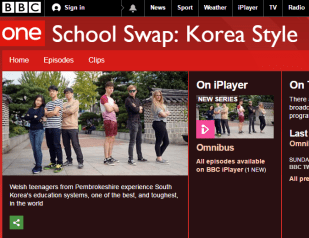 this week. 3 sixth formers from their idyllic welsh valley in Pembrokeshire swapped for three days into two of the best schools in Seoul. Make no bones about it; on the face of what we witnessed, the city pupils in Gangnam had the better deal when it came to school results, but at what cost? School days for most seem to last for up to 18 hours, with only 6 hours for the children to ‘sleep’, no more. before remounting the treadmill for another day in their 44 weeks of school year. You can read a little more here, and the programme is beautifully presented and developed by Sunday Times education editor Sian Griffiths, who had this to say at the start: “Sixty years ago, nearly 80% of the population here was illiterate, today South Korea is an economic giant. And they did all that through education.”
Make no bones about it, the academic standards between the 2 nations are light years apart, or so it seems, though the pressures on teenagers there are extreme. Suicide is the common cause of early adult death, and one student interviewed had lost 2 friends to suicide at age 16. Standards are higher elsewhere in the UK, and indeed at the individual school level we have state and independent schools here which outperform all of the nation states by published PISA outcomes. But put simply, the UK lags behind academic achievement of South Korea, end of. South Korea is reaching out to understand the better bits of what we do, improvements for example being to force the closure of schools by 10pm, rather then remaining as they do open til midnight. Yes, rub your eyes – ‘midnight’!
 Sian Griffiths’ worries are that if the South Koreans grab the best bits from our offer to children, such as our hands-on practical lessons in science or development of creative skills, they’ll not loose the academic advantage in hard maths and languages, and suddenly we’ll be exposed on all fronts as being second-rate and what little international successes we having will disappear completely. She makes a very valid point here, when she asks “and what lessons are we learning from the South Koreans?”
What surprised me about the programme, which showed only the 3 welshmen abroad as yet, not the return ‘fixture’, was that my expectations of a nannying Korean set of parents driving compliant, servile children after school to tutors and then back home for homework was so far off the mark! Of course films may lose the truth in the editing, but what with one of the parents having to work 16 hour shifts as a taxi driver to cover the high costs of at least 2 after school sessions, actu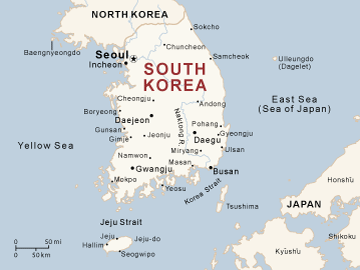 ally the story is much more complex. Here goes…
South Korea is about 30% smaller than England, and so is its population, so comparing the
2 countries is quite a neat thing to do. Their industrial revolution has largely happened since the Korean war, at a time when 80% if their population was illiterate. Now 99+% of their population stays into Sixth form, compared to about 60% of ours, though in truth the latter statistic is not comparable since recently we have insisted that all children stay in some form of education until the age of 18. The difference between the 2 Sixth Form educations is stark, as being diverse and spread from elite academics through to full vocational, where in Korean city schools, the push is fundamentally at the high level academic (including the study of English) level. The 2 city schools visited (boys and taught in separate schools) open their doors for study shortly after 7, with lessons running from 8 to 4pm. School is a full community provision, including ‘fine’ dining (well, hearty school meals for all) and after school, we see the students off to their tutors for a 2 hour catch-up session. They then travel home, eat dinner with the family, before setting off using public transport for some more specialist study (we saw English), before the students returned … to their school which was still open to complete their homework. Lights out at school circa midnight so the students travelling home and going immediately to bed, before prepping for school the next day from 6pm. Honestly, it’s bonkers for children to do this; the scenes in the classroom all day showed children falling a sleep in their books, and the patent exhaustion and stress of it all was visible to all – on the children, on the parents with their long hours and multiple jobs just to keep up the payments on all the extra tuition needed, and on the relationships between all.
Here’s what I learned that was positive from the programme.
- It seemed obvious that the students were consenting to their education, because for the vast majority of the day, they were able to live as independent consenting humans, forging friendships and learning what to like and not like without the pervasive stare of a helicopter parent.
- The peer group pressure to do well was obvious, and they were suitably harsh to each other to keep people in line, gee-ing each other up too as and when necessary.
- No ‘blame culture’ was evident the teachers were all teaching and working really hard, and no-one seemed to lose the plot if a child fell asleep. That ‘nap’ was clearly necessary and the learner came back on board as they regained consciousness, without the teacher making undue fuss.
- It’s clearly the student’s job from quite an early age to determine what they need and how much extra support they need, hence the tutors, second tutors and returns to school for homework, rather than study at home*.
- And because they seem permanently in the company of friends, they don’t seem to be going up in solitude, nor force-fed a narrower diet of what what the idiot’s lantern has for them.
- And because they are not suffocated with their family, family values are very strong, and at examination time, whilst the students are in the exam hall, the mothers are in the temple, praying for good fortune for their children’s results.
*We are talking city landscape here, with 80% of the population living in high rise flats, with excellent connecting public transport and shops open 24/7. Space is at such a premium, that the homes don’t seem large enough to permit a place for homework or private study.
In case you think I am coming out in favour of the South Korean approach, I’m totally not. I love growing up in our post-industrial world, with a balance available between the academic, the aesthetic, the sporting and creative circles that intertwine in such complex ways. I have never wanted my children to be feral, to grow up without being able to share with each other the closeness of a family life. But watching these brilliantly engaged adolescents, carving their own academic careers in a focussed peer group without intense adult intervention clearly is a reminder to us to move off centre stage a little bit more than we might, because the children are very capable of doing a whole lot more then we might expect. And of course, there are quite a few strategies we have already adopted here at Claires Court to enable the children to become independent and self-reliant, if not feral. We are 8 ’til late (late busses roll at 5.35pm except on fridays and snow days), with full services available at school, universal wi-fi and clubs, activities, study and focus groups for students to join and engage with at their own discretion and interest, and a growing number student-inspired and led.
Think about catching up the programme on iplayer; it’s a harsh society that permits so many of its young children to commit suicide, and the South Korean government is really doing their utmost to learn from why suicide rates are so much lower here in the UK. Yet, as our rates rise, maybe, our society can learn from the South Koreans as well. 100% of their 16 year olds identified our GCSE Maths paper as being suitable for the primary school years – eek!







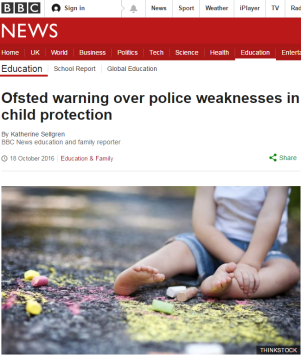 police weaknesses in child protection. HMCI Sir Michael Wilshaw in writing to the Chief of Constabulary, Sir Thomas Winsor, said there were cases where police officers had failed to attend key meetings about child protection or visits with social workers. In a number of forces there were delays in flagging up domestic abuse cases to the local council. In one case, an Ofsted inspector questioned a police decision to close a case even though “there was clear evidence that the children concerned had suffered non-accidental injuries”.
 rise until the service begins to fail. Commuters on the Paddington line might be happier now we have lost FGW and gained GWR, but down on Southern Railway, their well publicised chaos continues unabated. If things could get worse down there, recently the service has announced a further reduction in timeable by 15%, so that, as


 ‘responsibilities’) have to write and publish their
  A. J. Angulo is the Elizabeth Singleton Endowed Professor of Education and a professor of history (by courtesy) at Winthrop University. He is the author of Empire and Education: A History of Greed and Goodwill from the War of 1898 to the War on Terror. This summer, he wrote an excellent summary article of his thinking for the Guardian newspaper, in which he highlighted problems appearing in the States, with the arrival of for-profit companies pedalling university diplomas to those least knowledgeable in the value of same, and most gullible in terms of paying their way for a qualification not worth the diploma parchment it was printed on. The
 rapidly, a History degree at Bristol now
  hardware in question is outmoded and no longer updatable. Our early Samsung Chromebooks are 5 years old this Christmas, and still working as well as they did on the first day of opening. The issues is that their systems architecture is unlikely to support the next updates of Chrome browser in 2017. Shame, as my little black chrome book is and remains an amazing workhorse. The beautiful thing about the human mind is that it is capable of such extraordinary and unfathomable activities that it seems never in need of a policy to limit its capabilities and define its limitations. In practical terms, whilst we have over the last 50 year worked out that many more than a privileged few are capable of pursuing an education to graduate status and beyond, we are resetting our expectations in terms of who can/needs to bear the cost of the residential component, and whether distance learning away from the factory face actually delivers the skills development that the job/employer/customer needs.
 up too, in the 21st century we need to be adaptable, engaged and willing to take on new, and often as yet to be defined challenges. Education does not have such a single purpose, any more than work and play has, but it needs to support the very and many purposes individuals and society needs for their future development.
 e walk and torches for the return in the dark) and there are a number of lovely events and side shows happening over the next 2 hours before Star Fireworks set off their first display of the new 2016-17 season. They are the current reigning British Champions of Champions, and we get to see all the new ‘whizz-bangs that have been created for the new display season, fresh delivered from their place of manufacture – China.
 am acquiring funding for an exhibition or worthwhile work – journals and projects not weddings! — He’d probably be interested. He has been pretty full on with this and it’s been exhausting for us all in various ways so definite possibilities preferred please to avoid more overload.
  A Principled view