“…for the twenty-first century we will have to do more than just improve literacy and numeracy skills.”

20 years ago, in the DfE white paper 1997 White Paper, Excellence in Schools, the DfEE wrote the following:” If we are to prepare successfully for the twenty-first century we will have to do more than just improve literacy and numeracy skills. We need a broad,
flexible and motivating education that recognises the different talents of all children and delivers excellence for everyone.”  From that position paper, a whole series of changes came about in UK schools, including the birthing a broader offer for Sixth Formers, Curriculum 2000, and the establishment of the sponsored academies programme. 20 years on, and almost all the ideas have either perished or had their day. A levels have been rolled back to be the 3 subject gold standard, the modular approach being abandoned in favour of terminal examinations, and the massive expansion of the Academies programme sees these new schools and their multi-academy trust structures to be no more effective than the local authorities they were to replace. You can read the Education Policy Institute (EPI) research on the latter here: http://epi.org.uk/wp-content/uploads/2016/09/Academies-consolidated-presentation-FINAL.pdf

I write this blog update shortly after the declaration of the next general election, and the inevitable declaration by all parties that they will improve education further if elected. The current Conservative government have their next white paper ready to be published, and if the pollsters are to be believed, this White paper will soon see the light of day in early July. More structural change will be promised, including the establishment of new grammar schools and more Free schools, and the final pieces of the Excellence in Schools Agenda expunged.

It’s difficult to believe that successive governments want to reshape education when they come to power. Nothing seems ever to be left in place long enough to discern whether the ‘improvements’ planned are happening, and ‘evidence’ arising from schools and policy research departments ignore almost completely by the incoming successful politicians. At the time of writing, I have just listened to David Laws, the former Schools’ minister, now Chief Executive of the EPI speak at the ISA annual conference in York. In a frank discussion with us, he bemoaned the fact that politicians can force curriculum content change in schools, such as what History should be studied and what books should be read, despite all the evidence to the contrary of its efficacy.  He made specific mention of the abilities and frailties of Michael Gove, Secretary of State for Education 220px-david_laws_mp_2008during the coalition government’s term of office, weaknesses including his determination to meddle in matters despite advice. Mr Laws worried his audience more than a little, at the spectre of a returning MG into DfE after this election, if only Theresa May could find it in her heart to forgive him!
The Prime Minister’s strapline for her party is to provide ‘strong and stable’ government. What’s clear from the international evidence is that great things are happening in our good schools, be they state or independent. The ‘best’ we have in our schools are performing at the same level as the best in China and the Far East in terms of academic attainment, AND in addition we are providing a really creative, well qualified graduate flow of skilled innovators into UK PLC. The failure of our education system to remove the long tail of poor achievement from those at the bottom of the economic spectrum is challenging indeed, but we won’t be able to tackle this solely in our state schools situated in those areas of the country where expectations for work and social improvement are low.

It’s interesting to note that schools local to RBWM also show long tails of low achievement, yet the area has very high employment statistics. And herein lies the rub: the growth of the ‘gig’ economy, lots of self-employment has helped bridge the employment gap, yet provides little in the way of opportunities for self-improvement to those so employed.  There are no apprenticeships in the ‘gig’ economy, and no investment then in the acquisition of additional skills that the workers could gain along the way.  We are currently advertising for permanent staff to join our household teams, and few applications arise simply because of the ‘full’ employment status of the area.  And of course, available workers, living elsewhere in the country cannot ‘get on their bikes’ to Maidenhead, because the availability and cost of accommodation makes relocation much more difficult.

The one major breakthrough on the horizon is the arrival of the modern apprenticeships, and as part of this exercise we have applied to become an Apprenticeship Training provider. With a school-full of well qualified teachers and instructors, we will be able to adjust our mission to include work-force development for all of our staff, whatever their role. The application process is tortuous, complex and opaque, perhaps to ensure that ‘fraudulent’ providers are discouraged. But I see a very real promise available that Claires Court can continue to contribute to ‘Excellence in Schools’ not just by serving its pupils as well as we do, but in addition by developing the skills of the non-academic work force we employ in similar manner. ‘Night school’ has largely disappeared, so re-birthing training opportunities for employees is an excellent way forward, and I hope to report that our efforts to ‘provide for apprentices’ has at long last been realised. That’s a positive result we expect to hear in June, whatever the outcomes of the General Election.

Posted in Possibly related posts | Leave a comment

Fake news – hitting all schools, pupils and parents near you

2017 is going to be the year of Fake News clearly, because of course Mr Trump, Mr Putin and Mr Assad would have it so.  Everywhere the news is reported, someone seems to claim that the facts not true, or visa versa, or both.

Fake News

From the internet IT magazine ‘The Register’


The reality is much more nuanced that this, with most of the practical news being precisely that we would expect, accurately and honestly reported. The trouble is that good, old honest ‘News’ as such does not sell papers. Sensation, involving either royalty or celebrity causes so many more ‘clicks’ on the internet, which in turn attract the advertisers who fund the sites in the first place.

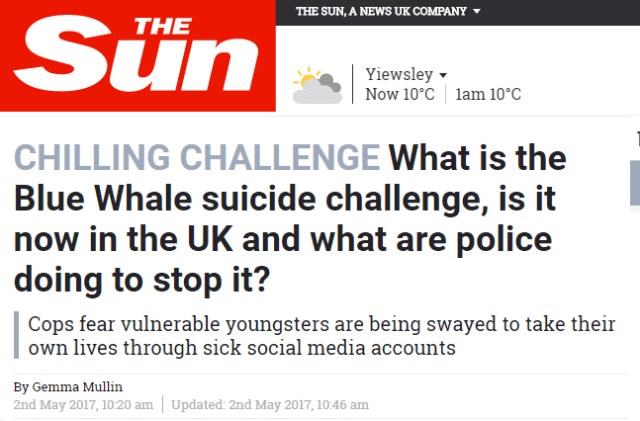
We do need to be concerned though. Try this headline from many of this week’s papers:

Blue whale

Most schools received this message from safeguarding agencies keen to alert their communities to an apparent surge of suicides caused by an App or on-line challenge.  We picked up the warnings, but something didn’t quite feel right; we emailed our local  police liaison who also agreed, and after some further research, it emerged that the story is an Urban Myth that originally surfaced in 2015 and has come back to challenge us. What is always true is that:

There are so many other ghastly media transmissions out there of concern. For example, Netflix currently have a TV drama 13 Reasons Why series currently available, heavily criticised for glamorising teenage suicide.  Even the innocent social medias and ‘chat rooms’ rapidly attract addictive traits amongst adolescent users.  In short, the best advice schools can give, repeatedly until the Internet closes is:

‘Parents should take a close interest in their children’s use of technology, social media and ‘screen time’, and encourage all such activity takes place in family supervised space.’

The trouble is that we can ‘trivialise’ concerns such as the Blue Whale challenge around young people, because risk-taking behaviours are hard-wired into adolescents and young adults, and the prevalence of suicide in this cohort is a serious concern.  It is after all the most likely reason for men aged 20 to 35 to die.  Fortunately, though every death in the school age cohort is a tragedy, it’s at much lower levels, and at the same time, the peer group are very aware of the risks and ‘alerts’ to us adults in school are much quicker to surface.

Fake News education

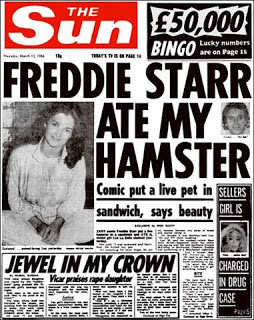
It’s interesting to note just how many ‘new’ responsibilities are coming to schools these days, as the above direction from the OECD indicates. Personally, I don’t think studying ‘Fake News’ in school is the best place, in part because really good ‘Fake News’ is so difficult to spot!  The RED top newspapers have been carrying such stories every since their introduction.  Back in 1986, I had the unenvious privilege of supporting a child at school whose father was accused (falsely as the Leveson enquiry in 2012 discovered) of eating a pet-

freddiehamster

What on earth can you say when such papers choose to publish stories that are just so sensational?  The damage to the family, the awful impact at school on friendships and inevitable isolation that followed were really distressing. Max Clifford told the Leveson Inquiry into media ethics that The Sun ran the now infamous headline ‘Freddie Star Ate my Hamster’ on its front page on March 13, 1986 with his permission, despite the story being untrue.

What was so sad is that Mr Clifford allowed the story to go ahead in order to drum up publicity for the comedian ahead of a tour.

My biggest caution to schools, pupils and parents is that all this ‘stuff’ is really not ‘normal’.  The more we give the oxygen of publicity to false stories and fake headlines, the more likely the easily-impressed will be.  Obviously we need to talk around the value of finding out the truth and acting for the best, but a rich, deep and broad curriculum has this content anyway.  I have just finished teaching the Black Death to Year 7, and the havoc that major plague brought to Europe makes for gruesome learning.  The UK did not recover its population numbers for over 400 years!  History classes are always full of discussion and analysis of what’s truth and what’s not, with the study of ‘propoganda’ high on the 20th century hit list.

the-black-death

Pieter Bruegel the Elder – 1562 – 200+ years after the Black Death plague

And it’s not just History studying ‘truth’. Whether it be in English from the study of any Shakespeare or Dickens’ works, Art, Sciences, Humanities and such like, all human life is there, in full glory, technicolour and gore. The best defence for all of our children in schools is to provide them with an education that challenges and inspires, and permits them to explore anger, sorrow, lies and deceit and all those other human emotions and frailties, recovery from which bStarry starry nightuilds the resilience they need to survive in the much harsher world of adulthood that lies ahead.

If there’s one anecdote I can recall from my own school experience that assisted me in understanding what was ‘real’ about suicide, it was learning  the story of Vincent Van Gogh’s life and death, who to this day inspires many of our artists in school.  As I was leaving sixth form back in 1971, in exploring the lyrics of Don Mclean’s Vincent with my friends, I came to terms that mental illness existed and was tragic, but something I did not need to own myself.  Listening to the song, whilst studying his paintings, I recall a coming of age. And that’s not ‘Fake news’.

Posted in Possibly related posts | Leave a comment

Somewhere a place for us…

The opening video to this post shows 2 of our Sixth Formers, Jack Jesseman (Y13) and Niamh Bates (Y12) singing at the Senior Commemoration service at the end of last term 4 weeks ago. Readers might be familiar with the original 1957 West Side story version, or perhaps the Pet Shop Boys remix from 20 years ago.  If not, then at least they’ll know the Romeo and Juliet original by William Shakespeare, in which we learn of the tragic love and deaths of 2 lovers separated by the enmity between their families, the Montagues and Capulets in Verona. West Side story transposes the tale to the Upper West Side neighborhood in New York City in the mid-1950s, with two teenage street gangs of different ethnic backgrounds, the Sharks, from Puerto Rico, and the Jets, a white gang.

(Spoiler alert) Unlike in the original, where both our young lovers die, in West side story, Maria cannot bring herself to commit further violence, and her choice to grieve and claim peace on of the most moving final scenes in theatre ever. As she cradles her dying love, Tony in her arms, she reprises Somewhere:

Somewhere

As I write, another well known family are sharing their grief for their loss of their own 3500mother, tragically killed 20 years ago in a car crash.  Of course I refer to Harry and William Windsor, the sons of Princess Diana and becoming I suspect in their own way almost as well known and loved as their mother.  What Prince Harry has done this last week, and supported so ably by the Duke and Duchess of Cambridge is to call-out about their own grieving for their mother, and talk openly about the stress and uncomfortable lack of well being still around their loss.  Simon Wessely writes really well about this in Wednesday’s Guardian newspaper “Princes William and Harry break mental health taboos for a new generation” and it’s a good read.
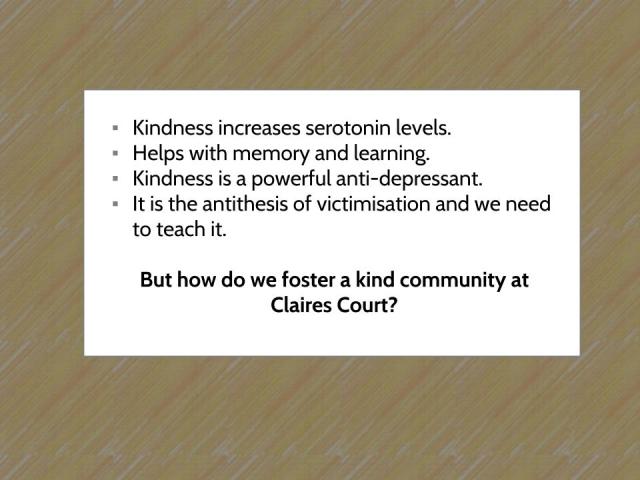
Parents and Friends of the Claires Court community regularly ask about our own break from service, “How have the holidays gone” etc.  Whilst I always reply “fabulous”, because it is such a privilege to be able to take such regular rest breaks,  in truth I always want to add the little ‘rider’ (second spoiler alert) that we teachers don’t just take a break. This Easter, the entire faculty (200+) spent Friday morning after the end of term looking at the ways we could further promote kindness and compassion in our school. Rachael Williams and Louise Hankinson, experts in the field of counselling services and psychotherapy engaged us in their thinking on the vexed issue of mental well-being.  Whilst it is clear that we are seeing an exponential growth in support requirements, both in school and in the wider society at larger, in many ways such exposure is evidence of a healthier society than perhaps one driven by the ‘stiff upper lip rule’.  The slide below shows you the challenge set to us here:

Session 3- Compassion in school.pptx (1)

Many of the discussions we have had in school are about updating what we do. The first pro-social behaviour initiative we ran across 10 years here covered the 1990s, at a time when it was agreed across the UK that the use of violence to discipline children had no place in schools.  Corporal punishment ceased at Claires Court back before 1986, and was outlawed in 1998 in all UK schools, but the belief persisted that physical punishment was part of the educative and disciplinary process, and was often viewed as ‘character building’.  To this day, there remains at the parenting level that a smack for very young children helps modify children’s behaviour, and for the under 2s there is modest evidence that it works. However, since there is also plenty of evidence that there are many other ways of inculcating acceptable behaviour patterns in the young that don’t involve the use of physical violence, no-one actually seriously advocates its use at all any more.

The therapeutic approach we have adopted to assist in our community when individuals feel challenged is known as Acceptance and Therapy Commitment, ACT, and we use this in combination with our Values programme and Learning approach, the Claires Court Essentials. As Academic Principal, I ensure our staff continuing professional development programme has 12 days reserved a year, and we need to use every hour of that time to keep up to speed with curriculum development in the face of national challenges and required changes to examinations. But suffice it to say this; we are spending increasing amounts of time, the most costly of all resources to the issue of providing ‘a place for all of us’ , together with ‘time to learn, time to care’.

So as a bright new day opens on our Summer Term 2017, expect there to be a lot of talk about kindness around amongst my colleagues and in my blogs. There is no longer public debate needed about whether it is a good thing to speak out and be honest about one’s feelings.  What Harry and William have demonstrated however is that, whatever the hurts they faced, (and boy have they faced more in their short lives than ever the rest of us have), they have got on and recognised they have part to play in making the world a better place for themselves and for us all.  They have not looked for special treatment, and though they can’t help being privileged by their birth, they have demonstrated a selflessness which we can all admire.  Above all, they have avoided blaming others for their situation, mindful of the need to distance themselves from unhelpful thoughts, reactions and sensations.

These by the way are the key purposes of our Commemoration Service, held every year, held to ensure we become and remain mindful of the need to serve our Commonwealth, be that local, national or across the Commonwealth, whilst recognising the passing of those in our community who have done just that, but lost their lives and passed away over the past 12 months.


Posted in Possibly related posts | Leave a comment

“If we are victorious in one more battle … we shall be utterly ruined.”

The headline is from the Greek historian Plutarch’s account of the battle of Asculum in Apulia (the heel of the boot in Italy) that gave us the phrase “pyrrhic victory”, the kind of victory won at such cost to life, limb and friendship, that you almost wish you’d lost.

I can’t help that the current government of the day is looking at a very good deal of its national policies and wondering a little as Laurel might ask of Hardy “Well , here’s another nice mess you’ve gotten me into!”  I could be referring to military matters, such as the new Aircraft carriers that don’t have sailors, or destroyers whose engines don’t work, or the Army more generally that simply can’t recruit to NHS matters, the Prison or Police Service or indeed to Social Care almost anywhere – we do seem have almost insoluble problems.

As you might guess, I am choosing to write about the government’s decisions over the last 2 decades to provide for schools the financial independence so they can get on and manage their affairs. When I entered the profession in the mid 1970s, local authorities were just beginning to give schools the opportunity to enjoy the benefits of local financial management of their budget and these became enshrined across the country from 1988. You can read more of the historical perspectives around these choices here in a National College of Teaching and Leadership module, and it makes an easy read.

NCTLimage

Put simply, over the last 30 years the industry has become fragmented in a myriad of small business units (over 30,000), and some have learned how to manage their affairs really well. Plenty have struggled to make the most of being a business as well as an education provider, and those schools in the main tend to be in more challenging areas where greater resources are needed and where the supply of willing graduate labour to work is hard to find.

It’s no secret that London has done really well, recovering from an incredibly low point it hit in the late 1990s.  Back in 2003, the then Secretary of State, Estelle Morris launched the London Challenge, led by its first Schools Commissioner, Sir Tim Brighouse, himself fresh from his successes in England’s second city, Birmingham.   I quote from an excellent article from the 2013 Guardian Newspaper:

” The London Challenge had a simple moral imperative: to have every young person in London receive a good, or better, education. Along with additional funding, a minister with specific responsibility for London schools was appointed. These two factors, supported by a single policy objective and a first-class team of officials in the Department for Education, gave the project a head start. The credibility of, and respect for, Tim Brighouse were crucial in getting local authorities, schools and teachers to believe in the project’s goal, and to secure their support. Their involvement in shaping the project ensured it was seen not as yet another top-down initiative but as one that included the ideas of key players.
The key components of the London Challenge were a close focus on raising the quality of school leadership and on the quality of teaching and learning. This focus was achieved through a leadership training programme for existing and aspirant leaders, and professional development and support for teachers seeking to improve their teaching. Another important part of the London Challenge was the detailed use of data, not only about the school overall but about the performance of individual subject departments and of students from ethnic groups.  The data was used to create “families” of schools with common characteristics. This enabled the London Challenge advisers to make clear to schools that their performance could not be defended on the grounds of being different in some way from every other school: there was no hiding place.”

On a personal perspective, I learned a lot from Tim Brighouse’s work, probably most specifically about bis ‘Butterfly effect‘ whereby High Impact/Low Effort interventions

CCC Jigsaw

could be made in schools.  Here’s Sir Tim on his small creatures: “My favourite sport – collecting ‘butterflies’ of good school practice – derives from chaos theory which is best illustrated by an example:  that if sufficient butterflies whirr their wings in the Amazonian rain forests, then it can set off a chain of climate change that eventually can cause a tornado in the United States.”

We bought multiple copies of his small book (2006) on School Improvement, Essential Pieces: The jigsaw of a successful school  and and shared them around our leadership group. 11 years later, we have much to thank Sir Tim for at Claires Court, as you’ll recognise from this small ‘piece’ from his puzzle, in which he identified the need to be communicative, collaborative and creative!

From the evidence from the London Challenge, the concept developed of Multi-Academy Trusts, which could build families of schools sharing the same kinds of pupils and characteristics, supporting each other , with direct challenge spin-offs to Manchester and the Black Country.  In truth, one of the major reasons why the London Challenge was so successful is the extra heavy funding London schools received in order to meet the genuine ‘challenges’ Sir Tim and his team discovered. Long past the Challenge’s closure in 2011, London has continued to enjoy that much heavier spending, and it is now the single most successful city in the land.

And now comes the crunch: schools across the country, be they in local authority hands or academy ownership have adopted many of these really successful ideas pioneered in London’s schools, though have not received much of the additional funding needed to ensure the programmes are full embedded and developed.  In parts of the country, such as those very near me in Wokingham and West Berkshire, funding has barely moved, so headteachers have had to be particularly creative to meet the growth in activity needed to truly make their schools successful.

From 2010 austerity struck, though it was said that education was to be protected. In some ways it was, but the growing numbers of pupils entering primary schools are now moving into secondary, so schools have been required to do more with the same money. In 2016, schools saw an increase in their employer contributions to both NI and pensions, and in 2017, tax rises in rates and apprenticeship charges add to the costs. So the net revenue available to schools is shrinking, at a time when an ageing work force is retiring more rapidly, recent entrants are staying for a shorter time (less than  5 years, and new recruitment has been well under target for years.

And finally, schools are now facing a readjustment of the monies they receive for each pupil. It is said that more than 50% of schools are going to gain a little or stay static, but in that large minority of schools, revenue is going to shrink, and for London schools, really by quite a lot. We now have the perfect scenario, as seen in BCE279: the schools are set facing the government, much as King Pyrrhus of Epirus did against Consul Publius Decius Mus and his  Roman army back in 279 BC at the battle of Asculum in Apulia.  Whoever wins this titanic struggle of provision against costs, there will be no victory worth celebrating. For schools to cut back their staffing so they have a working budget for the next 3 years, they will have to cut all the programmes and increased staffing levels needed to ensure the provision identified by the London Challenge remains secure. This is why 1 local headteacher, Mary Sandell of The Forest School resigned so publicly last month, and why others are going quietly into retirement or relocation for similar reasons.  The growth in new schools and expansion in existing schools is also badly affected by the sheer lack of teachers available in the locality. As with Pyrrhus, the state sector finds its friends are being cut down to the left and the right, is shorn of new troops to provide replacement and of resources to re-equip.  And from central command it hears some very odd and conflicting messages; one that what the country needs are new grammar schools, the other that schools can employ unqualified teachers to fill the roles needed in schools.

PyrrhicPeople unqualified for the role are no more fit to teach than they are to work in hospitals or prisons, to detect crime or manage dementia, to bear arms in the military or to sail aircraft carriers. Government can call the shots as much as it likes, but they need to be carefully crafted and well thought out.  If not, it may indeed win the perceived battle its sees to conquer our financial crisis, but it will emerge when it declares its victory over austerity without the well-educated workforce we need to populate our industries, public or private on which we place our trust to provide for our defence, our health, our care and safety, or the future education of our children.

Posted in Possibly related posts | Leave a comment

Excellent achievement and Cognitive dissonance…

Early March saw our IGCSE results in English and Maths released from the January series of examinations, for many Year 11 pupils this being their introduction into the suite of exam finals they are to take in May and June. Results were as you would expect a mixed bag, because that’s indicative of our broad ability intake, but with A* and As abounding it’s a reminder to all that for many terminal exams without coursework are a ‘good thing’.

The IGCSE examinations themselves have been around for 30 years, introduced at the same time as the England & Wales based GCSEs, and replaced the old O levels and CSE examinations. The new home-based GCSEs had large elements of coursework, indeed English was permitted to move to 100% coursework in the early years.  Verification and validation of coursework marking were managed by examiner visits and representative sampling of exam scripts, which were sent direct to the exam boards.  IGCSEs were developed to be sat all over the world, but it was clearly impractical to send examiners from England to local centres abroad, and so the IGCSE started and have remained as courses supported by terminal examinations only. Inevitably, the exponents of the new style of course with more coursework and less examination considered the new GCSEs better, as the graduating students were made more aware of what they knew, understood and could do through the 2-year educational process.  Graduates of the terminal exam process never had the opportunity to ‘improve’ their work over the 2 period of study, so had to be good enough in one hit, so to speak.

The immediate effect of the new GCSE courses was that children’s school achievement dramatically improved, with so many top level grades being achieved by the students, released from the stifling effect of the old terminal examination test of knowledge (the old O level). With impressive efficiency, teachers learned what the systems were to maximise best effect coursework, and results continued to improve through the 1990s and ‘noughties’. Sadly, whilst results improved, the actual literacy, numeracy and skill-base in 16 year old pupils did not improve, as seen by Sixth Forms, Universities and Employers alike, so the suspicion of ‘gaming’ even ‘cheating’ the system grew in the onlookers’ minds. 10 years or more ago, to counteract this ‘problem’, coursework was swapped out for ‘controlled assessments’, min-public exams during the 2 year GCSE programme, which would solve the perceived woes of coursework. Job done, verification and validation swapped out for external marking, and public confidence in the GCSE exam process restored.

Except not quite, for the public exam bodies started noting that individual exam centres had continued to make further, sometimes rather too dramatic improvements for their students. Anecdotal evidence emerged about children being placed in classrooms and asked to copy down answers from the board, and whistle blowers in schools started to write about the blatant cheating taking place.  Here’s an article from the Secret teacher published in the Guardian in June 2015 “Controlled assessments are not properly scrutinised by line managers and exam boards, a problem that gets worse every year. More and more teachers allow students to use extensive written notes when only limited prompts are allowed. In April I found students in the library “redrafting” controlled assessments for the sixth or seventh time when they should not be attempted more than once.” 

The elements of the above have led to huge volumes of conflict within the profession, creating a real sense of Cognitive Dissonance for all. In many schools it seems, with the endless raft of assessment going on, the most effective way to ensure the best outcomes for the children was to enable them to cheat – “Out the window with Integrity” said one type of teacher – “I get my *performance bonus*, the children get their grades, what’s to worry?”


The Government felt it had to act, and called for the cancelling of all controlled assessments, and the new terminal examination GCSEs are rolling out in schools, with English, English Literature and Maths arriving this Summer in new terminal form, together with new number values (1-9) to replace the former letter grades (G-A*). By the Summer of 2019, all the old GCSEs will have been consigned to the scrap bin, and the opportunities for teachers to ‘cheat ‘ removed.  Hoorah say one and all.

Many Independent schools, Claires Court included, found that they needed to move away from GCSEs with controlled assessments for other reasons, not least because the 110+ tests an average independent school child taking 10 GCSE were rapidly becoming almost all the child had time to do in the 2 year period.  To be honest, as the course actually only covered some 60 weeks over the duration of the course, this made teaching all about the test and little else; failed ‘controlled assessments could be retaken, which only compounded the felony.  A child receiving a ‘b’  as opposed to a ‘a*’ (lower case grades being the way these mini tests were reported) immediately encouraged taking the assessment an extra time, which meant even more sessions were lost to the test.

Fortunately, the GCSE world of controlled assessments has been short lived, and the new GCSEs feel very much like the IGCSEs that have continued to be sat throughout the intervening period. Teachers and pupils are having to learn/relearn how to teach and study for terminal examinations, with far fewer indicators available to determine progress along the way.  It’s changing teacher  and pupil work load too, because work covered previously has to be resurfaced and considered anew, in the light of the broader thematic considerations that can now be introduced into the testing process.  Teachers probably have to be thinking all around the landscape, encouraging their students to do so too, because of course, we have absolutely no idea what questions will be set, or what the marking scheme will look like!!!


But the joy of all this uncertainty is that we will teach more effectively, the courses will be more creative and engaging; the children will genuinely feel (and we know this now because they are in Year 10) that school is more than just a series of interminable tests – actually we had broken away in about half-the subjects anyway, so even Year 11 feel they have had some time to be ‘free spirits’ with their learning.  Whilst the changes do not guarantee ‘Excellent achievement for all’, they make the outcomes even more likely.

And finally, as an Independent school, because we are not constrained by DfE rules about who does what, we have IGCSEs and GCSEs in whatever mix we wish. Whatever type of GCSEs you take, we still have the issues of a mix of letters and numbers for a couple of years, so it doesn’t honestly matter whether you get a Letter grade or a Number value. Universities and Employers of course are going to see the mix of alphabet soup for years to come, and the confusion will last as long as it did when the old O levels and CSEs moved from numbers to letters back 40 years ago.

*Readers of A Principled View might be surprised to learn that the Principals of Claires Court do not offer performance based pay.  We prefer to ensure our staff are well rewarded for their work and to ensure that if pay is to rise, it does for all. 


Posted in Possibly related posts | Leave a comment

Parking Technology instead of giving up Chocolate for Lent

It’s that time of year in which the Christian season of Lent is due to commence, (Wednesday 1 March), and families consider what ‘treat’ they are going to give up as a sign of their engagement with a 40 day period of abstinence.  It might be chocolate, or other such sweet treats, and for those that have not yet endured a ‘dry’ January, perhaps a few weeks without alcohol provides substitute.

Here in school we have largely ‘given up’ giving things up, and have for many years chosen to do something extra to make other people’s lives a little better. This has morphed into our 3 for 3 week, where the 3 schools seek to identify through their school councils up to 3 local charities they wish to support that enrich the lives of other children. And this work is certainly inspiring for many in our community, causing a vast array of activities spanning from the selling of cakes through to the massed spectacle of the B7 Fancy Dress walk.

So here’s my ‘little bit extra’ challenge for families and friends – I challenge you to ‘Park your Technology’ from bedtime to morning whilst at home. The idea is born of the many and varied tales we have now that adults and children in families are rather too wedded to their technology, their phone/handheld, being unable to be apart for more than a few seconds when at leisure. Now be that as it may, the reality would appear to be more sinister than just possession; indeed it is the very interaction with the device that is causing the development of addiction and symptoms of withdrawal in regular habitual users of such mobile technology.

aidememoire


The deal is this – for no money at all, dear reader, you can claim your sticky ‘tag’ from me. This tag is of the indestructible, showerproof kind, usually used for wristbands. In this band’s case, it is designed to be stuck around the handle of a small basket as in the picture at the top, and used by families for family designed rules. You might choose to have it by the front door, so that all technology is deposited on entry (harsh), or perhaps at the bottom of the staircase so no technology is permitted upstairs (night-time perhaps) or by the side of the room where the family eats, so no technology is taken to the ‘table’ when eating and family time is taking place.

Here’s where you can request a ‘Reminder wristband’. http://schl.cc/2J

It’s for individual families to decide what to do – and to vary it as you think fit during the week and at weekend – the basic deal though is to ‘Park the Technology’ for some part of every day and see if that makes a positive difference to household conversation and family life.  I have 200 such wristbands, and I’ll send them to anyone, anywhere in the UK. Start date is 1 March 2017, and end date is when you choose, though hopefully not before Maundy Thursday 13 April.

The writer (that’s me by the way) is going for the ‘bedtime’ basket, and I started a week early just to check I can cope, and… so far, so good. Thanks for reading this far, and I look forward to engaging 200 people in my challenge!

Posted in Possibly related posts | Leave a comment

A broken system. Progress 8, GCSEs and SATs.

debrakidd's avatarLove Learning by Debra Kidd

A couple of weeks ago I spent 3 hours with the infinitely patient Lucy Rimmington from Ofqual, trying to get under the skin of Progress 8, the new GCSEs and what it all means for teachers, children and parents. Thanks to her and to several teachers who helped me with questions and queries along that way, I’ve written this blog to try to explain to parents and teachers some of the central issues in our exam system. I should be clear that Lucy was simply explaining processes and language to me and that any opinions or conclusions drawn are mine alone.

My first question centred around what I referred to as “norm referencing” and what is more correctly termed “comparative outcomes.” Is it true, I asked, that the proportion of pupils passing GCSEs is set in advance, regardless of criteria or achievement? The answer is yes, well sort of. Exam…

View original post 1,847 more words

Posted in Possibly related posts | 1 Comment

Living like a Lord – ISA Whitbread Memorial Prize 2016 – Todd Lindley

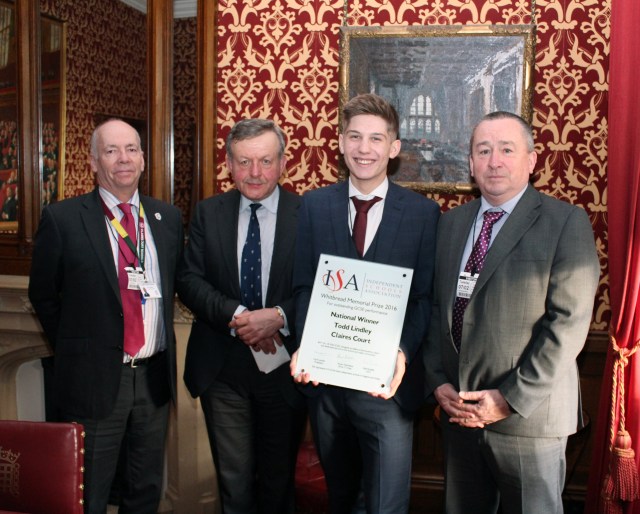
As a result of his GCSE performance (8A*, 2 A, 1 B) in his GCSE examinations, his contribution to school life, his performance on the sports and athletic fields and his contribution to the wider community as a sports coach, Todd Lindley was awarded the Whitbread Memorial prize 2016.  It is always lovely to win an Award, and as you can see from our announcement last term, both Todd and the school were pretty pleased.

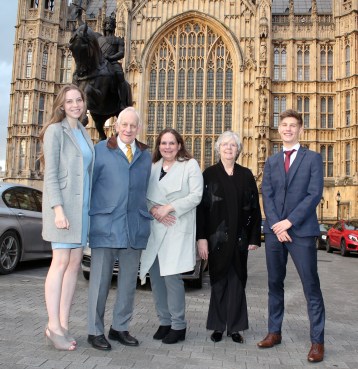
Actually receiving the Award takes a huge bound forward in terms of prestige, as Todd, his mother Julia, sister Gabriella and grandparents Alan  and Monica Sibley found out on Tuesday. The family party, accompanied by Headmaster John Rayer and myself were invited to the House of Lords by the President of ISA, the Lord Lexden to receive the award. todd-hs-of-lords-4As it happens, I have known Alastair Cooke for many years, from his previous professional life as the general Secretary of the Independent Schools Council. As soon as he read our submission in nomination of Todd for the award, he recognised the fact that Todd’s sister had received the same award 3 years previously (item 10 on this ISA bulletin), and with extraordinary generosity invited Gabby to the House to enjoy the occasion.

It gets better, because we were invited to witness Question time in the House for 60 minutes or so, when the Speaker of the House of Lords, Lord Fowler made his noble statement on the failure of John Bercow, the Speaker of the House of Commons to consult with him on the question of Donald Trump being invited to speak to the House. We witnessed real politicking in the making, something which was a main news headline later that day. It gets better still, when shortly after Lord Speaker’s intervention, we witnessed former Claires Court schoolboy, Lord James O’Shaughnessy, now a junior minister in the Department for Health, defend the government’s strategy to ensure we have sufficient nurses in our hospitals for the future. Boy, by even the Lords’ gentle ways, James was given a grilling by home and opposition members. Filled with admiration for the work of the house, we descended from Strangers gallery into the main circulation square of the lords, only to be greeted by Lord O’Shaughnessy, like long lost friends!  Whatever else happened then could only metaphorically put the ‘icing on the cake’, which  actually happened, because Lord Lexden then invited us to tea with him in the Lords Dining Room!  And of course there was the little matter of the presentation itself, which took place in one of the excellent meeting rooms, somewhere in the gods above the chamber.

todd-hs-of-lords-9

Other highlights included mixing with many of the most famous Lords of the Land for an afternoon, such as the Lords Neil Kinnock and Michael Howard, sharing the Gents with Lord David Putnam and taking tea with one of the kindest, nicest men you could ever meet, The Lord Lexden OBE. Sadly there are few photographic highlights of our afternoon spent as Lords of the Land, because such technology is left at the door. However, Messrs Lindley, Rayer and Wilding were snapped all at once in our gracious host’s company, a photographic memory that I will treasure for a long time to come.  #CCpride

todd-hs-of-lords-23

Posted in Possibly related posts | 1 Comment

ImagineNation – a call to arms

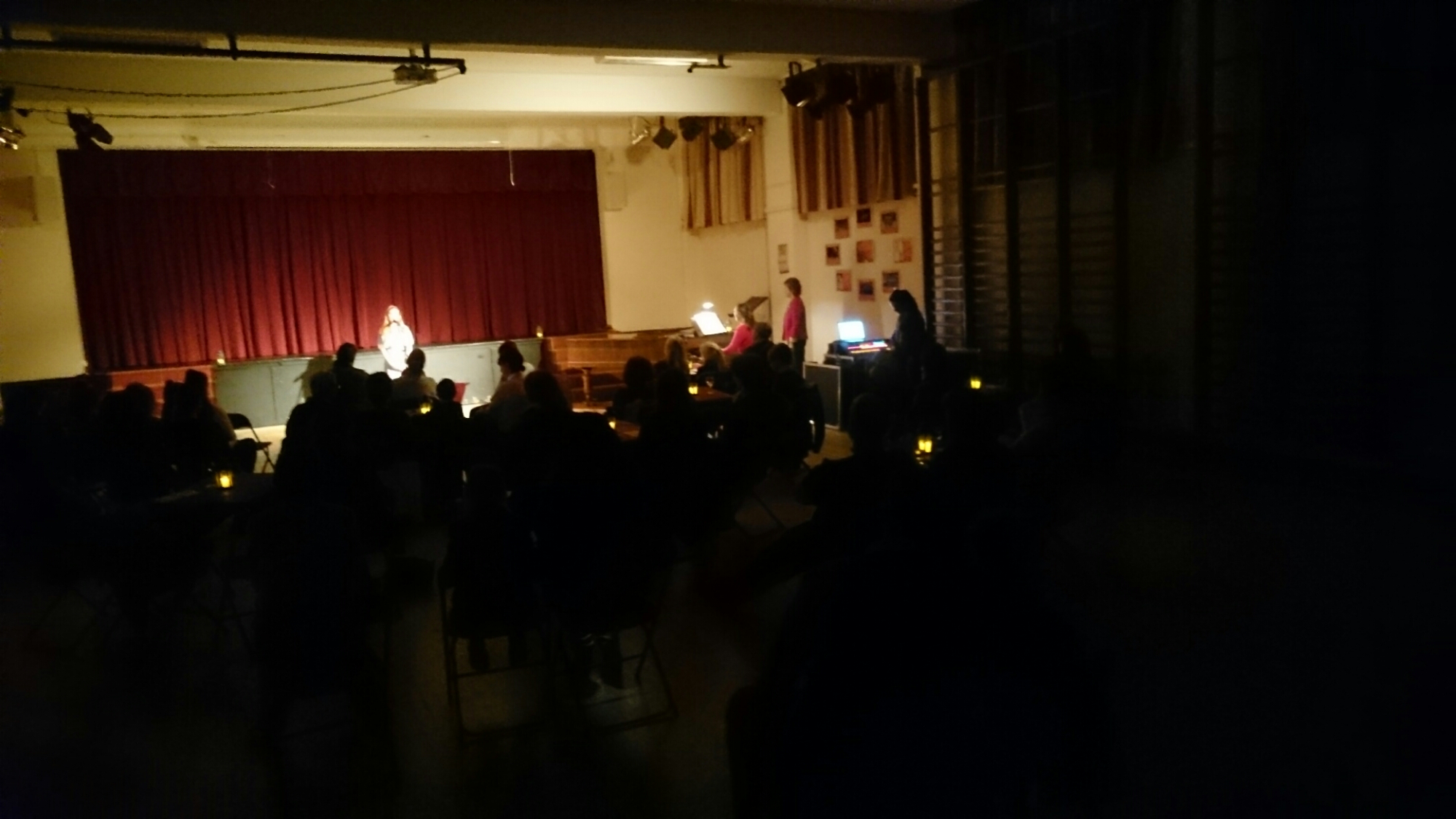
This Wednesday at Senior Girls, a select audience of parents and friends enjoyed an extraordinary showcase of the girls’ singing abilities of both formal and contemporary music. Each performance lasted about 4 minutes, so we are talking full on ‘single’ duration. I’d have bought them all. Director of Music Hester Goodsell and singing teacher, Freyja Barter, supported so well by Vron Foster and accompanist Jean Glenorchy set up an amazing album of delights, all laid out in cabaret style, as my very bad photo shows here.

I spoke at the end of the concert about the absolute importance we place in Claires Court on performance Art, and its sheer longevity as an ambition. Shortly after Freyja left the Sixth Form, her singing group’s short album was selected for free mass distribution by the Daily Mail, the first girl’s ‘hit’ we have had in my memory. Since then the Sixth Form have established a major footprint in original theatre work, concluding this last summer with their own ‘musical’ play around Noel Coward’s Black Dog.  A few year’s ago, we were able to persuade Michael Morpurgo to stage his novel ‘The Kites are flying’ as a stage play at the Edinburgh fringe, and the memory of that work still brings tears to my eyes, set as a love story on the wall that divides Jerusalem.

imaginenationWriting back in 2010, Michael Morpurgo has this to say about the critical need for a robust Arts education in schools:  “I would like to propose that we let the imagination take its place at the heart of learning, and that we create a climate in which it can flourish. We need discovery; making; doing; exploring; creating; critical thinking; seeing; hearing; experiencing. Children have to be introduced to the arts in every form.”  It’s almost the strapline for the Claires Court Learning Essentials, the approach we have developed since then for everything we do at school. Now on Tuesday this week,  we see the publication of the updated report on the Value of a Cultural education in schools by the Cultural Learning Alliance.  The Report is such an easy read, and its key research findings could not be clearer:

1. Participation in structured arts activities can increase cognitive abilities by 17%.

2. Learning through arts and culture can improve attainment in Maths and English.

3. Learning through arts and culture develops skills and behaviour that lead children to do better in school.

4. Students from low-income families who take part in arts activities at school are three times more likely to get a degree.

5. Employability of students who study arts subjects is higher and they are more likely to stay in employment.

6. Students from low-income families who engage in the arts at school are twice as likely to volunteer.

7. Students from low-income families who engage in the arts at school are 20% more likely to vote as young adults.

8. Young offenders who take part in arts activities are 18% less likely to re-offend.

9. Children who take part in arts activities in the home during their early years are ahead in reading and Maths at age nine.

10. People who take part in the arts are 38% more likely to report good health.

Read the Key Research Findings in full at: www.culturallearningalliance.org.uk/evidence

I’ll conclude with a quote from the recently deposed First Lady of the White House, Michelle Obama:

“Arts education is not a luxury, it’s a necessity. It’s really the air many of these kids breathe. It’s how we get kids excited about getting up and going to school in the morning. It’s how we get them to take ownership of their future.”  

And I say Amen to that!


Posted in Possibly related posts | Leave a comment

And the Good News is…!

It’s Inauguration day, Brexit plan week and NHS month…

good-news-ii1and whilst there may of course be plenty to shout about, not much of the mood music is positive. It’s dry January, nights are long, mornings still dark, weather still wintry and some big banks have announced they are relocating thousands of jobs from London to Europe. With the best will in the world, it is easy to understand why the news media can’t find too much good news to shout about.

Thursday 19 January was DfE’s publication of the GCSE and A level performance tables. compareDear Reader, please believe me when I say that schools in the independent sector have almost no idea about the outcomes of such publications in any given year, other than that we are able to look up our data with 24 hours to go to see ‘what’s what’.  Now the statistics are published, not only can any one go and look up the data, but they can make use of the government’s comparison tool to compare the performance of any schools they might wish.  FYI, you can find that tool here: https://www.compare-school-performance.service.gov.uk/

24 hours later, and I have been able to study the outcomes of thee ‘new’ form book the government have created. For the Claires Court Sixth Form outcomes in terms of progress measures, we show up really well – here’s the snap-shot:

compareccs

This performance comfortably places our performance better than any other school with the Royal Borough, significantly better than any of our immediate competitors in both the state grammar, comprehensive of independent sectors.  This places us as school number 100 out of a total of 4,380 schools, otherwise inside the top 3%  (2.28%) of all Sixth Form schools and colleges. In many ways, our challenge is not just to achieve the best with the highest of fliers, but with those of more modest abilities who strive to pursue their Sixth Form studies through to more modest outcomes. The stats to be published in March on students completing their main course of study should be just as exceptional; we are always keen to keep every soul on board, come what may.

GCSE performance tables you’ll see are as opaque as the Sixth Form are clear, because our sector now is almost completely excluded – all the IGCSE using schools (our sector) are misrecorded, and since government has captured no information on the entry cohort we have entering Year 7, they show no progress measures either. In due course, I’ll write more about this, but in the meantime, let’s just enjoy the good news about our Sixth Form.  But you knew that already of course, because you read our Court Report.

https://www.flipsnack.com/ClairesCourt/court-report-2016.html 


Posted in Possibly related posts | Leave a comment