@jshe: “I am always doing that which I cannot do in order than I may learn how to do it.” Picasso

Posted in Uncategorized | Leave a comment

“The role of the teacher is to create the conditions for invention rather than provide ready-made knowledge.” —Seymour Papert

Introduction to Seymour Papert(from his own website – http://www.papert.org/): People laughed at Seymour Papert in the sixties when he talked about children using computers as instruments for learning and for enhancing creativity. The idea of an inexpensive personal computer was then science fiction. But Papert was conducting serious research in his capacity as a professor at MIT. This research led to many firsts. It was in his laboratory that children first had the chance to use the computer to write and to make graphics. The Logo programming language was created there, as were the first children’s toys with built-in computation. The Logo Foundation was created to inform people about Logo and to support them in their use of Logo-based software for learning and teaching. In short, Seymour knows his stuff about learning.

Getting to the point

I have just returned from our Year 11 History Trip, supporting their GCSE studies. Our destination was Berlin, and the two areas of study were the rise of the Nazi party and the Cold War. It would of course have been very easy to have the study materials in printed or electronic form, as History has for all of its teaching courses.  The wonderful thing about the city of Berlin is that it sits at the geographical centre of both topics and it (and Germany more generally) sits close by our interests as competing western democratic industrial nations.

During our visit to the Reichstag, we stood outside Chancellor Merkel’s office and knocked on the door. Sadly, it seems we had just missed her, but the experience promoted by our guide was very much in which we sensed the proximity of the German leader to those whom she governs and to whom she is accountable. Sir Norman Foster’s inspirational architectural  construct of the new parliamentary space within the old Imperial building is breathtaking in its contemporary design. Almost nothing is left of the old building, except some specific signs of previous conflict from its past, such as bullet holes in the masonry and graffiti written in cyrillic script by conquering soldiers from Russia and their allies.

During our stay, students covered the museums of Check Point Charlie and the Topography of Terror (adjacent to the SS HQ), the Berlin Wall, and its graffitied memorial, the East Side gallery, the Berlin underground bunkers, the Olympic Stadium and the Holocaust memorial.

The educational highlight is always the Sachsenhausen Concentration camp, in which political, military and outcast prisoners were held, and in many cases murdered by their Nazi captors. I quote from the website:

Concentration camp Sachsenhausen was built in the summer of 1936 by prisoners from the Emsland concentration camps. It was the first camp to be built after ‘Reichsführer SS’ Heinrich Himmler was put in charge of the German police in July 1936. The new concentration camp was designed and planned by SS architects to be the ideal camp. It was to express the world view of the SS in its architecture and at the same time symbolically subdue the prisoners to the absolute power of the SS. Sachsenhausen concentration camp took on a special position in the system of NS concentration camps. This was highlighted by the move of the concentration camp inspectorate’s administrative department from Berlin to Oranienburg. The inspectorate was responsible for all of the concentration camps within the German realm of power.

Between 1936 and 1945, more than 200,000 people were imprisoned in Sachsenhausen. At first the prisoners were political opponents of the national socialist regime, then came the people declared by the national socialists to be racially or biologically inferior and from 1939 onwards, increasing numbers of citizens from occupied European countries were transported to the camp.

Our stay in Berlin was in a former military barracks, now AO Hostel, Koepenicker Strasse, near Ostbahnhof station, close to the city centre. Both functional and well equipped for groups, it certainly keeps us feeling humble in thought and deed.

The challenge for our 29 students is now to populate the History department’s website to commemorate the trip, and illustrate to you, Dear Reader, in writing and pictures what perhaps they gained from this intense study residential. For certain I suspect they will never forget their experience, but knowledge and understanding will be more deeply embedded through some further work reflecting on their findings. You can visit our website here – https://sites.google.com/a/clairescourt.net/berlin-february-2014/ Armed with cameras and the tools of research at their finger tips, Y11 can provide us with some unique insights…

…as Seymour Papert would say: “The role of the teacher is to create the conditions for invention rather than provide ready-made knowledge.”

Posted in Uncategorized | Tagged , | 2 Comments

“Whatever you can do, or dream you can do, begin it.”

Appointment to Assistant Headship, Claires Court Junior Boys, Mr Eric Leuzinger BEd

image002As our school community knows, Jeff Watkins, Headmaster of our Junior Boys school is to retire at the end of this academic year, and his successor is Justin Spanswick, currently Assistant Head (Pastoral). Jeff and Justin are working really closely, together with Deputy Head Susan Payne and Judy Nott, Assistant Head (Timetable) to ensure we have a smooth transition. I am delighted to announce that Eric Leuzinger has been promoted to take over as Assistant Head (Pastoral) with effect from September. I commenced my teaching career at Claires Court with Mr Leuzinger present in my Year 7 Science class in 1975, I taught him quite a bit of what he knows, and we shared a love of practical gadgetry! After Claires Court, Mr Leuzinger completed his secondary education at RGS High Wycombe, before putting his love of the scientific and technical to work in the Air freight, Construction and pest control industries. It was clearly his last experience that took him to University (Westminster College, Oxford)  as a late entry into teaching, and he started work with us as a Year 6 teacher in 1999. He is married to Lynn (also a primary school teacher) and their son Jake is a graduate of both CCJB and CCSB! I am sure those who know Mr Leuzinger will be delighted for him, and for the school at large. He is a remarkable practitioner, interesting, interested in his pupils, firm and fair. Here is Eric, icnr eclnvited to present from the Google stand with Chris Rowan at BETT this January on collaborative working using cloud technologies.

William Hutchison Murray, author of the title quotation (and mountaineer), is to be commended for the directness of this call to arms. It seems he wrote these lines after making a downpayment on a boat passage for a planned Scottish Himalayan exhibition in 1951.  The certainty that the party would travel (or lose their money) stiffened the climbers sinews and such like. Sadly, despite his best efforts, Hutchison didn’t make the grade as a highest altitude climber, and missed out on the 1953 conquest of Everest by Hillary and Tenzing. However he directs us to be bold, and we are being just that…

New Campus Consultation

A big thank you to all those parents – over 100 of you – who visited our exhibitions two weeks ago and gave us valuable feedback.  Your insights are already informing the architectural team as they develop alternative design concepts in this phase of the development.

During the three days you told us:

*         You like the present “diamond” structure of separation of boys and girls and want to see this maintained
*         You think the co-educational arrangements for Nursery and Sixth Form work well
*         You value the existing intimate, familiar “feel” of our buildings and wish to see this preserved
*         Also the small class sizes, the caring environment  and the good pastoral care that we provide
*         Your preference is for separate entry and collection points at the beginning and end of the day for juniors and seniors, boys and girls
*         You want a better access from Cannon Lane than the present driveway and good car parking availability
*         You are excited at the prospect of more and better facilities available to all on the one site

Many of you also kindly completed a short questionnaire about the project.  I don’t think it will come as a surprise that an analysis of the early returns shows us that you think the most important aspect of the project is to provide a better environment for teaching and learning just ahead of the concept of a single campus destination.  Interestingly more of you put consideration for the wildlife slightly ahead of designing energy efficiency and sustainability into the new buildings!  Also it does appear that if you are a parent of a senior boy or girl you are slightly more relaxed about the opportunities for boys and girls to mix away from the classroom.

For every parent who visited there were about 7 families who weren’t able to come and see our exhibition.  We would like you all to be able to do so and have therefore set up a special website<http://www.clairescourt-consultation.co.uk/> – with the details from our display boards.  One of the webpages has a timeline which will help you understand how our consultation will progress.  You will also be able to share your own thoughts about these proposals by completing the short questionnaire online.

Please let us know!

And finally…

Murray’s full quotation is: “Whatever you can do, or dream you can do, begin it. Boldness has genius, power, and magic in it. Begin it now! “

Posted in Uncategorized | Tagged , | Leave a comment

Digital Newsletter Monday 10 February 2014 – The Rising Damp edition (fingers firmly crossed).

“Avast there me hearties” or some such Tosh of a greeting, from the Island Republic that is East Maidenhead. Those that know the senior boys site of Claires Court will know that it nestles gently some 800 yards away from the River Thames at Boulters Lock. Some 12 years ago, following the completion of the Jubliee River, our area was declared now rather better protected than beforehand from the dangers of flooding. In 2003, the Jubilee was first called into action, found slightly wanting yet largely did its job. Of protecting Maidenhead. People who live in Windsor, Wraysbury, Datchet and Weybridge just feel we shipped our problem their way. Such has been the deluge this winter that we now have unprecedented flooding upwater and downwater, and our fingers are crossed that despite that, we’ll stay dry. The photograph does not show our new rowing lake, but the main road north of the school to Cookham. Gulp.

Global warming is here to stay, and a brand new resource that may assist us in schools with our work has just been opened up:

BIG FACTS ON CLIMATE CHANGE, AGRICULTURE AND FOOD SECURITY

“Big Facts is a resource of the most up-to-date and robust facts relevant to the nexus of climate change, agriculture and food security. It is intended to provide a credible and reliable platform for fact checking amid the range of claims that appear in reports, advocacy materials and other sources. Full sources are supplied for all facts and figures and all content has gone through a process of peer review”.

Driving us to Drink

Full of rain is the recent Tullimore Dew whiskey advert, in which which pals honor a friend at a graveyard.  It is worth the view simply for the happy ending, which seems impossible for most of the short 2 minute film. Bells have also done well with a great South African advert, in which an old man celebrates learning to read. OK, probably politically incorrect to suggest Drink companies are assisting those of us in education with materials to literally raise the spirits, so here’s one from Guinness that raises our ‘hops’ instead, as they celebrate the 2014 Winter Olympic sisterhood of twin U.S. biathletes Tracy and Lanny Barnes. Cheers.

A new College of Teaching

I attended today the launch party of the proposed new College of Teaching, which MP Charlotte Lesley introduced us to at the Autumn Study conference. The event was held in the Merchant Taylors Hall in the City of London, as was very well attended indeed by pretty much every interest group in English education. The work has recently been driven by the Prince’s Teaching Institute, and I found the various sections of the presentation really quite heartwarming. “The College of Teaching will aim to devise evidence-based best practice in teaching, accredit teachers and offer them rigorous professional development. It is hoped that 80,000 teachers will join up, with one in five promoted to the status of “fellow”, following the tradition of other professional bodies such as the Royal College of Physicians.” Here’s the Telegraph’s take on the day – http://goo.gl/pQ7tiG

How do you teach Critical Thinking?

Here’s a clear website that highlights these issues really well, and is worthy of a wider audience methinks. Elisapiens is Spanish by origin, and published in a wide variety of languages. I like the look because it is underpinned by coherent values. “To educate an individual in critical thinking is to educate him or her to be capable of governing or controlling their own personal and professional life and to be able to find answers and solutions to problems.”

Even more from the PISA people at OECD

The Huffington post this weeks highlights a little GEM from the 2012 data, that being that attendance at pre-school improves performance in the PISA exam, by about 20 marks. The graphic below (which I can’t find from PISA direct) tells the story.

What’s happening in your school to prepare to teach Computational Thinking sometime soon?

Here’s my friend Miles Berry, the principal lecturer in Computing Education at the University of Roehampton, talking about the new computing curriculum, and suggesting ways in which teachers can prepare for the changes ahead. Published 6 Feb 2014

Useful links:

Computing in the national curriculum – a guide for primary teachers – http://www.computingatschool.org.uk/d…

DfE expert panel resource site – http://bit.ly/ittcomp

Future Learn MOOC (free online course) – https://www.futurelearn.com/courses/t…

Building a new school from the ground up – http://goo.gl/56DFvg

Many of you know that I am planning the building of a new campus with my colleagues to look after the whole of Claires Court (yes and pleasingly it is out of the flood plain!).

In researching ideas, I have come across all sorts of empowering research, and if you want to find someone even more tireless then me, then go to Larry Ferlazzo’s site for an amazing cornucopia of delights. As Larry makes clear himself, he is discovering more each day than he can keep up with, so sometimes it is nice when you find a research team that has done just that – surveyed global knowledge and come up with the answer. Here’s the Odyssey Initiative’s headlines:

1. Inquiry works at all ages – use the interests and passions of the youngest learners to drive learning

2. An Integrated curriculum is powerful – let different disciplines help children think in new ways.

3. Multiple assessment give a fuller picture – there’s no one set of assessments that work

4. Built In professional development sustains teachers – make collaborative reflection part of the normal way of working.

5. Open ended Technology use is the way forward (ration its use appropriately, but avoid it completely for the under 2s). Never use ‘Drill and Kill’ programmes.

6. Learning should be grounded in place – use your physical location to enhance learning

And finally, a cautionary tale. As The Harvard economist Sendhil Mullainathan and the Princeton psychologist Eldar Shafir argue in their book, “Scarcity, why having so little means so much”, Poverty is a matter of willpower and bad decisions.. It’s not that foolish choices make you poor; it’s that poverty’s effects on the mind lead to bad choices. Living with too little imposes huge psychic costs, reducing our mental bandwidth and distorting our decision making in ways that dig us deeper into a bad situation. And rather oddly, that’s why us work rich, time poor teachers sometimes can’t be trusted either – our cognitive skills can plummet below the basement!

Have a good week, and enjoy half-term when it arrives.

James Wilding jtw@clairescourt.net, jameswilding.wordpress.com
Posted in Uncategorized | Tagged , , | Leave a comment

7 days – it’s always 7 days – and what happens when the ‘phone doesn’t ring

One of the Open secrets within our school is that we are due an Inspection event. Not just any set of visitors, but a defining set that are hand-picked specifically to pull our weft and weave apart, check what DNA they find to ensure it is the genotype that covers the code we say we generate in our handbooks, and in passing make sure that those we educate are actually being just that – becoming leaders of their learning.

What is incredibly stressful for us all is that we think we know when such an event is to happen. 3 years ago next week we were pretty certain we were to be ‘done’ then, because it was 6 years ago next week we were last ‘stood by our beds’ and had our work checked. At about the 3 year mark, the government extended school inspections out from 3 to 6 for schools that were found to be compliant and Good and Outstanding. So at the last minute we stood down, and 2 years ago this week reset our alarm because (not knowing any better) we thought our ‘sixth sense’ was telling us ‘The Inspector Calls!’ Well – you’ve guessed it, I was not rung today, so as we have half-term in 2 weeks time, we can all stand down for a couple of weeks and get on with normal life, whatever that is.  Favourite lessons can now be taught, frantic last minute marking and feedback-ing will gently ease and the school will probably become a better learning environment as a result.

The 7 day thing is about how we get to hear – 5 working days notice, 7 calendar days, and Inspections take place on Tuesday to Friday inclusive. It’s how ISC schools are inspected, by the way, by the Independent Schools Inspectorate (ISI for short), not Ofsted by the way. ISI don’t have our data, our demographic info, our timetables or even dare I say, any of our planning until they ring. Once the call comes in, I have 24 hours to turn the data round and send it back, and then to plan with the assigned Reporting Inspector how s/he is going to manage the process with his team (who s/he is unlikely to have worked with before). Not receiving a phone call today means we are not being inspected next week; every week since November we have been inspecting the call. We are rather tired of waiting it must be said.

The changes since we were last inspected are immense; new heads in post at Junior Boys and Girls, many new teachers leading departments, new pedagogies and philosophies, new technologies such as Chromebooks and iPads weren’t invented and Apps for Edu were but a twinkle in Google’s eye, and above all, the entire National Curriculum and Public examination system has been turned over as if it were a dead donkey at the end of its travails. Yes our academic results have continued to reflect really well on both boys and girls, our successes in terms of University entrance have continued to impress, and our other departures to senior schools elsewhere and indeed into the world of work continue to provide endless opportunities for debate and paid employment respectively.

Over the last 2 years we have gathered Olympians and Paralympians to the fold, our pupils have gained honours, credit and praise for some quite astonishing achievements by any measure, and there isn’t really a flip side; what’s not to like. Looking forward, we have unwrapped a cunning plan for the potential redevelopment of Claires Court onto one campus site up by Junior Boys.  Some exciting new partners have come forward to assist in making that happen.  Some old acquaintances of the school are renewing their friendship as it seems our potential value as a community partner has increased substantially.

It takes some new eyes, seeing us for the first time, to help us in re-marking what actually has stayed the same. We are compellingly friendly as an institution. I know  that sounds odd, but just inside each of our 3 front doors is to be found something that seems really very much like a home. We have learned for 54 years that buildings do not a school make, nor examinations sat therein. What marks our school out is that it feels like home inside; all within are ‘family’, and will be treated with respect and care. We don’t exist for anything other than the children we serve. There’s no grand design to turn out captains of industry or great explorers, no mould or two into which we press our children to squeeze out the shape expected of our graduates, no arrogance of place or vaulting ambition. That’s not to say we don’t plan for children to succeed beyond their wildest dreams, because we do. But it takes time and care and something not achieved by hothouse or straightjacket.

I attended the G9 Subject Options fair this evening for our girls seeking to confirm their GCSE choices for Year 10. English, Maths and Science were there in all pomp, but no need to preen their feathers as all are required to continue in these core disciplines. MFL were vying with their S’il vous plaits, Danke schön and Gracias in equal measures, knowing perchance that Bus Comms, Drama, Music and Tech might turn those from their path to something seemingly more relevant. The sense of market place conjured up was real; we genuinely don’t mind which subject the emerging students take up at this next stage. After all, it’s not just their current lives rather than ours we are talking about, but their futures in an uncertain world. Being treated as young adults, engaging with the variety of opportunities that excite and committing to a sustained course of diligent endeavour is way to guarantee confident, optimistic and engaging young adults will emerge in 2 years time.

We are doing the same with those making A level choices currently, as we are with those looking for secondary school options. It’s true to say that we are both open for business and working all hours. This very obvious marketplace for education which is being developed as an entity not just in England but across the globe is providing in principle a wide range of diverse opportunities for parents and pupils. Yet in practice it is not. Michael Gove was suggesting yesterday that the days need to be longer,  discipline and exams harder, holidays shorter, such that state schools become indistinguishable from private schools. What a complete pastiche the man is making of actually what schools like us stand for. In response, Siobhan Freegard, founder of the Netmums website, had this to say (BBC website):

“What parents want is a school where children are recognised as individuals”. But she says parents seem unconvinced that the plusher private facilities for sports and arts are likely to appear any time soon in their local state school. On more testing, parents are supportive, she says, but it needs to be testing with a clear purpose. The Netmums boss says the most unambiguous reaction was to the idea of longer school days, with a strong negative response from mothers. They wanted more flexible working so they could get home in time, rather than stretching the day for their children”.

I started the day at a Junior Boys coffee morning, with parents choosing to adjust their own career expectations by making themselves available as parents for their children and to support their school. Now most weren’t there, I know, and life isn’t just about tea and cakes. But our kind of school provides the kind of breadth that allows for a full family life for some, and for an extended day with very many opportunities for others. Life, like Education, isn’t just one size fits all. We have choices and actually that’s the most powerful message our school sends out every day. As for the phone call – it will be really quite nice to wake up tomorrow to think that it’ll be 3 weeks or so before I have to ‘fret’ once more. So I won’t – no worries there!

Posted in Uncategorized | Tagged , | Leave a comment

The ever-shifting foundations of Good Curriculum design and practice – using PISA/OECD data!

In December 2013, the OECD PISA triennial international survey hit the news stands and England was pilloried for being so far behind the leading nations in the world. In addition to their somewhat arcane abilities test in reading, maths and science (questions in which differ by the way from country to country, though the OECD think that’s not an issue) which compared test scores from 65 countries. Happiness was ranked based on the percentage of students who agreed or disagreed with the statement “I feel happy at school.” The picture above shows us Brits firmly in the happy, somewhat above the learning neutral zone. Sure there are happier more able children, but some of the most academically successful are deeply miserable, with the Koreans most likely to commit suicide. Frankly the Slovaks, other eastern blocks and the Argentinians and Qataris have got a lot more to worry about – put simply hopeless at school and miserable about life in general.

According to the Independent Schools Council, our sector of schools performs up there near Korea, Shanghai and Singapore, and with so many of our schools benchmarked as excellent for pastoral care and spirit, we might actually be top right in the ‘highly happy at being highly successful’ section of the graph as a sector. But not so fast, Pal. Analysis of the PISA surveys by their owner OECD highlights that in both the UK and US,  performance within schools is often much wider than the performance between schools.  Of course OECD are talking about performance in solely academic terms in this analysis of schools, and they point out that this variance is much reduced in the highest performing education systems.

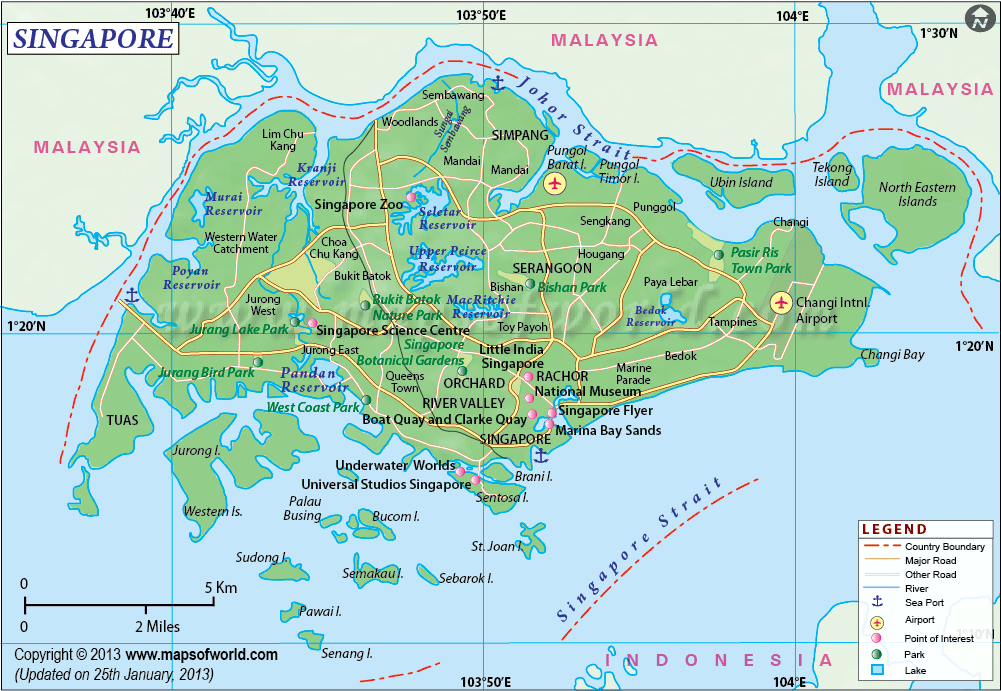
Comparing the top 6, what is the magic bullet that Singapore have achieved that Shanghai is moving towards, and that South Korea is so off beam about? What is it that Singapore did over 10 years ago (1998, 2005), that China is now directing (from 2012) and that is informing everyone’s next steps?  Answer: reduce the content to be taught, learned and tested.
Singapore reduced the content in their curriculum by first 30% so they had room to teach thinking skills and ICT and then by 20% at the subject teachers level so that teachers had time to tailor the curriculum to meet individual needs – “Teach Less, Learn More”.  That’s right – don’t believe me – read the Singaporean parliamentary reply here – http://goo.gl/wfeObf.

One paragraph sums it up perfectly “The aim of the ‘Teach Less, Learn More’ movement was to steer our educators towards adopting a range of effective teaching approaches to better engage students and enable them to develop enduring understanding and skills for life. More classroom time was given for student interaction and exploration, opportunities for expression, and learning of life-long skills. Based on the Ministry’s internal studies, student engagement levels have risen since the implementation of ‘Teach Less, Learn More’”.

What Singapore is now doing is seeking to move its offer even further, because its citizen outcomes at 18 still point too much at a closed, non-growth, mind-set. There is not point promoting the leading learners of Singapore into government and civil service. That’s not where wealth comes from, particularly in an island nation surrounded by bigger and more powerful trading groups. Wealth comes from innovation, creativity and a can-do mind set, close coupled to a well ordered society in which liberal values and a civil community exists. Sound’s familiar? Quite – in so far as that GB is like Singapore, but scaled up somewhat. As I listen to this morning’s Today programme on Radio 4, which was focussing on why there are now almost 0.5 Million French nationals living in London, it was quite obvious that our capital city has a really attractive, vibrant positive achievement culture that attracts our neighbours.

Singaporean schools display less of the variability than UK schools, and where we need to take care is to ensure that our schools continue to develop the whole child, not just pressure cook the more able to be even more able, because focussing on performance to improve performance further simply doesn’t work. And those under that pressure slip bit by bit in terms of self-esteem; that’s the South Korean way, and look what effect that has on their young, with that unenviable record for teen suicide.

What is remarkable about the Singaporean approach over the last decade is just how close to the Claires Court Essentials they are moving their programme.  They are just abolished academic banding (we have never felt that educationally sound). They have renewed their focus on Arts, Music and Physical Education. Here’s their infographic. They also have begun to focus on a 21st Century set of skill competencies (that’s the Risk-taking, resilience, creative, collaborative set we have established here). And we both agree that by holistic, we do mean all-round education, and we have mapped the skills into the curriculum so that there is no chance some of the skills are missed through teacher variation.

Where I doff my hat to Singapore is that they made Google Apps for Edu available for staff in September 2009, a year or so before us.  We overtook them in 2012 when our major influx of Chromebooks arrived, and as these devices have just landed in Southern Asia last Summer, it is taking time for the schools and Ministry to find the budget to make that next step. All who use Google Apps for Edu have become passionate evangelists for the technology.  Other products exist, and most noticeably iPads in schools throughout our area. What GAFE and Chromebooks permit most obviously is multiple collaborative working within seconds, and that is the essence of how we are managing increasingly to ensure that none (except the disengaged, perish the thought) are left behind.

And finally, wherever a Curriculum is planned to go, it must be underpinned by enduring values and mapped using excellent assessment tools. For Singapore: Respect, Resilience, Responsibility, Integrity, Care and Harmony. For CC: Responsibility, Respect, Loyalty and Integrity. Resilience sits as one of our competencies to be built, and I think we have that right. Values are caught as much as they are taught; Resilience I suspect is not just one thing, and builds in layers as children meet and respond to a wide variety of challenges – more of a skill to be learned and developed.

For England Edu PLC per se, I feel the country has much more to do. So many ways of ‘birthing’ and running a school now exist, and there seems to be no common denominator. PISA data might show that the difference within schools in the UK is pretty wide; like all data, it is historic and is only sampled every 3 years, and I wonder in 3 years what their findings will show for the State sector here. My heart hopes that all schools and the professionals that reside therein get ‘Learning’ as we do. My head tells me otherwise sadly; just this week the Making Education Work report highlighted that the direction the country needs to take is the way we have gone – and the DfE (in all their wisdom) have a closed mind set and has focussed on a core  narrow syllabus driven by exams only for 16 and 18 year olds, with no attention given to the need to develop emotional literacy, team working and empathy for others. Fingers crossed, the Authors of the Report manage to persuade a broader political coalition to change for the better. Because I don’t believe in ‘hope’ alone, our school leadership has lead that change such that our Claires Court Essentials is indeed a Curriculum to be admired and advocated – which we do. Often. ☺

Posted in Uncategorized | Tagged , | 1 Comment

“It is in the shelter of each other that the people live” An Irish proverb

cropped-p1020294.jpgDuring our working lives at Claires Court, we plan a very good deal, check across the piece that the opportunities arising are fairly shared, and reflect yet further after the event to ‘mop up’ where needs be. Serendipity however has its part to play, and last week included more than one such luck break.
It started when the arrangements for us to welcome 3 parties of 50 headteachers and school leaders from Sweden visited Claires Court for half-a day. This time of year, London is awash with Technology tourists, coming to visit the BETT show at Excel, the largest exhibition of its kind in the world. All the major corps are there, Microsoft, Intel, Lenovo, Google and Samsung etc.  The organiser from Samsung Sweden was Joakim Abrahamsson, and post the event, he had this to say:
Dear James,
I would like to thank you once again for a fantastic reception and visit at your school.
Everyone who participated was really stunned by the hospitality and kindness from staff and students.

It has been very inspiring for the Swedish delegation to visit your school and understand how you work with Google apps, Samsung Chromebooks and ICT overall at your school.

The school environment and surrounding’s was something that really impressed the delegation, alongside with the very polite and engaged students. The feeling of being in someone’s home instead of in a traditional school environment was a comment that came out several times.
Being toured around by the students, having the chance to talk to both them and other teachers was something that was highly appreciated.
We hope we get a chance to visit you again in the future. 

Thank you again!

Kind regards
Joakim Abrahamsson
Product Manager IM B2B
Samsung Electronics Nordic AB

cnr eclRegular readers of this Blog know we are working closely with Google and Samsung, and so it was perhaps no surprise that both corporations were keen to invite us to speak from their stands at BETT, to share our experiences and expertise with others planning a similar educational journey.  Chris Rowan and Eric Leuzinger spoke on Friday morning, 10.30 am, on the best of Junior boys practice, spotlighting the Weblog and wowing the large audience quite considerably.

Paul Robson spoke from the stand at 1pm, sharing some of his huge expertise on managing such an amazing roll out as ours, explaining what’s hot and what’s not and in every other way highlighting the very best of what can be done.  I spoke with 2 younger students, Joe and Barnaby, from the Samsung stand on Friday noon, and at Google on Saturday noon – here is our presentation.  These various talks seemed to do 3 things: build further on our reputation for caring and sharing, building a body of professional knowledge and experiences for others to work with and connect; link us with new friends and acquaintances with their own talents and interests, keen to sweep us up into a bigger mainstream of ‘flow’; excite us as practitioners, renewing our interests and passions for our own colleagues back home.

It was most notable that the main entrance to BETT 2014 was dominated by the Samsung stand. They had areas for lectures, for using their Chromebooks and tablets, to study their services and to test out other initiatives and technologies that are coming in to the Classroom. Their front door was formed by a mammoth video wall, and guess what – pictures of Claires Court pupils and staff featured all over the display. Respect, Samsung and thank you for the recognition. The pictures came from the video they made here last summer, and included stills from the other 2 institutions they included in that work last year.

I found the whole week quite moving. For such serious players from Sweden, for example the team leading digital learning in Sweden’s 3rd City, Malmo, to be so very impressed by what we are doing was indeed gratifying. But more than that, they were blown away by the hospitality our children offered, by both their friendship and quality as communicators. They admired our teachers ability to make demands of our children in just the right way; tough enough to get output, wise enough to ensure choice and diversity was possible.  And we have been offered many opportunities to engage further, which is nice, and we’ll be thinking that through over the next few days and weeks. You can read our news thread here.

I guess that the Irish saying covers our work last week quite well. Nothing really happened, we didn’t invent anything new, and this week we are back at the ranch, cutting and mowing as normal. But we did really live our values last week, we stood up and were counted when our friends asked. We know this week that we have rather more friends in the world community, ones who recognise that we are worth the journey for refreshment and conversation. Oh, and for some very serious learning opportunities too.

Posted in Uncategorized | Tagged , , , , | Leave a comment

Improving the Claires Court newsfeed for 2014 – paper v web!

ImageRegular and established readers of our Bulletins and weekly Newsletters will know that we have been metronomic for at least 2 decades in the writing and publication of weekly bulletins to nurture our various parent and pupil groups in the school. Last year, when we trialled our eBulletin only approach, we found our pretty quickly that our readers did not like the lack of a paper aide-mémoire for forthcoming events and happenings across our school. In addition, the variety of messages, from Heads, PTAs, other client groups and so forth often meant you did not know what you were missing.

So we reverted to paper whilst we did some ‘thinking’ and ‘consulting’ and ‘testing’ and you can now see what this looks like.  We know many of our parents need a paper copy to pin on the fridge to keep up to date with what needs to happen and where. In paper, at the end of each week (copy deadline is Thursday 12 noon), each school secretary creates (using a digital tool called SMORE) and prints one A4 paper sheet, covering what’s coming up and things on the to-do list. During the rest of the day, they add digital content and then email that bigger digital newsletter to the email ring and post to the school website. We now have an eBulletin that should fit the screen of any device, whatever its size, and we get some reliable broad scale data from Smore about whose seeing what.  For example in less than 2 weeks almost 6000 views of the bulletins have taken place, from more than 10 different countries. That’s good because we know we have a very active readership of the new eBulletins.

Reader feedback has also come in to Marketing, much very positive, highlighting that we have indeed made progress.

“Love the new bulletin! No doubt loads of work to get it up and ready in the new format – congratulations to all. Particularly love the ability to update my calendar with the relevant sports fixtures – a massive improvement and much appreciated (and it works, I’ve done it).” 

What is also interesting is the parental feedback that they do need a paper version with forthcoming events as an easy to use ready reckoner. Which of course is odd, because we are providing that very artifact, which indicates the perennial problem of child post has not been solved. Inevitably in a technological world there will be some glitches between content and user experience; ‘do read this in your browser’ for example, as that will bring hyperlinks alive. The service works in any browser and on any device; it may indeed trigger a ‘download Chrome‘ instruction if user technology does not identify there is a browser present on the device. Some of our parents only have work-provided technology to use, and work may have ‘locked the device down’ to keep ‘fluff’ out.  That should not prevent seeing our message or making use of its contents, but it does raise a fear factor that our news wont get through.

Sport news and updating has massively improved, in so far as we have outsourced all this information to the Schoolssports.com site, which permits parents to access the calender for future fixtures for their children’s teams and no others.  This is pretty neat as a concept, and as parents of Year 6 and below children know, we to provide paper information specific to such events as we know you need that detail that way too. Again, early days for this change in approach, but it certainly assists the office, as they don’t need to retype and reinvent the fixture list! The weather recently seems to do enough of that anyway!

ImageAnd finally, there are some who believe that a change for the better is a contradiction in terms, so to those, I can only apologise for what we have done. The aim is to reduce work, increase access/readability and grow engagement. To the school secretaries, I believe we have found a template approach to the week’s work that will reduce the time they have had to spend creating the bulletin (at least a day’s work a week), and give them some further pleasure knowing that we can now measure the effectiveness of the eBulletin and give them feedback on their work. To our wider community, I can say that  we have kept what is urgent as paper, but tagged to that a digital version that works whatever piece of kit is being used, and readily becomes part of our website as well. Well that’s the plan anyway, and here’s hoping the promising start makes even more sense in a few week’s time!

Posted in Uncategorized | Tagged , , , | Leave a comment

Facts v Skills and Knowledge v Wisdom – why Engineering still rocks!

Into my seventh decade of wandering the planet (sounds really old), and I continue to learn in this connected educational world in which I work. Commencing teaching under old style O levels and A levels in the 1970’s, I joined a profession hungry for change. The experience of the educator in those days was either to train the regurgitation of facts, practice the skills of paraphrase and precis or to borrow time from these acts so as translate those facts into a new context so that if nothing else some reason was shed onto the process. All seemed very dry and bookwormy.

In Biology, for example, considerable lesson time was spent learning the relative stages of cellular and tissue development from zygote to embryo for differing fauna, and not jsut to know how to label them, but to draw anew – here’s an example Screenshot_2(actually almost).

Over 40 years the change in body of scientific knowledge to be learned and skills to be practiced is huge. What is on the syllabus now in most subjects is far ahead than at the start of my career.  It is a sobering thought that almost all the practical industrial Chemistry I was teaching in 1978 had ceased to work that way in the UK prior to the second world war. I embarked upon the updating of the sciences straight away, and pupil engagement grew rapidly (all boys, as the girls did not join our school until 1993). We doubled the number of science labs (1>2), we grew a lab technician (Chris Perry), Jacky Burgess joined the team and science expanded to ensure everyone who could would follow the three disciplines we still have today, Biology, Chemistry and Physics.

The explosion in scientific method in use in the school through the 1980s was phenomenal. Not only were the labs repositories of live invertebrates (locusts and butterflies), but fish, toads and mammals too. Throughout this time we were building radios, investigating digital circuits, creating flip-flops and on one disastrous occasion, blowing up ‘Thermite’ bombs in the dark and losing some eyebrows in the process. Given this specific experiment was used industrially to weld rails in situ in the 18th century, the knowledge was not new, but the excitement was real. Children in CC labs from the age of 10 learned to manipulate quite complex equipment and made stuff happen. And when the Technology block opened, with 5 labs and workshops, our hands-on approach gathered pace. The Motor car was joined by the Hovercraft and GoKart, and all was well until the Millenium bug hit. Everyone went digital in 2000, and we stopped making big mechanical objects work. Shame.

It is thus that I commend the arrival of some new back-to-the-future science down at the senior boys and senior girls with a STEM project involving the design, build and financing of an electric car. So long as the groups steer well clear of my own electric beauty, they’ll be fine. It really is worth noting that practical skills are in extraordinary short supply; 21st century digital natives don’t actually know how one end of a spanner works with a bolt any more than I did way back when. But the palpable excitement that some Frankenstein of a car or two can be created has wet a lot of whistles.

 So give me none of the facts v skills and  knowledge v wisdom debate, because this whole dialogue within education (drummed up by those with a political agenda)  that one of the emboldened entities above is more important than the other is sterile and pointless. They are in all practical ways joined together. Back in the day, no self-respecting vehicle-owning student at University was short of a Haynes manual or two, which rather neatly brought the facts of what made up a car in line with a description of the skills required to mend it NB facts+skills=knowledge. And if you were daft enough to set about a Haynes project to refurb a derelict car and make it roadworthy, then you would end up a poorer, but wiser man. Wisdom = knowledge in action. And have learned some useful and transferable mechanical skills.

We can test the acquisition of facts quite readily, and perhaps in order that we may compete with Malaysia, South Korea, Shanghai or Singapore, politicians are eager to raise the testing stakes further, making facts more important than skills. Now these are all countries with a retro-look about their education provision, because corporal punishment is endemic in all. I know where I’d rather live, in a democratic country liberated from corporal and capital punishment and where the voice of the child can be heard.  But that’s another post. In the meantime STEM club, keep up the good work, and by the way, across over in the aforementioned countries, there will indeed be boys and girls like you just as engrossed by this kind of project. Engineering excites us all.

Posted in Uncategorized | Leave a comment

Weekly digital Newsletter 13 January 2014 – the ‘Shaking that bush’ edition http://goo.gl/fPwHDf

http://goo.gl/fPwHDf

One of the greatest ever scenes in Movie History (OK a bit blokeish, I’ll admit) is this one in which our prisoner, Paul Newman (Cool hand Luke) manages to escape from the chain gang.

I have used the Metaphor ‘keep shaking that bush’ to inspire, encourage and cajole for ever, both as protagonist and run-away. In short, those of us who run schools need to spend the predominant part of our time concentrating on ‘doing the day job’ as the ‘core mission’, the focus that brings us to work and ensures we have the knowledge, skills and authority to lead and manage well. But there are plenty of times when as ‘Lead Learner’, you need not to be leading but supporting, encouraging and provoking, in no particular order but certainly in appropriate balance. So do watch the clip – 90 seconds of your life – if nothing else so that the allusions that follow make some deeper kind of sense.

Looking across the Educational horizon at the dawn of 2014, I can see a whole lot of bushes shaking. And there are indeed sharpshooters out there, engaging our attention with ringing shots. But there are better, far-sighted people shaping and making, and it’s worth listening to what they have to say first.

For those whose schools are in the Independent Schools Association, it must be said we are indeed fortunate, because those heads stepping up to lead our members each year are providing a climate of inspiration and support second to none.  Here’s Richard Walden. ISA’s new chair welcome message of 2014 – and worth a full read first.

In 5 days time, I chair a meeting of those within our Association that lead Professional Development, to take forward our ideas and hopes for ISA’s new training centre in Great Chesterford and the training course developments alongside. If you have thoughts, however small, please email me at jtw@clairescourt.net and I’ll surface those as part of the conversation on the day.  The paper I prepared some weeks ago to help stimulate the thinking is here – http://goo.gl/XO9d4U

And for those of you that like predictions, here’s a lovely article today from the Independent, highlighting how much Isaac Asimov, the famous science fiction author, got right from 1964 – that’s 50 years ago.

To business:

After a miserable year in which both DfE and OfSTED made no friends close to me, 2014 dawned with some Christmas cheer from the office of the HMCI.  Michael Wilshaw caused the withdrawal of the 2013 OfSTED guidance, and replace it with stuff that looks ever so much closer to the ISI model we love and cherish. I rather like the fact that he chose to post on the Times Ed blog, so we don’t have to read all the guff, but can see the highlights:

Here’s Pete Wharmby’s blog, spoofing up a Hogwarts OfSTED report, priceless.

No sign of a dawn in Michael Gove’s performance; his latest appalling idea that we should celebrate the centenary of the First World war as a victory over imperialism took most people’s breath away. Here’s an antidote. There are countless public petitions going around now, with over 25,000 signatures calling for his sacking on one. What’s working for us radical, neo-liberal, 21st century educator, focus of the child types is that all the evidence coming in from the Heinz variety of world research studies is that our approach (see picture) is absolutely right.

The scientific study of complex systems is now with us, and there are indeed great Masters programmes out there now at Warwick, Erasmus, UCLA and so forth whereby practitioners can get a handle on the ‘bunfight’ that are even more bunched such as education – known as Complex Adaptive Systems – They are complex in that they are diverse and made up of multiple interconnected elements and adaptive in that they have the capacity to change and learn from experience. Over the last 20 years, when UK education has failed is when it has tried to simplify its understanding by recommending one size fits all approaches, be that for Numeracy, Literacy, Teaching of Phonics or indeed Lesson observations. It’s worth knowing that one step beyond the CAS is Chaos – ruled by Chaos theory and all that jazz.  You simply can’t just create a Mission and say that’s what we’re going to do, you have to create a culture and environment and provide 10 years for the outcome to materialise – for example Kennedy and the Moon shot. Mission statements don’t work (witness English cricket winning ashes this summer and losing them even more comprehensively 5 months on); headteachers need to have the time and the requirement to develop the whole weft-and-weave that makes for that successful whole school experience in which children thrive and grow. BTW – you might need to watch my stuff on CAS over the next year or two*.

*An old WIlding’s prediction for 2014

Education: practical maths in schools is a formula for future success says Conrad Wolfram, and he should know. Follow his thinking in this excellent Observer editorial. His views are now being turned into action in a pilot that Wolfram is running in 10% of Estonia’s middle and upper schools. He has rewritten the maths curriculum for teenagers. Pupils will be asked to answer questions such as: “Will it rain tomorrow?” They will have access to weather data and use computer programmes to give a forecast rather than a right or wrong answer. Previous readers of my blog will know that I rate Dan Meyer too – between these gents and our maths teachers, we ought to be all right in 2014.

New Year’s resolution page

In Cool Hand Luke, there is a prison game when the eponymous Luke takes part in a prison game, whereby he eats or otherwise ingests 50 hard boiled eggs. Here’s a promise to you – I won’t do that, but here’s an opportunity you’ll find more difficult to refuse: (thanks to a great spread of such posters – see more here http://www.pinterest.com/yiayiacathy/great-quotes/ – via Viayia Cathy).

And here’s guidance (below) for your reluctant learners to say something more productive than “I don’t know”. (Ta to Jeff Dunn, www.edudemic.com)

That might be all for now folks, except that next week is BETT2014 at the Excel centre in Docklands. On Friday, for ISA Professional Development, I am running a whole day of activities up there, and ISA teachers Chris Rowan and Eric Leuzinger (CC) are speaking from the Google Stand at 10.20 and Stephen Lockyer (The Mead) at 12.30 with Google. I am with our delegation from ISA CPD all day, and speaking from the Samsung stand at 12 noon.  All largely about Cloud stuff and chromebooks.

In conclusion

It is amazing now just how much inspiration is available from teachers who blog (hem, hem). Whether it is via old-fashioned newsletter, blog, tweet or posting via Pinterest or Tumblr, the reality is ‘there’s stuff out there!’


Twitter followers can now map their ‘footprint’  using http://tweepsmap.com/Map/


This picture shows mine, and clearly I am now ‘huge’ in El Salvador. Quite.

Much more importantly, education is now alight with the whole contribution social media is making to the debate about what works in schools. Never before has the public been able to hold those in charge accountable for their role with such surgical precision. Whether politician or paid official, 2014 sees us witness to the open challenge to those in charge more than ever before. As they say – keep shaking the bush!

James Wilding,

jtw@clairescourt.net.

@james_wilding,

jameswilding.wordpress.com
13 January 2014


Posted in Uncategorized | Tagged , , | Leave a comment