Following a recent visit by the Independent Schools Inspectorate, I am delighted to report that we were found to be fully compliant against the Independent Schools Standards Regulations, and can now look forward to a further 3 years of approved activity until our next inspection as required by the Department for Education. The full report can be read on the school website, https://www.clairescourt.com/about-us/reports-and-policies and will soon be visible on the Inspectorate’s own site too.
Very long term watchers of our school will be aware that the school has been inspected by the same Inspectorate regularly since 1990, and we have always been reported on most favourably as a consequence of those visits. Inspections are deeply stressful events, none more than those conducted following the reopening of school reviews by Ofsted and ISI after the Covid-19 pandemic. The sorry saga of that endured by Caversham Primary School in November 2022 is well amplifeied by the BBC headline Ruth Perry: Ofsted inspection ‘contributed’ to head teacher’s death. Claires Court was inspected in that same week, and had to ensure a similar delay; though the findings from the schools were very different indeed, we had made complaint to the Inspectorate about their conduct during their time with us, and had to wait umpteen months in silence whilst they examined our concerns.
Weeks of discussions with our inspectorate followed, as we examined the difficulties the inspection uncovered, not least the lack of written draft report visible until February half-term, literally 12 months ago to the day I write this blog, to then be followed by months of further wrangling with both ISI and DfE. Not withstanding the school’s prior clear commitment to provide appropriate accommodation and provision for the teaching of GCSE Food & Nutrition to boys, as documented in its proposals to DfE/ISI wef September 2023, the Reporting Inspector determined during his visit that we should have done better than this agreed timescale. Our various defences, including agreed policy provision, risk assessment on possible detriment, planning permission for new building not being agreed, or the delays caused by 2 years of pandemic, the tight restrictions on pupils crossing sites as a consequence until March 2022 may well have all been valid, but that did not mean discrimination between genders had not occurred for the few caught up in the period 2021-22.
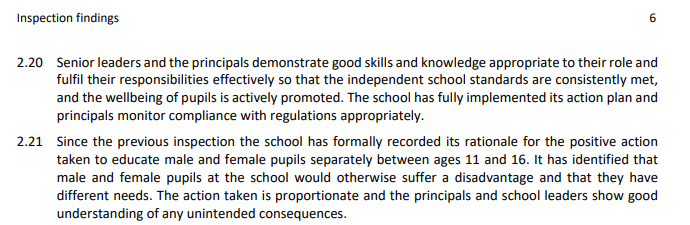
As this new follow-up report makes clear, and not withstanding the local authority’s ongoing and perplexing delays with granting planning permission, we have both now provided the missing GCSE course for boys and proven beyond doubt that the school’s choice to maintain its Diamond shape, enabling gender separation at secondary level for boys and girls is demonstrably to the benefit of both parties.
Sufficient is now said on this matter; the Inspectorate’s own efforts in visiting the school this term, in covering many of the details of our mutual concerns so well during their visit has concluded their findings in the school’s favour. The many other excellent findings of their visit in November 2022 continue to shine through – we have at our heart the very best interests of our children. our parents and our teachers – and maintaining these endeavours into the future remains the core objective.
For this first year of provision, the Claires Court Parent Teacher Association have supported the school’s pastoral teams through the provision of this fabulous service for parents, teachers and schools.
Creating great conversations at home is really important, but all too often making sure that parents have the true facts available with which to engage their children is not that easy. This Wednesday’s Times newspaper ran a headline “In school and on medication — the truth about ADHD in children“. ADHD specialist Elizabeth Swann reported to SchoolTV that 60% of all readily available information on the Internet via search engine is completely wrong AND that the term ADHD is the 7th most searched for abbreviation via Google IN THE WORLD!
Finding a trusted news source is really important, indeed a byline of the BBC advertising for their News service itself, but in terms of children’ focussed information, having a central content resource is really important – hence the PTA support for the provision of the SchoolTV service for Claires Court.
I’ve 3 items from our SchoolTV service for your consideration: SchoolTV’s take on NeuroDiversity if that’s of interest to you, leading on from the Times headlines from Wednesday. Neurodiversity in children and adolescents is a concept celebrating the natural variation in how young minds work. It acknowledges that neurological differences, such as ADHD, autism, dyslexia, and giftedness, are not disabilities but unique aspects of human cognition, and we are so much better treating them as such rather than labels/badges to wear.
With major conflicts taking place in Ukraine and Gaza, it’s no surprise our children want to talk these through, even perhaps want to know what they can do to help and how; children can often encounter distressing images and stories of war and conflict through the 24-hour news cycle and social media. These experiences can provoke anxiety and fear in young minds whose worldviews are still forming. Traumatic events imprint strong emotional memories that can influence a child’s behaviour and perception of danger. SchoolTV have produced an excellent SPECIAL REPORT: Discussing War & Conflict , in which Dr Emma Woodward FRSA, Child Psychologist and TEDx Speaker gives you an insight on how children’s healthy brains react to distressing images and how parents can handle those difficult questions that might arise.
And finally, I point you at This month on SchoolTV – Respectful Relationships
Fostering a nurturing environment of respectful relationships within your family holds the key to not only harmonious living, but also improved academic outcomes for your children. As parents, guardians and caregivers, embracing the art of teaching children about respect at a young age sets the stage for a lifetime of healthy interactions and empathetic understanding. It will help cultivate a positive environment where communication flourishes, conflicts are resolved constructively, and bonds are fortified. Claires Court tries incredibly hard, and has an outstanding long-term reputation for care and consideration, indeed its core values include at their heart, Respect, but we certainly need every ounce of help with this that homes can bring.
Teaching children to respect themselves and others will open up avenues for both personal growth and academic achievement. Fostering an environment where respect is not just a word, but a practiced behaviour, will empower young people with essential life skills. Effective communication, active listening, and the art of compromise, will provide your child with a solid foundation that will transcend family interactions and help them collaborate effectively with peers, teachers and the broader community.
Equipping children with an understanding of healthy versus unhealthy relationships is an important aspect of their development. It will guide them to make informed choices, foster positive connections, and set boundaries that contribute to their emotional wellbeing. Understanding the nuances between healthy and unhealthy relationships provides children with the essential tools to navigate their social world, build self-esteem, and cultivate meaningful relationships.
In this edition of SchoolTV, learn how to empower young people in healthy interactions to embrace differences and forge connections that honour their self-worth. We hope you take time to reflect on the information offered in this month’s edition, and we always welcome your feedback. If you do have any concerns about the wellbeing of your child, please contact the school for further information or seek medical or professional help.
Discussing the presence of AI in the home, it seems that until recently, I have been one of the oddest people in the world, choosing not have enabled a Smart Assistant at home. Whether you are Apple, Amazon or Google will depend on which voice you get, those of Siri, Alexa or – yes Google. Across most households I have visited over a year or two now, the background digital assistant has been there quietly humming in the background, providing music, weather forecasts, news and indeed genuine assistance to the household, recipe advice and all sorts.
Since Merlyn Mind joined Claires Court 3 years ago as one of only 50 institutions in the world to trial AI in the classroom, we’ve been able to expand its involvement in school life with every junior classroom now equipped to provide that support for teachers. 3 boys from Year 9 (Computer Science {Cs}group who brought the school drone to our firework show) visited last term Year 6 to hear their views on the benefits and otherwise of Merlyn as currently configured for use. It’s amazing how astute our children are, how quickly they can summarise What Works Well, and Even Better If, and so fairly quickly, the #CCScDrone squad were able to report back to Merlyn as consumers.
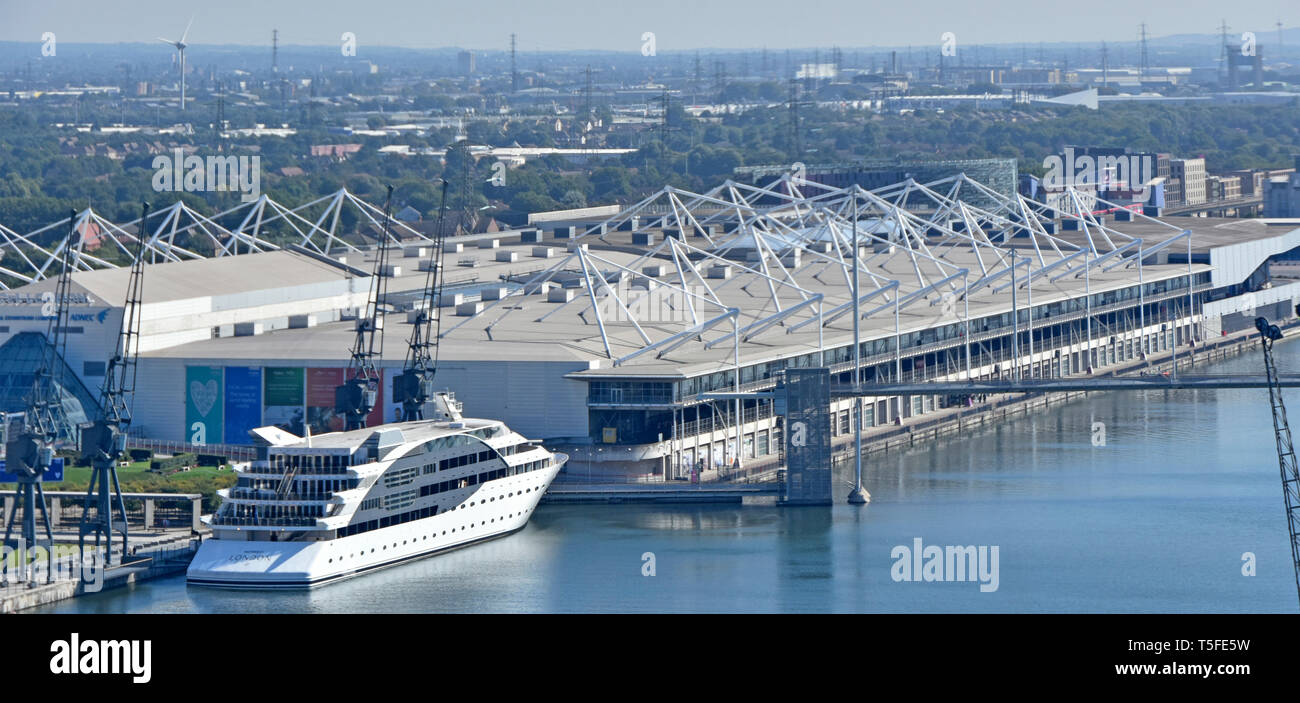
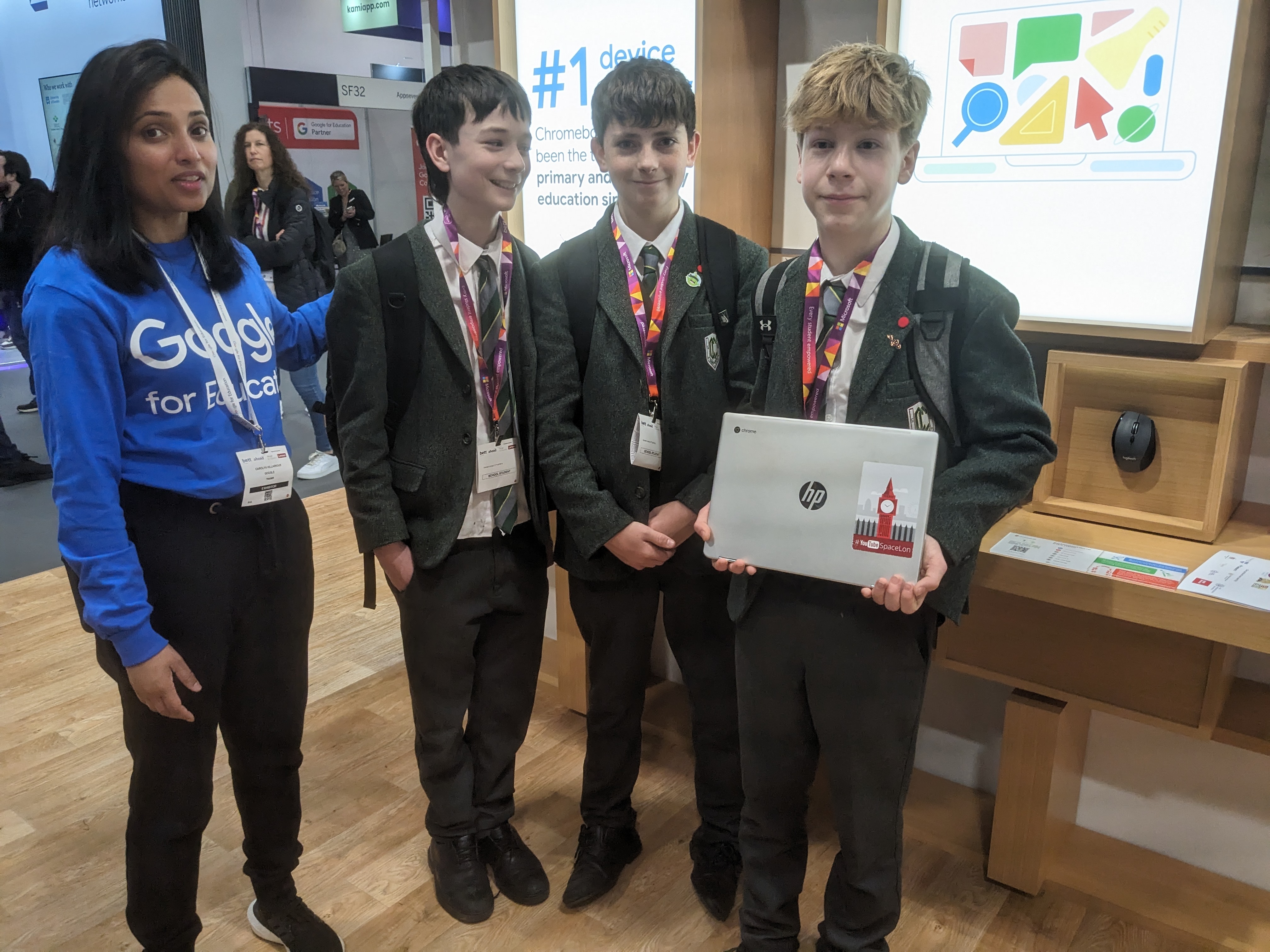
Friday 26 January is a big day for the #CCScDroneSquad, as they are due to present to a range of industry specialists their work with Drones. They are travelling to BETT24 at the Excel centre in Stratford, London, armed with their presentation seeking sponsor support for 2 more drones, so they can develop their programme for teaching junior children about smart robots, of which of course modern drones are brilliant examples.
Specifically, they are also meeting with the US team from Merlyn, both for feedback but also to receive examples of the next generation of classroom AI, Merlyn Origin. The team are to be based on the Sunborn Hotel, seen above outside Excel, and we will feel a little like entrepreneurs entering the Dragon’s Den! You can see their presentation visible here, and we are really hopeful of learning a lot from our visit to BETT, teaming up with Merlyn and their UK partners, C-Learning, and who knows, coming back with some unexpected booty too.
PART 2 will follow after our return – Saturday 27 January 2024.
#CCCsDroneSquad arrived at BETT24, ready to meet with the team from Meryln and C-Learning. The team had chosen to hear our feedback on the use of Merlyn Mind with our Juniors in one of the board rooms on the luxury yacht hotel, Sunborn. Below shows our team under clear scrutiny, being commended for the exceptional detail that they had taken to summarise the strengths of the classroom tool, plus hear where the weaknesses lay in terms of technology limitations.
The new Merlyn Origin was shown to the team, and they were invited to interact with Marlyn’s AI directly, learning how to ask prompts both to receive answers to questions but also how to cause Merlyn to generate new content from scratch. In so doing, the boys made History, being the first children in the world to so do! Parents may not know this, but within the educational context, how data on children may be stored, recycled and reused is strictly controlled, and although Merlyn Origin was 2 months ago in the USA, its use with children has not yet been authorised. For the boys part, because they had not logged in as users of Merlyn, but being third party interrogators, the way they ask questions and improve their interactions is the major way in which Merlyn will learn how to work more successfully in the school environment. The #CCCs delegates have been charged with prompting Merlyn for the next 6 weeks over the 3 hours a week we have reserved for this research, and they’ll give further feedback through C-Learning on their findings on the new tool. Of course the researchers can’t be paid for their work, but in return for their efforts, Merlyn have agreed to provide a second DJI mini, so the team now have the agonising decision whether to buy an identical 3 mini Pro, or go for the more automated 4 mini, despite its poorer performance in windy conditions.
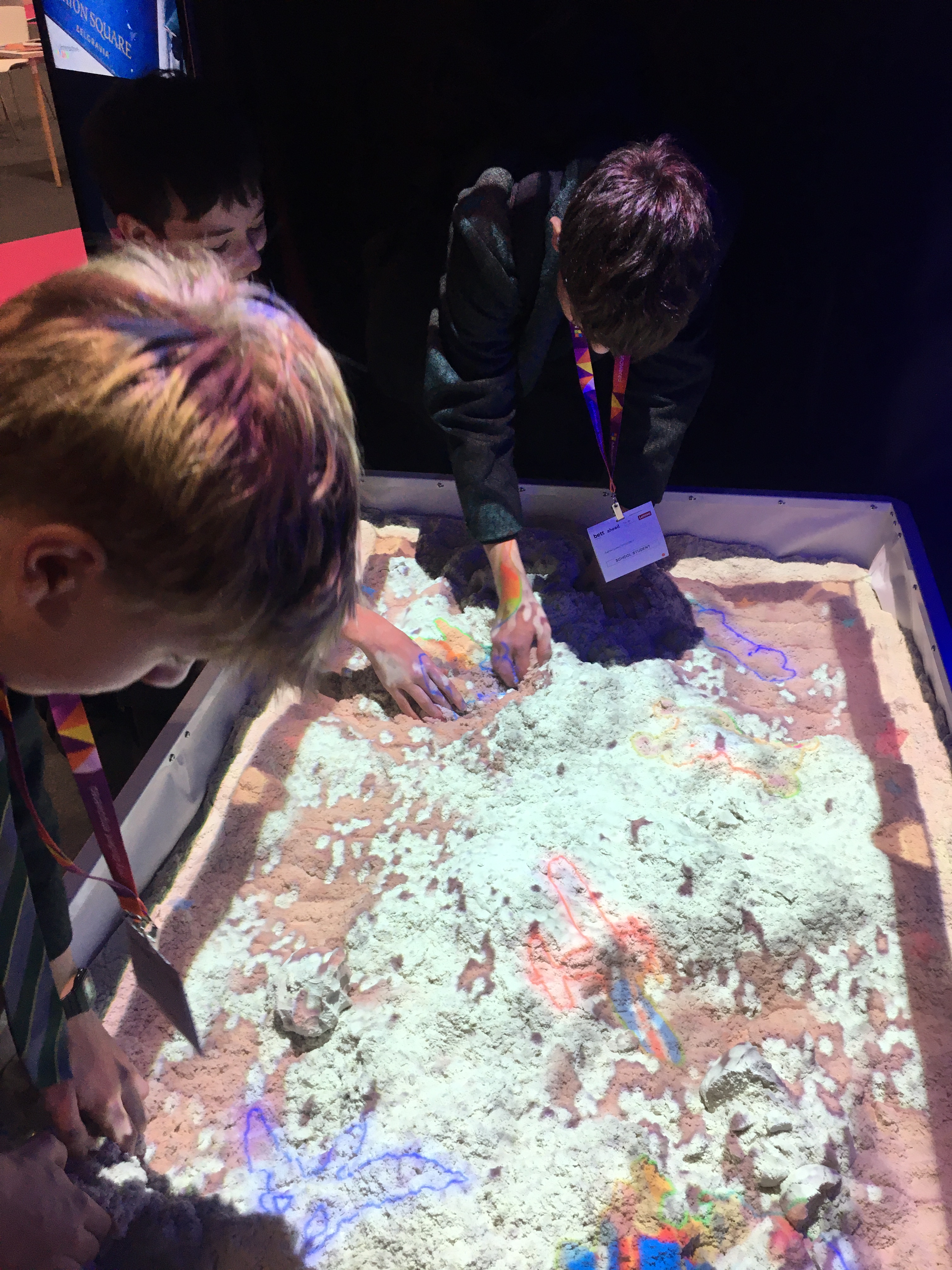
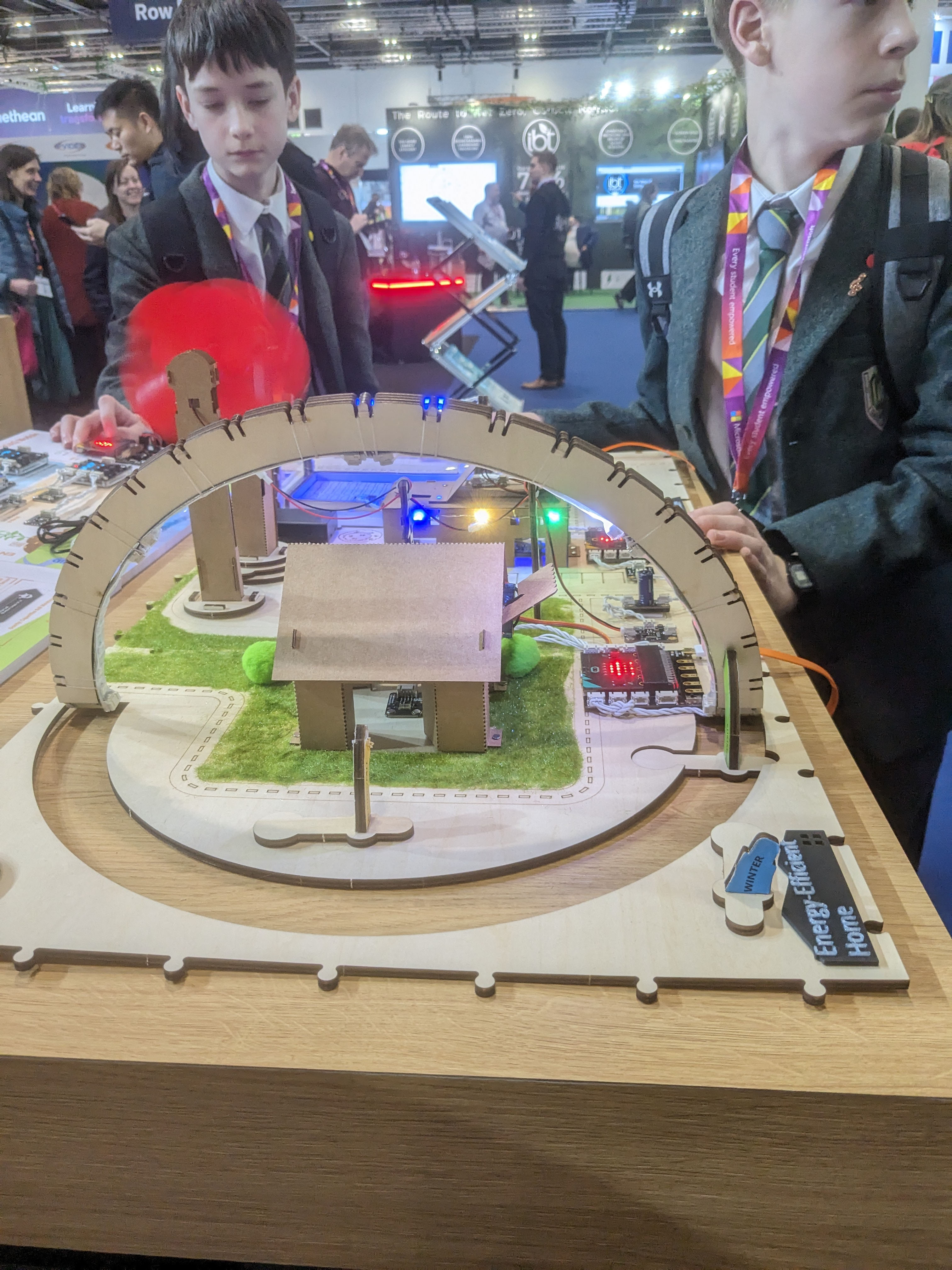
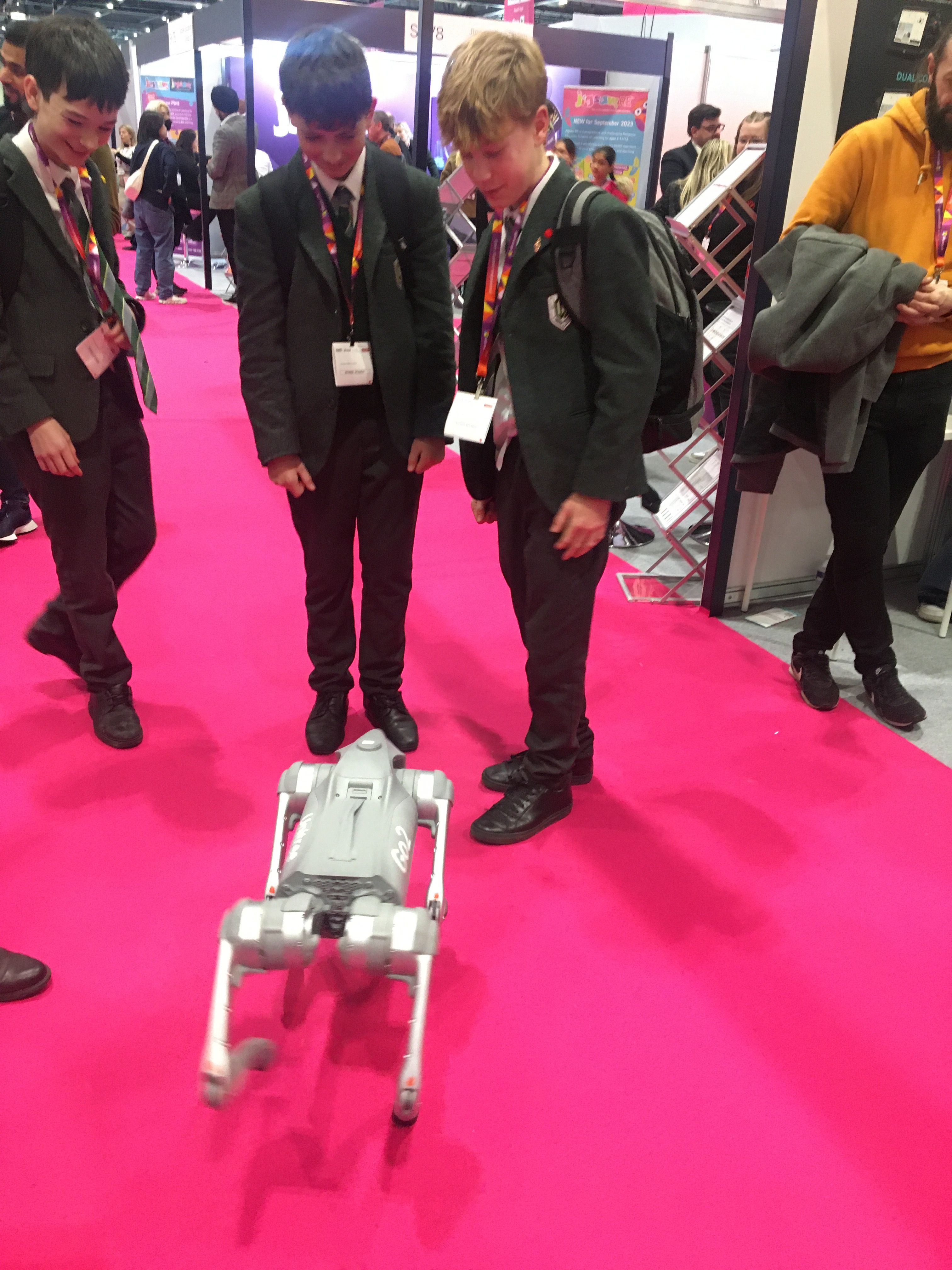
After 2 hours with the Merlyn team (which included a fabulous buffet lunch), the team then visited the main BETT24 exhibition, and the photos below capture some of their explorations, from tactile sand, , robotics, robot dogs, sharing their work with the team from Google and eSports.
Overall, the experience was remarkable for the #CCCs team, presentations as they had their research outcomes to an entrepreneurial company currently just completing their 1st $million dollar spend on a new innovation tool for the classroom. The school in due course will receive 20 Merlyn Origins, but receiving the first 6, for trialling in the Junior school and making a welcome return to the senior school’s science labs is really thrilling. Our squad has outstanding invitations to visit 4 junior schools to show them how drones can be used in education as well, so winning the second drone and thus getting 50% of the addition resource needed was a major step forward.
And finally, of course, if there is any reader out there willing to complete stage 2 of the #CCCsDroneSquad’s project – we need a further £700, then please do get in touch!!!
All the experts (and there are many) who offer Careers advice suggest that our working lifetime will be 80,000 hours. Having now completed 48 years at work now, I can conservatively estimate I have completed some 120,000 hours to date, and I’ve good plans to stay at work for 2024, God willing. I returned to work this year on 2 January, a tad premature it must be said, but the weather was dreadful, so resting indoors, I found myself listening to that great old friend, Radio 4, and caught up with a current programme entitled Seven Deadly Psychologies, this broadcast being the last in the series on ‘Sloth‘. I quote from the Wikipedia entry:
“Sloth is one of the seven deadly sins in Catholic teachings. It is the most difficult sin to define and credit as sin, since it refers to an assortment of ideas, dating from antiquity and including mental, spiritual, pathological, and conditional states.[1] One definition is a habitual disinclination to exertion, or laziness.[2][better source needed] Views concerning the virtue of work to support society and further God’s plan suggest that through inactivity, one invites sin: “For Satan finds some mischief still for idle hands to do.” (“Against Idleness and Mischief” by Isaac Watts).
The half hour I spent listening was very well invested, not least because as I return from a 2 week break from work, I have mixed feelings – reluctant because vacation and the Christmas break have gone really well, yet inspired by the down-time to neverthless get cracking on the plans I have for the year ahead. BBC website summarises today’s content as follows and I commend the programme to anyone with 28 minutes to spare – https://www.bbc.co.uk/programmes/m001trml.
“Sloth is, unsurprisingly, the final sin of the series. Lethargic, languid, lazy old sloth. Such sluggishness is often caused by a lack of dopamine, the neurochemical that helps drive motivation and movement. And it’s not always a bad thing. Our brains and bodies need rest in order to recharge, perhaps especially in today’s world of hyper-productivity and stimulation. But too much sloth, and you can get stuck in a downward spiral of apathy or depression. How best can we get ourselves out of a slump? And how can we get the balance right between uptime and downtime?“
So, that rather sets the record straight, I have taken suitable rest. recovered from the exertions of 2023 and now move from one of the 7 deadly sins to the one of the 3 major virtues, that being Hope. As it happens, the other 2 great virtues are absolutely vital too, being Faith and Love. Faith covers trust and confidence in others, which I have to have because without that a school simply can’t function. Love is the greatest of the 3, because is is the catalyst that enables Faith and Hope, creating unbreakable relationships, be they in families or friends, and more than that provides incentives for the future for the wider community at large.
But why we need Hope at the start of the ‘New Year’ is because it provides the optimistic mindset that makes the first step into the future possible. As I walked into school on Monday, along with all other pupils and staff at the time, it was distinctly noticeable that our stride lengthened and pace quickened. By the time assembly started 30 minutes later school was not just back in session, but its collective heart was beating and excitement pervaded the atmosphere. As I complete the week, walking to the gate at the close, footballers, rowers, scholars and friends were all leaving with cu han obvious skip in their collective steps – school was back, their purposes galvanised once more and stories to share over the well deserved weekend ahead.
Hope though is not enough, and works best when it is underpinned with meticulous planning and the unwavering nerve to ensure that things get done. I am very conscious of the need to ensure our many plans for school, including new car parking, buildings and opportunities are delivered in a timely manner. I’m conscious, as much in writing these words as notes for bulletins and the like, that sometimes I have to wait for other pieces of the planning jigsaw which are not in my care. Last month we we required to provide surfaced for our planning application for a new multi-user games area (MUGA) for juniors (like the surfaces we have at Senior Boys and Girls) an Ecological Survey to support the application. This is a document that runs to 85 pages and highlights of course the vital importance we need to attach to ensuring the biodiversity of the area is maintained as well as the insufferable complexity of planning in the C21 which slows almost everything we want to do and adds utterly unnecessary costs to such projects. After all, since we are enabling an area than half a football pitch (0.2 acre) to become all weather in an estate of 60 acres in which we have recently planted 5000 trees and surrounded by a further 600 acres of Thicket and natural chalk landscape, this kind of requirement is a sledgehammer to crack a nut.
To conclude, some time in the next few weeks we should receive approval for our various new projects for 2024, including MUGA, new music and food studios at Senior Boys. My intention remains to provide the best and most diverse set of opportunities we can for our children and families of course, whilst keeping the most eagle of eyes on what new threats and challenges might be lying ahead too. I am not impressed at all by the growing threats form the Labour party to tax our tuition fees, and the failure to appreciate our parents have already paid full taxes and dues to provide for a state sector place for their child which they have chosen not to take up! Integral to our plans to mitigate such threats is to continue to be a central part of the local landscape in East Berks and South Bucks, and to ensure our local towns and villages appreciate how important it is that Claires Court is nourished in return. We are the home for so many groups now, rowing, football, cricket and such like, and reliable partners too for sailing, golf, rugby, hockey and netball, creating the future by sharing our good – onwards into 2024!
Any readers of my blog for the last 2 weeks will be very aware that I have strongly promoted the Children’s Commissioner for England, Dame Rachel de Souza’s ‘The Big Ambition’ survey. You can see her last email to me of 7 December at the foot of this blog, and, honestly, it’s quite heartening, as I like reading “Thank you so much for your incredible efforts in sharing ‘The Big Ambition’ survey with the children and parents at Claires Court Schools“. She might of course say that to all the heads; the email makes it quite clear that our school community has participated well to date, and yet could perhaps speak even more fully on behalf of children within RBWM. The deadline for completion has now been extended to 19 January 2024, as a consequence.
A year ago, we welcomed the Independent Schools Inspectorate into the school, and as part of their work, they directly canvassed the parents, pupils and staff in our community (3 different questionnaires), from which the feedback they received permitted the Inspectorate to draw ‘inspection trails’, seek further evidence and arise at judgements on the school’s work. Because these events were dislocated by the pandemic across the country, the last survey/inspection had taken place 5 years ago, when ISI had sampled parents previously. Usually we would have canvassed parental attitudes using the ISI model, though disconnected by the same pandemic we had not, so actually our own survey last October was for a separate organisation, the Independent Schools Council, asking demographic and societal questions mainly for marketing and business development purposes, very different of course.
The Inspectorate made 2 clear recommendations as a consequence of their Educational Quality report, in which they found so much that was excellent:
1. Enable male and female pupils on separate sites to further develop their social understanding by extending the opportunities to collaborate.
2. Enable all pupils, and especially the more able, to further develop and use instinctively their higher order thinking, and promote greater autonomy in their own learning.
We only received the details of the recommendations in March 2023, because of the delays incurred by ISI, nevertheless much of our planned development since has had to include responding positively to these suggestions. Whilst every school’s inspection gives rise to recommendations like this, we’ve worked really hard, so I are very hopeful that our parent body can genuinely see the changes we have implemented, and not just at Junior or Sixth Form level, where the boys and girls are in such regular engagement every day. Secondary boys and girls are meeting much more frequently, indeed the brilliant show, “Another Day in Paradise” is a great example of how the best in music and drama are coming together to #CCBelong, #CCChallenge and #CCExcel.
Claires Court’s approach to education has always included encouraging an independent approach to learning, very evident in the school once the children are settled into their new classes and teachers come October Half-term, though not necessarily there right from the start of September, for a host of practical and well-being reasons. One of the key elements of ‘schooling’ is just that, establishing good routines for all at the re-start of school after a long break. Recommendation 2 is really important of course, but it’s become rather familiar amongst headteachers because the words seem to resurface in every report when perhaps the Inspectorate are grasping for a target that crosses all age ranges.
It’s really important to remember that the focus on ‘independent working’ was a major feature of the GCSE reforms in the 1980s following the introduction of coursework in addition terminal exams. Sadly we found that the requirements for coursework steadily ceased to actually foster independence and became much more formula driven by the exam board requirements and associated mark scheme. As a consequence, those same exam boards migrated GCSE programs (2008-16) into lots of mini assessments over 2 years, which in their own way of course further destroyed independent working – for most GCSE students they had to sit over 100 assessments in 18 months! During this period, schools developed the concept of ‘predicted’ grades, because of course, students were banking grades along the way, making the end result much more ‘predictable’.
Come the Gove reforms that commenced in 2014, more new GCSE exams started in 2017, only to be blown really of course by the 2020-22 pandemic, and it’s only now when we are beginning to see how those further developments all stack up. We don’t have useful comparative data from year to year, as the disruption to exams has been serious. Currently the English government is on mission to make the exam requirements harder, in direct competition with Wales and Northern Ireland who don’t. Yet the exams cover the same content… sounds daft? I know, it is.
Assessment at 16 has become a minefield and we have to be so careful where we tread. Scotland has gone its own way, choosing a new secondary curriculum and new assessments at 16+ which are much more skills based and less founded on knowledge (as have other English speaking countries). It turns out that the students in Scotland learn less than those in other countries (including England), as a consequence degrading their students’ educational attainment, with the rating of their secondary Education offer plummeting in the latest PISA and University ratings.
The biggest single research-based question that Learning Scientists have explored over recent times has been: ‘Does this method of teaching/learning have a positive impact upon the child’? There is a host of writing out there to suggest that 21st Century learning is different for the current generation, who need to know less but have the tools to explore how to find out what the solutions are more readily. Guess what – the researchers keep coming back to the evidence that students need to learn stuff as well as how to manipulate it – in short, you can’t acquire skills without knowledge. This is now an absolute given – in the new world of generative Artificial Intelligence, where your software interface can provide you with the ideal way to cook an omelette, but unless you have the prior knowledge of what makes up an omelette etc. the software won’t make the food for you. And you do need to know a little more than ingredients to understand why cooking makes food safe as well as palatable to eat.
In school we are currently ‘playing with AI, using Merlyn at Juniors, seeing Bard and ChatGPT at secondary and the new arrivals of Amazon Q and Gemini are going to speed up the pace of AI acquisition quite a bit more for us all. Exam boards are of course absolutely scared witless – they know the teacher must not write the student’s work for them, but how might the teacher be able to identify that the work is not of the individual’s own making in the first place, when mark schemes include the use of Buzz words and required answers? Below is something that ChatGPT wrote, 100 words in the style of myself, on the value of AI in Education:
“In the dynamic landscape of education, AI emerges as an invaluable ally, transforming traditional classrooms into hubs of innovation. Through personalized learning, AI tailors educational content to individual student needs, fostering a customized and efficient learning experience. Automated grading systems alleviate teachers’ burdens, allowing them to focus on inspiring creativity and critical thinking. AI-powered educational tools engage students through interactive simulations and adaptive exercises, making learning not just informative but also captivating. Moreover, AI facilitates data-driven insights, enabling educators to identify trends and adapt curriculum strategies accordingly. Embracing AI in schools not only enhances efficiency but also cultivates a tech-savvy generation prepared for the challenges of the future.” ChatGPT in the style of www,jameswilding.blog, 07/12/2023. To be honest, please don’t believe such statements, which are largely drivel, I’m ashamed to say.
The Independent Schools Inspectorate and its reporting inspectors hold very dear that the school has actually asked the members of its customer base for feedback on its activities – ISI never want to find out that the parents actually don’t have a voice in the school or lack a respected way of given useful feedback. It’s all very well to suggest that the ‘head’s door is always open’, but we recognise that much of the time that’s not really of value for parents – often time-poor and busy too. Of course I have asked every AI generative tool that exists what might I need to do to improve the school further, but that’s of little value for anyone given the robot is not a real customer and doesn’t have personal experience to draw from. Well I say the robot doesn’t have a helpful answer, but actually it has provided an answer for our consideration – and I post it below for your full edification – “I told you so!”
In conclusion, I do encourage all parents to take part in such school surveys. Whilst some of responses may be unflattering, they do give cause for serious consideration, of that you can be assured.
Below is the email received on 7 November 2023, from Dame Rachel de Souza:
FAO Mr James Wilding,
I hope that you have had a good Autumn term and are all looking forward to the Christmas holidays.
Thank you so much for your incredible efforts in sharing ‘The Big Ambition’ survey with the children and parents at Claires Court Schools.
We have had an amazing response from nursery, primary and secondary schools across England and as a result I’ve decided to extend the closing date to Friday 19th January 2024 to allow even more children the chance to have their say.
This will give schools, children and young people an extra month over the festive season to take part in ‘The Big Ambition’.
It only takes 5-10 minutes and can be completed in assemblies, form times, PSHE or in other lessons in the run up to Christmas or when you come back in January. A suggested lesson plan can be found on our webpage. Alternatively, please share this flyer with a link to the survey with parents and children to complete at home.
‘The Big Ambition’ provides a much-needed opportunity for the children of England to tell policy makers what is important to them ahead of the General Election.
Let’s make sure that the children and young people of Windsor and Maidenhead are represented in the results.
I received the following message from Dame Rachel De Souza, Children’s Commissioner for England yesterday, Thursday 17 November 2023.
“I have launched this survey, The Big Ambition, to hear from all children and young people in England aged between 6 and 18 years old. Adults can answer on behalf of a child or young person aged up to 18. You can find a link to that survey at the foot of this letter. I will use this survey to take children and young people’s views to the Government.
I want to ensure that the voices of all children in the Maidenhead area are fairly represented in the findings so that I can share their views with the most senior members of the country.
I must reiterate that it is vital that all children have their voice heard through this survey because, as Children’s Commissioner for England, I have a statutory duty to protect and promote the views and interests of children. The Big Ambition provides a much-needed opportunity for the children of England to tell political decision makers what is important to them ahead of the General Election. I will be sharing their responses with Government to ensure that children’s voices are heard.
Please share the survey and resources with teachers in your school and encourage them to use it in their lessons. Children can complete the survey in assemblies, form times, PSHE or in other lessons this term. The survey can also be done as homework and parents can assist children who cannot complete the survey themselves (children under 5 and children with Special Educational Needs). This is a great opportunity to teach children about politics and why it is important for them to use their voice. Be sure to check out the lesson plans on my website if you want to teach your pupils more about politics before they fill in the survey!”
As Principal of the only through school in Maidenhead, I have a huge interest in encouraging Pupil Voice, the emblem for which in our school was designed by the children and of which we are very proud. My family’s Latin Motto, which sits in the school badge we founded and developed says “Ut Omnes Unum Sint” translating as “So that all may be one.”
Having a unifying set of values is not the same has have the same view of everything, indeed as a school and nation we share the wish to have very different choices in terms of identity and ambition. When Halifax FC visited Maidenhead United last Saturday, it was definitely not to play out a 0-0 draw (Maidenhead won by the way). But both sets of spectators have a shared love of the sport of Football, and for many their leisure time becomes the driving force of their lives. For others, it’s the opportunity to gather knowledge and learn, swapping perhaps the Terrace for the Library to further their ambitions. For yet more, it’s about service to others, building the community links that make town and society thrive.
And all of those possibilities arise from enabling in our young children the opportunity to make choices and express their opinions, and of course to endeavour to surface some options so they see we have considered those concerns. So I welcome the Children’s Commissioner’s ‘Big Ambition survey’, and by writing this blog, encourage others to do so too!
Given the cataclysmic battles taking place in Ukraine and Gaza, the extraordinary impact those conflicts are having on the innocent citizens caught up therein are causing emotions to run high. Both wars are unfolding catastrophes, amplified by the immediacy of the documentary evidence of suffering, loss and destruction. Last week, to inform and advise my staff returning from half term, I wrote the following commentary to them:
“Education Secretary Gillian Keegan, the Minister for Schools and the Minister for Skills have written to schools and colleges on 17 October 2023 to provide advice on how to respond to the Israel-Hamas conflict in the classroom – you can find that advice here.
Over the half-term break, our own community leaders covering the faith represented in the war, Imam Abid Hashmi, Rabbi Dr Jonathan Romain and Reverend Sally Lynch all met at Maidenhead Mosque to each read a prayer for peace from their own tradition. I attach the newspaper article covering that appeal, and I quote one element from that which covers our needs so well, that by Imman Hashmi: “[We said] not to let that disturb our peace here in our Maidenhead community. No matter what happens over there, here, Jews, Muslims, Christians, we are all brothers,” he said.
Clearly we will have members of our school caught up in this conflict, and some I fear directly with the loss of loved ones in Israel and Gaza. In addition, we have in our midst 12 Ukrainian children and young people, for whom war back home remains a lived reality. With such conflicts in mind, the DfE produce additional guidance and support last year, to help teachers and schools navigate issues such as the Israeli-Palestinian conflict, the legacy of the British Empire or societal responses to racism in accordance with the law. We recognise that teachers must not promote partisan political views and should offer a balanced overview of opposing views when political issues are taught, and it is certainly important we keep well clear of the toxic comments and expressions of hatred visible on social media, consumption of which will herald no victory!“
This Sunday heralds the arrival of Remembrance events across the nation, led by the central National Service of Remembrance to be held at the Cenotaph on Whitehall, London. Starting at 11am, the service will commemorate the contribution of British and Commonwealth military and civilian servicemen and women involved in the two world wars and later conflicts. The Department for Culture, Media and Sport coordinates the event, alongside colleagues from across government, the armed forces and veterans’ organisations. Those more recent conflicts, particularly in Iraq and Afghanistan have renewed our nation’s focus on the loss to parents, wives and husbands, children and family and there is no doubt that the nature of the services is to focus on that sense of loss in the cause of heroic service by serving military, called to action by their country, our nation, the United Kingdom.
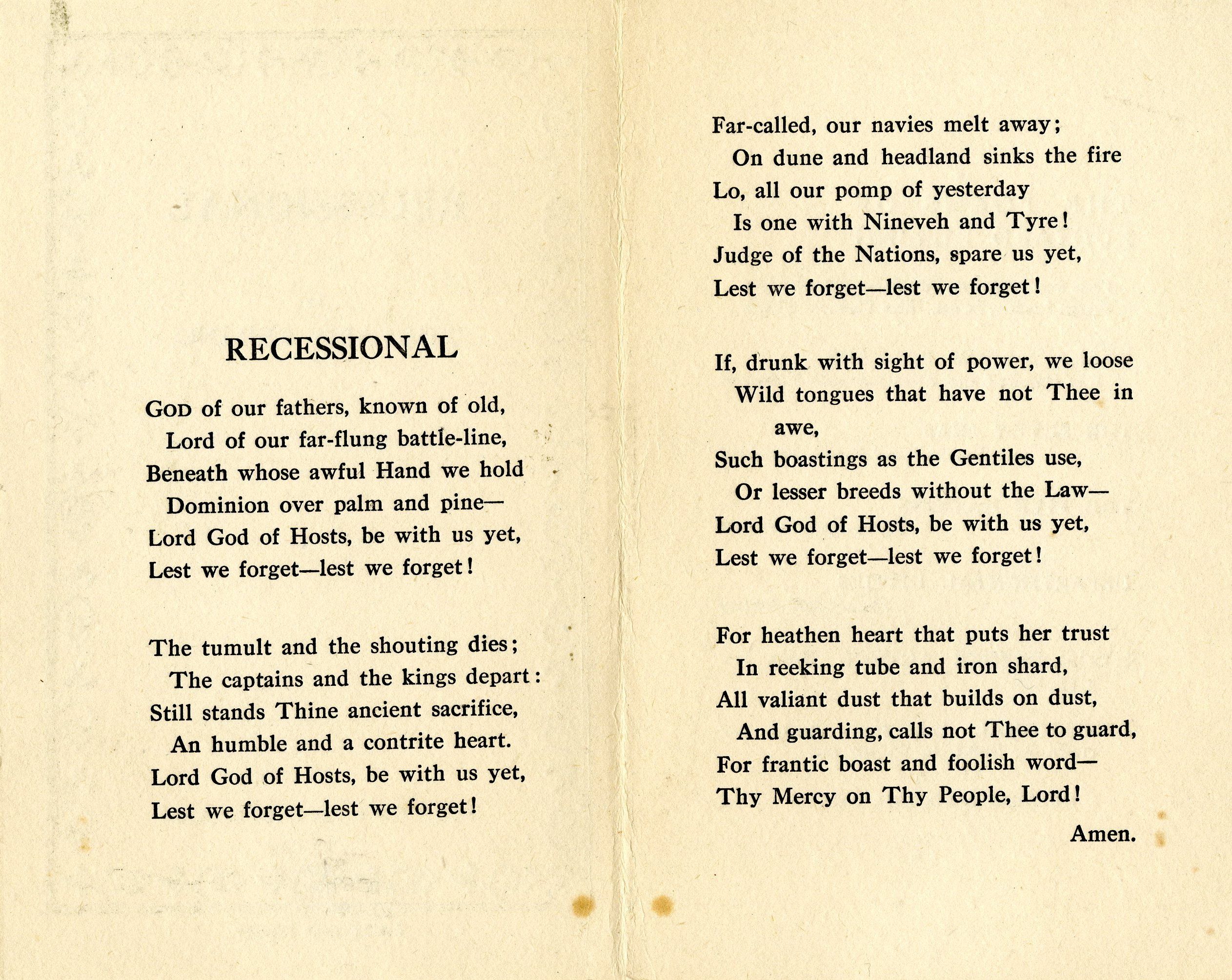
The phase ‘Lest we forget’ predates the First World war by many years, written first by one of our country’s greatest poets, Rudyard Kipling, coming from his poem ‘Recessional’, written for Queen Victoria’s Diamond Jubilee, published 17 July 1897. I’ve posted the full poem at the close of this blog, and Wikipedia’s excellent short commentary describing the poem has this to say:
“Initially, Kipling had not intended to write a poem for the Jubilee. It was written and published only towards the close of the Jubilee celebrations, and represents a comment on them, an afterword. The poem went against the celebratory mood of the time, providing instead a reminder of the transient nature of British Imperial power. The poem expresses both pride in the British Empire, but also an underlying sadness that the Empire might go the way of all previous empires. The title and its allusion to an end rather than a beginning add solemnity and gravitas to Kipling’s message. In the poem, Kipling argues that boasting and jingoism, faults of which he was often accused, were inappropriate and vain in light of the permanence of God.”
From the outbreak of the First World War, Kipling wrote propaganda for the British government and as an expression of his patriotism managed to persuade the military authorities to permit his son John, initially rejected for service because of poor eyesight, to be commissioned as a second lieutenant into the 2nd Battalion, Irish Guards on 15 August 1914, two days before his seventeenth birthday. Not 6 weeks later, John was reported injured and missing in action during the Battle of Loos, and despite the frantic searches of both parents, John’s body was not found. Rudyard became involved with the Commonwealth War Graves Commission and wrote as an epitaph “If any question why we died, / Tell them, because our fathers lied.” It’s perhaps nice that in 1992, the same Commonwealth War Graves Commission discovered a mistake in the paperwork and identified his grave changing an inscription on the gravestone of an unknown soldier to read John Kipling, which lies in the St Mary’s ADS Cemetery in Haisnes.
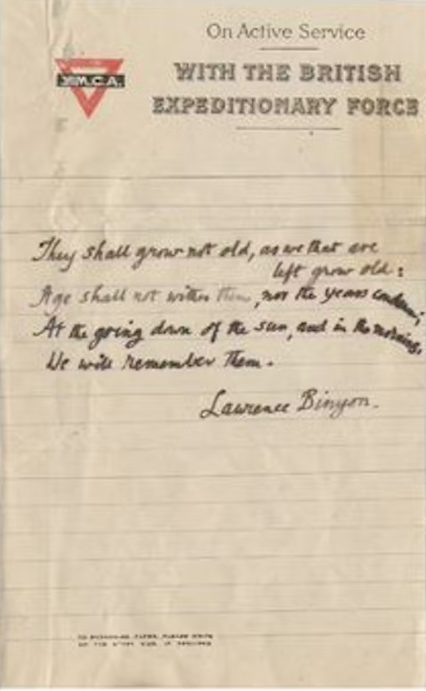
Kipling used his powerful writing at the time to validate another poet’s words, those of Laurence Binyon. Right from the start of the Great War in 1914, long lists of the dead and other casualties were appearing in newspapers, and looking at across the sea in Cornwall, Binyon composed nded were appearing in British newspapers. With the British Expeditionary Force in retreat from Mons, promises of a speedy end to war were fading fast.
Against this backdrop Binyon, then Assistant Keeper of Prints and Drawings at the British Museum, sat to compose “For the Fallen”, a poem that Rudyard Kipling would one day praise as “the most beautiful expression of sorrow in the English language”.
Whilst the 11th hour of the 11th Day of the 11th Month of 1918 was when the fighting stopped with the signing of the armistice by the allies and Germany, the war itself continued into 1919 until the signing of the peace treaty of Versailles on 19 June 1919. There was nothing neat about the close of that war, and the ensuing months and years that followed saw continued suffering and misery across Europe. On On 14 May 1921, the various associations that provide diverse support for the surviving military ex-servicemen chose to come together and the Royal British Legion was formed, who oversee this charitable work to the present day.
The following statement comes from their website today and it makes a defining statement of the purpose for Remembrance:
Remembrance honours those who serve to defend our democratic freedoms and way of life.
We unite across faiths, cultures and backgrounds to remember the service and sacrifice of the Armed Forces community from United Kingdom and the Commonwealth. We will remember them.
We remember the sacrifice of the Armed Forces community from United Kingdom and the Commonwealth.
We pay tribute to the special contribution of families and of the emergency services.
We acknowledge innocent civilians who have lost their lives in conflict and acts of terrorism.
Wearing a poppy is is never compulsory but is greatly appreciated by those who it is intended to support. When and how you choose to wear a poppy is a reflection of your individual experiences and personal memories.
Remembrance unites people of all faiths, cultures, and backgrounds but it is also deeply personal.
It could mean wearing a poppy in November, before Remembrance Sunday. It could mean joining with others in your community on a commemorative anniversary. Or it could mean taking a moment on your own to pause and reflect. Everyone is free to remember in their own way, or to choose not to remember at all.
To conclude the point I have been illustrating, Remembrance as both a process have been deeply woven into the British and Commonwealth’s psyche for over a century, and unlike most other services covers all faiths and none. As child, the old, injured and invalided ex-servicemen from the legion wore their medals with pride and by engaging with them though the purchase of a poppy we felt we assisted in obeying Kipling’s warning, Lest we forget, obey Binyon’s instruction “We will remember them” and concur with that witness articulated by Kipling that it was his lies that killed his son. So many young men went to war willingly, not knowing the horrors soon to befall them, and the catastrophic effect on all the countries involved must not be forgotten. 25% of entire military population of France was lost, that’s 1.3 million men, exceeded only by Russia with 1.8 million, with Britain & empire not far behind with 913,00 (715,000 UK, 198,00 dominions).
The ghastliness of both conflicts in Ukraine and Israel cannot be underestimated, indeed barely comprehended at present, but whatever views we might have about the various legitimacies of action, we are surely best off keeping those views separate from the genuine and solemn purpose Remembrance has at the heart of our national life in Britain. Kipling’s Recessional below mourns the passing of our Empire 120 years and more ago, but those in Empire did not let us down in the 14-18 war. Year 9 boys and girls in our school last month have been studying in depth the contribution made by the Hindu and Urdu populations of the Indian sub-continent, as well as those from the other dominions too; neither would really have understood the Christian prayer-type structure of the poem, but they truly understood and honoured the loyalty they felt for our King and country, and over 1.3 million gave service during the war across all arenas, from the Western Front, Turkey, Iran (to protect our oil fields), Egypt, its own frontiers with its neighbours, Singapore and China. In teaching this history in school, we bring to the attention of the next generation the knowledge and understanding of the past, by writing an assessment on same, we test their knowledge and help embed the memory in their consciousness that the Great War took place, and left nobody across the world in any doubt of the subsequent devastating effect of war.
Remembrance does not glorify war and its symbol, the red poppy, is a sign of both Remembrance and hope for a peaceful future.
‘Building the future for our children and young people’ – Your place is here
Our development as a school over the last three years may seem to have been slowed by the interruption caused by Covid-19 and the refusal by the National Planning Inspectorate of our plans to develop a one campus solution. Yet, we’ve managed to relocate all of our juniors onto our Ridgeway site, bringing boys and girls together for the first time in our history. Our academic staff at all levels have achieved so much including the diversification and expansion of classroom and co-curricular activity and the winning of regional, national and international championships. I show below images in our Flikr album of some of our remarkable ‘new’ developments we have achieved, worthy of celebration in their own right.
They include ‘Forest School’, Combined Cadet Force (CCF), Sailing, Kayaking & Canoeing (all part of our Outdoor Ed offer), Expansion of teaching facilities for Senior Girls and for Sixth Form and our New Classrooms at Juniors.https://www.flickr.com/photos/199286161@N08/albums/72177720312054765
Perhaps the most remarkable achievement for our community is the way in which we have been able to welcome and absorb into our community across the school the now 13 Ukrainian children sheltering with their mothers from the spectre of War back home. Peace there seems inconceivable currently, as it does in Israel where war has broken out once more, following the terrorist violence in Israel.
This half-term sees a wide range of small but important infrastructure improvements on all three sites that ought to improve our ‘lived’ experience and demonstrate that our ongoing ‘evolution’ as a school will continue apace. These include the laying of reinforcement for our overflow parking at Claires Court Juniors and the installation of new temporary accommodation to expand the Speed, Agility & Quickness facilities for Senior Girls & Sixth Form.
In the longer term, I am delighted to confirm that our planning Application for new Music and Food Technology facilities at Senior Boys has now been received by RBWM Planning and we await the consultation process with interest. For the record our application reference is Ref No: 23/02394/FULL
Whilst it is always sad to see valued teachers and support staff move on, the arrival of new colleagues and leaders certainly provides new angles, interests and enthusiasms. We are certainly benefiting from that throughout the school this autumn, perhaps doubly enhanced by the lovely weather we have enjoyed until recently. Our PTA Fireworks last Saturday evening certainly benefited (in the main) and provided an excellent celebration of our school and its community in action. Though I mentioned good weather, if your car ended up ‘stuck’ in the field, do please accept my apologies – that sharp 30 minutes of heavy rain circa 5.30pm prove a challenge too far! This video from the #CCCSc Drone squad gives a short glimpse of us all from above!
The photo (from the Computer Science Drone Team) shows the event in full flow, clearly ‘lightsabers’ sold well! On this link you can see a little of the movie footage
I do hope that I can post an even more positive postscript after half-term, highlighting the remarkable Senior School Choir tour taking place in Belgium, and as part of their tour performing under the Menin Gate in Ypres at the 8pm Remembrance ceremony. At this time of appalling events in Ukraine, Gaza and Israel, there is no better sign of hope that our young people can participate in is that profoundly moving ceremony in which we make clear that “We will remember them”.
Friday 13 October update – last week’s blog is rather kindly validated by Professor Alan Smithers’ letter in today’s Times newspaper –
Readers who have engaged with my writings over the years know that, where I can, I give credit where credit is due. Education is deeply indebted to the Thatcher government’s reforms of the 1980s, most notably to Lord Baker who as Education Secretary at the time led the change from the tripartite system of O’Levels, CSEs and other stuff through to the development of the GCSE programmes we now have in our schools. Move on 15 years, and Education becomes indebted again to the reforms led by David Blunkett in the Blair government period, tightening up GCSEs, widening the 16+ curriculum, funding new school developments and releasing local school managements from the very tight strictures of local authority management.
“Be careful what you wish for” I hear you say, because of course between the 2 decades of progress we have also enjoyed the ‘reigning back’ by more conservative politicians, most recently by Michael Gove from 2010-14 and his reforms subsequently supported by 9 Education secretaries that have followed, current incumbent being Gillian Keegan, appointed in October 2022, just coming up to the end of he first year of tenure, so that means of course that she’s due to be replaced some time soon.
Of course there are some that might believe that my school would be much better off if I (and my brother Hugh) would choose to retire now, having just completed 42 years in charge. The good news for those who know Claires Court, is that leadership here has been of the matrix kind before I joined in 1975, my parents before me working with colleagues who were also heads in leadership. Legends in our life time have included Karen Rogg, Trevor Sharkey, David Course, Ann Pitts, Andy Giles, Jeff Watkins, Liz Green, John Rayer, Steph Rogers, Paul Bevis, Maggie Heywood and the current amazing colleagues, Leanne Kirby, Gary Hope and Steve Richards. That sense of continuity and institutional knowledge holds us in very good stead. The school was set up to offer for each child the opportunity to be the best they can be, and it remains that to this day.
We seem to be in full swing for the various party conferences, and I certainly don’t envy Gillian Keegan as Secretary of State for Education, arriving in Manchester shortly. Prime Minister Rishi Sunak’s decision to wonder out loud whether or not he should be changing A levels for a new approach now is as disturbing as it has been for those running transport policy as he suggest now might be the time to cancel HS2 north of Birmingham.
Here’s the simple education situation in terms of accountability to research methods. When you change a system, you need to run it for at least 5 years to see whether the changes have been worthwhile and added value. A levels and GCSE changed 6 years ago for most subjects, but of course we lost 3 years of data because of the Covid pandemic. The country has implemented T levels, a vocational alternative, with the first cohort graduating this Summer, and that too will need a further 4 years of research data before we tinker further.
That’s not of course stating that we should not consider additional changes, but that we need to bear in mind that every change bears a cost and causes unforeseen circumstances. Currently, we have the most efficient process for permitting students to excel in their subjects at 18, and then release them to University to graduate in 3 years time. We are the most successful country in graduating students through their degree in a specified time, and the methodology for charging has been proven on balance to work well.
If we reduced the depth of understanding at 18+ in favour of a broader curriculum, such as the IB, we then are asking students in many disciplines such as Medicine and Engineering to study a further year at University. And in turn, we don’t provide for our amazing expert teachers for A level the opportunity to carry out the depth study work they wish in their graduate discipline – there is no guarantee that such specialist A level staff would be willing to switch to a different grade of teaching and learning. These choices have existed for decades, and through care and evolution we have managed in the 3 home countries of England, Wales and Northern Island to keep ‘home’ education in schools to age 18. Scotland’s different choice continues not to play in its favour, offering a less standardised approach at secondary school, though covered by the general principles of their ‘Curriculum for Excellence’. Introduced in 2014, CfE was flagged at increasing breadth and choice at secondary level, and actually the reverse has happened, and the narrowing of the curriclume has also led to a drop in overall standards as well.
A much similar outcome would be from a decision to remove GCSEs at 16+, because the Core and Options choice at 14+ would disappear straight away. Over the past 12 or so years DfE has tried to impose a Baccalaureate approach for this phase, with every one following History or Geography and a Foreign Language. Of course the EBacc is one approach, but my RS staff would argue that the elements of Philosophy and Ethics they teach would genuinely benefit all students, as of course would all the other artistic, creative, design, business, musical and technical disciplines too. I’m currently leading a school-based initiative to introduce AI, Coding and Drone-led Computer Science here, and for those with a real interest in this area, for them its clearly of more value than an MFL. Indeed whilst we can argue that A levels are a ‘Gold Standard’ there are certainly not the only way to assess performance and competence at 18+, with BTECs being a popular alternative, including more coursework assessment at the point of completion.
The news currently is dominated by international issues such as Climate change and the Ukraine conflict, about which we can do little. Other really important issues are such more straightforward; HS2 is a plan to link the North to the South, and there’s no point in beheading it. Border controls, Prison security, Justice delivery and even National Heath and Care services can only function well if they are valued, well-led and supported. The fragmented and fractious approach since the demise of the Blair-Brown governments commenced with the Osborne’s austerity cuts of 2010, a classic example of a plan utterly failing, when we are now spending more public money than ever. It seems that politicians simply can’t stop cutting off their own nose to spite their face, most recent example being that the costs to the NHS to cover the current nurse and doctors strikes has cost them more than the initial pay rise requested.
Those that know my school are very aware of the encouragement we have offered to mature entrants to the profession, with many now in middle and senior levels of management having had careers elsewhere first. The government sets targets for teacher recruitment, aiming to attract for example 20% of Maths graduates to join the profession, which is a really tough ask given the salary levels used by industry to attract these skills their way. The job of teaching Maths though needs more than just ‘nous with sums’, and the mature entry incumbents have such real life experience to offer as well. Trouble is, those with such life experiences simply won’t put up with the cannon-fodder approach schools and colleges have adopted, with 40,000 teachers quitting for other employment last year.
So to conclude, there are a number of orthodoxies I am promoting that politicians could learn by.
Evolve not Revolve;
Invest in people first, and do keep abreast of what technology can do;
Don’t overspecify on physical infrastructure investments, we can often to just as well with less;
Maintain breadth, depth and diversity, though we need the core skills of English, Maths and Sciences, other methods to encourage engagement and reasoning are just as valuable;
Be careful what you wish for – suggesting the French Bacc and education system are to be admired is not borne out by reality;
As with politicians, encourage those entering any of the professions to have gathered a good deal of experience elsewhere first, and value that experience on the entry pay grade.
And for goodness sake, celebrate and make education in schools fun – it’s the consumers’ childhood and we mustn’t lose sight of that!!!
Firstly, I extend a warm welcome to all of our Claires Court Schools community, returning as we have this week from our Summer break. From the many parents, teachers and friends I know, our own country seems to have been the most popular destination, though with such a diverse set of ages and stages, I do appreciate most parts of the world will have been included in individual family choices. And perhaps somewhat ironically, after such a wet period over the break, we’ve returned to scorching sunshine and the hottest temperatures of 2023 to date. Actually, school is always so much more pleasant when the sun is out and the children can exercise outside; the buzz on all sites was full evident on Thursday morning, though Mrs Kirby and the ‘Welcome’ balloons up the Ridgeway driveway did rather take the trophy for ‘best dressed’ school!
It must be said that the national picture for public Education (or for that matter Health or Care) could not be much grimmer than it is at present, suffering as such services so obviously are from the austerity cuts of the ‘coalition’ government of 2010, maintained by the subsequent variants of Conservative rule since, where expert report after expert report seems to have been ignored because the conclusions requiring long term government investment in buildings, resources and staffing have been ignored in favour of political expediency, the consequences of Brexit and of course the C-19 epidemic. The latest ‘salvo’ of criticism hitting Prime Minister Sunak and his cabinet is the RAAC fiasco, in which thousands of public buildings housing schools, hospitals and public services more widely have reached well beyond their end of life period, and have now had to be closed because their occupancy truly threatens life and limb. What seems most disappointing of all is that such buildings are being identified in those communities across the country whose voice at national level has been hardest to hear, being most likely from those parts of the community which is most disadvantaged. Having said that, Maidenhead no longer has a central car park to support its high street; at the best of times it’s not been a real attraction and now it resembles many of those satellite shopping streets in city suburbs, hardly one to celebrate the town’s boast of being the ‘Jewel on the Thames’, because you can’t easily drop in by car.
At the Senior Boys assembly this morning, I reminded school that most of the concrete present in our school follows the recipe the ancient civilizations 1000 years before the Romans brought it across some 2000 years ago, and as Hadrian’s wall reminds us, it does last well through the centuries. The principle ingredients for our modern education systems certainly have been known for the same long amount of time – promoted by Socrates during his lifetime 470–399 BC. He believed that as self-learners we must first admit to our ignorance and realise that there is a world of knowledge ready to be accessed, but only once we can accept that we don’t already know everything. So here goes!!!
Firstly, we have to accept that those who write, publish and broadcast the news do so knowing that only ‘bad news’ sells papers. Current government policy on Assessment in Education is so very confused that it’s no surprise that the newspapers have been heralding a catastrophic decline in secondary school standards at both GCSE and A level as being indicative of ‘Trouble’ this August. In terms of results, there has been no decline, just a decision this year in England to reduce the percentage of candidates in each grade band, which was delivered by simple statistical manoeuvre. If only 3% of the country at GCSE are to be awarded top grade 9, then you raise the mark at which a grade 9 can be achieved until only 3% can receive it. Across every subject area, this mechanism was used, so last year’s 54% permitting a grade 5 to be awarded is lifted to (say) 60%, so that we move down the % gaining grade 5 or above from 60% of the population back to 50%. I can give you a real example from our own experience in using a common exam across England Wales for Drama – the grade differentials are 5% – so you needed to gain 5 more marks in England than Wales to reach the threshold of the same grade. And of course, that’s across every subject (just happens we actually use the Welsh board for Drama!!!
Spoiler alert – this section is a little technical. When as Education Secretary, Michael Gove changed both the GCSE and A level examination systems, he did so simultaneously for the period 2017-19, against all professional advice. He wanted to improve and extend the content of the exams to match the most rigorous of other countries in the world, but even in the best of worlds, we would not know whether the curriculum and exam changes have been effective until we had 5 years of data, taking us to 2024 and beyond. For many subjects the only years in which the harder exams were actually sat were 2018 and 2019, and the marking actually was probably softer then than it will be in the longer term as teachers get more experienced and there are mote past paper worked examples. This year’s grade boundaries in Drama are actually higher than in 2019, so Drama teachers (and indeed teachers of all the arts & design subjects) across the country are absolutely up in arms because artificially crushing arts grades (which has happened) drives people out of the creative subjects which of course we are still desperate for in employment terms and in industries where indeed we lead the world.
At our staff Inset on Tuesday at Norden Farm this week, I shared this very short video of Sir Ken Robinson talking about creativity; please watch it because in less than 3 minutes Sir Ken highlights just how creative young children are, and that education has the very really danger of crushing the innovation out of children to their and of course wider society’s detriment.
Education is so much more than Instruction and Compliance checked by testing. Research consistently highlights that children of all abilities do so much better in cities and communities where aspiration is alive and evidence of social mobility is visible. Born in the shadow of Big Ben or Canary Wharf exemplifies that sense of opportunity all can have, as did a hundred years ago when people and communities were embedded around ports, mining, coal and steel manufacturing. Take the complexity and quality of those industries away, replace them with warehousing, prisons, or perhaps even less mass unemployment and both aspiration and ingenuity are killed stone dead.
Nationally over the span of time, government knows this; the effect of moving museums and public broadcasting out of London into our other major cities has rebirthed industries galore. Government needs to understand its role in leadership – crossing your fingers and hoping that we’ll get wind farms to replace the petrol forecourts due to close by 2035 just won’t work. What this means in schools and colleges is that the investment in rebuilding them that was cancelled in 2010 has to restart, and at the pace of 400+ a year. There will be squabbling about new schools needed on green fields (you don’t need to lecture me about those), but creating vibrant learning spaces for children is the prerequisite of those children in due course ‘making the grade’.
And then providing vibrant learning, with modern ways of assessment that don’t hark back to the same methods as those used in the Victorian Era would be the next best thing. Here’s such a report from Her Majesty’s School Inspector back then:
The amount of money that schools were given in the Victorian years often depended on the marks obtained by the children in the school examinations. The main problems were caused by the absence of many children from school for various reasons. This meant that they missed a lot of lessons and might do badly in the exams, or of course not even appear. Really, it’s not change much over the last 143 years; this month’s headlines tell us we have school absence as a major issue in 2023 – here’s the BBC report on that 1 in 5 children missing school statistic from earlier this week -https://www.bbc.co.uk/news/uk-66701748. Great news perhaps that Eton and Star academies are coming together to open up 3 new aspirational Sixth Form Colleges in Dudley, Middlesbrough and Oldham, but when that could indeed be at the expense of the DfE and Treasury being required to have a proper plan to fund and renew the public estate of schools.
To summarise, back in 2010 we had a clear plan for the refurbishment of schools at 400+ a year and the redevelopment of our curriculum in schools to be truly suitable for the 2020s and beyond. As a leading headteacher then, I’d regularly been at DfE meeting with ministers and civil servants to ensure that the Independent Sector played its full part in these developments. The money was cancelled by George Osborne, Coalition Chancellor, and the Curriculum was set back at least 10 years by Michael Gove’s reforms in 2014. Where our sector has been able to flourish is because we can choose to be independent, move to international qualifications and of course not rely upon 3rd party system builders to throw up school buildings with finite life spans of 30 years or less. In 2023, our own A level and GCSE results remain very high quality, matriculating our students for their future chosen degrees, apprenticeships and careers. We’ve been able to ‘dodge the bullets’ of government decisions, and across the piece of education, health and welfare, I am delighted that Claires Court Schools Ltd. remain in robust good health. But when we look at the huge criticism that national politicians make of Education, please let’s bear in mind that both the provisioning of and decision making that has been in their hands for the past 13 years, and they are the ones who chose to break the plans, change the grades and … fail.






 A Principled view