Just dropped onto my desk is some useful guidance from the Boarding Schools Association, with regards to the Zika virus, new arrival on the scene as a major health concern across the world. Almost all the major health developments we have seen over the last 200 years have resulted initially from major infrastructure projects that bring drainage, sewage treatment, potable water, appropriate food supplies for all and such like. Alongside the infrastructure build has come vaccinations, for smallpox, polio, measles, mumps, whooping cough and a litany of others that help protect us just enough to give us both immunity and a healthy immune system.
The effects of Zika are almost Orwellian in their darkness, having little effect on the adult but disastrous effects on the unborn child. Now the link between Zika virus and microcephaly is not proven as yet, but the circumstantial evidence is worryingly close. The placenta is the most amazing organ, protecting the unborn child from a very great deal of ‘junk’ in the mother’s bloodstream, but it does seem as though the smallest particulate life-form known to man can makes it way through and cause irreparable damage.
It’s worth noting that the arrival of penicillin and the other antibiotics has given us breathing space of about seventy years before the bacteria have found a way of growing resistance to them – suddenly we are back to basics, requiring fantastic sterile techniques to ensure we can secure operating theatres and sick bays from such superbugs. It’s interesting to note that some cancers have found a way of by-passing the chemicals designed to obliterate them in like manner, but due to the amazing work of the Royal Marsden and major research centres in the states, we are learning how to stimulate the body’s own immune system to fight active cancer cells. This pioneer work is perhaps 20 years old now, accelerating over the last 3, and is bit by bit making a huge difference to some of the most invasive cancers we know, such as Melanoma.
To summarise part 1 of this blog; thank goodness we have public health and research and medicine and all that medical jazz, without which many of us would not have made it through to now. However the dangers are real and ever present, and we need to be vigilant and show no complacency. Probably the most amazing thing of all is that not only can humans consciously do something to make the world healthier, but their body immune systems can as well, unconsciously. It’s how we are built.
Todd Rose is the Director of the Mind, Brain and Education program at the Harvard Graduate School of Education. His book, The End of Average has just been published (£20, Allen Lane) and it’s a ripping 196 page-turning read. Daniel Pink, a man who most in the world take really seriously about what motivates us to succeed writes this on the back cover of the book “Todd Rose has taken the latest findings from a new era of science, the science of the individual, to show that our one-dimensional understanding of achievement has seriously underestimated human potential. This book is readable, enlightening, and way above average…”

U.S. National archives/The Associated Press File photo
Don’t get me wrong, I love the book. Everything in it we already try to deploy within Claires Court. The science behind the book is this: Try as hard as you like, there is nothing that fits average. If you measure the dimensions of 15,000 women across 9 measures, and create an ‘normal’ woman, you’ll not find one whose normal. If you measure 140 dimensions of 4000 USAF air force fighter pilots and create an average, the number that match the average is a big fat zero.
You can read the fascinating detail of these late 1940s studies here in the Toronto star.
I have always feared that the concept of equal opportunity is deeply flawed, as this really well-known cartoon shows. If only everyone was a monkey, climbing trees would be a breeze. And for humans, equal opportunity works until gender, nationality, colour, money, privilege kicks in. Despite us liberals’ best efforts, social mobility is worse now than ever before. And the main reason why of course is that we expect everybody to fit a 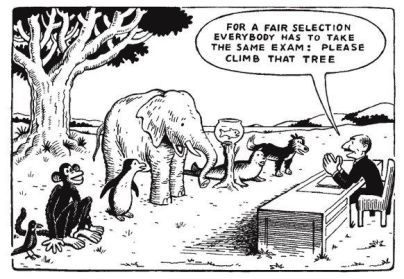 set of rules that have become harder and harder to fit. So instead of seeking equality of opportunity, we need to concentrate on equality of fit; as there is no such thing as average, we’ll never create children to match a one-size fits-all template.
There is a lot written about building resilience in children so that they can experience the slings and arrows of education and social pressures without suffering. Honestly, we have this right now within the greatest nursery school and family settings. Ideal is 5 mornings of social educative play, coupled with 5 afternoons of more personal contact in smaller groups, ideally with a loving parent. We can substitute the latter by ensuring the afternoon context of nursery is not the same as the morning, but the development of close relationships between child and adult homemaker are essential. It is extraordinary in so many schools just how quickly the child’s socialisation has to become a fit for very tight boundaries of compliance. In the wrong kind of classroom, things can go very slowly indeed. As a wordpress friend, Edna Sackson writes in her blog today, “How much time do you spend shushing twenty-four children while one child speaks?” There’s no need to run a class where the vast majority of learners are inactive and learning how to do nothing.
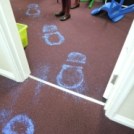
Giant footprints at CC
Children need expressive arts as part of their diet, they need sport and physical education, they need to paint and draw and create and above all do things that enable them to explore, take risks, do things differently and through those experiences and failures find out the things they can do really well. And amazingly as all we adults know, since every adult is unique, if they have unique skills and talents to match, then they’ll
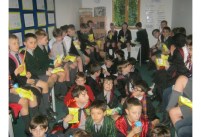
Spell making at CC
always thrive in our society. But what happens if their school life does not give them this diverse diet? Does it really matter, so long as they get the grades to make the next step in their education? Surely a bit of tough love, straight and narrow education never hurt anyone in their formative years?
So here’s the scientific evidence from the USAF study on pilot ‘fit’. As planes rolled off the production line, the cockpit was fitted out to the dimensions of ‘average pilot size’, and the pilots were made to fit the plane. And of course, since no-one actually was the average size, the ‘fit’ was not great. As the demands got tougher, the job got harder in the dawn of jet-powered aviation. The planes were faster and more complicated to fly, the problems with handling them were so frequent and involved so many different aircraft that the air force had an alarming, life-or-death mystery on its hands. At its worst, on one day 17 pilots were killed. Once their researcher, Lt. Gilbert S. Daniels was put on the case, his findings were clear: Daniels published his findings in a 1952 Air Force Technical Note entitled The “Average Man”? In it, he contended that if the military wanted to improve the performance of its soldiers, including its pilots, it needed to change the design of any environments in which those soldiers were expected to perform. The recommended change was radical: the environments needed to fit the individual rather than the average.
Not only did the USAF listen and change, so did every other engineering industry as well. Imagine what it would be like to drive your car with the seat and steering wheel settings at the opposite end of your fit. Imagine being too low in the seat and having to drive at high speed through chicanes? You’d stop at once, rather than risk life and limb.
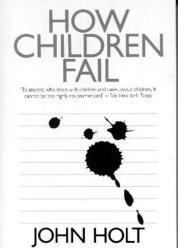 Well one industry in the Western World has chosen not to follow the scientific evidence base, and that is Education. There are institutional outriders such as Claires Court, where the sheer longevity and commitment of teaching staff to do ‘the right things the right way’ means we work to fit the school to the child, and we know how to do that now to the ‘nth degree. But in the mainstream, sadly, the industrialisation of education and the short-termism of ministerial tenure has changed the focus toward narrow assessment and teaching to the test. Another american researcher, this one from the sixties, John Holt discovered for children that which Daniels discovered a decade earlier for pilots. There is no such thing as average, so teaching children so they can achieve an average mark is doomed to failure. Together with his colleague, Bill Hull, Holt moved the emphasis on his teaching to concepts and active learning, and spotted that the ‘better’ students were solely those who were able to forget what they had learned after the test rather than before. Wikipedia covers John Holt’s work really well, as of course did all the teacher training colleges back in the day … until they were shut down in the ’90s in favour of short-and-sharp post-graduate work-place learning where success has been monetised by performing to the test and rising your school up the performance tables.
The health of our children is the most precious of things to our parents, as it was in the fifties. Whilst in the USAF there were of course plenty of pilots who did survive flying their machines, so many men ‘crashing and burning’ was too high a cost to bear. Likewise now in 2016, whilst the epidemic of adolescent mental health problems continues to escalate across the country, we can still see plenty of signs that students are doing well at school, passing their exams and getting the best jobs. Of course like the pilots, some can cope, but the cost to our society is unacceptable. Current experts in childhood mental health, such as Professors Tanya Byron and Sarah-Jayne Blakemore bang on about this time and again. Children need a massive balance between play, education and nurture, and the ‘fit’ needs to be ‘personal’. This choice to wrap education around the child is a mindset, which dedicated professional teaching staff know. Tailoring to the child works best. And even government knows this: “Every child matters!”
And guess what, not only will children grow in every sense of the word consciously, engaged with their school and education and mastering the most complex of skills, with lots of effort and quite a lot of failing too along the way. And that broad diet of work shaped around their needs means that their unconscious health is looked after as well. They develop the resilience to their mental health as much as they do with their immune system. Amazingly, it’s how we are built.
Alternatively, you can believe in what our Ministers for Education feel about educational ‘fit’.
The “purpose of education” is to enable people to read academic texts and appreciate the theatre.
Schools minister Nick Gibb


 en work through their primary years is a loss of the bright eyes and love for learning that I see each day in school. It’s true children don’t mind being tested, so long as no-one uses the results of such testing to compare them with others and then ‘do them down’. It’s certainly the case that in the wrong hands, children rapidly lose a love of learning, indeed leave their childhood and enter that early adolescent stage of choosing to be uncooperative because actually the classroom has nothing in it for their learning. Beware setting our young learners on the exit strategy ‘Goodbye, children’, because they’ll never recover that innocence of learning that permits children to try anything and attempt everything!
 education has tried over the last 20 years has failed, spectacularly, then please watch Professor Dylan Wiliam’s lecture at the Schools Network in 2011. His talk opens with “If we are serious about improving education, we have to stop people doing good things” – definitely worth a watch.
 advances in the fight against illiteracy so that all people – regardless of geography, language, race, class, or gender – have the opportunity to fulfill their potential through the power of words.
 John Locke, philosopher, in 1689, begin a proposition around which all of us are reminded that we are under “the sovereignty of the law”.

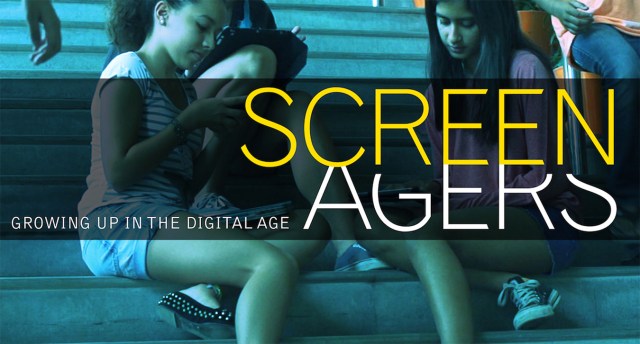 Across the pond in the United States, a major and remarkable new film is doing the rounds, limited to responsible screenings in school halls, community centres and such like, so that families can attend and take on board the powers and dangers now confronting all with the ubiquitous technology of ‘screens’. The film ‘Screenagers’ (
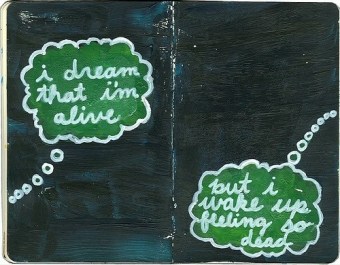 rules head and impulsive behaviour is rapidly rewarded by social ‘high-fives’ and peer encouragement. It is at this time that we are most susceptible to our first real burst of clinical depression, and 50% of us will suffer such mental illness by age 25. The picture is worse for girls, with the female gender suffering by a 2:1 ratio. Those who ‘catch’ depression early, say by age 13, are more likely to have repeat bouts, each more serious than the previous. On each occasion those who suffer feel they are the cause of their problem and don’t want to bother their parents with their issues. In short, not receiving treatment the first time lends itself to repeat bouts in the near future.
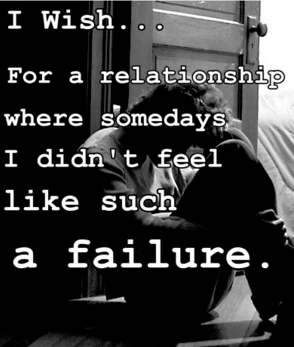 The trouble is, this is not enough. Teenagers feel emotions really strongly, far more personally than we as adults. As our school’s values guru, Margaret Goldthorpe reminds us every time she visits, it’s almost inevitable we adults disempower and demotivate the young people around us. Parents and teachers seem so very successful, cool and in control, and whilst children admire that, often they don’t feel able to come up to our expectations. We may offer them affirming homes and relationships with adults, but as they crave independence to learn this for themselves, they are confronted in the flesh and on screen by endless examples that they are not up to ‘scratch’. This negative propaganda about teenage failure is absolutely everywhere, perhaps even promulgated by my writing this blog. The politicians who talk about education and our schools continue to highlight just how ‘weak’ our children are in comparison with their peers in other countries, and guess what, our children take that on board and stress about it lots. Just look at today’s stories of headteachers ‘quitting’ because of ‘factory farming’ pupils, whilst our Prime Minister defends controversial plans to force all state schools in England to become academies, saying it is time to “finish the job”. Honestly what job – the destruction of our children’s mental health perhaps?
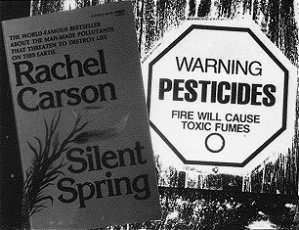 more conscious of the need to be healthy, to stay away from alcohol, tobacco and drugs. They want to do well by school and family. When they are very young, so many have been presented with the screen, large and small, as a way to better themselves, find out more and become independent learners, as well as have fun and play games. None of us want to blame our young people for the predicament we are finding them in. But hear you this; the epidemic of mental illnesses in the United States that triggered Dr Ruston to make her film last year is an object lesson to us all, a digital version of ‘Silent Spring’ which back in 1962 informed the world that the life saving, mosquito killing pesticides were quietly and lethally destroying our living world. And if we are not careful, we are permitting the digital equivalent to happen in 2016; and it’s not the screen itself that’s the problem, but the relentless and needless escalation of unnecessary pressure of all kinds on children whose limbic systems simply are not up to the job, and can’t help but shut down.
 *For a detailed exposition by an expert in this field, watch Dr Harry Barry’s Youtube lecture –
  etics through his work on pea plants in the 1850/60s, and over the subsequent 100 years we have learned a vast amount about how genes code for our many and various inherited characteristics. What Mendel and others never found out was t
 The ability of humans to process information, be that visual , auditory, tactile, through movement or taste is developed in the same ways. Wine or tea tasting are sets of skills developed around specific food stuffs. Great photographers and artists are fundamentally at home with the tools of their trade. Our latest sporting hero, Danny Willett, winner of the Masters 2016 and wearer of the Green jacket learned his golfing trade the hard way through endless practice, an appetite for hard work and a resolute competitive edge. And we know that as adults age and cease to use all of their mental faculties, their ability to process new information rapidly declines. Reintroduce physical and mental activities to a willing student and those signs of old age rapidly disappear.
 Inevitably in education, the same is true. A balanced educational diet is essential to ensure children develop the best they can be. And the diet really does need to be of the rainbow quality throughout the early, primary and secondary years, because we simply don’t know where our future lies in this uncertain world (which has been uncertain for decades by the way).
  As important as the content is, it’s the approach that matters more. Children are their best teachers and aids for their friends, from the age of 4 or 5. Here’s one of the more famous examples of the power of peer advice,
  Julie Christie and Alan Bates, adults in secret love linked by Leo Colston, their child messenger (the go-between) played by Dominic Guard. I have seen the film quite a few times, but it’s the book’s opening lines that stay with me:
 In the same budget, George Osborne announced that all state schools were to become academies* by 2020, breaking completely the control that local authorities have had over our schools since the Education act of 1944 when secondary education became free in state schools. Whilst the majority of secondary schools are already academies, most primary schools are not, and the country simply does not have the expertise to fragment this junior provision whilst protecting the rights of those most vulnerable who cannot protect themselves. The chancellor said that the government’s goal was “to complete this schools revolution and help every secondary school become an academy” with power being in the hands of heads and teachers, “not bureaucrats”.
 Though I suspect Christ’s resurrection story and the promise of redemption is the way to go for most of us, it’s time for my uplifting Easter message. I have become mindful of the acceleration of time in recent years, when everything is done for a purpose, a next step on our travels, which are often more ambitious and extensive than yesteryear. We are not workshy privileged adults from the past, playing games in a world where the harsh realities of life are far away. But we can at least recognise the need to find time to take a rest, to play around, enjoy our families and friends and have some fun, so please do. You might even get a film out. The BBC remade the Go-between last year – I can’t source the movie but Youtube has a great trailer,
 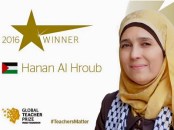 There have been 2 winners so far, Nancie Atwell (English teacher, Maine, USA) in 2015 and Hanan Al Hroub (Primary specialist in supporting children traumatised by violence, West Bank, Palestine). Their stories, and those of the other finalists can be read
  Atwell donated her prize to her school and their work to disseminate her innovative teaching methods. And what’s fantastic is that the methods used by both winners are spreading across the world more rapidly because of the fame this prize has brought. Atwell’s pupils read an average of 40 books a year and probably write as many, such education providing a real antidote to the anti-academic nature of rural life in Maine.
 have been using CEM centre benchmarking tools since the early 1990s, and right from the start at Reception age, we are able to ‘benchmark’ our children’s abilities using CEM centre tools.
 In addition during the early years, we also use CEM centre’s suite of diagnostic tools known as InCAS, which provides detailed, age related information and recommendations as the children progress through each year of education to age 11.
 o improve children’s GCSE grades on average by just over half a grade, once the prior academic ability, deprivation, student’s gender, single sex and compositional variable are taken into account. In short, we match the Independent Sector’s average. This difference equates to a gain of about two years’ normal progress and suggests that attending an independent school is associated with the equivalent of two additional years of schooling by the age of 16. Interpreting the difference on the scale of international PISA outcomes equates it to raising the UK’s latest PISA 2 results to be above the highest European performers, such as Finland, Switzerland and the Netherlands, and on a par with (or close to) countries such as Japan and Korea.
 looking bleak. I
 The full quote by Professor Dame Carol Black is: “If you’re leading an organisation, your job is to guide it, care for it, protect it as best you can and try to make sure good things happen to it.” She is Principal of Newnham College, Cambridge, and is a special adviser to the Department of Health and Public Health England. She is also Chair of the
 as many regular readers will know.
  A Principled view